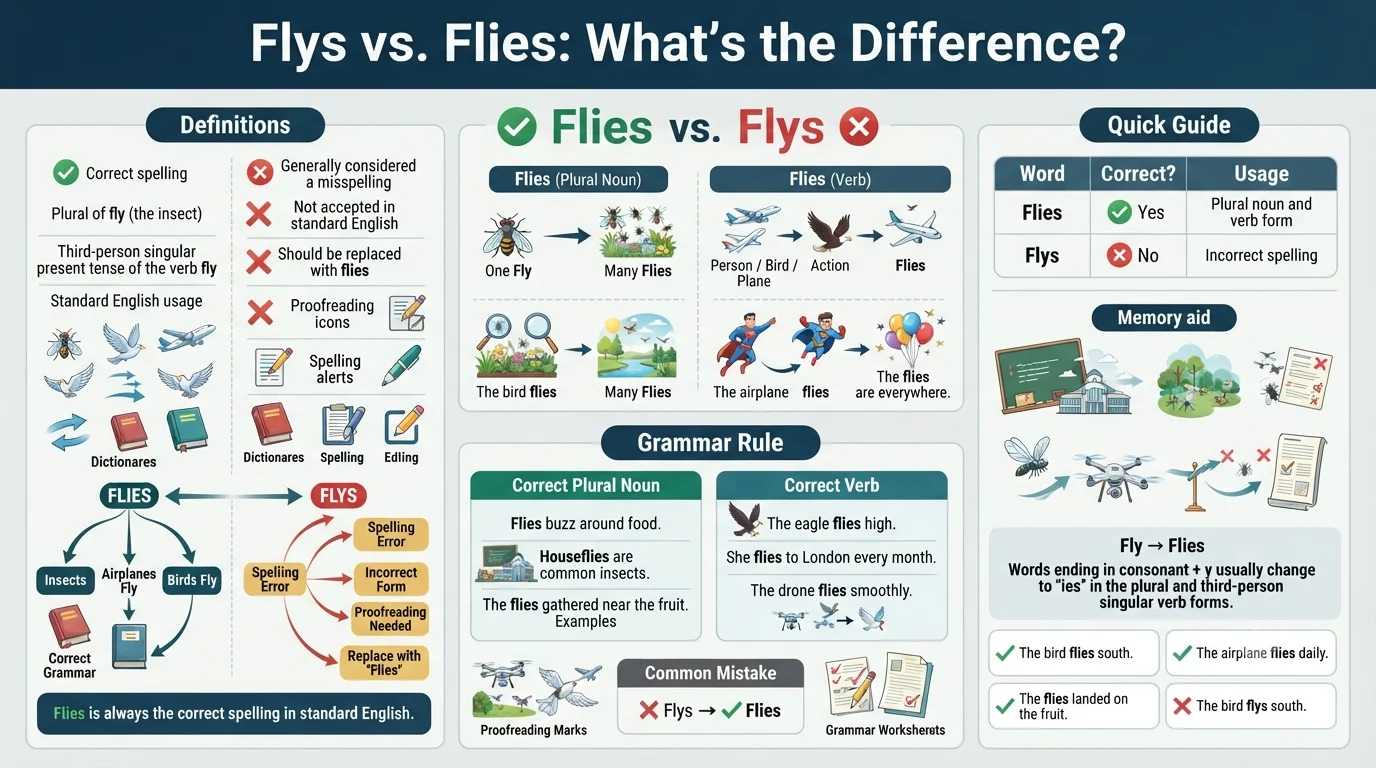
Flys or flies is a common spelling dilemma where one option serves as a valid verb form while the other represents a plural noun and an alternative verb conjugation. Specifically, flies is the correct spelling for the plural noun of the insect and the third person singular present verb tense, whereas flys is generally considered a misspelling in standard English.
Many writers wonder about the correct spelling when they write about insects or travel. People often mix up flys or flies because English spelling rules can feel confusing. Such errors usually happen when writers form plurals or change verb tenses quickly. You can easily master this spelling rule with a little practice. Correct writing builds trust with your readers every single day. Clear spelling also keeps your messages professional and easy to understand.
- The correct plural form of the noun fly is flies.
- The correct third-person singular present tense of the verb to fly is flies.
- The spelling flys is almost always an incorrect spelling error in standard English.
- You should replace instances of flys with flies to maintain grammatical accuracy.
- Context helps determine whether the word functions as a noun or a verb.
Definition and Explanation
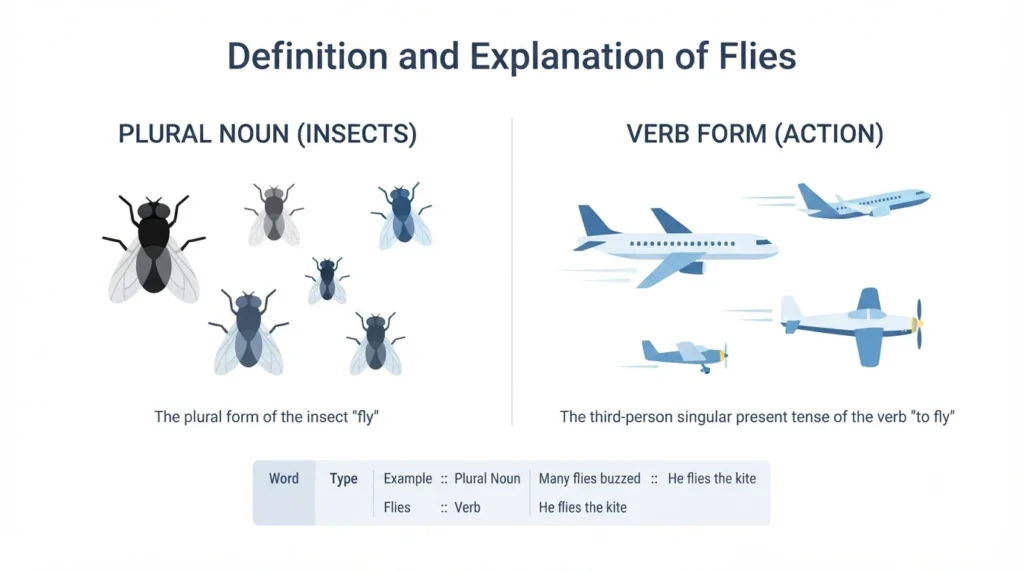
Language learners frequently encounter spelling choices that look similar but possess different grammatical rules. Understanding the background of flys or flies requires looking at standard English morphology. Nouns ending in a consonant followed by a y typically change the y to i and add es to form the plural. Verbs follow the exact same pattern in the third person singular present tense.
| Form Type | Target Word | Grammatical Status | Correct Usage Example |
| Plural Noun | Flies | Standard and Correct | The kitchen window attracted many flies. |
| Verb Tense | Flies | Standard and Correct | She flies to New York every Monday. |
| Misspelling | Flys | Incorrect in Standard English | He flys a kite in the park. |
Advantages and Disadvantages
Advantages of Using Correct Spelling
- Accurate spelling protects your professional reputation in business and academic writing.
- Clean text prevents reader distraction and improves overall comprehension.
- Search engines reward properly spelled content with better visibility and higher rankings.
Disadvantages of Incorrect Spelling
- Typographical errors reduce your credibility among discerning readers.
- Poor spelling lowers search engine optimization performance for your digital content.
- Confusing words misinform language learners who rely on accurate guidance.
Real-World Examples
Writers encounter these terms across various industries, from aviation logs to biology reports. Consider how professionals use the correct form in daily contexts.
 1: The pilot flies commercial airplanes across international borders.
 2: Several annoying flies buzzed around the picnic basket.
 3: Time flies when you enjoy interesting work projects.
Each scenario demonstrates that flies acts as a versatile word in English grammar. Writers never utilize the incorrect spelling flys in official documentation or published literature.
Regional and Global Usage
Standard international English dictionaries uniformly reject the spelling flys. British, American, Canadian, and Australian English standards list flies as the only acceptable form for both the plural noun and the third-person verb. Global communication networks demand strict adherence to these established rules. Digital spell check tools automatically flag flys as a spelling mistake across all regional platforms.
Common Mistakes
Writers frequently commit errors when applying regular pluralization rules to irregular-looking words. People assume that adding an s directly to a word ending in y works universally.
| Incorrect Usage | Correct Correction | Explanation |
| The boy flys model airplanes. | The boy flies model airplanes. | Verbs ending in consonant plus y drop the y and add ies. |
| Clean up those dead flys. | Clean up those dead flies. | Nouns ending in consonant plus y form plurals with ies. |
| He flys under the radar. | He flies under the radar. | Idiomatic expressions demand correct verb conjugation. |
Exercises with Answers
Test your understanding of flys or flies by completing the following sentences with the correct word form.
Practice Questions
- The airline captain _______ to London every weekend.
- Swatting away buzzing _______ can prove frustrating during summer.
- Time _______ when you work on engaging tasks.
- The young bird _______ from branch to branch effortlessly.
Answer Key
- flies (Verb form for third-person singular present tense)
- flies (Plural noun form for the insect)
- flies (Standard idiom for passing time)
- flies (Verb form showing action)
Related Concepts or Comparisons
Grammar comparisons help clarify tricky spelling rules. Similar words ending in y follow identical rules for plurals and verb conjugations. For instance, the noun spy becomes spies, and the verb cry becomes cries. Recognizing these patterns eliminates confusion between flys or flies and other linguistic variants.
FAQs
What is the difference between flys and flies?
The term flies is the correct spelling for both plural insects and third-person singular verbs. Meanwhile, flys is an incorrect spelling that lacks recognition in standard English dictionaries.
Is flys ever correct in Scrabble or games?
Official tournament word lists reject flys as a valid entry. Players must use flies to score points legally.
Why do people spell it flys?
Many writers apply the basic plural rule of simply adding an s to words. However, words ending in a consonant followed by y require changing y to i before adding es.
How do I remember the correct spelling?
Remember that proper English rules change the y to an i for both nouns and verbs. Think of words like spy turning into spies to reinforce the pattern.
Can flies be a noun and a verb?
Context determines the role of flies in a sentence. It functions as a plural noun when describing insects and as a verb when describing airborne movement.
Do automated spell checkers catch flys?
Most modern word processors and browser extensions instantly underline flys in red. They prompt users to correct the typo to flies.
Are there any exceptions to this spelling rule?
Words ending in a vowel followed by y, such as toy or key, simply add an s to become toys or keys. Because fly ends in a consonant plus y, it follows the ies rule instead.
How does proper spelling affect SEO rankings?
Search engines analyze text quality and penalize pages filled with basic spelling mistakes. Using flies instead of flys ensures better readability scores and higher search placement.
Conclusion
Mastering tricky spelling choices like flys or flies elevates your writing quality instantly. Proper grammar builds authority and ensures clear communication with your audience. Writers should always eliminate the incorrect spelling flys from their vocabulary. Consistent practice reinforces these foundational language rules over time. Professional success often depends on attention to small details such as correct word forms.
Meta Information and Assets
- Meta Title:
- Meta Description: Discover whether flys or flies is correct. Learn grammar rules, view examples, and avoid common spelling mistakes easily today.
- URL Slug: /flys-or-flies-spelling-guide
Feature Image Prompt
A professional, modern, and educational flat design vector illustration featuring a clean layout. The image displays a balanced comparison of grammar rules on a soft blue background, highlighting the correct word flies with high-resolution clarity and a 16:9 widescreen ratio.
Secondary Image Prompt
Title text in the image: “Definition and Explanation of Flies”. A clean, minimalist infographic showing the split between plural nouns and verb forms using flat vector icons of insects and airplanes, set against a clean white background with a 16:9 aspect ratio.
Slug: /definition-and-explanation-of-flies
Focus Keyphrase: definition and explanation of flies

Charlotte Wilson is a language writer passionate about word meanings, synonyms, and clear communication. She creates accurate and engaging content to help readers expand their vocabulary and language skills.





3 thoughts on “Flys or Flies| Which Spelling Is Correct? (Grammar Guide)”