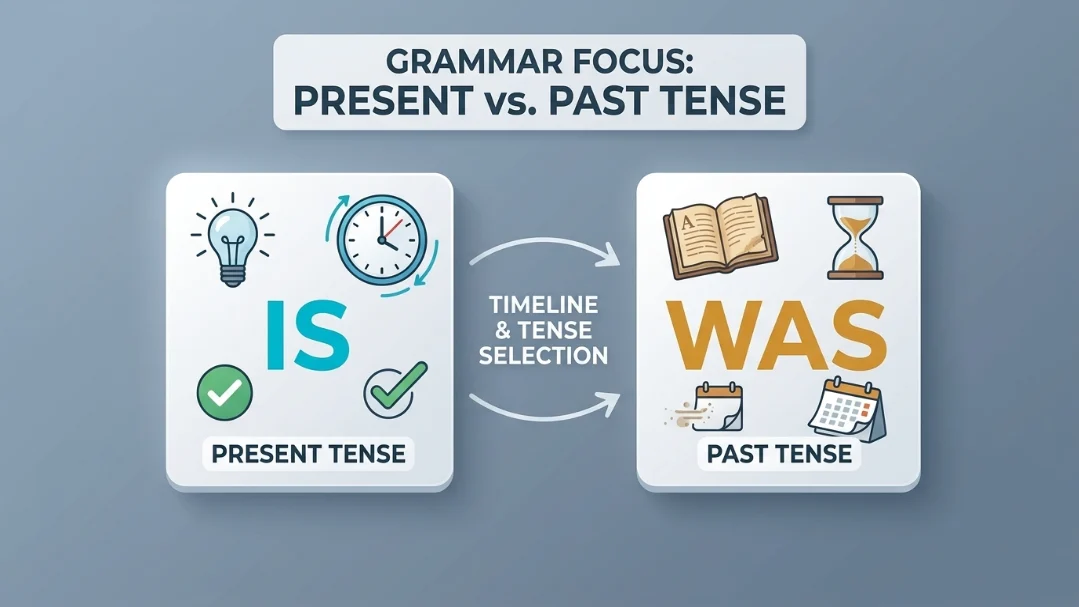
The main difference between “is” and “was” comes down to time, state of existence, and factual permanence. You should use “is” when describing present actions, existing conditions, or timeless universal truths. Conversely, you must use “was” when referring to past states, completed actions, or conditions that are no longer true today.
Choosing between “is” and “was” seems easy at first glance, yet it confuses writers daily. Both words are forms of the fundamental linking verb “to be.” However, choosing the wrong tense can instantly alter your message, confuse your audience, or distort historical facts.
Understanding when to select “is or was” forms the foundation of strong grammar. Whether you are writing a academic paper, sending a quick business email, or editing a novel, correct verb tense agreement ensures your ideas remain clear. When you talk about something happening right now, you need the present tense. When you discuss an event that finished yesterday, you require the past tense.
This comprehensive guide will help you master the rules governing “is or was.” By exploring clear definitions, real-world examples, regional variations, and practical exercises, you will eliminate doubts and write with absolute confidence.
Understanding verb tense selection becomes simple when you categorize state, time, and context. The foundational guidelines below highlight how to navigate these choices effortlessly.
- Present Reality: Use “is” for current states, ongoing conditions, and existing facts.
- Past Reality: Use “was” for completed events, past states, and historical truths that no longer exist in the present.
- Universal Truths: Use “is” for general truths and scientific facts, even when reporting past statements.
- Hypothetical States: Use “were” instead of “was” when expressing imaginary, impossible, or subjunctive conditions.
- Agreement in Form: Ensure both “is” and “was” match singular nouns and third-person singular pronouns like he, she, and it.
Definition and Fundamental Explanation
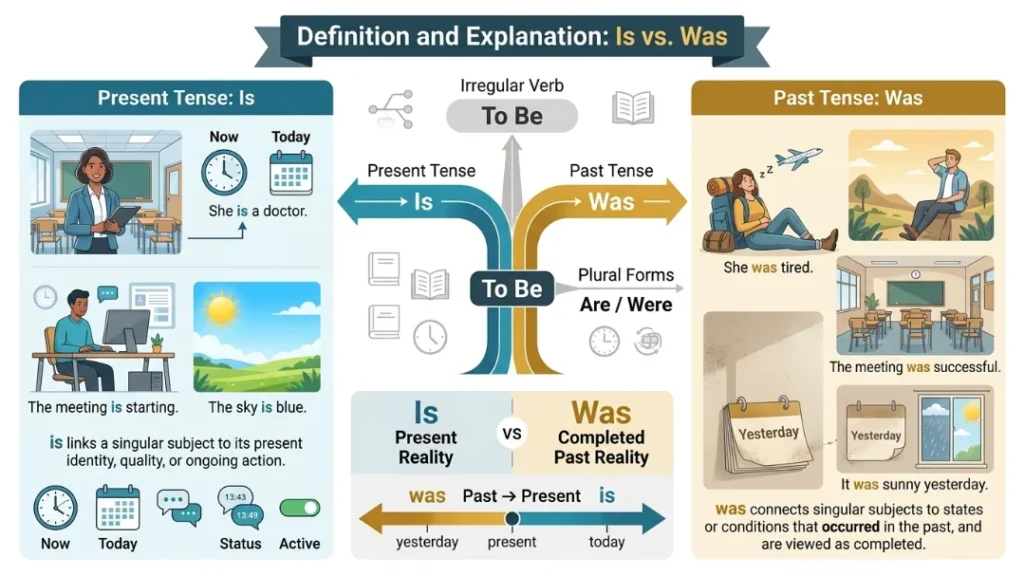
To master “is or was,” you must first look at the core verb from which both words originate. Both terms belong to the irregular verb “to be,” which acts as a linking verb or an auxiliary verb in English syntax.
                  ┌── Present Tense ──► IS  (Singular: He / She / It / Singular Noun)
                  │
[ Verb "TO BE" ] ─┼── Past Tense    ──► WAS (Singular: I / He / She / It / Singular Noun)
                  │
                  └── Plural Tense  ──► ARE / WERE (Plural: We / They / You)
The Role of Present Tense “Is”
The word “is” serves as the third-person singular present tense form of “to be.” You will pair “is” with singular nouns or pronouns such as he, she, and it.
Furthermore, “is” connects a subject to a state of being, a quality, or an ongoing progressive action happening right now. For instance, in the sentence “She is a doctor,” the verb indicates her current professional identity.
The Role of Past Tense “Was”
The word “was” functions as the first-person and third-person singular past tense form of “to be.” Consequently, you can use “was” with I, he, she, it, and singular nouns.
In addition, “was” indicates that a state or action occurred in time prior to the present moment and has officially concluded. For example, in the sentence “She was tired,” the verb demonstrates that her fatigue belonged to a past period and is no longer assumed to continue.
Detailed Comparison: Is vs. Was
Comparing these two linking verbs side by side clarifies their distinct grammatical functions across various sentence structures.
| Grammatical Feature | Present Form: “Is” | Past Form: “Was” |
| Primary Tense | Present Simple / Present Continuous | Past Simple / Past Continuous |
| Applicable Pronouns | He, She, It, Singular Nouns | I, He, She, It, Singular Nouns |
| Time Reference | Right now, general time, permanent state | Completed time, historical period, former state |
| Continuous Form Example | He is running a marathon today. | He was running when it started to rain. |
| Linking Verb Example | The coffee is hot. | The coffee was hot an hour ago. |
| Passive Voice Example | The report is generated automatically. | The report was generated yesterday. |
Deep Dive into the Present Tense: When to Use “Is”
While time determines basic usage, specific scenarios demand the present tense “is” regardless of surrounding conditions.
Permanent and General Truths
When you state scientific facts, universal constants, or permanent truths, always choose “is.” Even if a historical scientist discovered the fact centuries ago, the principle remains active today.
Incorrect: Galileo proved that the Earth was round.
Correct: Galileo proved that the Earth is round.
Because the Earth remains round today, using “is” preserves scientific accuracy.
Current Habits and Ongoing States
If an action occurs regularly or describes an ongoing identity, “is” serves as the ideal choice.
Example: Marcus is an author who writes daily.
This sentence tells the reader that Marcus currently writes books for a living.
Literature, Art, and Media Analysis
When writing literary analysis, critics rely on the “literary present tense.” Characters in books, plays, and movies exist in a perpetual present state within their stories.
Example: In Hamlet, Shakespeare demonstrates how indecision is destructive.
Even though Shakespeare wrote the play hundreds of years ago, the narrative content remains present to the reader.
Deep Dive into the Past Tense: When to Use “Was”
Transitioning to “was” requires an intentional focus on completed time, historical context, and changed conditions.
Historical Events and Former Identities
When describing historical figures, deceased individuals, or closed businesses, you must select “was.”
Example: George Washington was the first President of the United States.
Because Washington’s life and presidency ended in the past, “was” correctly establishes temporal boundaries.
Completed States and Temporary Past Conditions
If a situation changed completely, “was” alerts the reader to that precise transformation.
Example: The building was a school before developers converted it into apartments.
This sentence clarifies that the structure no longer functions as a school.
Interruptions in Past Continuous Actions
When describing a continuous action that was interrupted by another event, “was” functions alongside a present participle.
Example: Sarah was reading a book when the power failed.
Here, “was reading” establishes an ongoing action in the past that encountered a sudden interruption.
The Subjunctive Mood: Why “Was” Isn’t Always Right
Many writers instinctively choose “was” when describing imaginary scenarios. However, traditional grammar rules dictate a shift to “were” in hypothetical or counterfactual contexts.
                      ┌── Real Past Event      ──► Use WAS  ("I was tired yesterday.")
[ Conditional Context ]─┤
                      └── Imaginary / Wish     ──► Use WERE ("If I were king...")
Unreal Conditions and Wishes
When you express a wish, a dream, or an impossible scenario, opt for the subjunctive “were” rather than “was,” even with singular subjects.
Incorrect: If I was you, I would accept the job offer.
Correct: If I were you, I would accept the job offer.
Because I cannot literally become you, the statement describes an unreal condition. Therefore, “were” correctly signals the subjunctive mood.
Hypothetical Statements with “As If”
Similarly, when using phrases like “as if” or “as though” to describe non-factual situations, choose “were.”
Example: He speaks as if he were the owner of the company.
This structure implies that he does not actually own the business, highlighting the hypothetical nature of his tone.
Advantages and Disadvantages of Tense Choices
Selecting between “is or was” brings distinct stylistic and structural consequences to your writing. Recognizing these trade-offs helps you refine your prose effectively.
Using Present Tense (“Is”)
Using present tense creates immediacy and brings your text directly to life.
- Advantages:
- Creates immediate engagement for readers.
- Suits modern, fast-paced business communication.
- Preserves timeless accuracy for educational content.
- Disadvantages:
- Can sound jarring if mixed carelessly with historical accounts.
- Risks making dynamic, evolving situations sound prematurely locked.
Using Past Tense (“Was”)
Relying on past tense establishes clear boundaries and provides historical distance.
- Advantages:
- Provides absolute clarity regarding completed events.
- Fits standard narrative storytelling naturally.
- Prevents readers from assuming past conditions still apply.
- Disadvantages:
- Can make dynamic topics sound outdated or obsolete.
- Distances the reader emotionally from the narrative.
Real-World Examples in Different Contexts
Examining “is or was” across various professional domains demonstrates how tense shifts alter meaning.
Business and Professional Communication
In corporate environments, switching between “is” and “was” changes project status instantly.
Status Active: The project is on track to hit quarterly targets.
Status Completed/Past: The project was on track until supply chains stalled.
The first sentence reassures executives, whereas the second alerts them to historical disruptions.
Journalism and News Reporting
Journalists carefully select verb tenses to reflect fresh developments versus archived facts.
Breaking News: The mayor is currently addressing reporters at City Hall.
Follow-up Story: The mayor was at City Hall earlier today to sign the bill.
The present tense signals live action, while the past tense moves the event into historical reporting.
Science and Academic Writing
Academics use “is” for persistent conclusions and “was” for specific experimental procedures.
Procedure: The sample was heated to 100 degrees Celsius.
Finding: The resulting compound is remarkably stable under pressure.
This distinct boundary clarifies what researchers did in the lab versus what scientific truth emerged from the test.
Regional and Global Usage Variations
While the core rules of “is or was” remain uniform across standard English, subtle regional preferences exist in casual spoken registers.
                           ┌── American English ──► Strict Subjunctive Preference
                           │                        ("If I were you...")
[ Regional Differences ] ──┤
                           └── British English  ──► Relaxed Casual Subjunctive
                                                    ("If I was you..." in informal speech)
American English Practices
American English maintains a strong preference for strict subjunctive structures in formal writing and everyday speech. Most style guides used in North America—such as the Chicago Manual of Style and APA—insist on using “were” instead of “was” for hypothetical situations.
British and Commonwealth Practices
British, Australian, and New Zealand English follow identical formal rules as American English. However, in casual spoken British English, speakers frequently substitute “was” for “were” in subjunctive conditional phrases without raising eyebrows.
Casual Spoken UK: If I was free, I’d pop over.
Formal Standard UK/US: If I were free, I would visit.
While informal speech accepts this shortcut globally, professional, literary, and academic contexts universally demand standard agreement.
Common Mistakes and How to Avoid Them
Even experienced writers occasionally fall into tense-selection traps. Reviewing these frequent errors will protect your work from confusion.
                               ┌── Tense Inconsistency ──► Switching tenses mid-sentence
                               │
[ Frequent Errors to Avoid ] ──┼── Misusing Subjunctive ─► Using "was" for imaginary wishes
                               │
                               └── Historical Confusion ──► Using "was" for living truths
Mistake 1: Unintentional Tense Shifts
Switching tenses within a single paragraph creates unnecessary friction for your reader.
Flawed: She walks into the room and was shocked by what she saw.
Corrected: She walks into the room and is shocked by what she sees.
Alternative: She walked into the room and was shocked by what she saw.
Maintain a consistent baseline tense unless a real timeline shift requires a change.
Mistake 2: Referring to Deceased Authors’ Works in the Past
Writers often incorrectly assume that because an author died, their books must be discussed in the past tense.
Flawed: In 1984, George Orwell was describing a dystopian world.
Corrected: In 1984, George Orwell describes a dystopian world.
While Orwell lived in the past, his literary work continues to exist and speak to readers in the present.
Mistake 3: Overusing “Was” for Timeless General Truths
Attributing past tense to ongoing physical phenomena creates confusing statements.
Flawed: She taught her students that water was composed of hydrogen and oxygen.
Corrected: She taught her students that water is composed of hydrogen and oxygen.
Water’s chemical composition remains unchanged, meaning the present tense “is” remains logically necessary.
Comparative Matrix: Tense Usage Across Writing Styles
Different industries and genres maintain specific expectations regarding verb tense selection. The summary matrix below details these standard preferences.
| Writing Field | Primary Choice | Secondary Choice | Key Rule to Remember |
| Academic Research | Past Tense (“Was”) | Present Tense (“Is”) | Use “was” for methodology; use “is” for eternal truths. |
| Fiction Narrative | Past Tense (“Was”) | Present Tense (“Is”) | Stick to “was” for standard story beats; use “is” in dialogue. |
| Technical Manuals | Present Tense (“Is”) | Past Tense (“Was”) | Use “is” to describe system hardware features and real-time operations. |
| History & Biography | Past Tense (“Was”) | Present Tense (“Is”) | Use “was” for life events; use “is” when analyzing enduring legacies. |
| Marketing Copy | Present Tense (“Is”) | Past Tense (“Was”) | Use “is” to highlight active product benefits directly. |
Practice Exercises with Answers
Testing your knowledge solidifies understanding. Complete the following exercises by choosing the correct verb form for each sentence.
Exercise 1: Choose the Correct Form (Is, Was, or Were)
- The sun _______ a massive ball of plasma located at the center of our solar system.
- Yesterday, the traffic _______ heavier than usual due to unexpected road construction.
- If I _______ the CEO of this company, I would implement flexible working hours immediately.
- She explained to the jury that perjury _______ a serious federal crime.
- Marcus _______ working at his desk when the fire alarm rang across the building.
- The novel Moby-Dick _______ a classic story about obsession and the sea.
- Last year, our primary office _______ located in downtown Chicago.
- Water _______ composed of two hydrogen atoms and one oxygen atom.
- I wish it _______ warmer outside today so we could go swimming.
- The financial audit _______ completed by our team early this morning.
Answers and Explanations
- is — Explanation: This sentence expresses a permanent scientific fact.
- was — Explanation: The word “yesterday” clearly signals a completed past event.
- were — Explanation: This sentence represents an unreal, hypothetical state requiring the subjunctive mood.
- is — Explanation: The legal definition of perjury remains a continuous, objective truth today.
- was — Explanation: This sentence describes a continuous action in the past interrupted by another event.
- is — Explanation: Literary works are discussed using the literary present tense.
- was — Explanation: The timeframe “last year” confirms the location has changed.
- is — Explanation: This statement expresses a timeless universal law of chemistry.
- were — Explanation: The phrase “I wish” introduces a hypothetical scenario needing the subjunctive mood.
- was — Explanation: The action was finished earlier this morning, marking it as a completed past event.
Related Concepts and Comparisons
To fully master “is or was,” exploring adjacent grammatical structures provides helpful broader context.
                     ┌── Present Pair ──► IS  vs. ARE  (Singular vs. Plural)
[ Connected Pairs ] ─┼── Past Pair    ──► WAS vs. WERE (Singular vs. Plural)
                     └── Modal Pair   ──► IS  vs. HAS  (State vs. Possession)
Is vs. Are
While “is” pairs exclusively with singular subjects, “are” serves as its plural present-tense counterpart.
Singular: The computer is updating.
Plural: The computers are updating.
Was vs. Were
Similarly, while “was” serves singular past subjects, “were” operates as the standard plural past tense form, as well as the universal subjunctive form.
Singular Past: The worker was efficient.
Plural Past: The workers were efficient.
Subjunctive: I wish the worker were faster.
Is vs. Has
Writers occasionally confuse “is” with “has” when constructing contraction forms like “he’s.”
State of Being: He’s (He is) running late today.
Possession / Action: He’s (He has) finished his assignment.
Frequently Asked Questions
How do I decide whether to use is or was in a sentence?
Look carefully at the timeline of your sentence. If the statement describes an active condition, a current habit, or an unchangeable scientific fact, choose “is.” If the condition ended completely in the past, select “was.”
Is it correct to say “If I was” or “If I were”?
In formal writing, you should always say “If I were” when expressing an imaginary or impossible scenario. Using “If I was” occurs frequently in casual speech, but remains grammatically incorrect for hypothetical conditions.
Why do we use “is” for books written a long time ago?
Grammar rules dictate that creative works exist in the “literary present tense.” Because readers experience the story actively as they read, characters and plot elements use “is” rather than “was.
Which verb form is correct for scientific truths when using reporting verbs?
Always use “is” for scientific truths, even if the main verb sits in the past tense. For instance, write “The teacher stated that the Earth is round,” rather than “was round.”
Can “is” and “was” both appear correctly in the same sentence?
Yes, you can use both verbs in a single sentence if you are comparing past conditions to current realities. For example: “While the city was small fifty years ago, it is booming today.”
Should I use “is” or “was” when describing a deceased person’s legacy?
Use “was” for the person’s physical life events, but use “is” when referring to their ongoing influence today. For example: “Albert Einstein was born in 1879, but his theory of relativity is still central to modern physics.”
Is “was” ever used with plural subjects?
No, “was” should never pair with plural subjects in standard English. Plural subjects require “were” in the past tense. Saying “they was” represents a subject-verb agreement error.
Why does modern business writing favor “is” over “was”?
Modern business communication favors present tense verbs like “is” because they create a sense of direct action, immediate relevance, and active engagement for clients and stakeholders.
Conclusion
Mastering the choice between “is” and “was” requires paying close attention to time, permanence, and context. By using “is” for present realities, ongoing states, and universal truths, you keep your writing immediate, precise, and accurate. Conversely, employing “was” for finished events, historical facts, and past conditions ensures your timeline remains clear to readers.
Furthermore, remembering subtle distinctions—such as applying the literary present tense to creative works and reserving “were” for hypothetical subjunctive statements—elevates your prose from basic to professional. Verb choices shape how effectively your audience processes information.
By applying the principles, matrices, and rules provided in this guide, you will avoid common verb tense traps easily. Practice evaluating your sentences for subject-verb agreement and temporal consistency. With these strategies in place, you can select between “is or was” confidently across every personal, academic, and professional writing project.