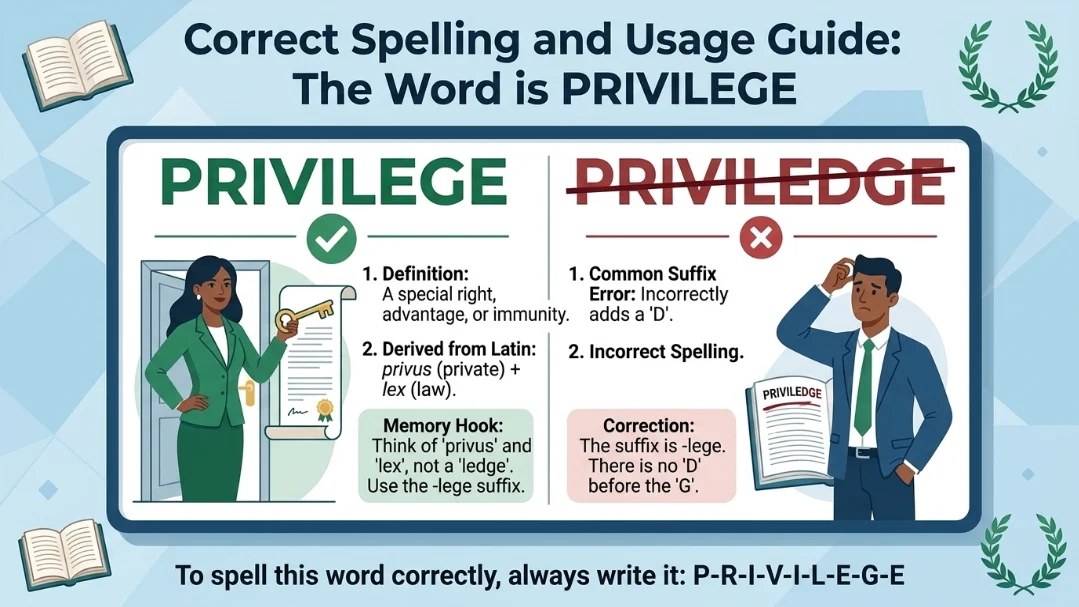
The correct spelling is privilege. The form priviledge is an incorrect spelling that results from adding an extra “d” by mistake. Always write “privilege” with two “i”s, two “e”s, and no letter “d”.
Understanding the difference between privilege or priviledge comes down to memorizing one simple rule. The standard English language accepts only one correct spelling.Here is Option 2 ready to use in your article or markdown editor:
| Aspect | ✅ Right | ❌ Wrong |
| Spelling | Privilege | ~~Priviledge~~ |
| Key Rule | Ends in -lege | Adds a silent “d” |
| Origin | Latin (privilegium) | Phonetic confusion |
When you write this word, remember that it ends with the letter group lege rather than dge. Because English contains words like “knowledge” and “bridge,” many writers naturally add a “d” before the “ge. However, this specific term never takes a “d”.
Definition and Explanation
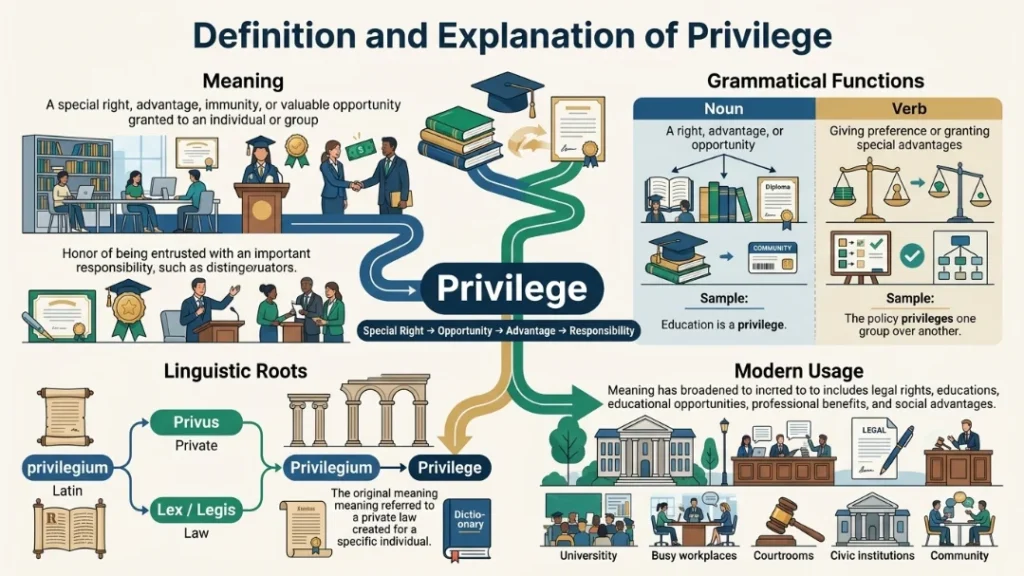
The word privilege is a noun and a verb. As a noun, it describes a special right, advantage, or immunity granted to a particular person or group. Additionally, it refers to an opportunity to do something that brings pride and satisfaction.
Grammatical Functions
- As a Noun: “Education is a privilege that everyone should enjoy.”
- As a Verb: “The new law privileges large corporations over small businesses.”
Linguistic Roots
The word comes directly from the Latin term privilegium. The Latin root combines privus (meaning “private”) and lex or legis (meaning “law”). Therefore, a privilege was originally a private law created for a single individual. Because the Latin root uses the letter g without any d, the modern English word preserves that exact structure.
Advantages of Using the Correct Spelling
Using the standard spelling offers several important benefits in professional and academic settings.
- Maintains Credibility: Clean spelling demonstrates attention to detail in resume building, email writing, and publication.
- Passes Automated Software Checks: Grammar checkers and search engines recognize “privilege” instantly while flagging alternatives.
- Ensures Clear Communication: Standardized writing helps readers focus on your main message rather than noticeable errors.
- Demonstrates Professional Knowledge: Proper orthography builds trust with editors, employers, and client networks.
Real-World Examples
Reviewing real-world sentences helps solidify the proper pattern in your mind. Notice how each sentence relies on the single valid form.
Academic Context
“Access to advanced research laboratories remains a rare privilege for undergraduate students.”
Legal Context
“Attorney-client privilege protects confidential conversations between lawyers and their clients.”
Professional Context
“It was a absolute privilege to present our quarterly findings to the board of directors.”
Everyday Conversation
“Having clean drinking water directly from the tap is a privilege many people overlook.”
Comparison Table of Common Mistakes
Writers frequently confuse words that share similar ending sounds. The table below highlights how “privilege” compares to other terms that do or do not use a “d”.
| Target Word | Correct Spelling | Incorrect Spelling | Key Phonetic Rule |
| Privilege | Privilege | Priviledge | No “d” sound; ends in -lege |
| Knowledge | Knowledge | Knowlege | Uses the -dge ending pattern |
| Sacrilege | Sacrilege | Sacriledge | No “d” sound; ends in -lege |
| Acknowledge | Acknowledge | Acknowlege | Uses the -dge ending pattern |
| Allegiance | Allegiance | Alledgiance | Uses -gi- without a “d” |
Regional and Global Usage
English spelling rules vary across global regions for many words. For example, British English and American English differ on terms like color versus colour.
However, the word privilege is identical in all regions.
- American English: Privilege
- British English: Privilege
- Canadian English: Privilege
- Australian English: Privilege
Consequently, you never need to alter the spelling when writing for international audiences.
Common Mistakes and Why They Happen
The misspelling priviledge occurs because of a natural mental process called phonetic substitution. English speakers hear the sound $/ɪdʒ/$ or $/ɛdʒ/$ at the end of words and automatically think of common words spelled with “dge.Here is Option 1 formatted and ready to copy directly into your markdown editor or blog post:
| Words Ending in -DGE (Germanic Origin) | Words Ending in -LEGE (Latin Origin) |
| Bridge | Privilege |
| Judge | Sacrilege |
| Knowledge | Sortilege |
| Pledge | College |
Because words like fudge, judge, and badge are learned early in school, your brain attempts to apply the “dge” pattern everywhere. Furthermore, because the letter “g” produces a soft sound in privilege, writers naturally assume a “d” belongs in front of it.
Practical Memory Tricks
You can use simple memory devices to avoid inserting an unwanted “d” into this word.
The Two-I and Two-E Trick
Count the vowels in the word. The word uses two Is followed by two Es.
- P – R – I – V – I – L – E – G – E
The Leg Strategy
Focus on the last four letters of the word: L-E-G-E. Think of the word LEG.
“You need a good leg to stand on your privilege.”
Since “leg” does not contain a “d”, the ending lege will not contain one either.
Practice Exercises with Answers
Test your understanding of the spelling rule using these practical exercises. Complete each sentence by choosing the correct option.
Exercise 1: Choose the Correct Word
- She considered it a (privilege / priviledge) to meet the speaker.
- Legal (privilege / priviledge) protects those internal documents.
- He did not mean to abuse his position of (privilege / priviledge).
- Do not take your health for granted; it is a true (privilege / priviledge).
Exercise 2: Identify the Errors
Read the following sentences and mark whether they are Correct or Incorrect.
- “The executive enjoyed every priviledge offered by the firm.”
- “Maintaining client confidentiality is a matter of professional privilege.”
- “They were granted the priviledge of early admission.”
Answer Key
Answers for Exercise 1
- privilege
- privilege
- privilege
- privilege
Answers for Exercise 2
- Incorrect (Should be privilege)
- Correct
- Incorrect (Should be privilege)
Related Concepts and Synonyms
When writing essays or articles, using variations of your target term creates engaging prose. Depending on whether you mean a special right or a personal honor, consider these related terms.Here is the table version:
| Perspective | Core Attributes | Associated Synonyms & Concepts |
| Positive Aspects | Earned/Granted Status & Benefits | Advantage, Honor, Entitlement, Benefit, Prerogative |
| Critical Aspects | Systemic Inequities & Shielding | Exemption, Bias, Immunity, Inequality, Favoritism |
Frequently Asked Questions
Is priviledge ever acceptable in formal English?
No, priviledge is never acceptable in standard written English. It is always classified as a spelling error.
Why is there no “d” in privilege?
The word comes directly from the Latin root privilegium, which lacks the letter “d”. English preserved this original spelling structure.
How do you spell privilege correctly every time?
Remember that the word contains two “i”s and two “e”s in a balanced pattern, ending with the sequence l-e-g-e.
Is privilege spelled differently in British English?
No, British English uses the exact same spelling: privilege.
What is another word for privilege?
Depending on the context, synonyms include advantage, prerogative, honor, benefit, and immunity.
Is privileged spelled with a “d”?
No, the past tense or adjective form is privileged. It keeps the exact same base root without adding a “d”.
What is the opposite of privilege?
Common antonyms include disadvantage, disability, restriction, and hardship.
Does sacrilege follow the same spelling pattern as privilege?
Yes, sacrilege also ends in -lege and does not contain a letter “d”.
Conclusion
Mastering the choice between privilege or priviledge is straightforward once you know the core rule. The spelling privilege is the only correct form in standard English across the world. Because the term originates from the Latin privilegium, it maintains its original structure without adding a letter “d”.
By relying on simple memory tricks like looking for the word “leg” inside lege, you can eliminate this error from your writing. Maintaining proper spelling enhances your credibility and ensures clear communication in every professional setting.