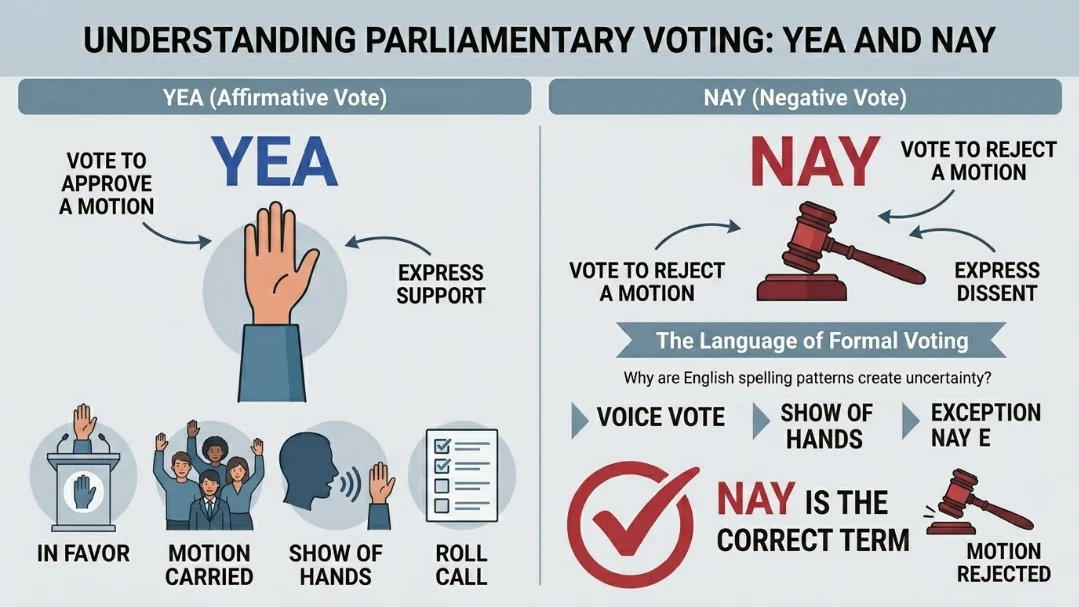
The phrase yea or nay represents a traditional expression used to register a formal vote, where “yea” signifies approval and “nay” signals opposition. Consequently, writers and speakers use this pairing in legislative bodies, parliamentary sessions, and formal boards to establish a clear affirmative or negative choice. Because modern spellings often confuse these archaic terms with “yeah” or “neigh,” using the correct historical spelling is vital for professional communication.
Words hold immense power in formal decision-making processes, especially when a single vote can alter the course of an organization or a nation. Among the oldest expressions in the English language for voting is the classic choice between yea or nay. While these terms might sound like echoes from a distant past, they remain deeply embedded in modern legislative systems, corporate boardrooms, and literary discussions.
Many writers struggle with this phrase because contemporary speech favors more casual alternatives. Specifically, people regularly confuse the ancient affirmative with its casual cousin, while accidentally substituting the negative option for the sound a horse makes. This confusion creates unprofessional errors in meeting minutes, legal transcriptions, and formal essays.
Understanding how to navigate this phrase correctly ensures that your formal documentation remains accurate. Furthermore, learning the historical and grammatical rules behind these terms will instantly elevate your professional communication skills. In this comprehensive guide, we will unpack every detail you need to master this formal expression, enabling you to use it flawlessly in any professional or academic setting.
The core rule surrounding this traditional expression relies on preserving historical spelling and formal context. You must avoid blending casual slang with parliamentary language.
To help you visualize the correct components, review this essential reference table:
| Term Element | Correct Spelling | Common Incorrect Variant | Functional Meaning |
| Affirmative Vote | Yea | Yeah / Yay | Yes / Approved |
| Negative Vote | Nay | Neigh | No / Rejected |
| Complete Phrase | Yea or nay | Yeah or neigh / Yay or nay | A definitive yes or no choice |
Definition and Explanation
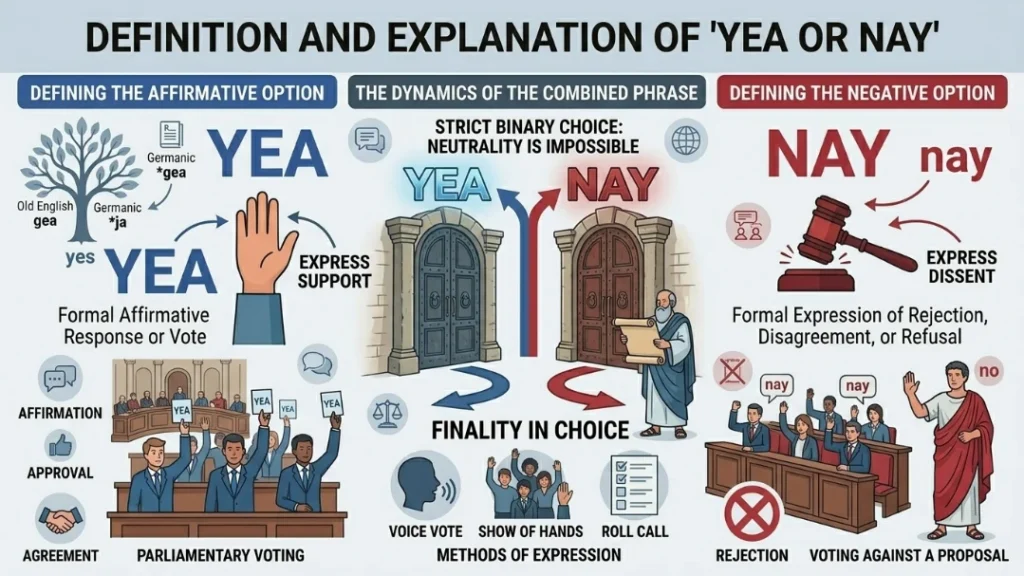
To use the expression effectively, one must look closely at the history and etymology of both components. These words entered the English language centuries ago, emerging from Old English and Germanic roots.
Defining the Affirmative Option
The word yea functions primarily as an adverb that signifies an affirmative vote or statement. Pronounced the same way as the word “yay,” this term historically served as a direct answer to a question framed in the affirmative. In modern settings, it translates directly to “yes.” Therefore, when a voter calls out this word, they are expressing their formal approval of a motion.
Defining the Negative Option
Conversely, the word nay serves as the traditional negative response. Pronounced exactly like the word “neigh,” this term signals rejection, refusal, or disagreement. In parliamentary procedures, casting this vote means you wish to defeat the proposed bill or resolution. Beyond voting, it can also function as a conjunction meaning “not only this but also,” though this usage is less common today.
The Dynamics of the Combined Phrase
When you join these two terms into a single idiom, you create a phrase that demands a final, binary decision. The phrase functions as a noun or an adjective describing a situation where neutrality is impossible. Because the structure is so rigid, it leaves no room for hesitation, compromise, or middle ground.
Historical Context and Parliamentary Origins
The persistence of this voting method owes everything to the traditions of the British Parliament and early democratic assemblies. Understanding this history clarifies why we still use these specific terms today.
The British Parliamentary System
Centuries ago, the Parliament of Great Britain established voice voting as a primary method for making quick decisions. Lawmakers needed an efficient way to signal their collective will without counting every single head on minor issues. By dividing the room into two distinct vocal camps, the Speaker of the House could gauge the general consensus based on volume.
During these sessions, members shouted their agreement or disagreement using these specific Old English terms. The acoustic difference between the long “e” sound in the historical affirmative and the sharp “a” sound in the negative helped the Speaker distinguish the two sides. Consequently, this acoustic clarity became the backbone of voice-based democratic processes.
Adaptation in the United States Congress
When the founders of the United States drafted their legislative rules, they heavily borrowed from British traditions. As a result, both the House of Representatives and the Senate adopted voice voting using these exact terms. Even today, the United States Constitution mentions the recording of these specific votes in the legislative journals, cementing the phrase in American law.
Advantages of Using Formal Voting Terms
Utilizing traditional terminology like yea or nay provides several unique structural benefits within formal organizations. It raises the gravity of the proceedings above casual conversation.
Clear Binary Outcomes
When a group relies on these traditional terms, it forces a clear, mathematical division of opinions. Because there are only two valid vocal responses, members cannot easily offer vague or conditional answers. This absolute clarity helps a chairperson determine the exact status of a motion without sorting through confusing verbal modifiers.
Preservation of Professional Tradition
Using established parliamentary language connects a modern organization to centuries of democratic governance. Whether you are running a university senate, a corporate board, or a local town hall, formal terms establish an atmosphere of seriousness. This traditional structure encourages participants to treat the proceedings with respect and decorum.
Clear Recording of Meeting Minutes
For secretaries and court reporters, these specific terms simplify the documentation process. Recording that an assembly voted via this method instantly signals to future readers that a formal voice vote occurred. This precision eliminates any ambiguity regarding the methodology used to pass a specific corporate resolution or amendment.
Disadvantages and Limitations
Despite its historic value, using a voice vote based on this expression presents several distinct practical challenges in modern environments. Leaders must recognize these limitations before calling for a vote.
Auditory Ambiguity in Large Crowds
The primary disadvantage of a voice vote relies on the subjective interpretation of sound volume. If a room contains hundreds of people, a passionate minority might shout louder than a polite majority. Therefore, a chairperson might misinterpret the true volume of the room, leading to an inaccurate declaration of the winner.
Lack of Anonymity
Shouting your stance out loud removes all privacy from the voting process. In highly contentious situations, members might feel intimidated by their peers if they have to announce their position publicly. Consequently, this peer pressure can skew the results, as timid members might choose to remain silent rather than voice an unpopular opinion.
Vulnerability to Modern Technology Glitches
In the era of remote board meetings and digital conferences, voice voting becomes exceptionally difficult to manage. Standard video conferencing software often cuts out when multiple people speak simultaneously. Because the algorithm attempts to prioritize a single microphone stream, the collective volume of the digital room is completely lost.
Real-World Examples in Governance
To see how these concepts function outside of textbooks, we can examine their implementation in real-world governance. Different organizations apply these voting rules in specific, structured ways.
Legislative Sessions in the United States Senate
During a standard session of the United States Senate, the presiding officer will regularly call for a voice vote on non-controversial amendments. The officer typically states, “As many as are in favor, say yea; most contrary, say nay.” Following the vocal responses, the officer will announce their decision by saying, “In the opinion of the Chair, the yeas have it.”
Corporate Board Resolutions
Imagine a major technology corporation deciding whether to acquire a smaller startup company. The corporate secretary reads the formal resolution to the board of directors. To expedite the process, the board chairman requests a formal voice vote, asking for a clear show of agreement through these traditional terms. This formal declaration ensures the choice is legally binding in the corporate record.
Local City Council Meetings
In smaller municipalities, city councils use this method to approve routine expenditures, such as road maintenance budgets or park equipment purchases. The council members quickly call out their answers in sequence. This swift process allows local governments to handle dozens of minor administrative tasks within a single evening session.
Regional and Global Usage Variations
While the core meaning of the phrase remains steady, the actual execution of voice voting varies significantly around the globe. Different English-speaking nations have adapted the language to suit their cultural preferences.
United Kingdom and Commonwealth Traditions
Interestingly, the modern British House of Commons has shifted away from the word yea in its daily operations. Instead, British Members of Parliament shout Aye or No when the Speaker puts a question to the floor. The Speaker then declares whether the Ayes or the Noes have it, maintaining a slightly different linguistic tradition than their American counterparts.
American Legislative Preferences
In contrast, the United States has firmly maintained the usage of yea alongside nay for its formal roll-call votes. However, for standard voice votes, the House and Senate frequently use Aye and No as well. This interplay means that American politicians must remain comfortable using both sets of formal vocabulary depending on the exact nature of the vote.
International Business Formality
Across global corporate boards, the choice of vocabulary often depends on the company’s bylaws. Standard international organizations frequently replace these archaic terms with the modern, universally understood words Yes and No. This shift prevents any potential translation confusion among board members who speak English as a second language.
Common Spelling Mistakes and Confusion
The biggest obstacle to using this phrase correctly is the high frequency of spelling errors. Because several English words sound identical but have vastly different meanings, writers regularly mix them up.
The Yeah vs. Yea Error
The most frequent mistake involves writing yeah instead of yea. The word yeah is a casual, informal variant of “yes” that originated in the twentieth century. It has absolutely no place in parliamentary procedures or formal writing. If you write “yeah or nay,” you are mistakenly mixing highly casual slang with rigid legal language.
The Yay vs. Yea Confusion
Another massive source of confusion is the word yay. This word is an exclamation of joy or excitement, typically used when celebrating a victory, such as shouting, “Yay, we won the game!” Because it sounds exactly like the voting term, people frequently misspell the phrase as “yay or nay.” While common on social media, this spelling remains incorrect in professional environments.
The Neigh vs. Nay Mistake
On the negative side of the phrase, writers occasionally confuse the voting term with neigh. The spelling neigh refers exclusively to the vocal sound made by a horse. Accidentally writing “yea or neigh” transforms a serious political or corporate choice into an unintended animal reference. Always ensure you drop the “eigh” when writing about human decisions.
Comparison Table of Homophones and Slang
To completely eliminate spelling errors, it is helpful to contrast the correct terms against their deceptive homophones. Reviewing these distinct definitions will help you keep them separate in your mind.
| Word | Proper Definition | Context for Correct Use | Appropriateness for Formal Votes |
| Yea | An affirmative vote; yes. | Parliamentary motions; traditional phrases. | Perfectly Correct |
| Nay | A negative vote; no. | Legislative choices; formal refusals. | Perfectly Correct |
| Yeah | Casual, everyday slang for yes. | Informally talking to friends or family. | Incorrect |
| Yay | An exclamation of celebration. | Cheering at a party or sporting event. | Incorrect |
| Neigh | The cry or sound of a horse. | Describing animal behavior on a farm. | Incorrect |
Structural Grammar Rules for the Phrase
When incorporating this phrase into complex sentences, you must follow specific grammatical guidelines. The phrase can change its form depending on how it functions in a sentence.
Pluralizing the Terms
When you count the total number of votes, you must convert these terms into their plural noun forms. The plural of yea is yeas, and the plural of nay is nays. For example, a journalist might write, “The final tally revealed sixty yeas and forty nays.” Notice that you do not add an apostrophe before the “s” when making these words plural.
Using the Phrase as a Compound Modifier
If you place the entire phrase before a noun to modify it, you should connect the words with hyphens. This structure creates a compound adjective. For instance, you would write, “The committee faced a yea-or-nay decision regarding the construction contract.” The hyphens signal to the reader that the three words function together as a single descriptive unit.
Subject-Verb Agreement
When discussing the winning side of a vote, you must match your verbs carefully to the plural nouns. Because yeas and nays are plural, they require plural verbs. Therefore, the correct phrasing is always, “The yeas have it,” rather than “the yeas has it.” This standard convention maintains proper grammatical agreement across all legislative transcripts.
Exercises with Answers
Application is the fastest path to mastery. Complete the following practical exercises to test your ability to spot errors and choose the correct terms.
Part 1: Multiple Choice
Select the option that uses the correct spelling and context for formal communication.
- The city council asked for a ________ vote on the new zoning laws.
- A) yeah or neigh
- B) yay or nay
- C) yea or nay
- When the clerk called her name, the senator stood up and shouted her clear ________.
- A) yea
- B) yeah
- C) yay
- The crowd cheered ________ when the home team scored the winning goal.
- A) yea
- B) yay
- C) nay
- We could hear the horses loudly ________ in the barn across the field.
- A) naying
- B) neighing
- C) yeahing
- After counting the paper ballots, the board announced that the ________ were in the majority.
- A) yays
- B) yeas
- C) yeahs
Part 2: Error Correction
Identify the spelling or contextual error in each sentence and rewrite it correctly.
- It was a simple yeah or nay question, but the manager refused to give a straight answer.
- The final legislative report recorded ninety-five yays and only twelve nays.
- I am absolutely thrilled about the promotion, so I shouted yea when I read the email!
- The chairman declared that the neighs had successfully blocked the controversial motion.
- Before we can launch the new advertising product, we must get a final yay or nay from the executive director.
Answers and Detailed Explanations
- C) yea or nay — This option represents the only accurate historical spelling for a formal voice vote.
- A) yea — Formal legislative responses require the traditional spelling without the casual “h” or celebratory “o.
- B) yay — Because this context describes an exclamation of joy, the celebratory spelling is required.
- B) neighing — This sentence refers directly to an animal sound, making the horse-specific spelling necessary.
- B) yeas — When pluralizing the affirmative vote, you must use the standard parliamentary noun form.
- Correction: It was a simple yea or nay question, but the manager refused to give a straight answer. (Explanation: Casual slang must be replaced with the correct idiom).
- Correction: The final legislative report recorded ninety-five yeas and only twelve nays. (Explanation: The plural form of the affirmative vote was misspelled as a cheer).
- Correction: I am absolutely thrilled about the promotion, so I shouted yay when I read the email! (Explanation: Personal celebration demands the joyful exclamation instead of a parliamentary vote).
- Correction: The chairman declared that the nays had successfully blocked the controversial motion. (Explanation: The animal sound spelling was mistakenly used for human voters).
- Correction: Before we can launch the new advertising product, we must get a final yea or nay from the executive director. (Explanation: The entire compound phrase must use the proper traditional spelling for formal decisions).
Related Concepts and Alternatives
To build a robust vocabulary, you should understand the modern alternatives and related concepts that can replace this phrase when necessary. Using different terms prevents your writing from becoming repetitive.
Adopting Modern Synonyms
If the traditional phrase feels too archaic for your specific target audience, you can easily swap it for modern equivalents. Excellent expressions include yes or no, for or against, and affirmative or negative. These modern phrases convey the exact same binary choice without carrying any historical baggage.
The Role of Abstentions
In true parliamentary procedure, voters are not strictly limited to these two vocal options. Members also have the right to abstain from voting if they feel conflicted or face a conflict of interest. An abstention means the member chooses to submit no opinion at all. Consequently, the presence of abstentions means that the total number of votes might not equal the total number of people in the room.
Roll-Call Votes vs. Voice Votes
It is critical to distinguish a voice vote from a formal roll-call vote. A voice vote allows an entire assembly to shout their positions simultaneously, providing a rapid but unrecorded result. In contrast, a roll-call vote requires the clerk to call each member’s name individually. The member then states their position, and their specific choice is permanently written next to their name in the official ledger.
FAQs
Is it correct to write yay or nay in a business email?
No, writing that phrase is technically incorrect because it combines a celebratory exclamation with a voting term. If you want to use the traditional expression, you must spell it accurately as yea or nay.
What is the origin of the word nay?
The word originates from Old Norse and Middle English roots, where it historically served as the standard negative response to a statement or question.
Can a horse make a nay sound?
No, a horse makes a neigh sound, which is a homophone for the voting term but uses a completely different spelling structure.
How does a chairperson declare the winner of a voice vote?
The chairperson listens to the collective volume of the room and typically says, “The yeas have it” or “The nays have it” to officially close the matter.
Why does the US Congress still use these old terms?
The United States Congress maintains these expressions to preserve historical legal traditions and comply with language patterns established during the founding of the nation.
Is yeah considered acceptable in formal minutes?
No, casual speech variants are highly unprofessional. You should always use the formal terms when transcribing an official corporate or legislative meeting.
What happens if a voice vote is too close to call by sound?
If the chairperson cannot clearly distinguish which side shouted louder, they will call for a division of the house, requiring members to stand up or raise their hands to be counted individually.
Can yea be used as a noun?
Yes, when it is pluralized into yeas, it functions as a noun representing the total number of affirmative votes cast during an election.
What is a compound modifier example for this phrase?
An excellent example is a sentence like, “The board held a yea-or-nay vote on the proposed corporate budget amendment.”
Should I capitalize these terms in regular text?
No, you do not need to capitalize these words unless they appear at the very beginning of a sentence or inside an official title.
Conclusion
Mastering the phrase yea or nay ensures that your professional communication remains elegant, accurate, and authoritative. While casual language constantly evolves, traditional parliamentary terms maintain a steady anchor in formal governance and business administration. By keeping the celebratory cheers and animal sounds out of your formal writing, you project absolute competence to your colleagues.
Always remember to analyze the specific context of your writing before selecting your vocabulary. If you are documenting a formal corporate board meeting or writing an academic essay on political history, stick closely to the traditional spelling. Conversely, if you are writing a casual message, modern alternatives like yes or no might serve you better.
Ultimately, avoiding common homophone traps prevents unnecessary distractions in your text. Dedicate yourself to studying these subtle differences, and your legal, professional, and corporate documents will always reflect the highest standards of clarity. Use this newfound mastery to guide your organization through its next major administrative decision with total linguistic confidence.