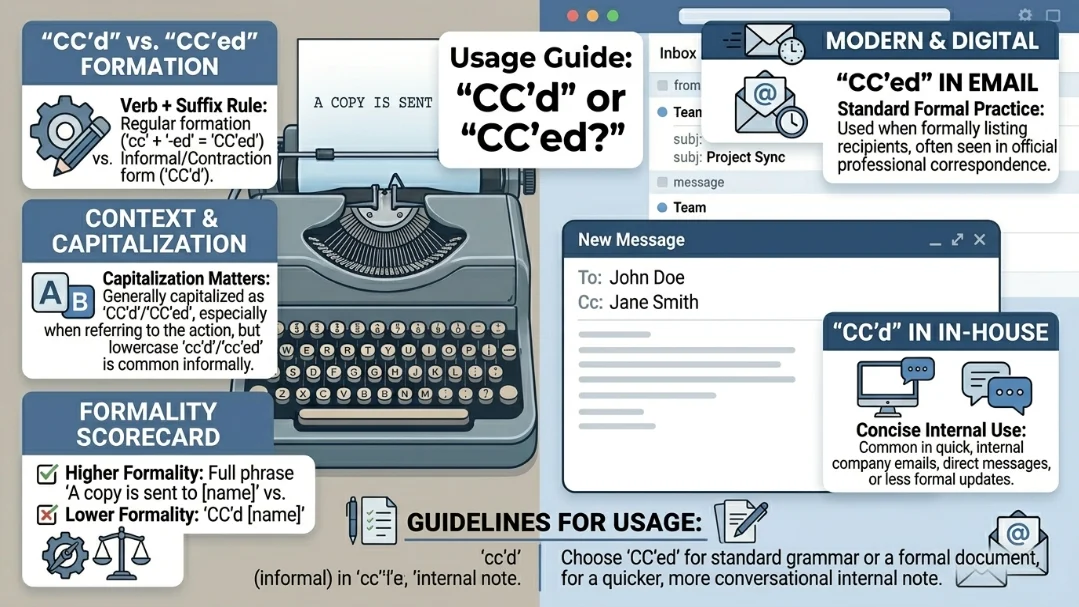
Both CC’d and CC’ed are grammatically acceptable past-tense forms of the verb “to CC” (carbon copy) in email correspondence. While CC’ed is more structurally consistent with standard English verb conjugation, CC’d is highly popular in modern, fast-paced professional settings because it mimics the visual abbreviation of the original term.
Navigating the unwritten rules of corporate communication can feel like walking through a minefield. One minute you are breezing through your morning inbox, and the next, you are staring blankly at a half-written draft. You need to tell a manager that you included them in an earlier message thread. Suddenly, a tiny grammatical dilemma halts your productivity entirely: Should you type CC’d or CC’ed?
This specific puzzle is one of the most common points of confusion in modern workplace writing. Because the term originated from a physical tool carbon paper and evolved rapidly into digital shorthand, standard style guides have spent years playing catch-up. Using the wrong variation will rarely cause a business disaster, but consistent, professional grammar builds your personal credibility.
Understanding how to use these abbreviations correctly ensures your professional communication remains polished, authoritative, and clear. This comprehensive guide will untangle the history of the term, break down regional preferences, highlight common mistakes, and provide clear rules to ensure you never hesitate before hitting send again.
If you are looking for a fast rule to apply to your emails right now, the short answer is that both options are correct. You can safely use either version, provided you remain consistent throughout your document or company correspondence.
- CC’ed is preferred by formal style guides (such as the Chicago Manual of Style) because it adds the traditional “-ed” suffix to turn a noun-turned-verb into the past tense.
- CC’d is a highly popular, modern contraction that uses an apostrophe to replace the missing “e,” mirroring how people naturally speak and abbreviate terms in digital workspaces.
The choice often comes down to your industry. Creative fields, tech startups, and fast-paced digital environments lean heavily toward CC’d. Legal, academic, and traditional corporate institutions often favor CC’ed for its alignment with classic English grammar conventions.
Definition and Explanation
To understand why this abbreviation causes so much debate, it helps to examine its technical history and linguistic journey.
The Origins of Carbon Copying
Long before the internet, offices relied on manual typewriters. To create an exact duplicate of a document as it was being typed, a clerk would place a sheet of paper coated with a layer of pigment known as carbon paper between the original sheet and a blank piece of paper underneath. The pressure of the typewriter keys transferred the ink, creating a duplicate. This duplicate was called a carbon copy, abbreviated as CC.
[Original Paper] -> Top sheet typed directly by the writer
       ↓
[Carbon Paper]   -> Middle sheet transferring pigment via pressure
       ↓
[Duplicate Copy] -> Bottom sheet receiving the carbon copy (CC)
When electronic mail emerged in the late 20th century, software developers adopted this familiar office terminology. The “CC” field was added to email headers to allow users to send secondary copies of a message to individuals who needed to stay informed but were not the primary recipients.
The Verbification of an Acronym
In linguistics, “verbification” occurs when a noun transitions into an active verb. As email became the primary mode of business communication, professionals stopped saying “I sent a carbon copy to John” and started saying “I CC’ed John.”
Because “CC” is an acronym composed of two consonants, adding past-tense suffixes creates a visual irregularity. Adding a simple “-d” creates “CCd,” which looks strange and is difficult to decode at a glance. To fix this visual awkwardness, writers introduced the apostrophe (CC’d) or the full past-tense spelling (CC’ed).
Advantages and Disadvantages
Choosing one form over the other carries subtle pros and cons depending on your audience. Examining these traits side-by-side highlights why different workplaces prefer different styles.
| CC’ed | • Follows standard rules of English suffix addition. • Highly favored by formal style guides. • Looks professional in academic and legal settings. | • Can look slightly bulky or visually repetitive. • Less common in fast-paced digital companies. | Legal briefs, formal letters, corporate policy documents, and academic outreach. |
| CC’d | • Visually clean and compact. • Accurately mimics the spoken rhythm of the word. • Preferred in modern, tech-forward environments. | • The apostrophe can occasionally look informal. • Disliked by strict linguistic purists. | Everyday workplace emails, instant messaging (Slack/Teams), and casual business updates. |
| cc’d / cc’ed | • Lowercase styling blends smoothly into casual text blocks. • Softens the tone of the sentence. | • Can be mistaken for a typo if not capitalized. • Lacks the crisp authority of uppercase acronyms. | Internal team chats, informal project updates, and peer-to-peer notes. |
Real-World Examples
Seeing these terms used in context helps clarify how they operate across different business situations. Below are realistic examples showcasing correct usage.
Example 1: Formal Corporate Update (Using CC’ed)
“Dear Board Members,
Please find attached the quarterly financial audits for your review. I have CC’ed the external compliance team on this thread to ensure all regulatory inquiries are answered promptly during tomorrow’s session.”
Example 2: Tech Startup Project Management (Using CC’d)
“Hey Team,
I just pushed the new design assets to the main repository. I CC’d Sarah from marketing so she can pull the graphics for the social media calendar. Let me know if you hit any bugs!”
Example 3: Capitalization vs. Lowercase Varieties
Both uppercase and lowercase varieties can be correct, though capitalization is generally preferred for clarity.
- Preferred: “I have CC’d HR on this formal grievance.” (Clear, distinct acronym)
- Acceptable: “I cc’ed the logistics coordinator yesterday.” (Softer layout, common in casual writing)
Regional and Global Usage
Language habits shift significantly across geographical borders. If you operate within an international marketplace, keeping these regional nuances in mind will help tailor your communication style.
North American Trends (United States and Canada)
In North American business cultures, efficiency and speed often dominate communication style choices. As a result, CC’d has seen a massive surge in popularity across US-based corporate offices, particularly within tech hubs, media agencies, and startup cultures. However, formal American publishing models, such as those governed by the Chicago Manual of Style, continue to recommend CC’ed.
United Kingdom and Commonwealth Nations
British, Australian, and New Zealand professional environments tend to lean more conservative regarding traditional grammar structures. The spelling CC’ed is frequently favored in these regions because it respects standard Germanic-English verb rules. Additionally, some Commonwealth entities prefer using the term copied altogether (e.g., “I have copied Marcus into this chain”) to completely bypass the awkwardness of acronym conjugation.
Common Mistakes to Avoid
Because “CC” is an adapted term, it is easy to slip into messy typing habits. Reviewing these common pitfalls will keep your writing sharp and error-free.
1. The Raw Suffix Error (CCd)
Omitting both the apostrophe and the extra “e” results in CCd. This layout creates a confusing visual cluster that breaks reading rhythm. Always use a separator or an explicit vowel.
- Incorrect:
I CCd the manager on that invoice. - Correct:
I CC'd the manager on that invoice.
2. Doubling the Consonants (CCC'ed)
Writers occasionally worry that the past tense requires doubling the final letter, leading to CCC'ed. This is incorrect because “CC” stands for a specific phrase (carbon copy) and should not have its core letters altered.
- Incorrect:
I CCC'ed the accounting team. - Correct:
I CC'ed the accounting team.
3. Tense Mixing in Present vs. Past
Ensure you do not use past-tense markers when describing automated or real-time actions.
- Incorrect:
Please make sure you CC'd me on future tickets. - Correct:
Please make sure you CC me on future tickets.
Exercises with Answers
Test your understanding of email abbreviations with these quick practice scenarios. Choose the best option for each scenario, then review the answers and explanations below.
Sentence Completion Exercises
- For our upcoming submission to the supreme court, our lead counsel requested that all junior partners be __________ on the case files.
- Hey Tom, just letting you know I __________ you on the client pitch deck five minutes ago.
- To keep tracking clean, the automated script automatically __________ the department head whenever an outage occurs.
- If you haven’t already __________ the vendor on the shipping manifesto, please do so by 5:00 PM.
Answer Key and Explanations
- CC’ed (or copied). Explanation: Legal briefs and official court communication require formal, traditional grammar profiles.
- CC’d. Explanation: The casual tone (“Hey Tom”) and immediate context make the streamlined contraction ideal for this internal conversation.
- CCs. Explanation: This sentence requires the present tense third-person singular form because it describes a regular, automated routine.
- CC’ed (or CC’d). Explanation: Either past-tense variant works correctly here, provided it fits the established style pattern of your business team.
Related Concepts and Comparisons
To round out your email mastery, it is important to understand how “CC” compares to other common inbox options and alternative phrasing.
CC vs. BCC
The most critical structural comparison inside your mail window is between CC and BCC.
- CC (Carbon Copy): All recipients included in this field can see one another’s names and email addresses. It is used to keep stakeholders looped into a project transparently.
- BCC (Blind Carbon Copy): The identities of recipients placed in this field remain completely hidden from everyone else on the thread. It is used for privacy protection or when emailing large external lists.
To CC vs. To Copy
If you dislike how acronyms look when turned into verbs, you can easily use standard English words instead. Swapping abbreviations for “copied” or “looped in” maintains a highly professional tone while sidestepping the grammatical debate entirely.
"I CC'd the billing department." -> "I copied the billing department."
"Make sure you CC HR."            -> "Make sure you loop in HR."
Frequently Asked Questions
Is CC’d or CC’ed more correct?
Both terms are grammatically valid. CC’ed follows standard English suffix patterns, making it popular with formal style guides. CC’d uses an apostrophe contraction, making it a popular choice for fast, clean, and modern digital communication.
How do you spell CC in past tense?
You can spell it as CC’ed, CC’d, cc’ed, or cc’d. Choose one specific format and maintain consistency across your entire document or communication chain.
Should CC be capitalized in an email?
Capitalization is generally preferred (CC) because it highlights that the word is an acronym. Lowercase writing (cc) is acceptable in casual internal messaging but can look unpolished in formal business communication.
Can I write CCed without an apostrophe?
Writing CCed (without an apostrophe) is increasingly accepted in modern dictionaries due to common usage. However, many readers find it visually awkward compared to CC’ed or CC’d.
What is the past tense of BCC?
Following the same logic as CC, the past tense of BCC can be written as BCC’d or BCC’ed. Alternatively, you can use the phrase “blind-copied.”
Is it unprofessional to say looped in instead of CC’d?
Not at all. Phrases like “looped in,” “copied,” or “included” are highly professional, natural alternatives that read smoothly in any business environment.
Does the Chicago Manual of Style prefer CC’d or CC’ed?
The Chicago Manual of Style recommends spelling out acronym-derived verbs with standard suffixes, making CC’ed their preferred selection.
What does CC stand for historically?
It stands for carbon copy, referencing the old physical office practice of using blue carbon paper sheets to duplicate typed documents.
Conclusion
The debate between CC’d and CC’ed shows how living languages naturally adapt to new technology. Neither selection is objectively incorrect, and your choice will rarely make or break a professional opportunity. The key to maintaining a high-quality professional image does not lie in choosing one specific variation over the other; it lies in consistency.
If you use CC’d in your first paragraph, do not switch to CC’ed in your closing remarks. Take a moment to evaluate your workspace environment. If you work in a traditional, conservative field like law, finance, or academia, lean toward CC’ed. If you operate in a modern, agile tech environment or creative agency, CC’d will serve you perfectly. When in doubt, you can always sidestep the issue entirely by using standard verbs like copied or included to ensure your emails remain clean, clear, and universally understood.

Jack Murphy is a language writer with a passion for word meanings, synonyms, and effective communication. He creates informative and easy to understand content to help readers enhance their vocabulary and language skills.





3 thoughts on “CC’d or CC’ed| The Ultimate Guide to Professional Email Grammar For 2026”