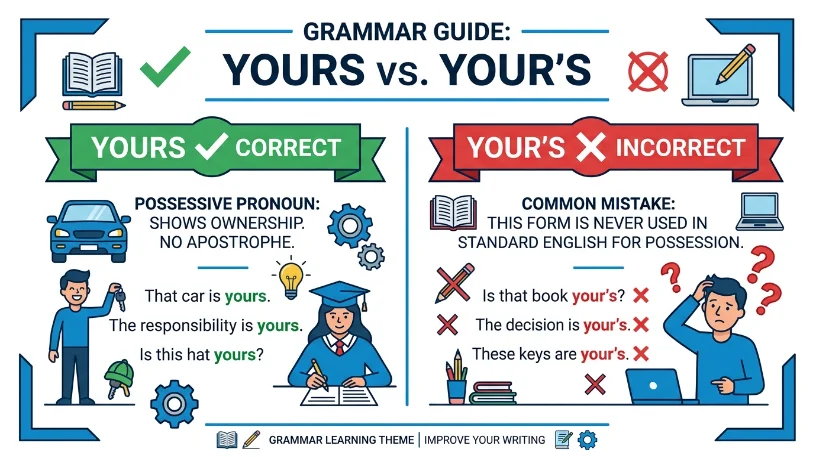
“Yours” is correct, while “your’s” is always incorrect. In English grammar, yours is a possessive pronoun that shows ownership without needing an apostrophe. Many people mistakenly write your’s because apostrophes are often used to show possession, but this rule does not apply to possessive pronouns like yours, his, hers, ours, and theirs.
English grammar can be tricky, especially when words look correct at first glance. One common mistake people make is writing your’s instead of yours. You may have seen both versions in emails, social media posts, school assignments, and even professional documents.
The confusion usually comes from the apostrophe. Since apostrophes often show possession, many writers assume that adding one to your creates the possessive form. However, English grammar works differently in this case.
Understanding the difference between yours or your’s is important because this mistake is easy to spot. In professional writing, academic papers, business emails, and website content, using the wrong form can make your writing appear less polished.
The good news is that the rule is simple. Once you learn it, you’ll never have to wonder whether to use yours or your’s again. This guide explains everything in plain English, with examples, comparisons, common mistakes, exercises, and answers to help you master this grammar rule.
Quick Answer
Which Is Correct: Yours or Your’s?
The correct word is:
✅ Yours
The incorrect word is:
❌ Your’s
Example
Correct:
This book is yours.
Incorrect:
This book is your’s.
If you remember only one thing from this article, remember this:
“Yours” never needs an apostrophe.
What Does “Yours” Mean?
Definition of Yours
Yours is a possessive pronoun.
It shows ownership or possession without repeating a noun.
Examples:
- This laptop is yours.
- The decision is yours.
- Is this jacket yours?
- The final choice is yours.
In each sentence, yours tells us who owns something.
Why “Yours” Has No Apostrophe
Many English learners wonder why yours doesn’t have an apostrophe.
The answer is simple.
Possessive pronouns do not use apostrophes.
Examples include:
| Pronoun | Correct Form |
|---|---|
| Mine | Mine |
| Yours | Yours |
| His | His |
| Hers | Hers |
| Ours | Ours |
| Theirs | Theirs |
Notice that none of these words contain an apostrophe.
Why Is “Your’s” Wrong?
The Grammar Rule
The word your’s does not exist in standard English grammar.
It is considered a spelling mistake.
Writers often add an apostrophe because they think possession always requires one.
For example:
- John’s car
- Sarah’s phone
- Company’s policy
These nouns use apostrophes.
However, possessive pronouns follow different rules.
Therefore:
- Mine ✅
- Yours ✅
- Hers ✅
Not:
- Mine’s ❌
- Your’s ❌
- Her’s ❌
Understanding the Common Confusion
The mistake usually happens because people compare:
- Your → Yours
- John → John’s
Since John’s uses an apostrophe, they assume your’s should too.
But possessive pronouns already show ownership. They don’t need an apostrophe.
Yours vs Your
Understanding the Difference
Many people confuse your and yours.
Your
Your is a possessive adjective.
It comes before a noun.
Examples:
- Your car is outside.
- Your phone is ringing.
- Your house looks beautiful.
Yours
Yours is a possessive pronoun.
It replaces a noun.
Examples:
- The car is yours.
- The phone is yours.
- The house is yours.
Comparison Table
| Word | Function | Example |
|---|---|---|
| Your | Possessive adjective | Your book is on the table. |
| Yours | Possessive pronoun | The book is yours. |
| Your’s | Incorrect spelling | Never correct |
Real World Examples
In Emails
Correct:
I received your message. The attached document is yours.
Incorrect:
The attached document is your’s.
In Business Communication
Correct:
The final decision is yours.
Incorrect:
The final decision is your’s.
In Social Media
Correct:
This achievement is yours.
Incorrect:
This achievement is your’s.
In School Assignments
Correct:
Is this notebook yours?
Incorrect:
Is this notebook your’s?
How to Remember the Rule
The Simple Memory Trick
Think about these words:
- Mine
- Yours
- Ours
- Theirs
Do any of them have apostrophes?
No.
Therefore, yours shouldn’t have one either.
The Quick Test
Ask yourself:
Can I replace the word with mine?
If yes, use yours.
Example:
This seat is mine.
Therefore:
This seat is yours.
Never:
This seat is your’s.
Advantages of Using the Correct Form
Better Professional Writing
Correct grammar improves credibility.
Employers, clients, and readers notice mistakes.
Using yours correctly helps your writing look polished.
Better Academic Performance
Students lose marks for grammar errors.
Learning this rule prevents an easy mistake.
Common Mistakes and Corrections
Mistake 1
Incorrect:
This pen is your’s.
Correct:
This pen is yours.
Mistake 2
Incorrect:
The choice is your’s.
Correct:
The choice is yours.
Mistake 3
Incorrect:
Is this bag your’s?
Correct:
Is this bag yours?
Mistake 4
Incorrect:
The victory is your’s.
Correct:
The victory is yours.
Related Grammar Concepts
Its vs It’s
Another common apostrophe mistake.
Correct:
- Its color is blue.
- It’s raining outside.
Difference:
- Its = possession
- It’s = it is
Whose vs Who’s
Correct:
- Whose jacket is this?
- Who’s coming today?
Difference:
- Whose = possession
- Who’s = who is
Their vs They’re vs There
Many writers confuse these words.
- Their = possession
- They’re = they are
- There = location
Example:
Their house is over there, and they’re inside.
Regional and Global Usage
American English
American English uses yours exactly the same way.
Example:
The responsibility is yours.
British English
British English follows the same rule.
Example:
The opportunity is yours.
Australian English
Australian English also uses yours without an apostrophe.
Example:
The package is yours.
No major English dialect accepts your’s as correct.
Exercises With Answers
Exercise 1
This jacket is ______.
A. yours
B. your’s
Answer:
✅ A. yours
Exercise 2
Choose the correct sentence.
A. The choice is your’s.
B. The choice is yours.
Answer:
✅ B. The choice is yours.
Exercise 3
Fill in the blank.
Is this notebook ______?
Answer:
✅ yours
Exercise 4
Correct the sentence.
This seat is your’s.
Answer:
✅ This seat is yours.
Exercise 5
Choose the correct option.
A. The decision is yours.
B. The decision is your’s.
Answer:
✅ A. The decision is yours.
Frequently Asked Questions
Is yours or your’s correct?
Yours is correct. Your’s is always incorrect in standard English.
Why is your’s wrong?
Because possessive pronouns do not use apostrophes. The correct possessive pronoun is yours.
Does yours need an apostrophe?
No. Yours never requires an apostrophe.
Is your’s ever acceptable?
No. Modern English grammar does not recognize your’s as a correct word.
How do I remember yours or your’s?
Remember that mine, yours, ours, and theirs never use apostrophes.
What part of speech is yours?
Yours is a possessive pronoun.
Can I use yours in formal writing?
Yes. Yours is correct in formal, academic, and professional writing.
Why do people write your’s?
Many people incorrectly assume possession always requires an apostrophe.
Is yours correct in emails?
Yes. For example:
The attached file is yours.
What is the difference between your and yours?
Your comes before a noun, while yours replaces a noun entirely.
Conclusion
The debate over yours or your’s is actually very simple once you understand the grammar rule. The correct word is yours, and your’s is always incorrect.
The confusion comes from the way apostrophes are used with nouns. Words like John’s and Sarah’s use apostrophes to show possession, but possessive pronouns follow different rules. Just like mine, hers, ours, and theirs, the word yours never needs an apostrophe.
A useful trick is to compare it with mine. Nobody writes mine’s, and for the same reason, nobody should write your’s. This small grammar rule can make a big difference in professional emails, academic writing, blog posts, and everyday communication.
Whenever you’re unsure, remember this simple sentence:
The correct form is always “yours,” never “your’s.”