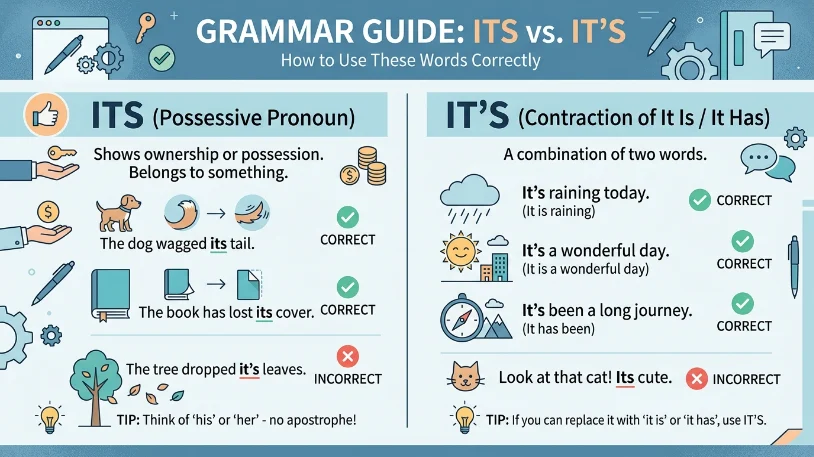
The difference between its and it’s is simple but commonly misunderstood. It’s is a contraction of it is or it has, while its is a possessive pronoun that shows ownership. Understanding when to use its or it’s can improve your writing, grammar accuracy, and professional communication.
Few grammar mistakes appear as often as mixing up its and it’s. Even experienced writers sometimes pause before choosing the correct word.
The confusion happens because apostrophes usually show possession. For example, “Sarah’s book” means the book belongs to Sarah. However, with its and it’s, the rule works differently.
Using the wrong form can make your writing look careless, especially in emails, academic papers, business reports, and website content. Fortunately, the difference is easy to understand once you learn a simple trick.
In this guide, you’ll learn exactly what its and it’s mean, how they are used, common mistakes to avoid, and practical examples that make the rule easy to remember.
Its or It’s?
What Does “It’s” Mean?
It’s is a contraction.
It means:
- It is
- It has
Examples:
- It’s raining outside.
- It’s a beautiful day.
- It’s been a long week.
If you can replace it’s with it is or it has, then it’s is correct.
What Does “Its” Mean?
Its is a possessive pronoun.
It shows that something belongs to an object, animal, organization, or idea.
Examples:
- The dog wagged its tail.
- The company changed its policy.
- The phone lost its signal.
If ownership is involved, use its.
Understanding the Difference Between Its and It’s
Why People Get Confused
Most possessive nouns use an apostrophe.
Examples:
- John’s car
- Emma’s laptop
- Teacher’s desk
Because of this pattern, many people assume it’s should show possession too.
But English grammar makes an exception.
The possessive form of it is simply its without an apostrophe.
The Easy Test
Whenever you’re unsure, replace the word with:
- it is
- it has
If the sentence still makes sense, use it’s.
Example:
“It’s cold today.”
“It is cold today.”
The sentence works, so it’s is correct.
Now look at this:
“The cat cleaned it’s paws.”
“The cat cleaned it is paws.”
The sentence makes no sense.
The correct form is:
“The cat cleaned its paws.”
Definition and Explanation
What Is a Possessive Pronoun?
A possessive pronoun shows ownership.
Examples include:
- My
- Your
- His
- Her
- Their
- Its
Example:
“The tree lost its leaves.”
The leaves belong to the tree.
What Is a Contraction?
A contraction combines two words into one shorter form.
Examples:
- Don’t = Do not
- Can’t = Cannot
- It’s = It is
Contractions are common in everyday writing and conversation.
Its vs It’s Comparison Table
| Feature | Its | It’s |
|---|---|---|
| Part of Speech | Possessive Pronoun | Contraction |
| Meaning | Belonging to it | It is / It has |
| Apostrophe | No | Yes |
| Shows Ownership | Yes | No |
| Example | The car lost its tire. | It’s a new car. |
When to Use Its
Showing Ownership
Use its when something belongs to an object, animal, company, or concept.
Examples:
- The bird built its nest.
- The machine stopped because its motor failed.
- The school updated its website.
Talking About Organizations
Companies and organizations often use its.
Examples:
- The business launched its new product.
- The university announced its scholarship program.
Referring to Animals
Examples:
- The horse shook its head.
- The lion protected its cubs.
When to Use It’s
Replacing “It Is”
Examples:
- It’s too late.
- It’s important to understand grammar.
- It’s easy once you know the rule.
Replacing “It Has”
Examples:
- It’s been a difficult year.
- It’s already started.
- It’s become very popular.
Real World Examples
Example in Business Writing
Incorrect:
“The company updated it’s privacy policy.”
Correct:
“The company updated its privacy policy.”
Example in Email Writing
Incorrect:
“I think its going to rain.”
Correct:
“I think it’s going to rain.”
Example in Academic Writing
Incorrect:
“The experiment reached it’s conclusion.”
Correct:
“The experiment reached its conclusion.”
Common Mistakes and How to Fix Them
Using It’s for Ownership
Incorrect:
“The dog wagged it’s tail.”
Correct:
“The dog wagged its tail.”
Forgetting That It’s Means It Is
Incorrect:
“Its a beautiful morning.”
Correct:
“It’s a beautiful morning.”
Assuming Every Possessive Needs an Apostrophe
Many learners think apostrophes always indicate possession.
That is true for many nouns, but not for possessive pronouns like:
- His
- Hers
- Yours
- Theirs
- Its
Advantages of Learning the Difference
Better Professional Writing
Correct grammar builds credibility.
Readers trust content that looks polished and accurate.
Improved Academic Performance
Grammar mistakes can affect grades in essays and assignments.
Using its and it’s correctly improves writing quality.
Stronger Content
For bloggers and website owners, grammar affects readability.
Well-written content encourages users to stay longer and trust the information.
Related Grammar Concepts
Your vs You’re
- Your = Possession
- You’re = You are
Example:
- Your car is parked outside.
- You’re late today.
Their vs They’re
- Their = Possession
- They’re = They are
Example:
- Their house is beautiful.
- They’re moving next month.
Whose vs Who’s
- Whose = Possession
- Who’s = Who is
Example:
- Whose jacket is this?
- Who’s coming tonight?
Regional and Global Usage
American English
American English follows the standard rule:
- Its = Possession
- It’s = It is / It has
British English
British English follows exactly the same rule.
There is no difference between American and British usage for its or it’s.
International English Learners
Many English learners struggle with this grammar point because it breaks the normal apostrophe pattern.
Once the contraction test is learned, the confusion usually disappears.
Practice Exercises With Answers
Exercise 1
The company changed ___ logo.
Answer:
its
Exercise 2
___ going to be a busy day.
Answer:
It’s
Exercise 3
Choose the correct word:
The cat cleaned ___ paws.
Answer:
its
Exercise 4
___ been a wonderful experience.
Answer:
It’s
Exercise 5
The phone lost ___ connection.
Answer:
its
Frequently Asked Questions
What is the difference between its and it’s?
Its shows possession, while it’s means “it is” or “it has.”
Is its possessive or contraction?
Its is a possessive pronoun.
Does it’s mean it is?
Yes. It’s can mean “it is” or “it has.”
Why doesn’t its have an apostrophe?
Because possessive pronouns do not use apostrophes.
How do I remember its or it’s?
Replace the word with “it is.” If the sentence works, use it’s.
Can it’s show ownership?
No. It’s never shows possession.
Is its grammatically correct without an apostrophe?
Yes. Its is the correct possessive form.
Do American and British English use different rules?
No. Both use the same grammar rule.
Is using its instead of it’s a common mistake?
Yes. It is one of the most common grammar errors in English writing.
How can I avoid mistakes with its or it’s?
Use the “it is” test before choosing the word.
Conclusion
The debate over its or it’s becomes much simpler once you understand the basic rule. Its shows ownership, while it’s is simply a shorter form of it is or it has.
Although the difference is small, using the correct word can significantly improve the quality of your writing. Whether you’re writing emails, blog posts, academic papers, or business documents, proper grammar helps you communicate clearly and professionally.
A useful trick is to replace it’s with it is. If the sentence still makes sense, use it’s. If you’re talking about something belonging to an object, animal, company, or idea, use its.
With a little practice, you’ll stop second-guessing yourself and start using both forms correctly every time.