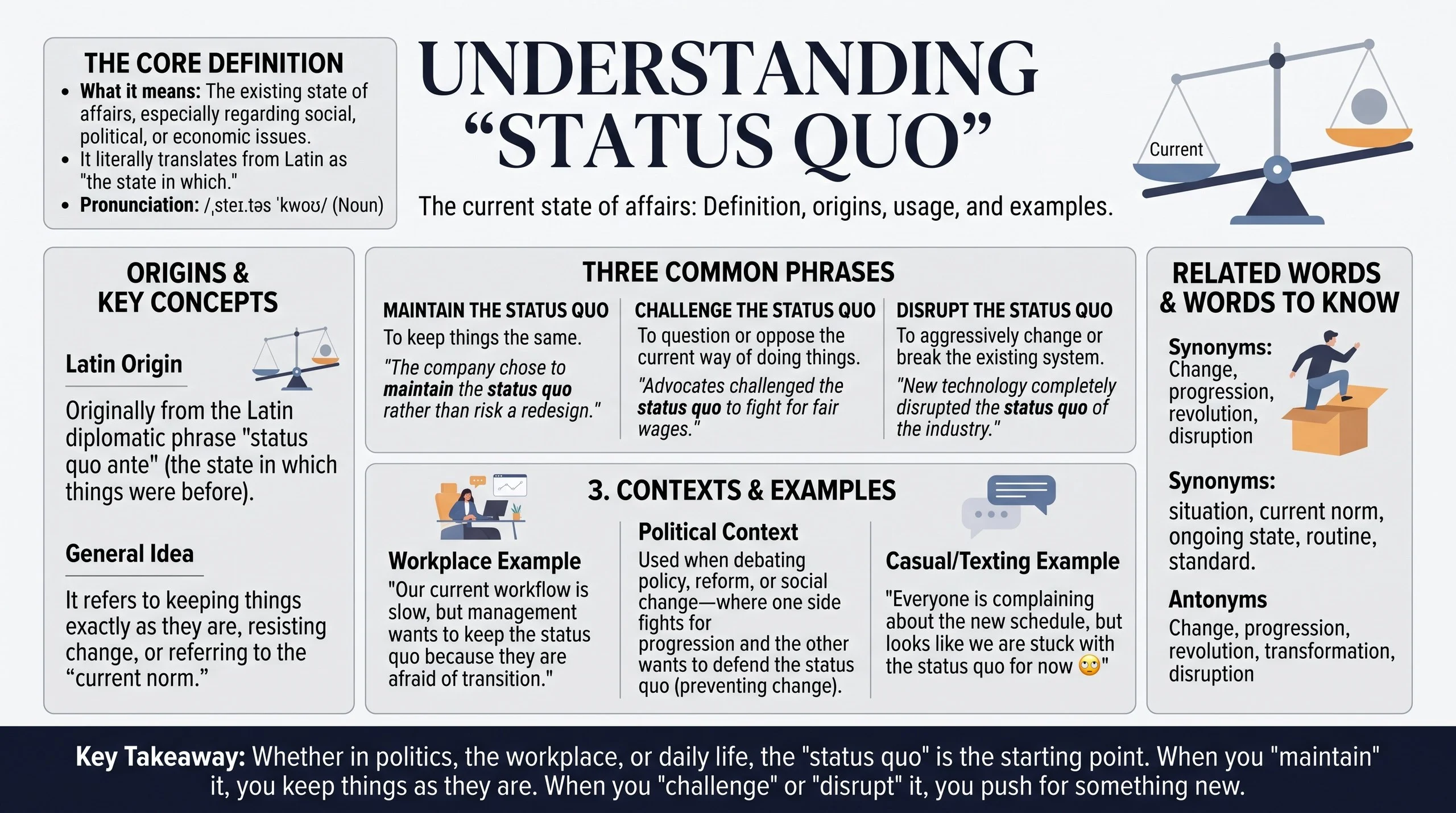
Status quo meaning refers to the existing state of affairs or the way things currently are. It describes a present situation that has not changed, especially when people discuss maintaining, challenging, or improving an established condition.
status quo meaning is the existing condition or situation at a particular time. You will often see the phrase in politics, business, education, relationships, news reports, and everyday conversations. It usually describes something that already exists rather than something being proposed or planned.
For example, if a company keeps its current work schedule despite suggestions for change, someone might say, “Management decided to maintain the status quo.” In that sentence, the phrase means the company will keep things as they currently are.
However, the expression can carry different shades of meaning depending on context. Sometimes it sounds neutral. In other situations, it suggests resistance to change. Therefore, understanding the surrounding sentence matters.
The expression also appears frequently in discussions about reform. A person who wants change may criticize the existing system. Another person may defend it because they believe the current arrangement works well.
This guide explains the definition, origin, tone, common uses, examples, related expressions, and potential misunderstandings. It also shows how Americans naturally use the phrase in conversation and writing.
Quick Answer Box
| Meaning | Context | Primary Platforms | Example | Tone |
| The existing state of affairs | Politics, work, education, society, daily life | News, social media, texting, professional writing | “They want to preserve the current system.” | Neutral, formal, or critical |
What Does status quo mean?
The phrase describes the existing state of affairs. In simple terms, it means the way things are right now.
For example, imagine a workplace where employees work from 9 a.m. to 5 p.m. A proposal suggests moving to flexible hours. If the company rejects the proposal and keeps the current schedule, it has maintained the existing arrangement.
That arrangement represents the status quo.
The phrase does not automatically mean that something is good or bad. Instead, it identifies the current condition. The speaker’s attitude comes from the surrounding language.
Consider these examples:
“Let’s maintain the status quo.”
Here, the speaker supports keeping things unchanged.
“We need to challenge the status quo.”
Here, the speaker believes the current situation needs improvement.
“The election could disrupt the status quo.”
Here, the speaker expects a significant change in an established system.
Therefore, status quo meaning depends partly on the speaker’s attitude toward change.
Is Status Quo a Positive or Negative Expression?
Neither. The phrase itself is neutral.
However, it can sound positive when someone values stability. For example, a manager might say that maintaining existing procedures protects customers and employees.
Conversely, activists and reformers may use the phrase negatively. They may argue that an unfair system continues because powerful groups prefer the existing arrangement.
For instance:
“Community leaders are calling for changes to the status quo.”
The sentence suggests dissatisfaction with current conditions.
Meanwhile:
“Investors welcomed the decision to preserve the status quo.”
This version suggests that stability is desirable.
Consequently, you should avoid assuming that the expression always praises or criticizes something.
What Is the Origin of the Expression?
The expression comes from Latin. Its literal sense relates to an existing state or condition.
It developed from a longer Latin expression associated with the condition in which something previously existed. Over time, English speakers shortened the expression to status quo.
Today, the phrase functions as an established English expression. It appears especially often in formal writing, journalism, politics, economics, law, and social commentary.
Although its origin is Latin, American English speakers commonly use it without treating it as a foreign expression. In fact, it is familiar to many readers and listeners.
Contextual Dynamics & Nuances of the Term
Understanding status quo meaning requires more than memorizing “things as they are.” The expression can communicate stability, resistance, tradition, or dissatisfaction.
Maintaining the Existing Situation
“Maintain the status quo” means keeping the current situation unchanged.
For example:
“The board voted to maintain the status quo.”
The board decided not to introduce a major change.
This construction appears frequently in business and politics. It can also occur in personal situations.
“She did not want to change the arrangement, so she maintained the status quo.”
The sentence simply means that she kept things as they were.
Challenging the Existing System
“Challenge the status quo” means questioning or opposing established practices.
For example:
“The new director wants to challenge the status quo.”
The director believes existing practices should be reconsidered.
This phrase often appears in discussions about innovation. Companies may describe creative employees as people who challenge established methods.
Similarly, social movements may challenge traditional systems by demanding legal, economic, or cultural change.
Disrupting Established Conditions
“Disrupt the status quo” suggests a stronger form of change.
For example:
“The new technology could disrupt the status quo.”
Technology may change how an industry operates.
The word “disrupt” creates a more energetic tone than “change.” Therefore, it often appears in technology, entrepreneurship, business, and marketing.
Preserving Stability
Sometimes people deliberately protect the existing arrangement.
For example:
“Officials chose stability over major reforms.”
In this context, preserving the status quo may represent caution.
That does not necessarily mean the officials oppose improvement. They may simply believe that rapid change could create unwanted consequences.
The Difference Between Status Quo and Stability
These expressions overlap, but they are not identical.
Status quo identifies the current state.
Stability describes a condition in which things remain steady or secure.
A situation can represent the status quo without being stable. For example, a political system may be the existing arrangement while experiencing frequent conflict.
Therefore, context determines which concept fits best.
Real Life Conversation Examples Using status quo meaning
The phrase is more common in formal or semi formal conversation than in casual texting. Still, people use it naturally when discussing work, politics, relationships, education, or social issues.
Example 1: Workplace Discussion
Maya: “Are we changing the work schedule next month?”
Jordan: “Not yet. Management decided to keep the status quo.”
Maya: “So everything stays the same for now?”
Jordan: “Exactly.”
Meaning: The company will continue using its existing schedule.
Example 2: Political Discussion
Alex: “Why are candidates talking so much about reform?”
Chris: “Because some of them want to challenge the status quo.”
Alex: “Meaning they want major changes?”
Chris: “Right. They think the current system is not working.”
Meaning: The speakers are discussing attempts to change an established political system.
Example 3: School Policy
Teacher: “Are we getting a new grading system?”
Student: “Apparently not. The administration wants to maintain the status quo.”
Teacher: “That means the current grading rules stay?”
Student: “Yep.”
Meaning: The existing grading system will remain in place.
Example 4: Relationship Situation
Friend 1: “Are you two finally going to define the relationship?”
Friend 2: “Honestly, we’re keeping the status quo for now.”
Friend 1: “So you’re both comfortable with things as they are?”
Friend 2: “Pretty much.”
Meaning: The relationship will continue in its current form without a major change.
Example 5: Business Strategy
CEO: “Should we enter the new market?”
Executive: “It could disrupt the status quo, but the opportunity is significant.”
CEO: “Then let’s study the risks before deciding.”
Meaning: Entering the market could substantially change the existing competitive environment.
Platform Specific Breakdown
The phrase appears across many communication environments. However, its frequency and tone can change depending on the platform.
How It Is Used on Snapchat
Snapchat conversations usually favor short, casual language. Therefore, users may not use the full phrase frequently unless they are discussing school, relationships, current events, or a specific situation.
A person might write:
“Everyone is scared to change the status quo lol.”
Another might say:
“Just leave the status quo alone 😂.”
The expression can sound intentionally formal when placed inside a casual message. That contrast may even make the message humorous.
For example:
“Bro said he wants to preserve the status quo 💀.”
The humor comes from using formal political language for an ordinary situation.
The Role of status quo meaning on TikTok
TikTok frequently uses the phrase in videos about culture, politics, careers, education, relationships, technology, and social trends.
Creators may use expressions such as:
“Challenging the status quo.”
“Breaking the status quo.”
“Why does the status quo need to change?”
“Who benefits from the status quo?”
On TikTok, the phrase can become part of a larger argument. A creator may use it to describe an established cultural habit and then explain why viewers should reconsider it.
However, not every use is serious. Some creators use the phrase humorously to describe ordinary routines.
For example:
“My cat refuses to challenge the status quo, so dinner is still at 6 p.m.”
The formal expression becomes funny because the subject is a pet’s routine.
Instagram and Texting Dynamics
Instagram captions often use the expression when discussing personal growth, entrepreneurship, social change, or creativity.
For example:
“Sometimes growth starts with challenging the status quo.”
In a professional caption, this can sound motivational.
In texting, however, simpler alternatives often feel more natural.
Instead of:
“I intend to challenge the status quo in our weekend plans.”
A friend might simply say:
“Let’s do something different this weekend.”
Therefore, the phrase is grammatically correct in texting, but it can sound more formal than ordinary conversational alternatives.
Alternative Meanings & NLP Variations of the Phrase
Although the core concept stays consistent, several related expressions can communicate similar ideas.
| Expression | Basic Meaning | Typical Tone |
| Current situation | What is happening now | Neutral |
| Existing conditions | Present circumstances | Formal |
| Current system | The system operating now | Neutral |
| Established order | Accepted structure | Formal |
| Way things are | Existing reality | Casual |
| Current arrangement | Existing setup | Neutral |
| Existing practice | A practice already in use | Formal |
| Conventional approach | Traditional method | Neutral |
| Established system | Existing organized structure | Formal |
| Present state | Current condition | Neutral |
Status Quo vs Current Situation
“Current situation” is broader and more conversational.
For example:
“What is the current situation?”
This asks about what is happening now.
By contrast:
“What is the status quo?”
This often focuses on an established arrangement that could remain unchanged or face pressure to change.
Status Quo vs Tradition
Tradition refers to practices, beliefs, or customs passed through generations or maintained over time.
The status quo refers more broadly to the current state of affairs.
Therefore, something can be part of the status quo without being traditional.
For example, a newly introduced workplace policy could become part of the status quo even though it has existed for only a short time.
Status Quo vs Routine
A routine is a repeated pattern of behavior.
The status quo is the broader existing condition.
For example, drinking coffee every morning can be a routine. A company’s entire work structure can represent its status quo.
These concepts overlap, but they operate at different levels.
Misinterpretations: When NOT to Use status quo meaning
The phrase is useful, but it does not fit every situation.
Avoid It When You Simply Mean “Right Now”
If you are telling a friend what you are doing at this moment, “status quo” may sound unnecessarily formal.
Instead of:
“The status quo is that I’m eating dinner.”
Say:
“I’m eating dinner right now.”
The simpler option sounds more natural.
Avoid It When Discussing Only a Temporary Event
The phrase usually works best when an existing condition has some continuity or significance.
For a brief event, “current situation” or “what is happening” may work better.
Avoid Using It as a Synonym for “Good”
The expression does not mean “good situation.”
For example:
“The status quo is excellent.”
This is possible, but the phrase itself does not create a positive meaning. The adjective does that work.
Avoid Confusing It With “Status”
“Status” can mean rank, position, condition, or social standing.
“Status quo” specifically refers to the existing state of affairs.
Therefore, these sentences have different meanings:
“Her social status changed.”
“The social status quo changed.”
The first concerns an individual’s position. The second concerns the broader existing arrangement.
Avoid Overusing It in Casual Messages
Formal vocabulary can sound unnatural when simpler words communicate the idea more clearly.
For example:
“I prefer maintaining the status quo regarding our dinner plans.”
This is grammatically fine, but:
“Let’s keep our dinner plans the same.”
sounds more natural among friends.
How to Respond in Chat Comfortably
When someone uses the phrase in a message, your response should match the context.
If you agree with keeping things unchanged, you can say:
“Yeah, I’m good with keeping things as they are.”
If you want change, you can say:
“I think we should try something different.”
If you are unsure, ask:
“What would you change?”
If someone uses the phrase jokingly, you can match the humor:
“Protecting the status quo like it’s a national treasure 😂.”
The key is not to force formal language into a casual conversation.
Casual Responses
“Yeah, things are fine as they are.”
“Honestly, I’m okay with keeping things the same.”
“Fair enough. No need to change it.”
“Let’s leave it alone for now.”
Professional Responses
“I agree that maintaining the current arrangement makes sense.”
“I understand the case for preserving the existing system.”
“We should evaluate the alternatives before changing the current approach.”
When You Disagree
“I understand, but I think the current system needs improvement.”
“I see your point. Still, I don’t think keeping things unchanged solves the problem.”
“I’d rather explore a different approach.”
These responses communicate disagreement without making the conversation unnecessarily confrontational.
FAQs
What does status quo mean in simple words?
It means the way things are now. When someone says they want to maintain the status quo, they mean they want to keep the current situation rather than make a significant change.
Is status quo a negative phrase?
No. The expression is neutral. However, speakers may use it negatively when criticizing an existing system, or positively when emphasizing stability and consistency.
What does maintaining the status quo mean?
Maintaining the status quo means keeping existing conditions, rules, practices, or arrangements unchanged. For example, a company may maintain its current schedule instead of adopting a proposed new schedule.
What does challenging the status quo mean?
It means questioning established practices or conditions and seeking change. The phrase often appears when people discuss innovation, reform, social movements, business strategies, or organizational improvements.
What is the status quo meaning in politics?
In politics, it generally refers to the existing political, legal, economic, or social arrangement. Politicians may defend it, reform it, or campaign against it.
Is status quo formal English?
Yes. It is widely accepted English, but it tends to sound more formal than everyday expressions such as “the way things are” or “the current situation.” It works especially well in professional and analytical writing.
What is another way to say status quo?
Depending on the context, you can use “current situation,” “existing conditions,” “current arrangement,” “present state,” “existing system,” or “way things are.”
Can I use status quo in a text message?
Yes. However, it may sound slightly formal in casual texting. That can be useful if you want a serious, witty, or deliberately polished tone.
Does status quo mean tradition?
Not exactly. Tradition involves practices or beliefs that continue over time. The status quo refers to the existing state of affairs, whether that situation is traditional, recent, or somewhere in between.
How do I know whether to use the phrase?
Use it when you are discussing an established situation that could remain unchanged or face a meaningful change. If you simply mean “what is happening right now,” a simpler phrase may sound more natural.
Conclusion
Understanding status quo meaning becomes easier when you connect the phrase to one simple idea: the existing state of affairs. It describes what already exists, whether that involves a workplace policy, political system, relationship arrangement, social habit, or business strategy.
The expression can remain completely neutral. However, context gives it emotional weight. Someone may defend the status quo because they value stability. Another person may challenge it because they want reform.
In everyday American English, simpler alternatives such as “the current situation,” “the way things are,” or “the existing system” often sound more casual. Still, the original expression remains useful in professional, political, academic, and social discussions.
Ultimately, knowing when to use the phrase matters as much as knowing its definition. Use it when an established situation is the subject of discussion, especially when change or stability is part of the conversation.