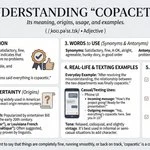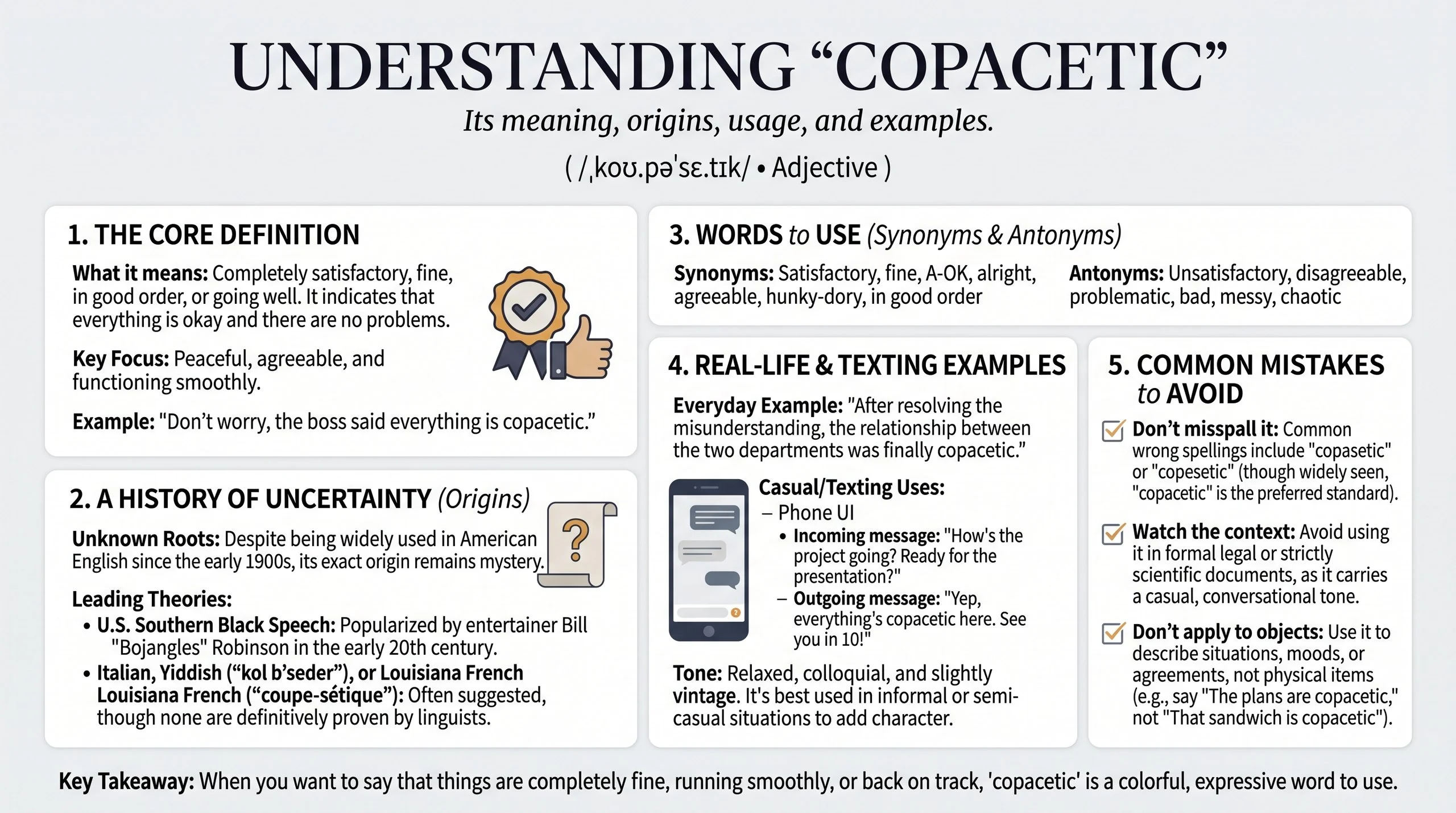
Copacetic meaning refers to something completely satisfactory, agreeable, or in good order. It describes a situation, relationship, plan, or condition that feels fine, settled, and free from serious problems, often with a calm, confident, and slightly informal tone.
The copacetic meaning is simple: something is satisfactory, fine, or going well. However, the word has a distinctive personality that makes it more interesting than ordinary words such as “okay” or “fine.”
You might hear someone say, “Everything is copacetic,” when they want to reassure another person that there are no serious problems. Likewise, a friend might describe a plan as copacetic when everything looks settled.
Although the word appears in dictionaries and has been used in American English for more than a century, its history remains somewhat mysterious. That uncertainty adds to its character. Unlike many modern slang terms, copacetic is not primarily an internet invention. Instead, it is an established American English adjective that occasionally appears in casual speech, writing, entertainment, and online conversations.
In this guide, you will learn what the word means, where it came from, how its tone works, when to use it, and how people might interpret it in texts, social media posts, and everyday conversations.
Quick Answer Box
| Meaning | Context | Primary Platforms | Example | Tone |
| Completely satisfactory, fine, or in good order | Casual conversation, writing, reassurance | Texting, Instagram, TikTok, Snapchat, everyday speech | “Everything is copacetic now.” | Casual, confident, slightly playful |
| Acceptable or going smoothly | Plans, relationships, situations, work | Messages, conversations, social posts | “The schedule is copacetic.” | Calm and positive |
| Free from major problems | Reassurance after an issue | Texts and spoken English | “No worries. We are copacetic.” | Reassuring |
What Does copacetic mean?
The copacetic meaning describes something that is satisfactory, agreeable, acceptable, or in good condition. In everyday language, it can often be replaced with “fine,” “all good,” “okay,” “going well,” or “everything is in order.”
For example:
“After we fixed the misunderstanding, everything was copacetic.”
Here, the speaker means that the situation became satisfactory again.
The word is an adjective. It commonly describes a situation, condition, arrangement, relationship, or general state of affairs.
Is copacetic a positive word?
Yes. The copacetic meaning generally carries a positive or reassuring sense.
However, it does not usually express intense excitement. If someone says, “Everything is copacetic,” they normally mean that everything is satisfactory and under control.
Compare these expressions:
| Expression | Strength | Typical feeling |
| Fine | Mild | Neutral |
| Okay | Mild | Neutral |
| Good | Moderate | Positive |
| Copacetic | Moderate | Satisfactory and confident |
| Excellent | Strong | Highly positive |
| Fantastic | Very strong | Enthusiastic |
Therefore, copacetic occupies an interesting space. It communicates positivity without sounding overly enthusiastic.
Is copacetic formal or informal?
The word can work in both casual and semi formal contexts. However, it has a conversational flavor because it is distinctive and somewhat unusual.
For example, saying “The project is copacetic” sounds more colorful than saying “The project is fine.”
In a formal business report, “satisfactory” or “acceptable” may sound more conventional. In conversation, however, copacetic can add personality.
What part of speech is copacetic?
Copacetic is an adjective.
You can use it to describe a condition or situation:
“The situation is copacetic.”
You can also use it after a linking verb:
“Everything looks copacetic.”
The word does not normally function as a noun or verb.
Where did the word come from?
The exact origin of copacetic remains uncertain. Researchers have proposed several explanations, but no single origin has been proven conclusively.
The word is documented in American English from the early twentieth century. It became associated with American speech and has appeared in newspapers, literature, entertainment, and everyday conversation.
Several theories have attempted to explain its unusual formation. Proposed explanations have included African American English, Louisiana French, Hebrew, Italian, and other linguistic influences. However, these theories remain disputed.
That uncertainty matters because popular explanations sometimes present one origin as an established fact. A careful explanation should distinguish between documented usage and speculation.
Why does the word sound unusual?
Copacetic has an unusual rhythm and spelling. That makes it memorable.
Words such as “good,” “fine,” and “okay” are extremely common. Copacetic sounds more deliberate. As a result, speakers sometimes use it for humor, emphasis, personality, or a slightly old fashioned effect.
For example:
“The coffee situation is officially copacetic.”
The sentence sounds playful because the word is more elaborate than necessary.
Contextual Dynamics and Nuances of the Term
Understanding the copacetic meaning requires more than memorizing “fine.” Context changes how the word feels.
A speaker can use copacetic sincerely, humorously, confidently, or even ironically.
Sincere usage
The most straightforward use communicates genuine satisfaction.
“We talked everything through, and now we are copacetic.”
The speaker means the disagreement has been resolved.
Reassuring usage
Someone can also use the word to calm another person.
“Don’t worry about the reservation. Everything is copacetic.”
Here, the speaker emphasizes that there is no major problem.
Playful usage
Because copacetic sounds are distinctive, people sometimes use them for comic effect.
“The snacks are secured, the playlist is ready, and the vibes are copacetic.”
The sentence sounds deliberately colorful.
Ironic usage
Tone can completely change interpretation.
Imagine someone arrives at a party where everything is clearly disorganized and says:
“Yep, everything is totally copacetic.”
The literal meaning is positive. However, the context may signal sarcasm.
Therefore, the copacetic meaning can remain positive while the speaker’s intention becomes humorous or ironic.
Emotional strength
Copacetic usually communicates calm satisfaction rather than excitement.
If your friend asks, “Are we good?” you could answer:
“Yep, we are copacetic.”
That sounds reassuring.
If you answer:
“We are absolutely ecstatic!”
you communicate a much stronger emotion.
The distinction helps prevent awkward usage.
Copacetic compared with okay
“Okay” is more flexible and much more common.
Copacetic sounds more distinctive. Therefore, it can make a simple statement feel more intentional.
| Word | Main idea | Personality |
| Okay | Acceptable | Plain |
| Fine | Satisfactory | Neutral |
| Good | Positive | Common |
| Copacetic | Completely satisfactory | Distinctive |
| Excellent | Very good | Strong |
| Perfect | No problems | Strong |
The best choice depends on the setting.
Real Life Conversation Examples Using copacetic meaning
The copacetic meaning becomes easier to understand when you see it in realistic conversations.
Example 1: After an argument
Alex: “Are we okay after yesterday?”
Jordan: “Yeah, we talked it out. Everything is copacetic.”
Here, the word communicates that the relationship is back to normal.
Example 2: Making weekend plans
Mia: “Does Saturday still work for you?”
Sam: “Saturday is copacetic for me.”
The speaker means Saturday is perfectly acceptable.
Example 3: Workplace coordination
Manager: “Is everything ready for the presentation?”
Employee: “Yes. The slides, notes, and schedule are all copacetic.”
The word communicates that the preparation is satisfactory.
Example 4: Reassuring a friend
Friend: “I thought I messed up the reservation.”
You: “Nope. I called them. Everything is copacetic.”
This usage gives reassurance without sounding overly dramatic.
Example 5: Playful texting
Friend: “Did you bring the snacks?”
You: “Snacks secured. Drinks secured. The evening is copacetic.”
The word adds humor and personality to an ordinary message.
Platform Specific Breakdown
Online communication changes how words are interpreted. A phrase that sounds natural in conversation can feel different in a caption, comment, or private message.
The copacetic meaning remains consistent across platforms, but the tone can shift based on context.
How It Is Used on Snapchat
Snapchat conversations tend to be brief, informal, and visual. Because of that, copacetic works best when the surrounding message is casual.
For example:
“Plans are copacetic 😌”
This communicates that everything is fine while adding a relaxed feeling.
Another option is:
“We are copacetic now lol.”
That version feels more conversational.
A dramatic photo can also make the word humorous:
“Somehow, everything is copacetic.”
The visual context may suggest that the situation is less organized than the message claims.
The Role of copacetic meaning on TikTok
TikTok language often favors distinctive vocabulary, irony, exaggeration, and recognizable personality.
The copacetic meaning can fit captions or spoken commentary when creators want to describe a situation as perfectly fine.
For example:
“POV: Somehow the group project became copacetic.”
The humor comes from using an unusual word for an everyday situation.
However, copacetic is not inherently TikTok slang. It is better understood as an established English word that creators may use because it sounds distinctive.
That distinction matters for accurate language analysis.
Instagram and Texting Dynamics
Instagram captions can use copacetic to create a slightly witty or polished voice.
Examples include:
“Coffee acquired. Today is officially copacetic.”
“Weekend plans are looking copacetic.”
“Everything feels copacetic today.”
Texting allows even more flexibility.
A friend might write:
“Are we good?”
You could respond:
“Yep, totally copacetic.”
That answer sounds calm, slightly playful, and confident.
Email and professional messaging
In professional communication, context matters.
You could use the word in a friendly workplace conversation:
“Everything looks copacetic on our end.”
However, more conventional language may be clearer in formal documents:
“Everything looks satisfactory on our end.”
The second option is less distinctive but more universally familiar.
Alternative Meanings and NLP Variations of the Phrase
There is only one core dictionary sense behind the word, but natural language systems recognize many related expressions.
Common semantic equivalents include:
| Alternative | Meaning | Best context |
| Fine | Satisfactory | Everyday conversation |
| Okay | Acceptable | Casual speech |
| Good | Positive | General use |
| All right | Acceptable or satisfactory | Conversation |
| Satisfactory | Meets expectations | Formal writing |
| Acceptable | Good enough | Professional contexts |
| Agreeable | Pleasant or suitable | Plans and arrangements |
| Orderly | Properly organized | Systems or situations |
| Settled | Resolved or stable | Disagreements and plans |
| Smooth | Without problems | Processes and events |
| Sound | Reliable or satisfactory | Plans and decisions |
| Solid | Dependable or good | Informal conversation |
The best synonym depends on what you want to communicate.
For example, “settled” emphasizes resolution. “Smooth” emphasizes the absence of problems. “Satisfactory” emphasizes acceptable quality.
Semantic variations
Searchers may encounter questions such as:
“What does copacetic mean?”
“Is copacetic positive?”
“Is copacetic slang?”
“Where did copacetic come from?”
“How do you use copacetic in a sentence?”
These questions all point toward the same central concept, but each has a different search intent.
- Someone asking for a definition wants clarity.
- Someone asking about slang wants cultural context.
- Someone asking for examples wants practical usage.
Copacetic versus satisfactory
The copacetic meaning overlaps strongly with “satisfactory,” but the words have different personalities.
“Satisfactory” sounds formal and objective.
“Copacetic” sounds more conversational and expressive.
Compare:
“The arrangement is satisfactory.”
with:
“The arrangement is copacetic.”
The first sounds like an evaluation. The second sounds more personal and distinctive.
Copacetic versus perfect
Copacetic does not necessarily mean perfect.
If something is copacetic, it is satisfactory or in good order. It does not have to be flawless.
That distinction is important.
A meeting can be copacetic even if it was not amazing. A plan can be copacetic even if it contains minor imperfections.
Therefore, translating copacetic as “perfect” in every situation can exaggerate the original meaning.
Misinterpretations: When NOT to Use copacetic meaning
The copacetic meaning is positive, but that does not make the word appropriate for every situation.
Do not use it when you need precise technical language
A medical report, legal document, engineering specification, or official policy may require exact terminology.
Instead of:
“The equipment is copacetic.”
a technical report should state the actual condition.
For example:
“The equipment passed the required inspection.”
Precision matters more than personality in technical writing.
Avoid forcing it into serious emotional situations
Suppose someone is grieving or discussing a major personal crisis.
Saying:
“Everything is copacetic!”
could sound dismissive.
The problem is not the dictionary definition. The issue is emotional fit.
Language should match the seriousness of the situation.
Do not assume everyone knows the word
Because copacetic is less common than “fine” or “okay,” some readers may not recognize it immediately.
If your audience includes beginners, clarity should come first.
Avoid using it only because it sounds sophisticated
Unusual vocabulary can improve writing when it fits naturally. However, unnecessary vocabulary can make simple ideas harder to understand.
If “everything is fine” communicates your point perfectly, you do not need to replace it.
Watch for sarcasm
Context can make a positive word sound sarcastic.
Consider:
“Everything is copacetic.”
If the speaker has just experienced several problems, the statement may be ironic.
Therefore, tone of voice, punctuation, emojis, and surrounding context can influence interpretation.
Do not confuse it with approval of everything
Saying that a situation is copacetic generally means it is satisfactory overall.
It does not necessarily mean every detail is excellent.
That distinction becomes important in workplace discussions and decision making.
How to Respond in Chat Comfortably
If someone uses the word copacetic with you, you usually do not need a complicated response.
The simplest approach is to respond to the intended meaning.
When someone says everything is copacetic
You can reply:
“Good to hear!”
This works in almost every casual situation.
Other options include:
“Glad everything worked out.”
“Perfect, thanks for confirming.”
“Nice, we are good then.”
“Sounds good to me.”
When someone uses it humorously
You can match their energy.
“Look at us being all sophisticated.”
Or:
“Very fancy way to say we are good.”
This works particularly well in friendly texting.
When you do not understand the word
There is nothing wrong with asking.
“Wait, does copacetic mean everything is okay?”
That is a clear and natural clarification.
When someone asks whether your plans are copacetic
You can answer directly:
“Yep, the plan works for me.”
Or:
“Absolutely. Everything looks good.”
The copacetic meaning does not require you to repeat the unusual word in your response.
When you want to sound playful
You could say:
“Officially copacetic. We survived.”
Or:
“All good over here. Extremely copacetic.”
This style works best with friends who understand your humor.
FAQs
What does copacetic meaning refer to?
The copacetic meaning refers to something being satisfactory, agreeable, acceptable, or in good order. It usually communicates that there are no serious problems.
Is copacetic a slang word?
Copacetic is better described as an established American English adjective rather than purely modern slang. It has a long history of informal and conversational use.
Is copacetic positive?
Yes. The copacetic meaning is generally positive. It suggests that a situation is satisfactory or going well, although it usually does not imply extreme excitement.
What is a simple synonym for copacetic?
“Fine,” “okay,” “good,” “satisfactory,” and “all right” are common alternatives. The best choice depends on the formality and emotional tone of the sentence.
Can you use copacetic in a text?
Yes. It can work naturally in casual texting, especially when you want to sound playful or distinctive.
For example:
“Yep, everything is copacetic.”
Is copacetic formal?
Copacetic can appear in semi formal communication, but it often feels conversational. In highly formal writing, words such as “satisfactory” or “acceptable” may sound more conventional.
What does copacetic mean in a relationship?
When someone describes a relationship as copacetic, they generally mean that the relationship is fine, peaceful, or functioning satisfactorily.
For example:
“We had a disagreement, but things are copacetic now.”
Where did copacetic originate?
The exact origin remains uncertain. The word is documented in American English from the early twentieth century, but several competing theories attempt to explain its formation.
Because no single theory has been conclusively established, confident claims about one specific origin should be treated cautiously.
Can copacetic mean perfect?
Not necessarily. The copacetic meaning is closer to satisfactory, agreeable, or in good order. Something can be copacetic without being flawless or perfect.
Why does copacetic sound unusual?
Its unusual spelling and sound make it more memorable than everyday alternatives such as “fine” or “okay.” That distinctive quality can make it useful for humor, personality, or playful conversation.
Conclusion
The copacetic meaning is ultimately about something being satisfactory, agreeable, or in good order. It is positive without necessarily sounding enthusiastic, which gives the word a useful middle ground between “fine” and “excellent.”
Although people sometimes encounter copaceticism through social media, the word is not a newly created internet expression. Instead, it has a much longer history in American English. Its exact origin remains uncertain, so responsible explanations should avoid presenting disputed theories as proven facts.
In everyday conversation, copacetic can add personality to a simple message. It can sound calm, playful, reassuring, or mildly humorous depending on context. However, simpler words may work better when maximum clarity matters.
Ultimately, knowing the copacetic meaning gives you another expressive option when “fine,” “good,” or “okay” feels a little too ordinary.