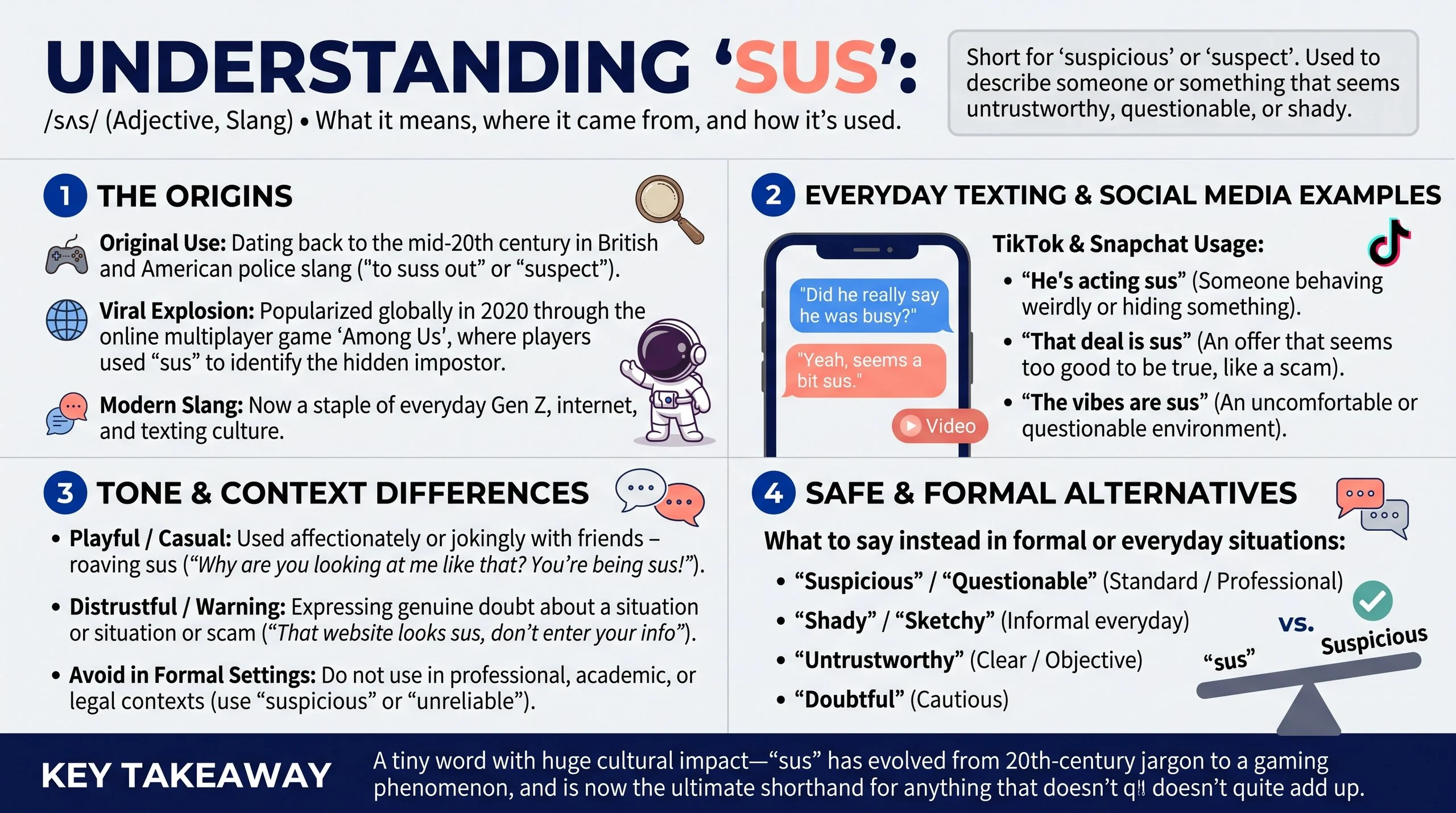
Sus means suspicious or suspect. People use it in casual internet slang when someone, something, or a situation seems questionable, dishonest, unusual, or difficult to trust. The term became especially popular through Among Us and social media.
Sus meaning is simple: it is casual slang for suspicious or, sometimes, suspect. However, the word can carry different levels of seriousness depending on the situation.
You might see it in a group chat, TikTok comment, Snapchat message, Instagram caption, gaming conversation, or casual text. For example, a friend might say, “That excuse is sus,” when your explanation sounds questionable.
The term became extremely popular during the rise of Among Us, where players regularly accused one another of acting suspiciously. Consequently, “sus” moved beyond gaming and became a common piece of internet vocabulary.
Today, people often use it playfully. Someone can call a friend sus without making a serious accusation. Still, context matters. The same word can sound funny among friends but judgmental in a professional conversation.
This guide explains the slang in detail. You will learn its meaning, history, tone, social use, platform differences, common misunderstandings, and natural ways to respond.
Quick Answer Box
| Meaning | Context | Primary Platforms | Example | Tone |
| Suspicious or questionable | Casual conversations | TikTok, Snapchat, Instagram, texting, gaming | “That story sounds sus.” | Playful, skeptical, teasing |
What Does sus mean?
The sus meaning usually refers to something that seems suspicious, questionable, doubtful, or potentially dishonest.
The word is a shortened form of “suspicious.” In some contexts, it can also connect to “suspect.” However, modern internet users generally understand it as an informal way to describe questionable behavior.
For example:
“Why did you suddenly leave the group chat? That’s sus.”
Here, the speaker does not necessarily claim that the person did something wrong. Instead, they are expressing doubt about the behavior.
Another example is:
“This website looks sus.”
That statement suggests the website appears untrustworthy or unusual.
The Basic Definition
At its core, the term communicates suspicion.
| Expression | Meaning |
| “That’s sus.” | That seems suspicious. |
| “You’re acting sus.” | Your behavior seems questionable. |
| “This looks suspicious.” | This looks unusual or untrustworthy. |
| “That excuse is sus.” | That explanation seems doubtful. |
| “Why are you being sus?” | Why are you acting suspiciously? |
The important point is that the slang does not automatically mean “guilty.”
Someone can appear suspicious without actually doing anything wrong. Therefore, the word often describes appearance or perception, not proven facts.
Is It Short for Suspicious?
Yes. In modern slang, “sus” is widely recognized as a shortened form of “suspicious.”
However, the abbreviation itself is not completely new. Informal uses of “sus” existed before its massive internet popularity. The gaming community, especially through Among Us, helped push the word into mainstream online culture.
Why Did the Word Become So Popular?
The biggest cultural boost came from Among Us, a multiplayer social deduction game released by InnerSloth.
In the game, players try to identify hidden impostors. Suspicious behavior becomes central to gameplay. As players discussed who looked suspicious, “sus” became a convenient shorthand.
The word then spread through memes, Twitch, YouTube, TikTok, Discord, Instagram, and everyday texting.
As a result, many people who have never played Among Us still understand the expression.
Contextual Dynamics and Nuances of the Term
Context changes the emotional meaning.
A person saying “You’re sus 😂” may simply be joking. Meanwhile, “That company seems sus” can communicate genuine distrust.
Therefore, reading the surrounding conversation matters.
Playful Suspicion
Among friends, the expression often works as teasing.
“You ate the last slice and said you didn’t? Sus.”
The speaker probably is not making a serious accusation. They are simply joking about obvious behavior.
Genuine Doubt
The term can also express real concern.
“That payment link looks suspicious. I wouldn’t click it.”
Here, the speaker is using casual language to communicate caution.
Mild Accusation
Sometimes the word sits between humor and seriousness.
“You knew about the surprise party and didn’t tell me. Very sus.”
The speaker suspects the person knows more than they are admitting.
Internet Humor
Online, the word can become deliberately exaggerated.
“Bro disappeared for three hours and came back with a sandwich. Sus.”
The humor comes from treating ordinary behavior as if it were evidence in a mystery.
Tone Depends on Relationship
The same sentence can feel completely different depending on who says it.
| Situation | Likely Interpretation |
| Close friends | Teasing |
| Gaming group | Suspicion |
| TikTok comments | Humor or meme language |
| Romantic conversation | Playful doubt |
| Workplace | Usually too informal |
| Safety discussion | Possible genuine concern |
| Argument | Potential accusation |
Consequently, the word is highly flexible.
Real Life Conversation Examples Using sus meaning
Understanding the sus meaning becomes easier when you see how people actually use the word.
Example 1: Friend Cancels Plans
Alex: “He said he forgot we had plans.”
Jordan: “After confirming twice? That’s sus.”
Here, “sus” means the explanation seems questionable.
Example 2: Gaming Conversation
- Player 1: “Why were you standing next to the body?”
- Player 2: “I was checking the room.”
- Player 3: “Bro, that’s sus.”
The word fits naturally because suspicion is central to social deduction games.
Example 3: Group Chat
Maya: “Who ate my cookies?”
Chris: “Not me.”
Maya: “You literally have crumbs on your shirt. Sus.”
This use is playful and obvious.
Example 4: Online Shopping
Sam: “I found these headphones for five dollars.”
Taylor: “Five dollars? That price is sus.”
The speaker means the deal seems unusually good or potentially unreliable.
Example 5: Romantic Conversation
Ava: “Who were you texting at midnight?”
Noah: “Nobody important.”
Ava: “Hmm. Sus.”
The word communicates playful suspicion. Depending on the relationship, it could also signal genuine concern.
What These Examples Have in Common
In every case, the word points toward something questionable.
However, the emotional intensity changes. Sometimes it means “funny.” Sometimes it means “I do not believe you.” Other times, it means “Be careful.”
That flexibility explains much of its popularity.
Platform Specific Breakdown
Internet slang changes slightly from platform to platform. The core definition stays stable, but the surrounding tone can shift.
How It Is Used on Snapchat
Snapchat conversations are often quick, informal, and personal. Therefore, the term commonly appears in short messages.
Examples include:
“Why did you delete that snap? Sus.”
“Who were you with? 👀 Sus.”
“That excuse is sus lol.”
On Snapchat, the expression can easily become teasing between friends.
Emojis also influence the tone.
| Message | Likely Tone |
| “That’s sus 😂” | Playful |
| “That’s sus 👀” | Curious or suspicious |
| “You’re sus 😭” | Humorous |
| “That seems suspicious.” | More serious |
| “Very sus…” | Suspicious or teasing |
Because Snapchat messages are often conversational, the word rarely needs a formal explanation.
The Role of sus meaning on TikTok
TikTok helped turn many slang terms into mainstream vocabulary. The expression frequently appears in comments, captions, memes, skits, gaming content, and reaction videos.
A TikTok comment might say:
“Bro knew exactly what he was doing. Sus.”
“That transition was sus 😂.”
“Why is nobody talking about this? Sus.”
The meaning can become intentionally exaggerated for entertainment.
TikTok users may also combine the word with familiar internet expressions.
For example:
“Bro is looking for extra sus today.”
“That explanation is giving us.”
“Something about this feels sad.”
The exact wording changes, but the underlying idea remains suspect.
Instagram and Texting Dynamics
Instagram comments often use the term as a reaction.
Someone posts a mysterious photograph, and a friend comments:
“Okayyy, this is sus 👀.”
In direct messages, the word usually feels more personal.
For example:
“You said you were sleeping, but you just posted a story. Sus.”
Texting follows a similar pattern.
Because text lacks facial expressions and vocal tone, emojis can help communicate whether the message is serious or playful.
Discord and Gaming Communities
Gaming communities played a major role in popularizing the word.
On Discord, players may use it during matches, voice chats, memes, or casual conversations.
“You left the room right before the body was found. Sus.”
The expression works especially well because gaming conversations often require quick reactions.
Workplace Communication
Using slang at work requires caution.
A message like:
“That deadline change is sus.”
could sound overly casual or even disrespectful.
A more professional alternative would be:
“That change raises some concerns.”
Instead, the slang works better in informal conversations with coworkers who already communicate casually.
Alternative Meanings and NLP Variations of the Phrase
The central idea remains suspect, but several related expressions communicate similar concepts.
| Expression | Meaning | Typical Tone |
| Suspicious | Something seems questionable | Neutral |
| Questionable | Something deserves doubt | Neutral |
| Shady | Something seems dishonest | Informal |
| Sketchy | Something seems unsafe or unreliable | Informal |
| Fishy | Something does not seem right | Informal |
| Dubious | Something seems difficult to believe | Formal |
| Untrustworthy | Something lacks reliability | Direct |
| Strange | Something seems unusual | Neutral |
| Odd | Something does not seem normal | Neutral |
| Sketch | Something appears questionable | Very informal |
These words are not perfect replacements in every situation.
For example, “sus” often carries a playful internet tone. “Dubious” sounds much more formal. “Shady” can imply dishonest behavior more strongly.
Sus Versus Suspicious
“Suspicious” is the standard English word.
“Sus” is casual slang.
Compare:
“The situation seems suspicious.”
with:
“This situation seems serious.”
The first sentence works in professional writing. The second belongs more naturally in casual digital communication.
Sus Versus Shady
These expressions overlap, but they are not identical.
“Shady” often suggests dishonest or unethical behavior. “Sus” can be much lighter.
Someone can act sus without necessarily being shady.
Sus Versus Sketchy
“Sketchy” often describes something that feels unsafe, unreliable, or questionable.
For example:
“That neighborhood looks sketchy.”
“Sus” can describe people, explanations, actions, posts, prices, and situations more broadly.
Misinterpretations: When NOT to Use sus meaning
Knowing when not to use slang is just as important as knowing what it means.
The sus meaning can sound humorous in one setting and insulting in another. Therefore, consider your audience first.
Formal Writing
Avoid slang in academic essays, legal documents, formal reports, and most professional correspondence.
Instead of:
“The numbers look suspicious.”
write:
“The numbers appear questionable.”
Serious Accusations
Avoid using the term when discussing serious allegations.
Calling someone’s behavior “sus” can make a serious issue sound trivial.
For sensitive situations, use precise language.
Instead of:
“His behavior is sus.”
you might say:
“His behavior raises serious concerns.”
Sensitive Personal Conversations
If someone is worried, upset, or explaining a difficult situation, jokingly calling them sus may feel dismissive.
Tone matters more than slang knowledge in these situations.
Professional Customer Service
Customer service communication should usually favor clear language.
Instead of:
“That charge is sus.”
say:
“I noticed a charge that I do not recognize.”
The second version communicates the issue without ambiguity.
How to Respond in Chat Comfortably
Someone may call you sus as a joke, tease, or genuine accusation. Your response should match the situation.
Funny Responses
If the conversation is clearly playful, you can respond with humor.
“Caught me lacking.”
“Okay, detective.”
“You have no evidence.”
“Allegations.”
“Objection.”
These replies keep the interaction light.
Casual Responses
If you want to stay relaxed, try:
“Why though?”
“What did I do?”
“Explain yourself.”
“Fair enough.”
“Maybe a little.”
These responses invite the other person to explain their suspicion.
Flirty Responses
In a playful romantic conversation, you could say:
“Only around you.”
“Maybe you bring it out of me.”
“You seem interested in finding out.”
“Can you blame me?”
However, make sure the relationship already supports that kind of teasing.
When You Actually Did Something Suspicious
Sometimes the accusation has a reasonable basis.
You can simply acknowledge it.
“Okay, that does look bad.”
“Fair point.”
“I see why you think that.”
“Yeah, that sounded worse than I meant.”
A calm response often works better than becoming defensive.
When Someone Is Being Too Serious
If the accusation feels unfair, you can ask for clarification.
“What exactly seems suspicious?”
“Why does it look that way?”
“I think there’s a misunderstanding.”
This shifts the conversation from accusation toward explanation.
Why Internet Slang Changes So Quickly
The popularity of slang follows online culture.
A word can begin in a small community, become a meme, spread across platforms, and eventually enter everyday speech.
That process happened with “sus.”
Gaming culture gave the word enormous visibility. Social media then amplified it.
From Shortened Word to Cultural Expression
Shortened words are useful online because they save time.
“Suss” or “suspicious” requires more effort than “sus.” More importantly, the shortened form developed its own personality.
It became associated with humor, memes, reaction culture, gaming, and playful suspicion.
Consequently, the word is now more than a simple abbreviation.
Why Short Slang Works Online
Digital conversations favor speed.
People communicate through:
| Format | Why Slang Works |
| Text messages | Fast and expressive |
| Comments | Short reactions |
| Memes | Easy to recognize |
| Gaming chat | Quick communication |
| TikTok | Highly shareable |
| Snapchat | Casual conversation |
| Discord | Community based communication |
Slang also creates a sense of belonging. People who understand a term immediately recognize the cultural reference.
Tone, Emotion, and Social Meaning
The same expression can communicate different emotions.
Consider:
“You’re sus.”
Without context, that sentence is ambiguous.
It could mean:
- “You are acting suspiciously.”
- “You are being funny.”
- “I do not believe you.”
- “I am teasing you.”
- “Something about this situation seems strange.”
The surrounding conversation provides the missing information.
Emoji Effects
Emojis can strongly change interpretation.
| Message | Possible Feeling |
| “You’re sus 😂” | Friendly teasing |
| “You’re sus 👀” | Curiosity |
| “You’re sus 😭” | Humorous disbelief |
| “You’re sus.” | Direct suspicion |
| “Very sus…” | Stronger doubt |
Therefore, punctuation and emojis matter.
Common Mistakes With the Slang
Even native speakers can misuse internet slang.
Mistake 1: Treating It as Proof of Guilt
Being called sus does not mean someone is guilty.
The expression communicates suspicion, not evidence.
Mistake 2: Using It Everywhere
Slang works best when the context supports it.
Using internet slang in every sentence can make your writing feel forced.
Mistake 3: Ignoring Audience
A close friend may understand the joke immediately. A manager, professor, client, or older relative may not.
Audience awareness improves communication.
Mistake 4: Confusing Suspicion With Serious Accusation
Calling something suspicious is not automatically the same as accusing someone of wrongdoing.
However, repeated accusations can create tension.
Mistake 5: Assuming Everyone Knows the Reference
Although the expression is widely recognized, not every person uses internet slang.
If clarity matters, choose the full word “suspicious.”
When Someone Says You Are Sus
Being called sus does not require one universal response.
First, identify the tone.
- If they are joking, joke back.
- If they are genuinely concerned, explain yourself.
- If they are accusing you unfairly, ask what caused the suspicion.
For example:
| Situation | Good Response |
| Friend joking | “You caught me.” |
| Someone teasing | “Where’s your evidence?” |
| Genuine concern | “What seems suspicious?” |
| Misunderstanding | “Let me explain.” |
| Serious accusation | “I understand why it looks that way, but here’s what happened.” |
This approach keeps the conversation natural without escalating it.
Is sus Positive or Negative?
The term is usually neutral to negative, but its emotional impact depends heavily on context.
Among friends, it can be affectionate teasing.
In a serious conversation, it can communicate distrust.
Therefore, there is no single emotional value attached to the word.
| Context | Emotional Effect |
| Meme | Funny |
| Gaming | Suspicious |
| Friendship | Teasing |
| Dating | Playfully doubtful |
| Workplace | Potentially unprofessional |
| Serious dispute | Accusatory |
The relationship between speakers matters greatly.
Is Asus Still Popular?
Yes, the expression remains recognizable in online communication.
However, slang popularity constantly changes. Some expressions become less fashionable while remaining understandable.
The word has strong cultural recognition because its popularity was tied to gaming and social media rather than a single short lived meme.
That gives it more staying power than many temporary internet expressions.
Still, younger users may combine it with newer slang, memes, and platform specific expressions.
Frequently Asked Questions
What does sus meaning refer to in texting?
The sus meaning in texting is usually “suspicious” or “questionable.” A person may use it when they doubt an explanation, notice unusual behavior, or simply want to tease someone.
Is sus a real English word?
Sus is widely used as informal internet slang. It comes from shortened forms associated with “suspicious” and “suspect.” It is not normally appropriate for formal English writing.
Why do people say sus?
People say it because it is short, recognizable, and expressive. It can communicate doubt without sounding as formal as “suspicious.” In many conversations, it also adds humor.
Did Among Us create the word?
No. The shortened form existed before Among Us. However, the game played a major role in making the expression extremely popular worldwide. Gaming culture then helped carry it into mainstream social media.
What does sus mean on TikTok?
On TikTok, the word usually means suspicious, questionable, or unusual. However, creators and commenters frequently use it humorously or exaggerate suspicion for entertainment.
What does sus mean on Snapchat?
On Snapchat, it commonly means suspicious. Friends may use it to tease one another about messages, photos, plans, excuses, or unusual behavior.
Is calling someone so rude?
It can be rude depending on context. Among close friends, it is often harmless teasing. In a serious or professional setting, however, it may sound accusatory or disrespectful.
What is the difference between sus and suspicious?
“Suspicious” is the standard English word. “Sus” is an informal shortened version used mostly in casual digital communication. The meaning overlaps, but the tone differs.
Can sus be used in a professional conversation?
It is better to avoid it in formal professional communication. Words such as “questionable,” “concerning,” “unusual,” or “unclear” usually communicate the same idea more professionally.
What should I say when someone calls me sus?
Your response should match their tone. If they are joking, you can joke back. If they seem serious, ask what seems suspicious. A simple “What did I do?” can work in many casual conversations.
Conclusion
The sus meaning is straightforward: something or someone appears suspicious, questionable, or unusual. However, its emotional meaning changes with context.
The word became especially prominent through Among Us, then spread across TikTok, Snapchat, Instagram, Discord, gaming communities, memes, and everyday texting. Today, people often use it as a playful shorthand rather than a serious accusation.
Still, context matters. Use the slang freely with friends when the tone is casual. For professional or sensitive conversations, choose clearer language such as “suspicious,” “questionable,” or “concerning.”
Ultimately, understanding slang is less about memorizing definitions and more about recognizing tone, audience, culture, and intent. That is what makes short internet expressions work so effectively in modern conversation.