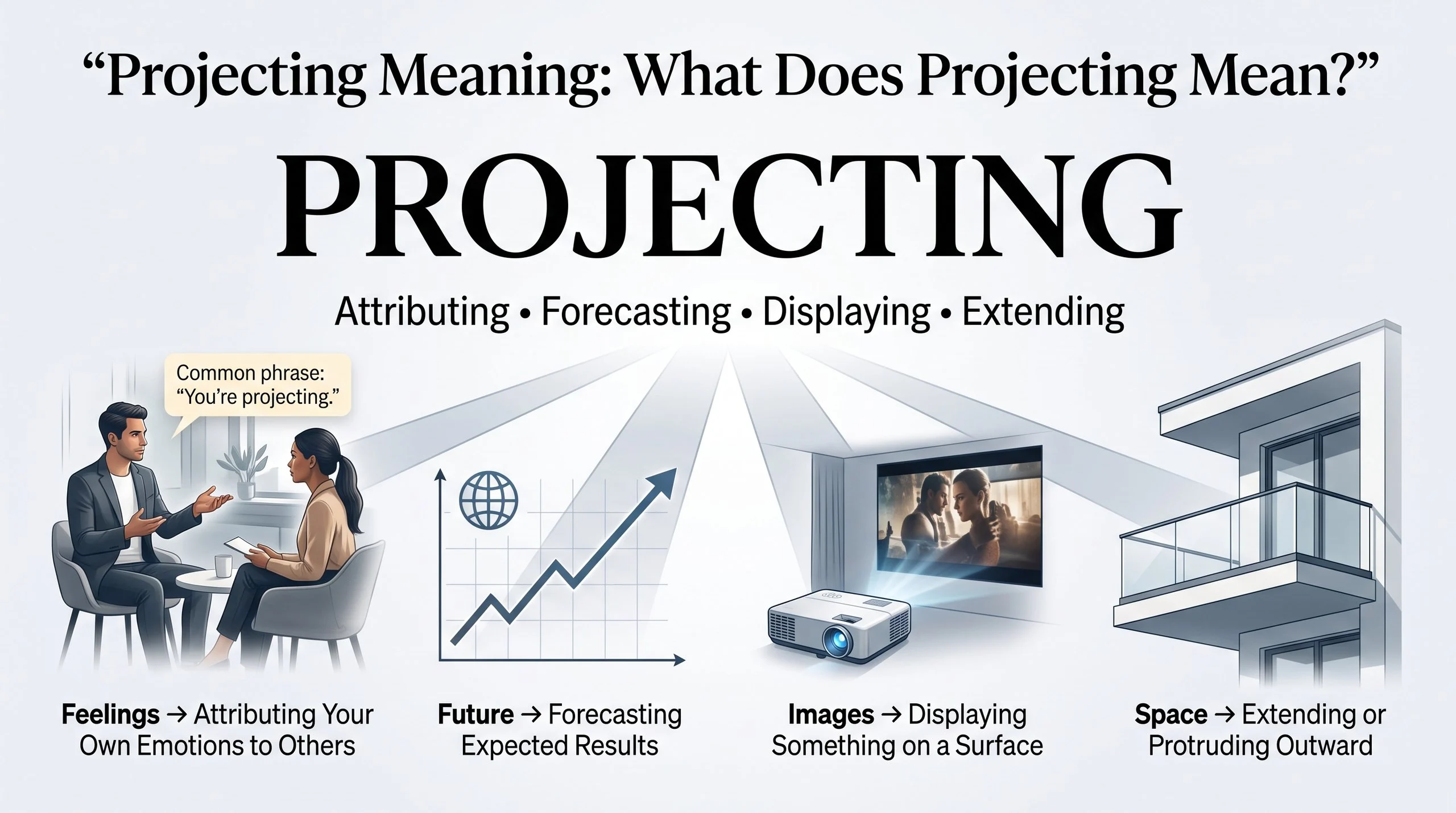
Projecting usually means placing your own feelings, thoughts, fears, or qualities onto another person. In everyday language, it can also mean estimating something for the future or displaying an image onto a surface. The meaning depends on the context.
Projecting meaning can vary depending on how the word appears in a sentence. Most commonly, projecting describes attributing your own feelings, thoughts, motives, or traits to someone else. For example, someone who feels insecure might accuse another person of being insecure. In psychology, this behavior is known as projection.
However, projecting has several other meanings. A business may be projecting higher sales next year. A designer may be projecting an image onto a screen. Someone can also be physically projecting something outward from a surface.
Therefore, understanding the context matters. The word can describe an emotional reaction, a prediction about the future, or the act of sending something outward.
This guide explains the meaning of projecting in clear, simple English. It also covers psychological projection, everyday examples, texting and social media usage, related words, common misunderstandings, and practical examples.
Quick Answer
| Meaning | Context | Primary Platforms | Example | Tone |
|---|---|---|---|---|
| Attributing your own feelings or traits to someone else | Psychology and relationships | Texting, social media, conversation | “You’re projecting your insecurity onto me.” | Critical |
| Estimating a future result | Business, finance, planning | Work, reports, news | “Sales are projecting to increase.” | Professional |
| Sending or displaying something outward | Technology and physical space | Presentations, media, design | “The projector is projecting the image.” | Neutral |
| Extending outward | Physical description | General English | “The balcony is projecting from the building.” | Descriptive |
What Does Projecting Mean?
Projecting is the present participle of the verb project. Its meaning changes according to the situation.
In emotional or psychological contexts, projecting means attributing your own feelings, attitudes, fears, or characteristics to another person.
For example:
“You’re projecting your insecurity onto me.”
The speaker means that the other person may be dealing with insecurity themselves and is incorrectly assuming that the speaker feels the same way.
In another context, projecting can mean predicting or estimating a future result.
For example:
“The company is projecting a 15% increase in revenue.”
Here, projecting means expecting or forecasting a future result.
The word can also describe sending an image, sound, or light outward.
For instance:
“The projector is projecting the presentation onto the screen.”
So, the surrounding words usually tell you which meaning applies.
Projecting Meaning in Psychology
One of the most common modern uses of projecting appears in psychology and relationship discussions.
Psychological projection occurs when a person attributes their own unwanted feelings, thoughts, impulses, or characteristics to someone else.
For example, imagine someone who feels jealous but repeatedly accuses their partner of being jealous. The accusation may reflect the person’s own emotional state rather than the partner’s actual behavior.
Another example involves dishonesty. Someone who frequently lies might constantly suspect others of lying.
In casual conversation, people often shorten this idea to:
“You’re projecting.”
That statement usually means:
“You’re putting your own feelings or behavior onto me.”
However, the phrase should not automatically be treated as a psychological diagnosis. People can misunderstand situations, disagree, or make unfair assumptions without engaging in a formal psychological process.
What Does “Stop Projecting” Mean?
“Stop projecting” usually means:
“Stop attributing your own feelings, insecurities, motives, or behavior to me.”
For example:
“You keep saying I’m jealous, but you’re the one checking everyone’s messages. Stop projecting.”
The phrase is common in arguments, relationship conversations, online discussions, and social media debates.
Its tone can range from mildly corrective to openly confrontational.
Projecting vs. Simply Making an Assumption
These ideas can look similar, but they are not exactly the same.
An assumption occurs when someone reaches a conclusion without enough evidence.
Projection specifically involves attributing your own internal experience or characteristics to another person.
Consider these examples:
- “I think she’s upset because she didn’t respond.” → Assumption
- “You’re upset because you can’t handle criticism.” → Could be projection if the speaker is attributing their own difficulty with criticism to someone else.
- “I know you’re jealous because I would feel jealous in your situation.” → Potential projection
Therefore, projection involves more than simply guessing.
Why Do People Say “You’re Projecting”?
People often use this phrase when they believe another person is judging them based on their own emotions or behavior.
For example:
“You think I’m trying to compete with you, but you’re projecting.”
The speaker is suggesting that the other person may actually be competitive themselves.
This phrase appears frequently during disagreements because people naturally interpret situations through their own experiences.
For example, a person who expects betrayal may become suspicious of innocent behavior. Likewise, someone who worries about rejection may interpret a short message as a sign of anger.
Still, calling something projection does not automatically make the accusation correct. Both people may have different interpretations of the situation.
Real-Life Examples of Projecting
1. In Relationships
“He accused me of flirting with everyone, but he was the one constantly flirting. I think he was projecting.”
Here, the speaker believes the accusation reflected the other person’s behavior.
2. Between Friends
“You’re calling me irresponsible because you forgot about the plans.”
The friend may be suggesting that the other person’s criticism reflects their own behavior.
3. At Work
“My manager keeps saying that I don’t trust the team. I wonder if she’s projecting her own concerns.”
This example uses projecting more cautiously. The speaker is suggesting a possibility rather than stating it as fact.
4. During an Online Argument
“You seem really angry about this. Are you projecting?”
Online, the word often appears when people believe someone is transferring their own emotional reaction onto another person.
5. In Family Conversations
“My parents keep saying I’m afraid to fail, but I’m not. It feels like they’re projecting their own fears onto me.”
This example shows how projection can occur in family relationships.
Five Natural Conversation Examples
Example 1: Relationship Argument
Alex: Why are you always worried that I’m talking to someone else?
Jordan: Because you act differently lately.
Alex: I think you’re projecting your own insecurity onto me.
Jordan: Maybe I need to think about that.
Here, projecting refers to transferring one’s insecurity onto another person.
Example 2: Friendship
Mia: You think I’m trying to compete with you.
Emma: It feels that way sometimes.
Mia: Honestly, I think you’re projecting. I’m happy for you.
The word suggests that Emma may be interpreting Mia’s behavior through her own competitive feelings.
Example 3: Online Discussion
User 1: You’re clearly angry because you can’t handle criticism.
User 2: I’m not angry. You’re projecting.
The response means the second person believes the first person’s accusation reflects their own emotional reaction.
Example 4: Workplace
Manager: You seem worried that everyone is judging your work.
Employee: Maybe. I’ve been stressed lately.
Manager: I understand.
This conversation demonstrates that projection should not be assumed automatically. Sometimes a person genuinely feels what they are accused of feeling.
Example 5: Casual Conversation
Sam: You think everyone dislikes you.
Chris: Maybe that’s because I notice how people react.
Sam: Or maybe you’re projecting what you feel about yourself onto them.
This example uses projecting in a more reflective way.
Projecting Meaning in Texting
In texting, projecting most often appears during disagreements or emotionally charged conversations.
A person might text:
- “You’re projecting.”
- “Stop projecting your insecurities onto me.”
- “That’s your fear talking. You’re projecting.”
- “You’re projecting your experience onto mine.”
- “I think you’re projecting right now.”
Because text messages lack facial expressions and vocal tone, the word can sound especially confrontational.
For that reason, context matters.
A message such as “You’re projecting” may sound like a calm observation between close friends. During an argument, however, it can sound dismissive or accusatory.
Projecting Meaning on Social Media
On social media, projecting often appears in comments and debates.
Someone may respond to criticism with:
“You’re projecting.”
The person usually means that the critic is attributing their own insecurity, jealousy, anger, or motivation to someone else.
The term has become popular because it provides a short way to challenge another person’s interpretation.
However, online conversations can make the word easy to misuse. Calling every disagreement “projection” can shut down meaningful discussion.
A disagreement is not automatically projection.
How Projecting Is Used on Snapchat
On Snapchat, projecting usually appears in private chats rather than as a formal definition.
For example:
“Why do you think I’m mad at you? You’re projecting.”
The word can also appear in conversations about dating, friendships, jealousy, or personal insecurities.
Because Snapchat conversations are often informal, users may use projecting without intending the technical psychological meaning.
Instead, they may simply mean:
“You’re assuming I feel the same way you do.”
The Role of Projecting on TikTok
TikTok has helped popularize psychological vocabulary in everyday conversation.
Users may discuss relationships, boundaries, emotional behavior, and self-awareness while using words such as projection, projecting, and projecting your insecurities.
For example:
“When someone accuses you of doing something they secretly do, that’s projection.”
However, social media explanations can simplify psychological concepts. Therefore, the everyday meaning of projecting may be broader than the formal psychological definition.
When you see the term in a TikTok caption or comment, check the surrounding context before assuming it refers to a clinical concept.
Instagram and Texting Dynamics
On Instagram, projecting can appear in captions, comments, direct messages, and relationship discussions.
For example:
“Some people criticize what they secretly struggle with. Don’t take the projection personally.”
In texting, the word is usually shorter and more direct:
“You’re projecting.”
The tone depends heavily on the conversation.
A playful exchange might make it harmless. A serious argument can make it sound like an accusation.
Projecting Meaning in Business
Projecting has a completely different meaning in business.
Here, projecting often means forecasting or estimating a future outcome.
For example:
“The company is projecting strong growth next year.”
This means the company expects growth based on available information, trends, or financial analysis.
Common business expressions include:
- projecting revenue
- projecting expenses
- projecting sales
- projecting growth
- projecting demand
- projecting profits
- projecting future costs
In this context, projecting has nothing to do with emotional projection.
Example
“The company is projecting $5 million in revenue next year.”
The company is making a forecast about future revenue.
Projecting Meaning in Finance
Financial analysts frequently use projecting when discussing future performance.
For example:
“Analysts are projecting higher earnings for the next quarter.”
Here, projecting means forecasting.
The prediction may come from historical data, market conditions, economic trends, company performance, or other evidence.
Related terms include:
- forecasting
- estimating
- predicting
- anticipating
- calculating
- modeling
Therefore, if you see projecting next to words such as revenue, earnings, sales, costs, or growth, it probably refers to a financial forecast.
Projecting Meaning in Technology
In technology, projecting can mean displaying something from one device or surface onto another.
For example:
“The laptop is projecting the presentation onto the wall.”
A projector can send light through an optical system to create an enlarged image on a screen or surface.
This meaning is especially common in:
- classrooms
- offices
- theaters
- presentations
- home entertainment
- digital displays
In this context, projecting means casting or displaying outward.
Projecting Meaning in Physical Space
Projecting can also describe something that extends outward from a surface.
For example:
“The balcony is projecting several feet from the building.”
Here, projecting means sticking out, extending, or protruding.
Other examples include:
- “The roof is projecting over the entrance.”
- “A branch was projecting from the wall.”
- “The platform projects over the water.”
This usage is more formal than the psychological meaning.
Alternative Meanings and Related Uses
The word projecting can have several meanings depending on its surrounding vocabulary.
Projecting Feelings
This means attributing your own emotions to someone else.
“You’re projecting your fear onto me.”
Projecting a Future Result
This means estimating or forecasting something.
“The company is projecting higher profits.”
Projecting an Image
This means displaying an image onto a surface.
“The device is projecting the video onto the screen.”
Projecting Outward
This means extending beyond a surface.
“The structure is projecting from the wall.”
These meanings share the general idea of something being placed, extended, or directed outward, but their practical uses differ.
Synonyms for Projecting
The best synonym depends on the intended meaning.
When Projecting Means Attributing Feelings
Useful alternatives include:
- attributing
- transferring
- imposing
- assigning
- externalizing
Example:
“She was attributing her fears to other people.”
When Projecting Means Predicting
Useful alternatives include:
- forecasting
- predicting
- estimating
- anticipating
- calculating
- expecting
Example:
“The company is forecasting higher sales.”
When Projecting Means Displaying
Useful alternatives include:
- displaying
- casting
- showing
- beaming
- presenting
Example:
“The projector is displaying the image.”
When Projecting Means Extending
Useful alternatives include:
- protruding
- extending
- sticking out
- jutting
- overhanging
Example:
“The roof extends beyond the wall.”
Projecting vs. Assuming
These words are related, but they are not interchangeable.
Assuming means accepting something as true without sufficient proof.
Projecting means attributing your own internal feelings, traits, motives, or experiences to another person.
For example:
“I assumed she was angry.”
This simply describes a guess.
“She thinks everyone is angry because she is angry herself.”
This may describe projection.
Therefore, projection can involve an assumption, but not every assumption is projection.
Projecting vs. Gaslighting
These terms are sometimes confused online.
Projecting involves attributing your own feelings or characteristics to another person.
Gaslighting involves manipulating someone in a way that causes them to question their own memory, perception, or understanding of reality.
For example:
“You’re jealous.”
If the speaker is actually jealous themselves, that could be projection.
By contrast, repeatedly denying something that happened and deliberately making another person doubt their memory could involve gaslighting.
The two concepts can overlap in some situations, but they are not synonyms.
Projecting vs. Deflecting
Deflecting means shifting attention away from yourself or a difficult issue.
For example:
“Why are you asking me about my mistake? What about yours?”
That response may be deflection.
Projecting focuses on transferring one’s own feelings or characteristics onto someone else.
For example:
“You’re irresponsible.”
If the person making the accusation is avoiding recognition of their own irresponsibility, projection may be involved.
Again, context matters.
Misinterpretations: When NOT to Use Projecting
Not every disagreement is projection.
Using the term too quickly can weaken an argument because it may replace evidence with an accusation.
1. Do Not Use It for Every Criticism
Someone criticizing your behavior is not automatically projecting.
They may have a legitimate concern.
2. Do Not Assume You Know Someone’s Inner Feelings
You cannot always determine whether another person’s accusation comes from their own insecurity.
Use cautious language when appropriate.
Instead of:
“You’re definitely projecting.”
You might say:
“I wonder if your own experience is influencing how you’re interpreting this.”
3. Do Not Confuse It With Prediction
In business, projecting usually means forecasting.
“We’re projecting higher sales.”
This has nothing to do with psychological projection.
4. Do Not Use It as a Shortcut to Win an Argument
Calling someone a projector does not automatically prove your position.
A strong conversation still requires evidence, listening, and context.
How to Respond When Someone Says “You’re Projecting”
Your response depends on the situation.
Calm Response
“What makes you think I’m projecting?”
This invites the other person to explain their reasoning.
Reflective Response
“That’s possible. Let me think about whether my own feelings are affecting my judgment.”
This works when you genuinely want to examine your reaction.
Direct Response
“I understand your point, but I’m responding to what you actually said, not projecting my feelings onto you.”
This keeps the conversation focused.
Clarifying Response
“Can you give me an example of what you think I’m projecting?”
A specific example can make the conversation more productive.
Common Mistakes With the Word Projecting
Mistake 1: Treating It as Only a Psychological Term
Projecting has several meanings.
Business, technology, architecture, and everyday English all use the word differently.
Mistake 2: Assuming “Projecting” Always Means Something Negative
Psychological projection can be discussed negatively, but projecting itself is not inherently negative.
For example:
“The company is projecting strong growth.”
That sentence has a positive and professional meaning.
Mistake 3: Confusing Projecting With Predicting
Predicting specifically refers to anticipating a future event.
Projecting can mean predicting in business contexts, but it can also describe several other actions.
Mistake 4: Using “Projection” and “Projecting” Interchangeably in Every Sentence
They are closely related, but grammar matters.
For example:
“That is projection.”
and
“You are projecting.”
Both can be correct, but they serve different grammatical roles.
Is Projecting Always Intentional?
No.
Psychological projection does not necessarily require deliberate deception.
A person may genuinely believe their interpretation of another person’s behavior.
For example, someone who feels insecure may sincerely believe another person is judging them.
That does not necessarily mean they consciously decided to transfer their insecurity.
Therefore, the word can describe an emotional pattern without implying deliberate manipulation.
Is “You’re Projecting” an Insult?
It can be.
The phrase itself is not inherently an insult. However, its tone often depends on the situation.
During a calm conversation, it may encourage self-reflection.
During an argument, it can sound dismissive or accusatory.
For example:
“I think you may be projecting some of your past experiences onto this situation.”
sounds more neutral than:
“You’re just projecting.”
The second version is much more direct.
FAQs
1. What does projecting mean?
Projecting usually means attributing your own feelings, thoughts, insecurities, or characteristics to another person. In other contexts, it can mean forecasting a future result or displaying something outward.
2. What does “you’re projecting” mean?
“You’re projecting” usually means “You’re attributing your own feelings, motives, fears, or behavior to me.”
3. Is projecting the same as assuming?
No. Assuming means reaching a conclusion without enough evidence. Projecting specifically involves transferring your own internal feelings, traits, or experiences onto another person.
4. What does projecting mean in psychology?
In psychology, projection refers to attributing one’s own unwanted feelings, thoughts, impulses, or characteristics to another person.
5. Is projecting always bad?
No. The word itself is neutral. Psychological projection can create misunderstandings, but projecting can also mean forecasting or displaying something.
6. What is an example of projecting?
Someone who feels jealous may accuse another person of being jealous. If the accusation reflects the speaker’s own emotional state, it may be an example of projection.
7. What is another word for projecting?
Depending on the context, alternatives include attributing, transferring, forecasting, predicting, estimating, displaying, casting, extending, and protruding.
8. What does projecting mean in business?
In business, projecting usually means forecasting or estimating a future result, such as revenue, sales, expenses, or growth.
9. What does projecting mean in technology?
In technology, projecting can mean displaying an image or video onto another surface, such as a projector displaying a presentation on a screen.
10. How do I know which meaning of projecting is intended?
Look at the surrounding words. Feelings and relationships usually indicate psychological projection. Revenue and growth suggest forecasting. Screens and images suggest displaying.
Key Takeaways
- Projecting has several meanings depending on context.
- In psychology, it means attributing your own feelings or traits to another person.
- “You’re projecting” usually challenges someone’s interpretation of another person’s behavior.
- In business, projecting often means forecasting future results.
- In technology, projecting can mean displaying an image onto a surface.
- In physical descriptions, projecting can mean extending or sticking outward.
- Projection is not automatically the same as assuming, deflecting, or gaslighting.
- Context is essential when interpreting the word.
Conclusion
Understanding projecting meaning becomes much easier when you look at the context surrounding the word. In relationships and online conversations, projecting usually refers to attributing your own emotions, insecurities, motives, or characteristics to another person. That is why phrases such as “You’re projecting” often appear during disagreements.
At the same time, projecting has completely different uses in other settings. A company can project future revenue, a device can project an image, and a structure can project outward from a surface. Therefore, the same word can describe emotional behavior, financial forecasting, technology, or physical space.
Ultimately, the most useful clue is the sentence itself. If the discussion involves feelings, projection may be psychological. If it involves sales or revenue, projecting probably means forecasting. If it involves a screen or image, it likely means displaying.
By recognizing these distinctions, you can understand projecting more accurately and use the word naturally in conversations, writing, professional communication, and online discussions.