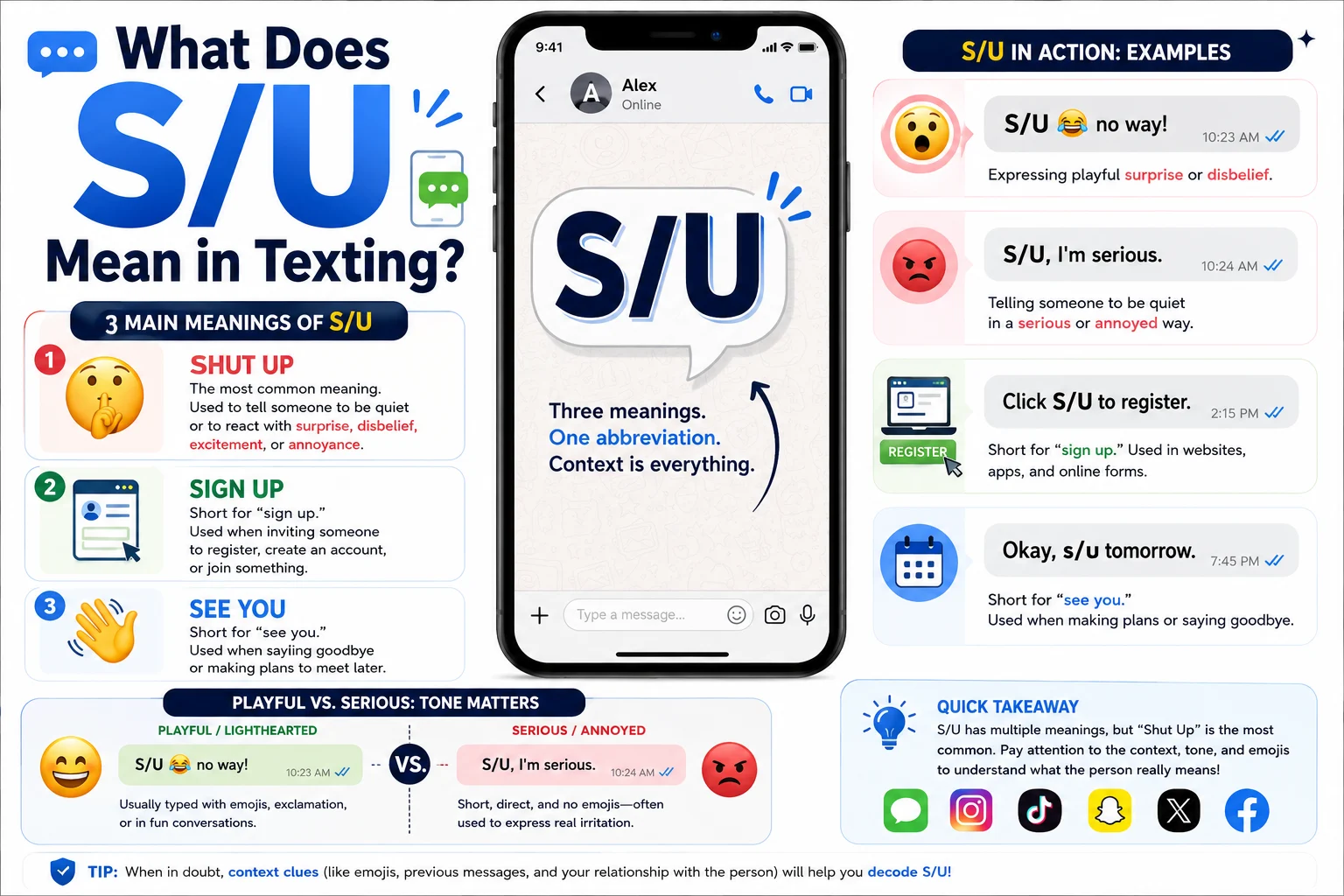
What does s/u mean? In texting and social media, S/U most commonly means “shut up.” Friends may use it seriously or playfully to express disbelief, surprise, excitement, or annoyance. In other contexts, it can also mean “sign up” or “see you.”
What does s/u mean is a common question when you encounter this abbreviation in texts, comments, Snapchat messages, or social media posts. In casual American texting, S/U usually means “shut up.” However, the intended meaning depends heavily on the conversation.
For instance, a friend might text, “S/U, you actually met him?” In this situation, the person probably expresses surprise rather than demanding silence. Similarly, someone might write, “S/U 😂” after hearing an unbelievable story. The phrase can therefore sound rude in one situation but playful in another.
Context matters because abbreviations remove much of the emotional information found in spoken conversation. A short message such as “s/u” does not show facial expression, volume, or body language. Consequently, punctuation, emojis, relationships, and surrounding messages can change the interpretation.
The abbreviation also has other meanings. On websites or in instructions, “S/U” may mean “sign up.” In some conversations, people may use it to represent “see you,” although this usage is less common.
This guide explains the major meanings, platform specific uses, conversational examples, tone differences, common mistakes, and appropriate responses.
QUICK ANSWER BOX
| Meaning | Context | Primary Platforms | Example | Tone |
|---|---|---|---|---|
| Shut up | Casual texting and slang | Snapchat, TikTok, Instagram, SMS | “S/U 😂 no way!” | Playful or rude |
| Sign up | Websites and instructions | Apps, websites, email | “Click S/U here” | Neutral |
| See you | Informal messages | Texting and chats | “S/U tomorrow” | Friendly |
| Surprise reaction | Friends and social media | Texting, comments | “S/U! You won?” | Excited |
| Disbelief | Casual conversations | Messaging apps | “S/U, seriously?” | Shocked |
WHAT DOES S/U MEAN?
The most common meaning of S/U is “shut up.”
In everyday American texting, people shorten “shut up” to “S/U” or “SU.” This abbreviation saves time and fits the quick style of digital communication.
Still, “shut up” does not always mean “stop talking.”
That distinction is important.
S/U as “shut up”
The literal expression “shut up” tells someone to stop speaking. Depending on the situation, it can sound commanding, annoyed, or insulting.
Consider this example:
“S/U and listen to me.”
The speaker probably wants silence.
Now compare it with:
“S/U! You got tickets?!”
Here, the sender probably means something closer to “No way!” or “Seriously?”
Therefore, the abbreviation can function as an emotional reaction instead of a direct command.
S/U as playful disbelief
Friends often use “S/U” when something sounds unbelievable.
For example:
“I just won $500.”
“S/U 😭”
The second person probably does not literally want the first person to stop talking. Instead, they are reacting to surprising information.
The intended message could be:
- “No way!”
- “Are you serious?”
- “I can’t believe it!”
- “You’re kidding!”
S/U as excitement
Exciting news can trigger the same response.
For example:
“S/U, you’re going to the concert?!”
The sender probably feels surprised and excited.
In this case, the phrase functions more like an enthusiastic reaction than an insult.
S/U as genuine annoyance
Sometimes, however, the abbreviation retains its literal meaning.
For example:
“S/U. I’m trying to study.”
Here, the speaker likely wants the other person to stop talking or messaging.
As a result, the surrounding context is essential.
THE DIFFERENCE BETWEEN “SHUT UP” AND PLAYFUL “S/U”
The same abbreviation can communicate very different emotions.
| Usage | Likely Meaning | Example | Tone |
|---|---|---|---|
| S/U right now | Stop talking | “S/U right now.” | Serious |
| S/U 😂 | I can’t believe you | “S/U 😂” | Playful |
| S/U!!! | That’s unbelievable | “S/U!!! You won?” | Excited |
| S/U, I’m busy | Stop bothering me | “S/U, I’m busy.” | Annoyed |
| S/U no way 😭 | That’s shocking | “S/U no way 😭” | Surprised |
| Bro, s/u 😂 | You’re joking | “Bro, s/u 😂” | Humorous |
The relationship between the speakers matters too.
A close friend may use “S/U” casually without causing offense. A stranger, coworker, teacher, or professional contact could interpret the same message as disrespectful.
Consequently, informal abbreviations require social awareness.
OTHER MEANINGS OF S/U
Although “shut up” is common in slang, it is not the only possible interpretation.
S/U meaning “sign up”
On websites, applications, and online services, “S/U” can stand for “sign up.”
For example:
“Click S/U to create your account.”
In this context, “shut up” obviously makes no sense.
The surrounding interface establishes the meaning.
You may encounter this abbreviation near:
- Account registration
- Membership forms
- Newsletters
- Online courses
- Subscription pages
- Event registration
Most modern websites simply use “Sign Up” instead of “S/U.” Therefore, this interpretation is more contextual than conversational.
S/U meaning “see you”
In some informal messages, S/U can represent “see you.”
For example:
“Okay, s/u tomorrow.”
The intended message would be:
“Okay, see you tomorrow.”
This usage exists, but it is less common than “shut up” in American texting slang.
Because of that ambiguity, using “S/U” to mean “see you” may confuse the recipient.
S/U in specialized contexts
Abbreviations can have technical or professional meanings as well.
A company, school, medical organization, or software platform may define its own abbreviation.
Therefore, the environment should always be considered.
A message from a friend is different from a button on a website or an abbreviation inside a technical document.
CONTEXTUAL DYNAMICS & NUANCES
Understanding slang requires more than translating letters.
Digital communication relies heavily on context.
The role of punctuation
Compare these messages:
“s/u”
“S/U!”
“S/U 😂”
“S/U??”
Each version can suggest a slightly different emotion.
- “S/U.” may feel blunt.
2. “S/U 😂” usually feels more playful.
3. “S/U!!!” can indicate excitement or shock.
4. “S/U??” may communicate disbelief.
Therefore, punctuation can act as an informal tone marker.
The role of capitalization
Capitalization does not create a completely different definition, but it can influence perceived intensity.
For example:
“s/u lol”
feels casual.
By comparison:
“S/U!”
can appear more energetic or forceful.
The difference remains subtle. Still, readers often use visual cues to infer emotion.
The role of emojis
Emojis can soften an otherwise harsh expression.
For example:
“S/U 😂”
often feels friendlier than:
“S/U.”
Likewise:
“S/U 😭”
can communicate overwhelming surprise.
However, an emoji does not guarantee friendly intent.
Someone can still use an emoji while being sarcastic or annoyed.
REAL LIFE CONVERSATION EXAMPLES USING S/U
Example 1: Unexpected news
Maya: I got tickets to the concert.
Ava: S/U 😭
Maya: I know! I was shocked too.
Here, “S/U” expresses disbelief and excitement.
Example 2: A funny story
Ryan: I accidentally sent my boss a meme meant for my brother.
Chris: S/U 😂
Ryan: Then he replied with a laughing emoji.
The abbreviation means something like “No way!” in this conversation.
Example 3: Genuine annoyance
Alex: Are you still talking?
Jordan: Yeah.
Alex: S/U. I’m trying to sleep.
This time, “S/U” has its literal meaning.
Example 4: Surprise
Nina: I passed the exam!
Emma: S/U! You said you didn’t study!
Nina: I somehow got an A.
Here, the abbreviation communicates surprise.
Example 5: Playful teasing
Sam: I ate the entire pizza.
Leo: S/U 😭
Sam: Don’t judge me.
The message is humorous rather than hostile.
PLATFORM SPECIFIC BREAKDOWN
Different platforms encourage slightly different forms of abbreviated communication.
How It Is Used on Snapchat
Snapchat conversations are generally informal and fast.
Consequently, “S/U” can appear in direct messages, group chats, captions, or replies.
A friend might send:
“S/U 😂 you actually did it?”
The recipient would probably understand the phrase as a playful reaction.
Snapchat also encourages visual communication. Therefore, a photo, video, Bitmoji, or emoji can provide additional context.
For example, someone might send a shocked selfie with:
“S/U 😂”
The image reinforces the emotional meaning.
The Role of S/U on TikTok
TikTok users frequently communicate through short comments and reaction phrases.
You may see variations such as:
“S/U 😭”
“Bro s/u”
“S/U rn”
“Nah s/u”
These expressions can indicate disbelief, amusement, or shock.
For example, someone watching an unbelievable video might comment:
“S/U 😭😭”
The person is probably reacting to what they saw rather than telling the creator to stop speaking.
TikTok also creates rapidly changing slang conventions. As a result, users may adapt abbreviations to match current meme language.
Instagram and Texting Dynamics
Instagram comments, DMs, and Stories can all contain abbreviated expressions.
A friend might reply to your Story:
“S/U you met him?!”
That probably means:
“No way! You met him?”
Traditional SMS texting uses the abbreviation in similarly casual conversations.
However, texting creates an important limitation. There is no voice tone.
A spoken “shut up!” can sound playful when accompanied by laughter. A typed “S/U” may look harsher.
Therefore, people often add emojis or extra words to clarify their intention.
S/U VS SIMILAR TEXTING ABBREVIATIONS
Several abbreviations can communicate surprise, disbelief, or amusement.
| Abbreviation | Meaning | Typical Tone |
|---|---|---|
| S/U | Shut up | Playful or blunt |
| OMG | Oh my God | Shocked or excited |
| WTF | What the f*** | Strong surprise |
| FR | For real | Confirmation |
| NGL | Not gonna lie | Honest reaction |
| IDK | I don’t know | Uncertain |
| LOL | Laughing out loud | Amused |
| LMFAO | Strong amusement | Very casual |
| RN | Right now | Casual |
| TBH | To be honest | Informal |
“S/U” is particularly dependent on context because its full phrase can sound rude.
ALTERNATIVE MEANINGS & NLP VARIATIONS
Natural language processing systems must consider context when interpreting abbreviations.
The letters “s/u” do not provide enough information by themselves.
For example:
“Click S/U.”
This likely means “sign up.”
Meanwhile:
“S/U 😂”
probably means “shut up.”
Finally:
“Okay, s/u tomorrow.”
could mean “see you.”
This is an example of contextual ambiguity.
Common search variations
People may search for the abbreviation in several ways:
- what does s/u mean
- what does SU mean in texting
- what does s/u mean on Snapchat
- what does s/u mean on TikTok
- s/u meaning in chat
- s/u meaning slang
- what does SU mean on Instagram
- what does s/u stand for
- what does s/u mean from a girl
- what does s/u mean from a guy
- is s/u rude
- does s/u mean shut up
These searches often address the same basic question.
Nevertheless, the platform and conversation can change the interpretation.
WHAT DOES S/U MEAN FROM A GIRL?
If a girl texts “S/U,” the meaning depends on context rather than gender.
For example:
“S/U 😂 you’re lying.”
She may mean that your story sounds unbelievable or funny.
By contrast:
“S/U. I’m working.”
probably means she genuinely wants you to stop messaging her.
Therefore, you should not assign a special meaning based solely on whether the sender is a girl.
The same principle applies when the sender is a guy.
WHAT DOES S/U MEAN FROM A GUY?
If a guy sends “S/U,” interpretation still depends on context.
For example:
“S/U bro 😭”
usually sounds playful.
However:
“S/U, seriously.”
may sound irritated.
The words surrounding the abbreviation provide important clues.
IS S/U RUDE?
It can be.
“Shut up” is traditionally an imperative expression. Consequently, it can sound disrespectful when someone uses it without a playful context.
Compare these examples:
“S/U. Stop talking.”
and:
“S/U! You actually won?!”
The first sounds confrontational.
The second probably communicates enthusiasm.
Therefore, the relationship and situation matter more than the abbreviation itself.
MISINTERPRETATIONS: WHEN NOT TO USE S/U
Knowing when not to use slang is just as important as knowing its meaning.
Avoid it in professional emails
Do not normally write:
“S/U, that’s amazing.”
to a manager or client.
The abbreviation can appear unprofessional.
A clearer alternative would be:
“That’s amazing!”
Avoid it with strangers when the tone is unclear
If you have never spoken with someone before, “S/U” may be interpreted literally.
The recipient could think you are telling them to stop talking.
Avoid it during serious disagreements
Sarcasm can escalate conflict.
If someone is upset, responding with:
“S/U.”
may make the situation worse.
Clear language is safer during serious conversations.
Avoid ambiguous “see you” usage
If you intend to say “see you,” writing “S/U” can create confusion.
Instead, write:
“See you tomorrow.”
That version is immediately clear.
Avoid unexplained abbreviations in formal writing
Academic papers, business documents, applications, and professional reports should generally use standard language.
Slang abbreviations belong primarily in informal communication.
HOW TO RESPOND IN CHAT COMFORTABLY
Your response should depend on the sender’s tone.
If they are clearly joking
You can play along.
“😂 What?!”
Or:
“I’m serious!”
If they are surprised
You can clarify the information.
“Yes, seriously!”
If they seem annoyed
Do not escalate the situation.
“Okay, my bad.”
That response acknowledges their boundary.
If you do not understand
Ask:
“Wait, do you mean shut up?”
This question works well when several interpretations are possible.
If someone says “S/U 😂”
A playful response might be:
“I knew you’d react like that 😂”
Matching the established tone usually works best.
HOW TO TELL WHICH MEANING IS INTENDED
Use contextual clues when interpreting the abbreviation.
| Clue | Likely Interpretation |
|---|---|
| Friend sends “S/U 😂” | Playful reaction |
| “S/U, you’re lying” | Disbelief |
| “S/U right now” | Stop talking |
| Website button says “S/U” | Sign up |
| “Okay, s/u tomorrow” | Possibly see you |
| Several laughing emojis | Humor |
| Angry punctuation | Possible annoyance |
| Professional interface | Sign up or another technical meaning |
Context usually resolves the ambiguity quickly.
COMMON MISTAKES WHEN USING S/U
Mistake 1: Assuming it always means “shut up”
Although this is the most common slang interpretation, context can produce another meaning.
Mistake 2: Assuming it is always rude
Friends may use the phrase affectionately or humorously.
Mistake 3: Assuming it is always playful
The abbreviation can also express genuine irritation.
Mistake 4: Ignoring emojis
Emojis often provide important clues about emotional intent.
Mistake 5: Using it with everyone
Not every relationship supports casual slang.
Mistake 6: Confusing it with “see you”
Although “S/U” can occasionally represent “see you,” this interpretation is less predictable.
S/U IN AMERICAN INTERNET CULTURE
American texting culture frequently shortens common expressions.
Some familiar examples include:
- BRB for “be right back”
- IDK for “I don’t know”
- IMO for “in my opinion”
- TBH for “to be honest”
- FR for “for real”
- RN for “right now”
- BTW for “by the way”
“S/U” follows the same basic principle.
People remove unnecessary letters because digital conversations reward speed and brevity.
However, slang evolves constantly.
An abbreviation that seems familiar in one online community may be unfamiliar in another.
That is why context remains essential.
S/U AND GENERATIONAL DIFFERENCES
Younger internet users may encounter “S/U” through social media, memes, and group chats.
Older users may recognize “shut up” immediately but interpret the abbreviation differently.
For example, one person may see:
“S/U 😂”
and understand it as “No way!”
Another person may read it literally as:
“Be quiet.”
Neither interpretation is necessarily irrational.
The difference comes from digital communication habits and familiarity with slang conventions.
FAQS
What does s/u mean in texting?
In casual texting, “s/u” most commonly means “shut up.” It can express genuine annoyance or playful disbelief, depending on the context.
What does s/u mean on Snapchat?
On Snapchat, “s/u” usually means “shut up,” especially when friends use it as a reaction to surprising or funny content.
Is S/U the same as shut up?
Usually, yes. When used as casual slang, “S/U” is an abbreviated form of “shut up.”
Can S/U mean something other than shut up?
Yes. Depending on context, it can mean “sign up” or, less commonly, “see you.” The surrounding message determines the intended meaning.
Is S/U rude?
It can be rude when used literally. Among friends, however, it often works as a playful reaction to surprising information.
What does S/U mean on TikTok?
On TikTok, users may use “S/U” as a short reaction meaning “shut up,” “no way,” or “I can’t believe it.” The exact tone depends on the video and comment.
What does S/U mean on Instagram?
In Instagram DMs or comments, “S/U” usually has the same casual meaning as “shut up.” Friends may use it to express surprise or disbelief.
What does S/U mean on a website?
On a website, “S/U” may mean “sign up,” particularly when it appears near account registration or membership options.
Does S/U mean “see you”?
It can, but this interpretation is less common and more ambiguous. If you mean “see you,” spelling out the phrase is clearer.
How should I respond to S/U?
Look at the context first. If it is playful, you can joke back. If it sounds serious, acknowledge the message and avoid escalating the situation.
CONCLUSION
The most common answer to what does s/u mean is “shut up.” However, the phrase does not always carry a hostile meaning.
Among friends, people often use “S/U” to express surprise, disbelief, excitement, or amusement. A message such as “S/U 😂” may essentially mean “No way!” rather than “Stop talking.”
Context therefore determines the tone.
The abbreviation can also mean “sign up” on websites and applications. In less common texting situations, it may represent “see you.” Because these alternatives exist, the surrounding words provide the strongest clue.
Platform culture influences interpretation as well. Snapchat, TikTok, Instagram, and private texting all encourage short, informal communication. As a result, abbreviations can become emotional reactions rather than literal translations.
The safest approach is simple: look at the conversation, relationship, punctuation, and emojis before deciding what S/U means.
When used among friends, it can be funny and expressive. In professional or unfamiliar settings, however, spelling out the intended phrase is usually clearer and more respectful.

Harry Edwards is a language writer specializing in word meanings, synonyms, and language usage. He creates clear, accurate, and engaging content to help readers improve their vocabulary and communication skills.


12 thoughts on “what does s/u mean| The Complete Texting and Slang Guide”