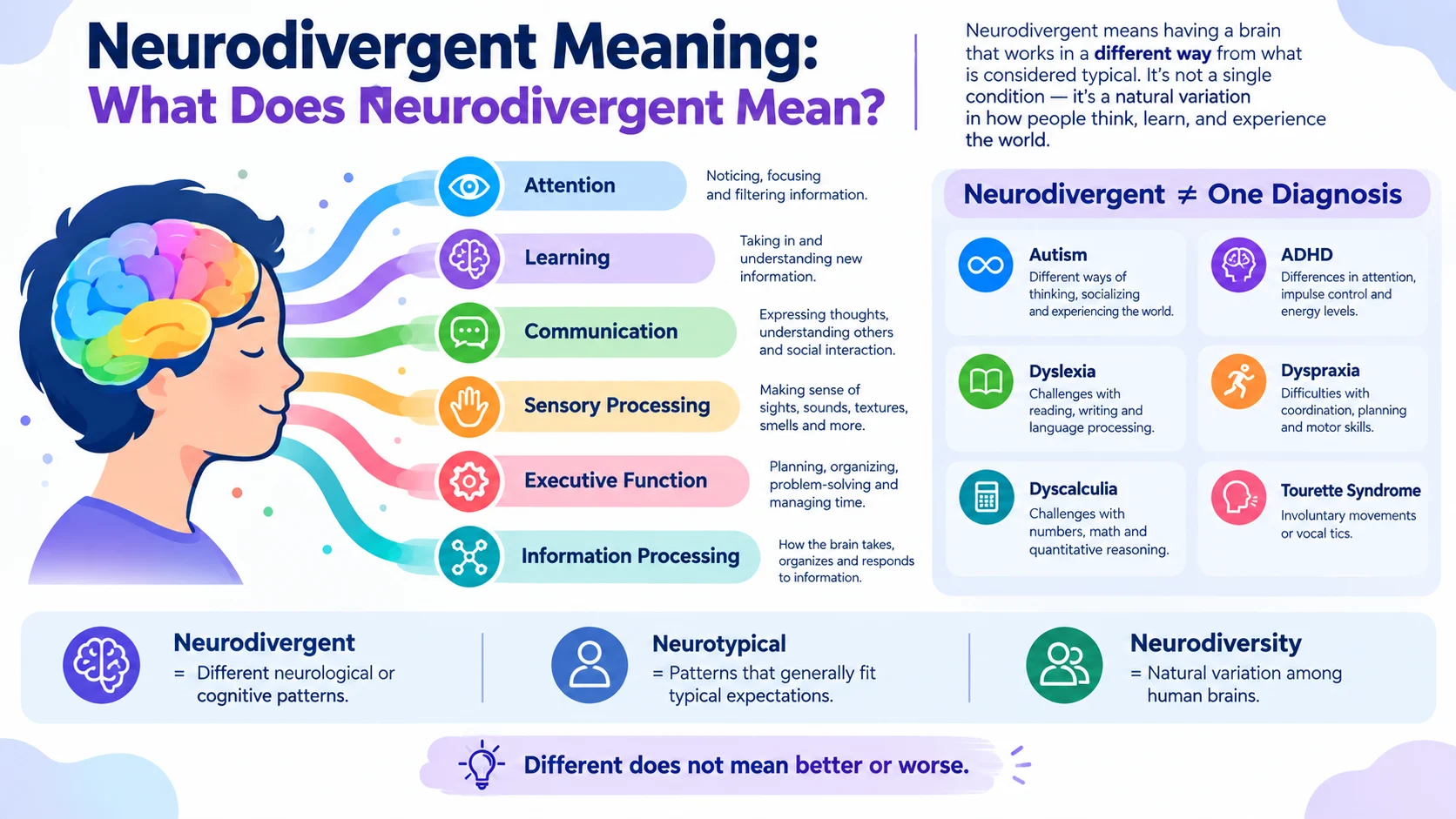
The neurodivergent meaning refers to a person whose brain processes information, communicates, learns, pays attention, or responds to the world in ways that differ from what people consider typical. The term does not describe one specific condition. Instead, it works as a broad description for many different neurological and cognitive experiences.
For example, people may use neurodivergent when talking about autism, ADHD, dyslexia, dyspraxia, or other forms of neurological difference. However, the exact use of the term can vary between people and communities.
Importantly, being neurodivergent does not mean that someone’s brain is simply “better” or “worse.” Different neurological traits can create strengths, challenges, or both. A person may process details deeply but struggle with certain social expectations. Someone else may have strong creative skills while finding some forms of organization difficult.
Therefore, understanding what does neurodivergent mean requires looking beyond stereotypes. The term focuses on differences in how people experience and process the world.
What Does Neurodivergent Mean?
Neurodivergent describes a person whose neurological functioning or cognitive processing differs from what society considers typical.
The term can relate to differences involving:
- Attention
- Learning
- Communication
- Sensory processing
- Social interaction
- Memory
- Executive function
- Information processing
- Movement
- Emotional regulation
For example, people may describe individuals with autism, ADHD, dyslexia, or dyspraxia as neurodivergent.
However, neurodivergence does not look the same for everyone. One person may need quiet surroundings to focus, while another may need movement or background sound.
Neurodivergent Definition in Simple English
A simple neurodivergent definition is:
Neurodivergent describes someone whose brain works or processes information differently from what is considered typical.
The word comes from the broader concept of neurodiversity.
Rather than suggesting that only one type of brain is normal, the neurodiversity perspective recognizes that human brains naturally differ.
Consequently, neurodivergent can describe many different experiences.
What Is Neurodivergence?
Neurodivergence refers to a difference in neurological functioning or cognitive processing from what a particular society or culture treats as typical.
The word often appears when people discuss conditions or traits related to:
- Attention
- Learning
- Communication
- Sensory experiences
- Social behavior
- Executive functioning
- Motor skills
- Information processing
Neurodivergence is therefore broader than a single diagnosis.
For example, someone with ADHD may experience differences in attention and executive function. Meanwhile, an autistic person may experience differences in sensory processing, communication, or social interaction.
These examples show why neurodivergence does not have one universal appearance.
Neurodivergent vs. Neurotypical
The easiest way to understand neurodivergent vs. neurotypical is to compare the terms.
Neurotypical generally describes a person whose neurological development and functioning align with what society considers typical.
Neurodivergent describes someone whose neurological functioning differs from that expected pattern.
| TermBasic Meaning | |
|---|---|
| Neurodivergent | Neurological or cognitive functioning differs from the typical pattern |
| Neurotypical | Neurological functioning generally follows typical patterns |
| Neurodiversity | The natural variation among human brains and minds |
| Neurodivergence | A difference from what society considers typical |
However, “typical” does not mean “better.” Likewise, “different” does not automatically mean “worse.”
These terms describe differences rather than ranking people’s worth.
What Is Neurodiversity?
Neurodiversity refers to the idea that human brains naturally vary in how they think, learn, communicate, and process information.
Think of it as similar to other forms of human variation. People have different personalities, learning styles, communication habits, and abilities.
The neurodiversity concept recognizes neurological differences as part of human diversity.
Therefore, neurodiversity and neurodivergence are not the same word.
- Neurodiversity describes variation across people.
- Neurodivergent describes an individual whose neurological functioning differs from what is considered typical.
For example, a classroom can contain neurodiverse students. One student may be neurodivergent, while another may be neurotypical.
Common Examples of Neurodivergence
The term neurodivergent can cover many different neurological and developmental differences.
Common examples include:
- Autism
- ADHD
- Dyslexia
- Dyspraxia or developmental coordination disorder
- Dyscalculia
- Tourette syndrome
Some people also use the term more broadly for other neurological or cognitive differences. However, usage can vary, and not everyone with a particular condition chooses the label.
Autism
Autistic people may experience differences in communication, social interaction, sensory processing, routines, interests, and information processing.
However, autism varies widely from person to person.
One autistic person may communicate verbally with ease but struggle with sensory overload. Another may communicate differently and need more support in daily life.
As a result, there is no single “neurodivergent” experience.
ADHD
People with ADHD may experience differences involving attention, impulsivity, activity levels, working memory, motivation, and executive functioning.
For example, someone may struggle to begin a simple task but become deeply focused on an activity that strongly interests them.
ADHD can affect school, work, relationships, and everyday routines. Nevertheless, its effects vary considerably between individuals.
Dyslexia
Dyslexia involves differences that can affect reading and language-related processing.
A person with dyslexia may have difficulty with reading fluency, spelling, or decoding written words. At the same time, dyslexia does not mean that someone lacks intelligence.
People with dyslexia can have many different skills and abilities.
Dyspraxia
Dyspraxia, often discussed alongside developmental coordination disorder, can affect movement and coordination.
Someone may find tasks involving motor planning, balance, organization, or coordination more difficult.
Again, experiences differ from person to person.
Dyscalculia
Dyscalculia involves persistent difficulty with certain aspects of learning and using mathematics.
Someone may struggle with number sense, calculations, sequencing, or understanding numerical concepts.
These difficulties do not mean that the person lacks intelligence overall.
Tourette Syndrome
Tourette syndrome involves repeated movements or sounds called motor and vocal tics.
The condition can affect people in different ways. Furthermore, popular media often presents an inaccurate picture of Tourette syndrome by focusing only on dramatic examples.
A person with Tourette syndrome may therefore have a very different experience from the stereotype.
What Does Being Neurodivergent Feel Like?
There is no single answer because neurodivergent people have different experiences.
Still, some people describe differences in areas such as:
- Sensory sensitivity
- Attention
- Time management
- Social communication
- Reading
- Writing
- Organization
- Motor coordination
- Emotional regulation
- Executive functioning
For instance, bright lights or loud sounds may feel overwhelming to one person. Another person may find it difficult to shift attention from one task to another.
Some people also describe intense focus on subjects they enjoy. Others may need extra time to process spoken information.
However, these experiences alone do not prove that someone is neurodivergent.
Neurodivergent and Sensory Processing
Sensory experiences often appear in conversations about neurodivergence.
Some people may experience ordinary sounds, lights, textures, smells, or physical sensations more strongly than others. This can make certain environments uncomfortable or overwhelming.
For example, a busy shopping center may feel exhausting because of:
- Loud conversations
- Bright lights
- Music
- Crowds
- Strong smells
- Constant movement
On the other hand, some people seek additional sensory input. They may enjoy movement, repetitive sounds, tactile objects, or other forms of stimulation.
Therefore, sensory processing can involve either sensitivity or sensory seeking, depending on the individual.
Neurodivergent and Executive Function
Executive function refers to mental processes that help people manage tasks and behavior.
These processes can include:
- Planning
- Organization
- Working memory
- Task initiation
- Time management
- Flexible thinking
- Inhibiting impulses
Some neurodivergent people experience challenges with one or more of these areas.
For example, a person may understand exactly what they need to do but struggle to start the task.
That difference matters because difficulty with task initiation does not necessarily mean laziness.
Neurodivergent Strengths
Neurodivergence can involve challenges, but it can also involve individual strengths.
Depending on the person, these may include:
- Creative thinking
- Deep focus
- Strong attention to detail
- Pattern recognition
- Specialized knowledge
- Original problem-solving
- Strong memory for particular subjects
- Different perspectives
However, it is important not to turn these traits into stereotypes.
Not every neurodivergent person has exceptional creativity or extraordinary memory. Likewise, not every neurotypical person lacks those abilities.
Individual differences always matter.
Is Neurodivergent a Diagnosis?
No. Neurodivergent is not one specific medical diagnosis.
Instead, it is a broad descriptive term.
A person may use the word after receiving a diagnosis such as ADHD or autism. Others may use it as a personal identity label.
Because the term has broad usage, its meaning can depend on context.
Therefore, calling someone neurodivergent should not automatically imply a specific diagnosis.
Can You Be Neurodivergent Without a Diagnosis?
Some people use the term neurodivergent before receiving a formal diagnosis. Others may prefer not to use it without one.
There is no single rule that determines how everyone must use the label.
However, self-identification and clinical diagnosis serve different purposes. A diagnosis involves a formal assessment, while an identity label can describe how someone understands their own experience.
If a person wants medical, educational, or workplace support, professional assessment may provide information about eligibility and appropriate accommodations.
Is Neurodivergent a Disability?
Neurodivergence and disability are related concepts, but they are not identical.
Some neurodivergent conditions can qualify as disabilities under particular laws or circumstances. Yet not every neurodivergent person considers themselves disabled.
Likewise, disability can involve many conditions that people would not describe as neurodivergence.
The key point is that neurodivergent describes neurological difference, while disability generally concerns an impairment and its effects within a person’s environment.
Neurodivergent at Work
Neurodivergent people may experience workplaces differently.
For example, an open office with constant noise may create concentration problems for someone with strong sensory sensitivity. Another person may work better when instructions arrive in writing instead of through a fast verbal discussion.
Helpful workplace practices can include:
- Clear written instructions
- Predictable schedules
- Quiet work areas
- Flexible communication
- Task lists
- Reasonable breaks
- Reduced unnecessary interruptions
Of course, useful support depends on the individual.
A good workplace does not assume that every neurodivergent employee needs the same adjustment.
Neurodivergent in School
Students can also have different learning and communication needs.
For example, one student may benefit from:
- Written instructions
- Extra processing time
- Quiet testing spaces
- Visual schedules
- Structured assignments
- Assistive technology
- Clear routines
Another student may need different support.
Consequently, teachers and schools should focus on the student’s actual needs rather than rely on assumptions about a diagnosis.
Neurodivergent Communication
Communication can look different across neurodivergent people.
Someone may prefer direct language rather than hints or implied meanings. Another person may communicate through writing more comfortably than speaking.
Likewise, eye contact, facial expressions, gestures, tone, and conversational timing can vary.
These differences do not automatically indicate a lack of empathy or interest.
Instead, people may simply communicate in different ways.
Neurodivergent Meaning in Social Media
The word neurodivergent appears frequently on social media.
You may encounter it on:
- TikTok
- X
- Online support communities
- Personal blogs
- Discussion forums
People may use phrases such as:
- “I’m neurodivergent.”
- “This is common in neurodivergent communities.”
- “My neurodivergent brain works differently.”
- “I need a quieter environment because of my sensory sensitivity.”
Online usage can sometimes become broader than clinical terminology. Therefore, context remains important.
Common Misconceptions About Neurodivergence
“Neurodivergent Means Mentally Ill”
Not necessarily.
Mental health conditions and neurodevelopmental or neurological differences can overlap, but they are not the same category.
The word neurodivergent covers a broad range of experiences.
“All Neurodivergent People Are the Same”
They are not.
Autism, ADHD, dyslexia, Tourette syndrome, and other conditions can affect people in very different ways.
Even two people with the same diagnosis can have completely different strengths and challenges.
“Neurodivergent Means Less Intelligent”
This is false.
Neurological difference does not determine overall intelligence.
A person can have difficulty with one cognitive task while excelling in another area.
“Neurodivergent Always Means Disabled”
Not necessarily.
Some neurodivergent people identify as disabled, while others do not. The relationship between neurodivergence and disability depends on the person, condition, environment, and legal or social context.
“Everyone Is a Little Neurodivergent”
People often use this phrase to suggest that everyone thinks differently. Human brains certainly vary.
However, the term neurodivergent usually has a more specific meaning than simply having an unusual personality or preference.
Using it carefully helps preserve its usefulness.
“Neurodivergent Is an Insult”
The term itself is generally intended as a neutral descriptive word.
Of course, tone matters. Someone can use almost any term disrespectfully.
Still, neurodivergent is commonly used as a respectful identity or descriptive term.
Neurodivergent vs. Neurodiverse
These words sound similar, but they have different uses.
Neurodivergent usually describes an individual.
Neurodiverse can describe a group containing different neurological types, although people sometimes use it differently in everyday conversation.
For example:
- “She is neurodivergent.”
- “The team has a neurodiverse group of employees.”
The distinction helps avoid confusion.
Neurodivergent vs. Neurotypical vs. Neurodiverse
Here is a simple comparison:
| Term | Refers To | Basic Idea |
|---|---|---|
| Neurodivergent | Individual | Brain functioning differs from typical patterns |
| Neurotypical | Individual | Brain functioning generally fits typical patterns |
| Neurodiverse | Group or environment | Contains neurological variation |
| Neurodiversity | Concept | Natural variation among human brains |
The exact use of these terms can vary across communities. Nevertheless, this framework works well for everyday understanding.
How to Use “Neurodivergent” Respectfully
If you are talking about another person, use the language they prefer.
For example, someone may prefer:
- “neurodivergent person”
- “autistic person”
- “person with ADHD”
- another identity or description
Avoid making assumptions based on behavior alone.
For instance, being quiet, disorganized, highly focused, or sensitive to noise does not automatically mean someone is neurodivergent.
Respectful language begins with recognizing individual differences.
Grammar and Usage of “Neurodivergent”
Neurodivergent usually functions as an adjective.
Examples include:
- “She is neurodivergent.”
- “He has a neurodivergent brain.”
- “The school supports neurodivergent students.”
- “They discussed neurodivergent experiences.”
The noun neurodivergence describes the state or concept of differing from typical neurological patterns.
Meanwhile, neurodiversity describes variation among brains and minds.
Why the Term Matters
The word neurodivergent can give people a useful way to describe experiences that may otherwise feel difficult to explain.
For example, someone might understand why certain environments overwhelm them after learning about sensory processing. Another person may recognize that their difficulties with task initiation relate to executive functioning rather than a lack of effort.
The term can also encourage better communication.
Instead of assuming that everyone should learn, work, or communicate in exactly the same way, people can recognize that different approaches may work better for different brains.
Quick Reference: Neurodivergent Meaning
| Question | Answer |
|---|---|
| What does neurodivergent mean? | Having neurological or cognitive functioning that differs from what is considered typical |
| Is neurodivergent a diagnosis? | No, it is a broad descriptive term |
| What is neurodiversity? | Natural variation among human brains and minds |
| What is neurotypical? | Describes someone whose neurological functioning generally fits typical patterns |
| Can autism be neurodivergent? | Yes, autistic people are commonly described as neurodivergent |
| Can ADHD be neurodivergent? | Yes |
| Can dyslexia be neurodivergent? | Yes |
| Is every neurodivergent person the same? | No |
| Does neurodivergent mean less intelligent? | No |
| Does neurodivergent always mean disabled? | No |
| Can someone use neurodivergent as an identity label? | Yes, some people do |
| Is neurodivergent an insult? | The term itself is generally descriptive and neutral |
Frequently Asked Questions
What is the simple meaning of neurodivergent?
Neurodivergent describes someone whose brain processes information, communicates, learns, or responds to the world differently from what society considers typical.
What does neurodivergent mean in a person?
When someone describes themselves as neurodivergent, they generally mean that their neurological or cognitive functioning differs from typical patterns. The term can relate to conditions such as autism, ADHD, dyslexia, or other forms of neurological difference.
Is ADHD considered neurodivergent?
Yes. ADHD is commonly included under the broad umbrella of neurodivergence.
Is autism considered neurodivergent?
Yes. Autistic people are commonly described as neurodivergent.
Is dyslexia neurodivergent?
Yes. Dyslexia is commonly included within discussions of neurodivergence because it involves differences in processing written and language-related information.
What is the difference between neurodivergent and neurotypical?
Neurodivergent describes neurological functioning that differs from what society considers typical. Neurotypical describes functioning that generally aligns with those typical patterns.
Is neurodivergent the same as neurodiverse?
No. Neurodivergent usually describes an individual, while neurodiversity describes variation among human brains. The terms can sometimes receive different usage depending on the community.
Does neurodivergent mean autistic?
No. Autism is one example of a neurodivergent condition or identity. The broader term can include other forms of neurological or cognitive difference.
Can a person be neurodivergent without a diagnosis?
Some people use the term to describe themselves without a formal diagnosis. However, self-identification and clinical diagnosis are different things.
Is neurodivergence a mental illness?
Neurodivergence is not a single mental illness. It is a broad term covering different neurological and cognitive experiences.
Are neurodivergent people more creative?
Some neurodivergent people report creative strengths, unusual perspectives, or strong problem-solving skills. However, creativity varies from person to person and should not become a stereotype.
Can neurodivergent people have successful careers?
Absolutely. Neurodivergent people work across many fields and have different strengths, challenges, preferences, and support needs.
Conclusion
The neurodivergent meaning describes a person whose neurological or cognitive functioning differs from what society considers typical. The term can include people with autism, ADHD, dyslexia, dyspraxia, Tourette syndrome, and other forms of neurological difference.
Most importantly, neurodivergence does not look the same for everyone. One person may experience sensory sensitivity, while another may have differences in attention, learning, communication, or executive function. Some people may experience significant challenges, while others may identify particular strengths.
The term also differs from neurotypical, neurodiverse, and neurodiversity. Understanding those differences makes conversations about neurological variation clearer and more respectful.
Ultimately, the word neurodivergent provides a broad way to talk about different ways human brains can work. It does not define a person’s intelligence, personality, value, or entire identity. Individual experiences always matter.

Charlotte Wilson is a language writer passionate about word meanings, synonyms, and clear communication. She creates accurate and engaging content to help readers expand their vocabulary and language skills.





14 thoughts on “Neurodivergent Meaning| What Does Neurodivergent Mean? Definition, Examples & How the Term Is Used 2026”