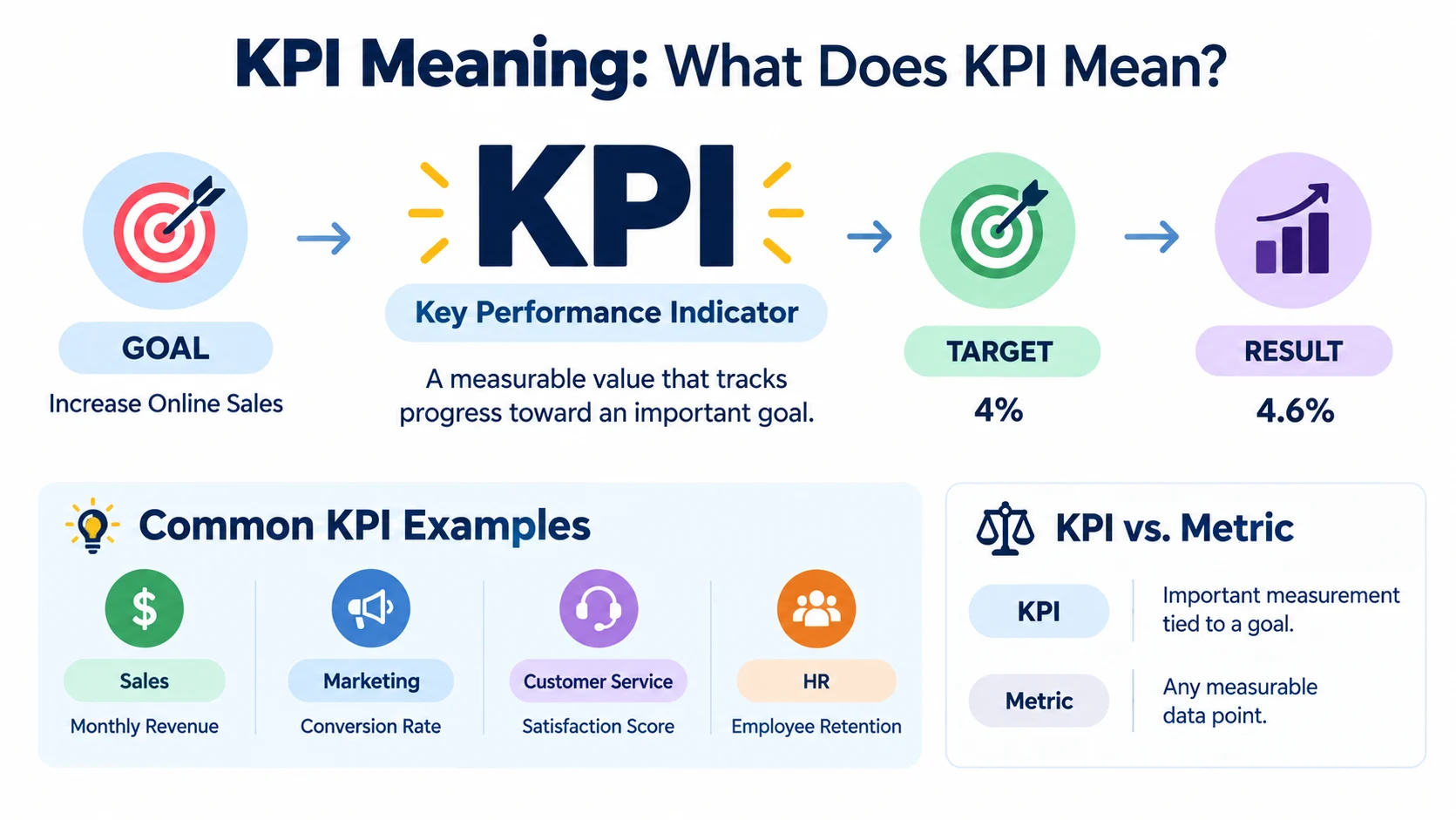
A KPI (Key Performance Indicator) is a measurable value that shows how effectively a person, team, department, or organization is achieving an important goal. Businesses use KPIs to track performance, identify problems, and measure progress.
If you have worked in a business, marketing team, office, or online company, you have probably heard someone ask, “What is our KPI?” The term may sound technical, but the KPI meaning is simple: a KPI is a measurable value used to track progress toward an important goal.
For example, a sales team might use monthly revenue as a KPI. A marketing team may track conversion rate. A customer service department could measure customer satisfaction. Meanwhile, an employee might have a KPI related to completed projects, sales targets, response times, or other job responsibilities.
However, not every number qualifies as a useful KPI. A good KPI connects directly to a meaningful objective. Therefore, organizations choose KPIs carefully instead of tracking every available number.
In this guide, you will learn what KPI means, how key performance indicators work, and how companies use them. You will also see practical KPI examples for business, employees, sales, marketing, finance, customer service, and personal goals.
What Does KPI Mean?
KPI stands for Key Performance Indicator.
A KPI is a measurable value that shows how effectively someone or something is progressing toward an important goal.
For example:
- A sales team may track monthly sales revenue.
- A website may track conversion rate.
- A customer service team may track average response time.
- A company may track profit margin.
- An employee may track completed projects.
In simple terms, a KPI answers this question:
“How do we know whether we are achieving our goal?”
KPI Meaning and Definition
The full form of KPI is Key Performance Indicator.
The word key means important. Performance refers to how well something is working or progressing. An indicator provides information that helps you understand that performance.
Put together, a key performance indicator is an important measurement used to evaluate progress.
For instance, imagine a company wants to increase online sales.
It could track:
- Website visitors
- Product page views
- Shopping cart activity
- Conversion rate
- Average order value
- Monthly revenue
All of these numbers can provide useful information. However, the company might select online sales revenue as a primary KPI because it directly reflects the main business goal.
That distinction matters. A KPI should connect a measurement to an objective.
What Is a KPI in Simple Words?
In simple words, a KPI is a number or measurable result that tells you whether you are moving toward an important goal.
Think of a KPI like a scoreboard.
If your goal is to improve sales, the scoreboard might show revenue. If your goal is to improve customer service, it might show customer satisfaction or response time.
Therefore, KPIs help people move beyond guesswork.
Instead of saying:
“I think we are doing well.”
A team can say:
“Our customer retention rate increased by 8% this quarter.”
The second statement uses measurable performance information.
How Do KPIs Work?
KPIs usually connect four basic elements:
- Goal
- Measurement
- Target
- Time period
For example:
Goal: Increase website sales
KPI: Conversion rate
Target: 5%
Time period: By the end of the quarter
This setup makes the objective easier to measure.
A KPI can also reveal when performance moves away from the target. As a result, teams can adjust their strategy before a small problem becomes a major one.
Why Are KPIs Important?
KPIs help organizations understand performance. More importantly, they connect daily activities with larger goals.
1. KPIs Measure Progress
A KPI gives you a measurable way to monitor progress.
For example, if a company wants to increase revenue from $100,000 to $150,000 per month, monthly revenue can provide a direct performance measurement.
2. KPIs Support Better Decisions
Managers can use KPI data to identify trends and problems.
Suppose website traffic rises but sales remain flat. That result may encourage the marketing team to investigate the website’s conversion process.
3. KPIs Create Clear Goals
Employees often perform better when they understand what they need to achieve.
A clear KPI can turn a vague goal such as “improve customer service” into a measurable objective such as “reduce average response time to under two hours.”
4. KPIs Improve Accountability
KPIs can make responsibilities easier to understand.
When a team has clearly defined measurements, members can see what results they need to deliver.
5. KPIs Show Trends
One result may not tell the whole story. However, tracking the same KPI over time can reveal whether performance is improving, declining, or remaining stable.
KPI Examples
Different industries use different KPIs because their goals differ.
Here are some common examples:
| Area | Example KPI |
|---|---|
| Sales | Monthly revenue |
| Marketing | Conversion rate |
| Website | Organic traffic |
| Customer service | Customer satisfaction score |
| Finance | Profit margin |
| Human resources | Employee retention rate |
| E-commerce | Average order value |
| Operations | On-time delivery rate |
| Project management | Projects completed on time |
| Education | Course completion rate |
The right KPI depends on the specific objective.
KPI Examples in Business
Businesses often use KPIs to monitor financial performance, growth, customers, operations, and employees.
Common business KPIs include:
- Revenue growth
- Net profit margin
- Customer retention rate
- Customer acquisition cost
- Return on investment
- Market share
- Employee turnover
- Operating costs
- Sales growth
- Customer satisfaction
For example, a growing company might choose monthly recurring revenue as a KPI because it wants to monitor predictable income.
Meanwhile, a retail business might focus on sales per store or average order value.
KPI Meaning in Marketing
In marketing, a KPI measures whether marketing activities support business goals.
Common marketing KPIs include:
- Conversion rate
- Cost per lead
- Customer acquisition cost
- Return on ad spend
- Website traffic
- Lead generation
- Email click-through rate
- Customer retention
- Marketing-generated revenue
For example, suppose a company launches an advertising campaign.
The marketing team could measure impressions, clicks, conversions, and revenue. If the main goal is generating customers, conversion rate or cost per acquisition may become an important KPI.
However, the best KPI depends on the campaign objective.
KPI Meaning in Sales
In sales, KPIs help teams measure sales activity and results.
Common sales KPIs include:
- Monthly sales revenue
- Number of deals closed
- Conversion rate
- Average deal size
- Sales growth
- Customer acquisition cost
- Sales cycle length
- Qualified leads
- Customer retention
For example, a salesperson may have a monthly revenue target.
If the target is $50,000 and the salesperson generates $55,000, the KPI shows that the target was exceeded.
KPI Meaning at Work
At work, a KPI can measure an employee’s or team’s performance against specific job objectives.
For example, an employee might have KPIs related to:
- Projects completed
- Deadlines met
- Sales generated
- Customer response time
- Error rate
- Tasks completed
- Customer satisfaction
- Production output
However, employee KPIs should match the person’s actual responsibilities.
A customer support employee, for example, should not normally have the same KPIs as a sales representative.
KPI Meaning in Performance Reviews
Companies sometimes use KPIs during employee performance reviews.
A manager may compare actual results with agreed targets.
For example:
KPI: Customer response time
Target: Under 4 hours
Actual result: 3.2 hours
This information gives the manager a measurable basis for discussing performance.
Still, KPIs should not always be viewed in isolation. Quality, teamwork, problem-solving, communication, and other responsibilities can also matter depending on the role.
KPI Meaning in Digital Marketing
Digital marketers often have access to many measurable data points. KPIs help them focus on the numbers that matter most.
For example, a digital marketing campaign might track:
- Website sessions
- Conversion rate
- Cost per click
- Cost per acquisition
- Return on ad spend
- Leads
- Revenue
- Email engagement
A campaign designed to generate sales might use revenue or return on ad spend as a major KPI.
On the other hand, a brand awareness campaign may focus on different measurements.
KPI Meaning in SEO
SEO teams use KPIs to measure organic search performance.
Common SEO KPIs include:
- Organic traffic
- Organic conversions
- Search visibility
- Keyword rankings
- Click-through rate
- Indexed pages
- Organic revenue
- Leads from organic search
For example, if an SEO campaign aims to generate more customers, organic conversions may provide more useful information than traffic alone.
That is because traffic shows visits, while conversions show whether those visits produce the desired action.
KPI vs. Metric: What’s the Difference?
People often use KPI and metric as if they mean exactly the same thing. They are related, but they are not always identical.
A metric is a measurable data point.
A KPI is a metric that an organization considers especially important for tracking a specific objective.
For example:
Metric: Website page views
KPI: Website conversion rate
Page views provide useful information. However, conversion rate may matter more when the goal involves generating customers.
Therefore:
Every KPI is a metric, but not every metric is a KPI.
KPI vs. Goal
A goal describes what you want to achieve.
A KPI measures progress toward that goal.
For example:
Goal: Increase customer retention.
KPI: Customer retention rate.
Target: Increase retention from 80% to 88%.
The goal provides direction, while the KPI provides measurement.
KPI vs. Target
A KPI and a target also have different roles.
A KPI is the measurement.
A target is the desired result.
For example:
KPI: Monthly revenue
Target: $100,000 per month
The KPI tells you what you measure. The target tells you what result you want.
KPI vs. OKR
OKR stands for Objectives and Key Results.
An OKR framework usually combines a broad objective with measurable key results.
A KPI, by contrast, typically focuses on an important performance measurement.
For example:
Objective: Improve customer experience.
Key Results:
- Increase customer satisfaction from 82% to 90%.
- Reduce average response time by 20%.
- Increase customer retention by 10%.
A company may use KPIs alongside OKRs rather than treating them as competing systems.
Types of KPIs
Organizations can classify KPIs in several ways.
Quantitative KPIs
These use numerical measurements.
Examples include:
- Revenue
- Sales volume
- Number of customers
- Conversion rate
- Production output
Qualitative KPIs
These focus on qualities or experiences that may require structured evaluation.
Examples include:
- Customer satisfaction
- Employee engagement
- Product quality
- Service quality
Leading KPIs
Leading indicators can provide information about activities or conditions that may influence future results.
For example, the number of qualified sales leads may help a company monitor its future sales pipeline.
Lagging KPIs
Lagging indicators measure results that have already occurred.
Examples include:
- Quarterly revenue
- Annual profit
- Customer churn
- Completed sales
A strong performance system may use both leading and lagging indicators.
How to Create a Good KPI
Creating a useful KPI requires more than choosing an impressive number.
1. Start With the Goal
First, define what you want to accomplish.
For example:
Goal: Increase online sales.
2. Choose a Relevant Measurement
Next, select a measurement that directly reflects the goal.
KPI: Online conversion rate.
3. Set a Clear Target
Give the KPI a specific target.
Target: Increase conversion rate from 3% to 4%.
4. Choose a Time Period
Define when you want to reach the target.
Time period: Within six months.
5. Review the KPI Regularly
Finally, monitor the KPI and adjust your strategy when necessary.
A KPI becomes more useful when people actually use the information to make decisions.
What Makes a Good KPI?
A useful KPI should generally be:
- Relevant to an important goal
- Measurable
- Clear
- Specific
- Trackable over time
- Actionable
- Easy to understand
Many organizations also use SMART principles when setting measurable objectives.
The key idea remains simple: measure what matters.
Common KPI Mistakes
Even experienced teams can misuse KPIs.
Tracking Too Many KPIs
More data does not automatically create better decisions.
If a dashboard contains dozens of unrelated measurements, important information can become difficult to see.
Choosing Vanity Metrics
A vanity metric may look impressive without showing meaningful progress.
For example, a large number of social media followers may not matter much if the actual goal is generating qualified customers.
Using the Wrong KPI
A measurement should match the goal.
If the objective involves improving customer retention, total website visits may not provide the clearest answer.
Setting Unrealistic Targets
An unrealistic target can discourage employees and create misleading performance expectations.
Targets should reflect available resources, historical performance, and business objectives.
Ignoring Context
A KPI does not always explain why a result changed.
For instance, lower sales may result from seasonal demand, supply problems, pricing changes, or other factors.
Therefore, teams should examine the context around KPI results.
KPI Examples in Everyday Work
KPIs do not only apply to large corporations.
A freelancer might track:
- Monthly income
- Client retention
- Projects completed
- Average project value
A teacher might monitor:
- Student attendance
- Assignment completion
- Course completion
A customer service representative might track:
- Average response time
- Resolution rate
- Customer satisfaction
A content creator could monitor:
- Video views
- Watch time
- Subscriber growth
- Conversion rate
The important point is that the KPI should connect to the person’s actual goal.
Examples of KPI Sentences
Here are some natural ways to use KPI in a sentence:
- “Our main KPI this quarter is customer retention.”
- “The marketing team reviewed its KPIs after the campaign.”
- “Sales revenue is one of our most important KPIs.”
- “This employee met all of her quarterly KPIs.”
- “We need a KPI that directly measures customer satisfaction.”
- “Website traffic is useful, but conversion rate is the main KPI for this campaign.”
KPI Grammar and Usage
KPI is a noun.
The plural form is KPIs, which means multiple key performance indicators.
Singular
“Revenue is our primary KPI.”
Plural
“The team tracks several KPIs.”
You can also write the full term:
“Key performance indicators help companies measure progress.”
In professional writing, introduce the full term first:
“We use key performance indicators (KPIs) to measure performance.”
After that, KPI or KPIs works naturally.
How Do You Pronounce KPI?
KPI is usually pronounced by saying the individual letters:
“K-P-I.”
You normally do not pronounce it as one word.
The full phrase is:
Key Performance Indicator.
What Does KPI Mean in Texting?
In casual texting, KPI usually keeps its business meaning: Key Performance Indicator.
For example:
“What are our KPIs for this month?”
This likely refers to work goals or performance measurements.
Unlike slang abbreviations such as “LOL” or “BRB,” KPI is primarily a business and workplace abbreviation.
What Does KPI Mean in Social Media?
On social media, KPI generally means Key Performance Indicator when people discuss marketing, content, advertising, or business performance.
For example, a social media manager might track:
- Engagement rate
- Follower growth
- Click-through rate
- Leads
- Conversions
- Revenue
The exact KPI depends on the campaign’s objective.
What Does KPI Mean in Management?
In management, KPI refers to a measurable indicator used to monitor progress toward important organizational, team, or individual goals.
Managers may use KPIs to:
- Track results
- Identify problems
- Set targets
- Review performance
- Compare results over time
- Support business decisions
Therefore, KPIs can help turn broad business objectives into measurable outcomes.
What Does KPI Mean in Finance?
In finance, KPIs can measure financial health and business performance.
Examples include:
- Revenue growth
- Gross profit margin
- Net profit margin
- Operating expenses
- Cash flow
- Return on investment
- Debt-to-equity ratio
Financial KPIs help organizations understand whether their financial results align with their objectives.
What Does KPI Mean in Customer Service?
Customer service teams can use KPIs to measure service quality and efficiency.
Common examples include:
- Average response time
- Average resolution time
- Customer satisfaction
- First-contact resolution
- Customer retention
- Support ticket volume
For example, a company may set a KPI to resolve 90% of support requests within a specific period.
What Does KPI Mean in HR?
Human resources departments also use KPIs.
Common HR KPIs include:
- Employee turnover rate
- Employee retention
- Time to hire
- Absenteeism rate
- Training completion
- Employee engagement
- Cost per hire
These measurements can help HR teams evaluate workforce-related goals.
What Does KPI Mean in Project Management?
Project managers use KPIs to track whether projects meet their objectives.
Common project KPIs include:
- Percentage of tasks completed
- Projects completed on time
- Budget variance
- Project duration
- Defect rate
- Resource utilization
- Customer satisfaction
For example, a project team might track whether milestones are completed according to schedule.
Are KPIs Always Numbers?
Most KPIs involve measurable data, but measurement does not always mean a simple count.
Some KPIs measure percentages, rates, ratios, scores, time, financial values, or other structured results.
For example:
- Revenue: $200,000
- Conversion rate: 4.5%
- Customer satisfaction: 92%
- Response time: 2 hours
- Employee retention: 88%
Therefore, a KPI can take different forms as long as it provides a meaningful measurement.
Can One Business Have Multiple KPIs?
Yes.
Most organizations need multiple KPIs because businesses usually have several important objectives.
For example, an online store might track:
- Revenue
- Conversion rate
- Average order value
- Customer retention
- Cart abandonment rate
However, each KPI should have a clear purpose.
The goal is not to collect every possible number. Instead, the goal is to identify the measurements that help people understand important performance areas.
Quick Reference: KPI Meaning
| Question | Answer |
|---|---|
| What does KPI mean? | Key Performance Indicator |
| What is a KPI? | A measurable indicator of progress toward an important goal |
| What is the plural of KPI? | KPIs |
| Where is KPI used? | Business, work, marketing, sales, finance, HR, and more |
| Is KPI a metric? | Yes, but it is a particularly important metric tied to a goal |
| What is a KPI example? | Monthly revenue, conversion rate, or customer satisfaction |
| How is KPI pronounced? | “K-P-I” |
| Does KPI mean slang? | Usually no; it is primarily a business abbreviation |
Frequently Asked Questions
What does KPI stand for?
KPI stands for Key Performance Indicator.
What is the simplest definition of KPI?
A KPI is a measurable value that shows progress toward an important goal.
What is an example of a KPI?
Monthly sales revenue is a common KPI. Other examples include conversion rate, customer satisfaction, employee retention, and profit margin.
What is the difference between KPI and metric?
A metric is any measurable data point. A KPI is a metric that has particular importance for measuring progress toward a specific goal.
What does KPI mean at work?
At work, KPI usually refers to a measurable performance indicator connected to an employee’s, team’s, or organization’s goals.
What does KPI mean in marketing?
In marketing, KPI means a measurable indicator used to evaluate marketing performance. Examples include conversion rate, cost per acquisition, leads, and return on ad spend.
What does KPI mean in sales?
In sales, KPI usually refers to a measurement such as revenue, deals closed, conversion rate, average deal size, or sales cycle length.
What does KPI mean in business?
In business, KPI means Key Performance Indicator, a measurement that helps an organization track progress toward important business objectives.
Is KPI the same as a goal?
No. A goal describes what you want to achieve, while a KPI measures progress toward that goal.
Is KPI the same as a target?
No. A KPI identifies what you measure, while a target identifies the desired result.
Can employees have KPIs?
Yes. Organizations may assign role-specific KPIs to employees. These measurements should reflect the employee’s actual responsibilities and objectives.
Can KPIs be negative?
A KPI itself is a measurement, not necessarily positive or negative. However, a KPI result can show performance below or above a desired target.
Why do companies use KPIs?
Companies use KPIs to measure progress, monitor performance, identify problems, support decisions, and evaluate whether important goals are being achieved.
Conclusion
The KPI meaning is Key Performance Indicator. A KPI is a measurable value that shows how effectively a person, team, department, or organization is progressing toward an important goal.
For example, a sales team might track revenue, a marketing team might measure conversion rate, and a customer service team might monitor response time or customer satisfaction. Meanwhile, an employee may have KPIs connected to projects, productivity, sales, quality, or other job responsibilities.
Most importantly, a KPI should measure something that matters. A large collection of numbers does not automatically create better performance. Instead, effective KPIs connect clear goals, meaningful measurements, specific targets, and useful time periods.
Once you understand this concept, phrases such as “track your KPIs,” “meet your KPIs,” and “KPI performance” become much easier to understand. In short, a KPI acts like a performance scoreboard that helps people see whether their efforts are producing the desired results.

Jack Murphy is a language writer with a passion for word meanings, synonyms, and effective communication. He creates informative and easy to understand content to help readers enhance their vocabulary and language skills.







3 thoughts on “KPI Meaning| What Does KPI Mean in Business, Work & Marketing? Key Performance Indicators Explained 2026”