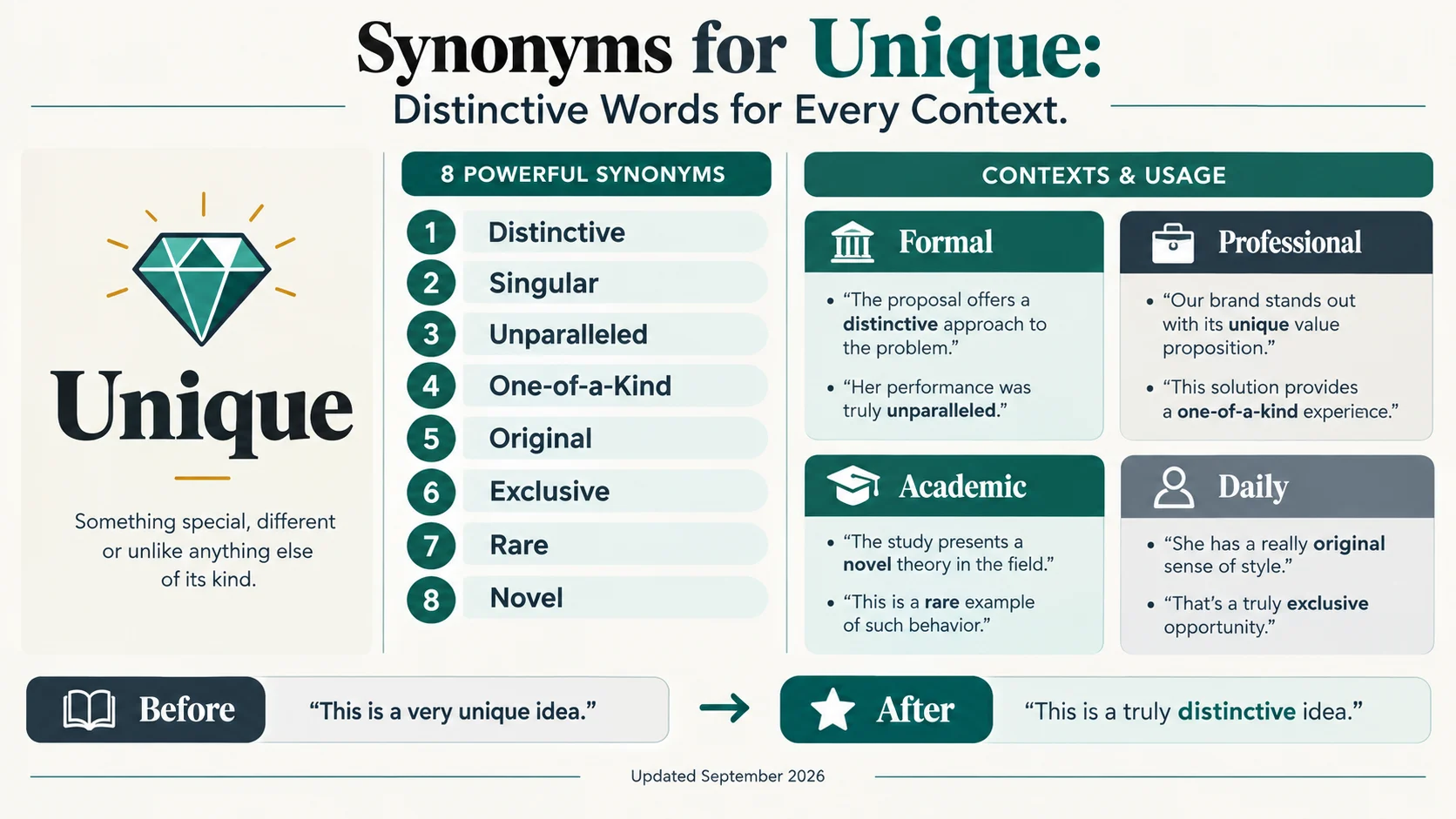
The best synonym for unique depends on your context. For formal writing, use distinctive or singular. For professional settings, choose exclusive or unparalleled. In everyday conversation, one-of-a-kind or original works best. Pick the word that matches your tone and audience.
What Does “Unique” Mean?
Definition
Unique describes something that is the only one of its kind. It signals exclusivity, rarity, and individuality. When you call something unique, you are saying that no exact match exists. The word comes from the Latin unicus, meaning “single” or “alone.” That root still shapes its meaning today: something unique stands apart from everything else.
Common Uses
| Usage | What It Means | Example |
|---|---|---|
| Describing a person | Someone with rare qualities | “She has a unique perspective on design.” |
| Describing an object | A one-of-a-kind item | “This is a unique handcrafted vase.” |
| Describing an experience | An unmatched moment | “The trip was a unique adventure.” |
| Describing a skill | A rare ability | “His unique talent set him apart.” |
| Business context | A distinct selling point | “Our brand offers a unique value proposition.” |
Best Synonyms for Unique
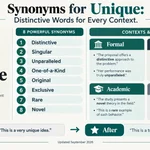
| Synonym | Meaning | Best Used When | Example |
|---|---|---|---|
| Distinctive | Clearly different from others | Emphasizing recognizable difference | “Her distinctive voice stands out.” |
| Singular | Exceptionally rare | Formal or literary contexts | “He showed singular dedication.” |
| Unparalleled | Having no equal | Highlighting superiority | “The service is unparalleled in the industry.” |
| One-of-a-kind | Literally the only one | Everyday emphasis | “This is a one-of-a-kind opportunity.” |
| Original | New and not derived | Creative work or ideas | “She pitched an original concept.” |
| Exclusive | Limited to a select group | Business and luxury contexts | “We offer exclusive access to members.” |
| Rare | Uncommon and hard to find | Describing scarcity | “That is a rare collectible.” |
| Uncommon | Not frequently seen | Neutral, factual writing | “His approach is uncommon but effective.” |
| Individual | Personal and distinct | Describing style or character | “Each piece has an individual charm.” |
| Novel | New and inventive | Academic or technical writing | “The study introduced a novel method.” |
Synonyms by Context
Formal Writing
Formal writing rewards precision. Choose singular, distinctive, or unparalleled when you want weight without sounding inflated. These words carry authority and fit well in essays, reports, and official documents.
- “The committee recognized her singular contribution to the field.”
- “The results are unparalleled in recent history.”
Professional Writing
In business, resumes, and marketing, exclusive, unrivaled, and standout do the heavy lifting. They project confidence and help your message land with clarity.
- “Our team delivers unrivaled customer support.”
- “He is a standout performer with a proven record.”
Academic Writing
Academic work favors novel, distinct, and differentiated. These terms signal rigor and avoid the casual tone that “unique” sometimes carries in scholarly contexts.
- “The researchers proposed a novel framework.”
- “Each sample showed distinct chemical properties.”
Daily Conversation
In everyday speech, one-of-a-kind, original, and special feel natural and warm. They keep the tone light while still conveying rarity.
- “That cafe is really one-of-a-kind.”
- “She has such an original sense of style.”
Professional Alternatives for Unique
When you need a term that works in a resume, pitch deck, or executive summary, choose from this set:
| Word | Why It Works | Example |
|---|---|---|
| Exclusive | Signals premium value | “We secured exclusive rights to the product.” |
| Unrivaled | Projects confidence | “Our service is unrivaled in speed.” |
| Distinctive | Clear and professional | “The brand has a distinctive identity.” |
| Standout | Strong in resumes | “A standout candidate with global experience.” |
| Differentiated | Fits strategy and marketing | “Our differentiated approach wins clients.” |
| Best-in-class | Common in business writing | “We offer best-in-class solutions.” |
Simple Alternatives for Unique
If you want plain, accessible words that anyone can understand:
| Simple Word | Example |
|---|---|
| Special | “This is a special day for us.” |
| Different | “Her style is different from the rest.” |
| Rare | “That is a rare find.” |
| Original | “He shared an original idea.” |
| One-of-a-kind | “It is a one-of-a-kind design.” |
Stronger Alternatives for Unique
When you want more impact or intensity, reach for these:
| Stronger Term | Best For | Example |
|---|---|---|
| Unparalleled | Marketing and formal writing | “The experience is unparalleled.” |
| Inimitable | Literary and sophisticated prose | “Her inimitable style cannot be copied.” |
| Matchless | Emphasis on superiority | “His skill is matchless.” |
| Peerless | Formal praise | “The craftsmanship is peerless.” |
| Unprecedented | Historical or record-setting claims | “The growth is unprecedented.” |
| Singular | Formal and elegant | “A singular achievement in science.” |
Difference Between Similar Synonyms
Many people use unique, distinctive, and rare as if they mean the same thing. They do not.
Unique means there is only one. Strictly speaking, something cannot be “very unique” or “somewhat unique.” It either is or is not the only one of its kind.
Distinctive means clearly different in a noticeable way. A distinctive voice is easy to recognize, but it is not necessarily the only one of its kind.
Rare means uncommon. A rare coin is hard to find, but other rare coins exist. Rarity is about frequency, not exclusivity.
Original means new and not copied. An original idea comes from the thinker, but similar ideas may exist elsewhere.
Unparalleled means having no equal. It carries a stronger claim than “unique” because it implies superiority, not just singularity.
Choosing the right word means asking what you actually mean. If you mean “the only one,” use unique. If you mean “easy to recognize,” use distinctive. If you mean “hard to find,” use rare.
Opposite Words (Antonyms)
The opposite of unique is anything that suggests sameness, commonness, or imitation. Here are the most useful antonyms:
| Antonym | Meaning | Example |
|---|---|---|
| Common | Found everywhere | “This is a common problem.” |
| Ordinary | Nothing special | “It was an ordinary day.” |
| Typical | Representative of a group | “That is a typical response.” |
| Generic | Lacking distinction | “The design felt generic.” |
| Mundane | Dull and everyday | “The tasks were mundane.” |
| Conventional | Following tradition | “He took a conventional approach.” |
| Imitative | Copied from something else | “The style was imitative, not original.” |
| Standard | Usual and expected | “This is the standard procedure.” |
FAQs
What is another word for unique?
Distinctive, singular, unparalleled, one-of-a-kind, original, and exclusive are all strong options. The right choice depends on your tone and context.
What is a formal synonym for unique?
Singular, unparalleled, and distinctive are the most formal. Novel works well in academic writing.
What is a professional alternative for unique?
Use exclusive, unrivaled, standout, or differentiated. These terms fit resumes, business proposals, and marketing copy.
What word can replace unique in a sentence?
| Sentence | Replacement |
|---|---|
| “She has a unique style.” | “She has a distinctive style.” |
| “This is a unique opportunity.” | “This is a rare opportunity.” |
| “He has a unique talent.” | “He has a singular talent.” |
| “The product is unique.” | “The product is one-of-a-kind.” |
Can you say “very unique”?
Most style guides advise against it. Unique already means “the only one of its kind,” so “very unique” is redundant. If you need emphasis, use truly unique or switch to unparalleled.
Is unique a positive word?
Usually, yes. It suggests rarity and individuality, which most people view as compliments. However, in some contexts, “unique” can imply oddness. Tone matters.
Conclusion
Unique is a powerful word, but it is not always the best one. When you need a synonym, match the term to your context. Use distinctive for recognizable difference, singular for formal elegance, exclusive for professional appeal, and one-of-a-kind for everyday clarity. Avoid overusing “unique” itself, since the word loses force when applied to everything.
The key is precision. Ask yourself what you actually mean: only one, hard to find, clearly different or simply special. Then choose the word that fits. Your writing will sound sharper, more credible, and more intentional.
Keep this guide nearby when you edit. It will help you swap tired words for stronger ones and make every sentence pull its weight.

Jack Murphy is a language writer with a passion for word meanings, synonyms, and effective communication. He creates informative and easy to understand content to help readers enhance their vocabulary and language skills.



1 thought on “Synonyms for Unique | 60+ Distinctive Alternatives”