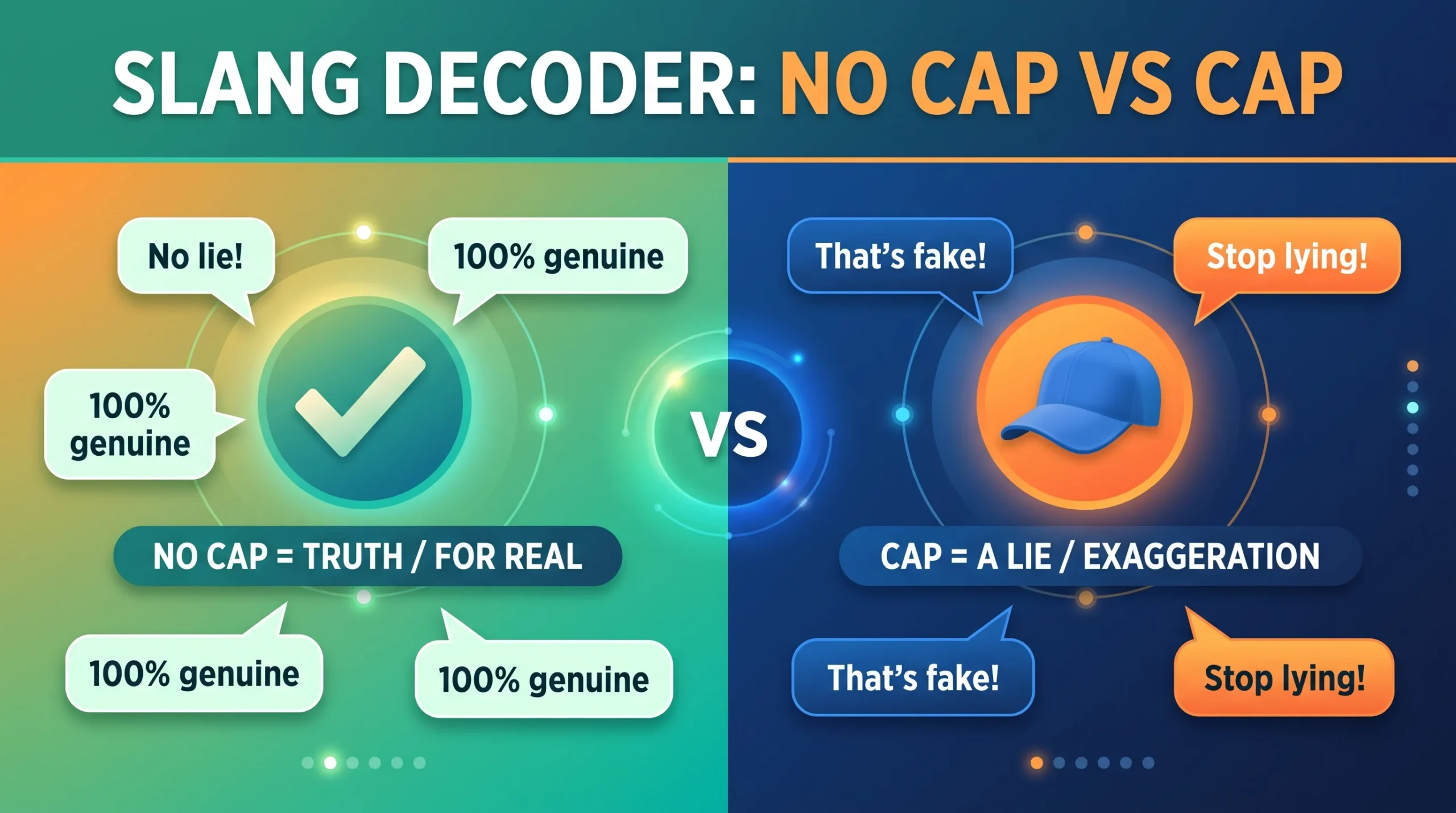
On the internet and in casual texting, no cap means “no lie,” “for real,” or “seriously.” It is used to emphasize that a statement is 100% genuine, true, and free of exaggeration or falsehood.
What Does No Cap Mean? A Complete Overview
Asking what does no cap mean is one of the most frequent searches for anyone keeping up with modern digital slang and pop culture. Language evolves rapidly, and modern youth slang frequently repurposes everyday words to convey specific emotional weight. Consequently, seeing the word “cap” detached from headwear can confuse readers at first. Furthermore, understanding its true meaning helps you read casual text messages accurately and participate in online trends naturally.
In modern texting, social media, and verbal conversations, the phrase functions as an absolute guarantee of truthfulness. When someone adds the phrase to a sentence, they are emphasizing that they are not lying, boasting artificially, or exaggerating the facts. Conversely, the root word cap means “a lie” or “a falsehood,” while calling someone out by saying capping means accusing them of lying or bluffing. Therefore, adding “no” directly in front of the word cancels out the falsehood, turning it into a pledge of authenticity.
The expression originated in Black American culture, specifically within Southern hip-hop communities in cities like Atlanta during the late 2010s. Rappers and music artists popularized the term in songs, where “capping” referred to flexing, exaggerating wealth, or fronting. Consequently, as the music dominated global streaming charts and short-form video platforms like TikTok, the phrase entered mainstream slang worldwide.
Quick Answer Guide
| Phrase | Primary Meaning | Primary Context | Example Sentence | Tone & Style |
| No Cap | For real / No lie | Social media, group chats | “That concert was the best night of my life, no cap.” | Authentic, Emphatic |
| Cap | A lie / Falsehood | Comments, story replies | “I think that story is total cap.” | Skeptical, Direct |
| Capping | Lying / Exaggerating | Debates, casual banter | “Why are you capping about your game score?” | Accusatory, Playful |
| Stop Capping | Stop lying | Direct confrontation | “Stop capping, we all know what actually happened.” | Blunt, Calling Out |
What Does No Cap Mean in Texting and Social Media?
When people ask what does no cap mean in text messages or direct messaging feeds, the primary answer is an assertion of complete honesty. Users add the phrase to validate bold claims, give intense compliments, or highlight unbelievable real-world events. Consequently, appending the phrase to a statement transforms a doubtful claim into a trusted story.
Furthermore, digital communication lacks physical tone of voice, making vocal emphasis difficult to express through plain text. Therefore, slang terms like this act as tone indicators, ensuring the reader knows the writer is being completely serious rather than sarcastic or hyperbolic.
For example, if a friend texts you about meeting a celebrity at a coffee shop, they might write, “I just took a selfie with Drake in downtown, no cap!” This usage assures you that they are not pulling a prank or misidentifying a stranger.
- Validating Bold Claims: Assures the reader that an unbelievable event actually happened.
- Amplifying Compliments: Signals that praise is genuine and not just polite flattery.
- Expressing Astonishment: Highlights genuine shock at real-world events or news.
Contextual Dynamics & Nuances of the Term
Understanding the phrase requires evaluating the surrounding conversational environment. Internet slang carries distinct social weight depending on who is speaking and where the conversation occurs.
- Social Media Posts: Reassures followers of real experiences with an emphatic, authentic tone.
- Casual Banter with Friends: Reinforces trust and bond with playful, honest energy.
- Live Stream Gaming Chats: Reacts to incredible skill plays with enthusiastic disbelief.
- Formal / Professional Emails: Inappropriate and highly unprofessional; avoid completely.
The Positive Usage: Authenticity and Praise
When used in friendly conversations, the expression acts as a seal of trust. It reassures your friends that you are being open, vulnerable, or genuine.
- Earnest Praise: Complimenting a friend’s outfit or skill without sounding fake.
- Storytelling Anchor: Grounding a dramatic personal anecdote in real truth.
- Shared Excitement: Celebrating team victories or personal achievements together.
The Opposite Side: Calling Out “Cap”
To fully grasp the phrase, you must understand its opposite. Dropping the “no” transforms the word into a tool for calling out deception.
- The Blue Cap Emoji (🧢): Internet users frequently comment with a single blue baseball cap emoji (🧢) to signal that they believe a video or post is fake or staged.
- Calling a Bluff: Telling someone “that’s cap” is a fast, casual way to express skepticism toward an exaggerated flex.
Real-Life Conversation Examples Using No Cap
Reviewing real-life chat exchanges helps illustrate how the term functions across different everyday scenarios.
1: Giving a Genuine Compliment
- User A: “How do I look in this suit for the wedding?”
- User B: “Bro, you look clean as ever, no cap!”
- User A: “Appreciate it man, was a bit nervous about the fit.”
2: Sharing an Unbelievable Story
- Friend A: “You will never guess what happened on my drive home.”
- Friend B: “What happened?”
- Friend A: “A stray dog opened my car door at the red light, no cap!”
3: Calling Out Exaggeration (Cap)
- Gamer 1: “I scored 50 points in that match single-handedly.”
- Gamer 2: “Bro, that is total cap, I checked your match stats!”
- Gamer 1: “Okay fine, it was more like 20 points, but still!”
4: Expressing Opinion on Media
- Viewer A: “Did you finish watching the season finale last night?”
- Viewer B: “Yes! That was the single best episode of TV this year, no cap.”
- Viewer A: “Agreed, the plot twist at the end was wild!”
5: Validating Personal Commitment
- Teammate A: “Are you actually going to hit the gym at 5:00 AM tomorrow?”
- Teammate B: “I will be waiting outside the doors before they open, no cap.”
- Teammate A: “Alright, I’ll set my alarm now!”
Platform-Specific Breakdown
Different online platforms embrace the expression in slightly different ways.
- TikTok: Widely used in video captions, text overlays, and comment feeds to emphasize dramatic storytimes or unscripted moments.
- X (Twitter): Frequently paired with the baseball cap emoji (🧢) in quote tweets to challenge sensationalized news or viral claims.
- Twitch & Discord: Spoken aloud by gamers to highlight incredible gameplay plays or call out opponents who boast about skills.
- iMessage & Group Chats: Used as sentence closers to add emphasis and honesty to casual text exchanges.
How It Is Used on TikTok and X
On TikTok, creators use the phrase in video titles like “I tried the hardest food challenge in town, no cap.” This hook promises viewers that the video is unscripted and real rather than staged for views.
On X (formerly Twitter), the blue cap emoji serves as visual shorthand. Commenters reply with “🧢” under posts they suspect are fabricated, creating a fast, crowd-sourced fact-checking culture in comment threads.
Alternative Meanings & NLP Variations of the Phrase
While the slang definition dominates modern digital queries, the word “cap” itself exists across several formal industries.
- Capitalization / Financial Cap (Finance): Refers to market capitalization or spending limits in corporate budgets.
- Cap / Capping (Manufacturing): The mechanical process of sealing bottles or containers in industrial plants.
- Salaried Salary Cap (Sports): The legal limit on total team payroll in professional sports leagues like the NBA or NFL.
- Capital Letter (Typography): Shortened term for uppercase text formatting.
Misinterpretations: When NOT to Use No Cap
Using informal slang in the wrong environment can create awkward moments or make professional communications look careless.
| Setting | Context | Appropriateness Level | Recommended Alternative |
| Casual Texting | Group Chat / DMs | Highly Appropriate | no cap / for real |
| Social Media | Public posts / Comments | Highly Appropriate | no cap / genuinely |
| Corporate Email | Work / Professional | Prohibited | Sincerely / I assure you |
| Academic Writing | Essays / Research | Prohibited | Undeniably / Truly |
Avoid in Professional and Formal Contexts
Never use street or internet slang in formal business correspondence or academic papers. Writing “The quarterly revenue growth was huge, no cap” to an executive or client sounds unprofessional. Instead, use clear, elevated terms like “genuinely,” “without question,” or “undeniably.”
Furthermore, refrain from overusing slang terms in every sentence. Forcing modern expressions into every message can feel unnatural or insincere to your audience.
How to Respond in Chat Comfortably
When someone uses the phrase in a text to you, responding naturally is simple once you recognize their intent.
- Reassuring Statements: If someone says “I’m going to help you move tomorrow, no cap,” respond with appreciation (“Thanks bro, I really appreciate it!”).
- Compliments: If someone texts “You killed that presentation, no cap,” accept the praise warmly (“Thank you! I worked really hard on it.”).
- Dramatic Stories: If someone shares a wild story with the phrase attached, match their surprise (“No way! That’s unbelievable!”).
FAQs
What does no cap mean on TikTok?
On TikTok, it means “for real” or “no lie.” Creators use it to emphasize that their story, video, or opinion is completely genuine and not exaggerated.
Where did the phrase no cap come from?
The term originated in Hip-Hop culture, particularly in the Southern US (Atlanta), where “capping” meant flexing, bragging, or lying about wealth.
What is the difference between cap and no cap?
Cap means a lie or fake statement. No cap means the absolute truth without exaggeration.
What does the blue cap emoji 🧢 mean?
The blue baseball cap emoji represents “cap” or lying. People drop it in comments when they believe a post or video is fake.
Is no cap an insult?
No, the phrase itself is a positive assurance of honesty. However, telling someone “that’s cap” is calling them out for lying.
How do you pronounce no cap?
You pronounce it exactly as written: “noh kap.”
Can you use no cap in professional emails?
No, it is informal slang and should be avoided in corporate, academic, or professional settings.
What does capping mean in gaming?
In general slang, “capping” means lying. However, in shooter games like Call of Duty, “capping” can also be short for “capturing” a flag or control point.
What is the origin of the word cap?
The slang term stems from early 20th-century slang where “to cap” meant to surpass, top, or exaggerate something beyond reality.
What is the synonym for no cap?
Common synonyms include for real (fr), no lie, seriously, honestly, and 100%.
Conclusion
Digital language continuously evolves, turning short cultural phrases into widespread tools for emotional clarity. Understanding expressions like this allows you to navigate group chats, social feeds, and modern pop culture with ease. Whether you are hyping up a friend’s achievement or sharing a wild personal experience, knowing how to express real authenticity ensures your message comes through clearly across every digital space.