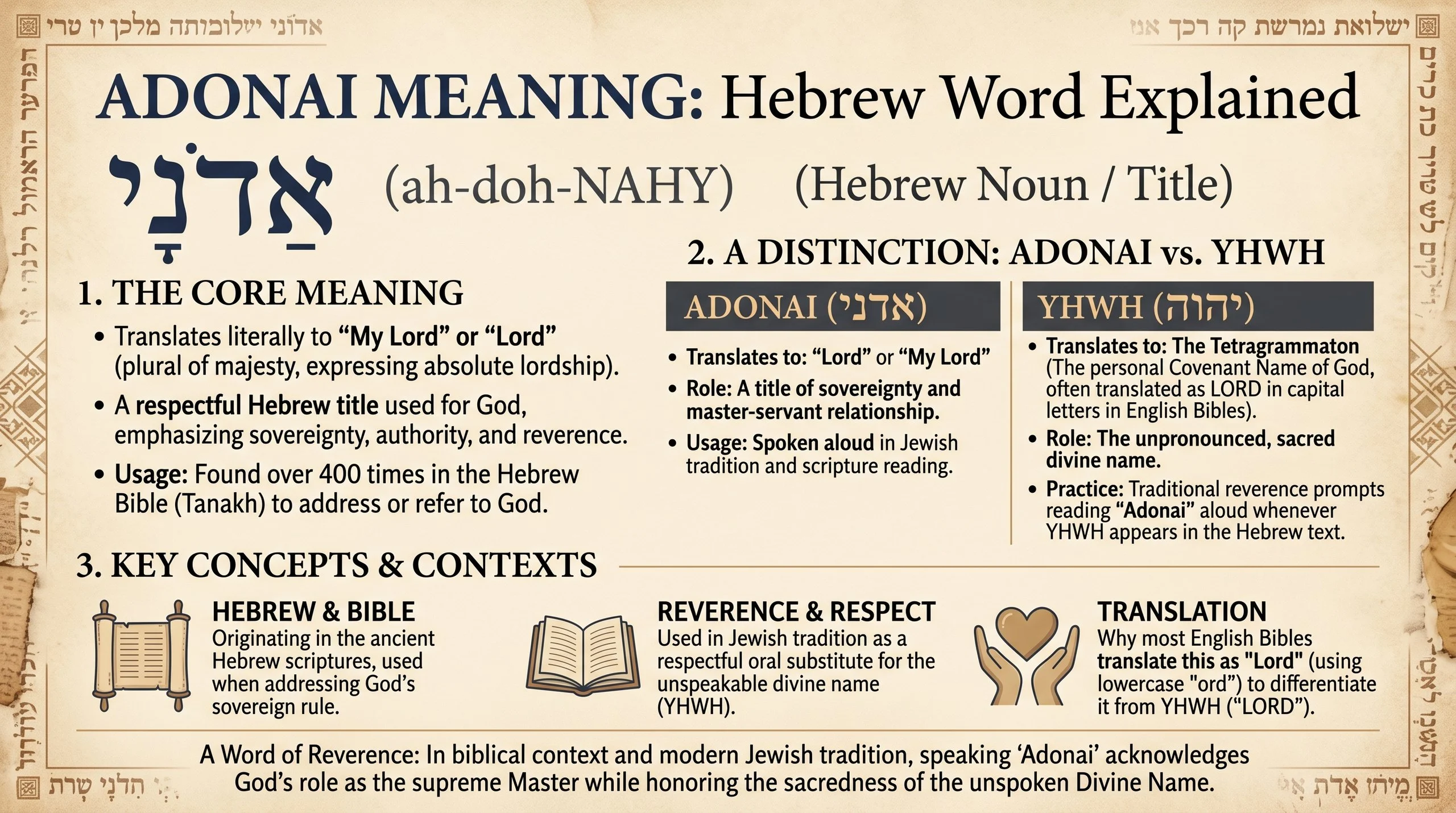
Adonai is a Hebrew title meaning “Lord” or “my Lord.” It is traditionally used in Jewish scripture and worship as a respectful way to refer to God. The term also appears in Christian biblical study, translations, prayer, and religious discussion.
Adonai meaning refers to the Hebrew expression traditionally translated as “Lord” or “my Lord.” It carries a strong sense of reverence and respect when used for God in Jewish scripture and worship. However, its meaning can change slightly depending on the grammatical and religious context.
The word appears frequently in discussions about the Hebrew Bible, prayer, theology, biblical translation, and Jewish tradition. Therefore, understanding the term requires more than a simple dictionary definition. Its spelling, pronunciation, history, and use all add important layers of meaning.
For English speakers, the term may appear in Bible studies, religious books, worship music, social media posts, or conversations about Hebrew words. Consequently, readers sometimes wonder whether it is a name, a title, a form of slang, or an ordinary Hebrew word.
The answer is important: Adonai is primarily a respectful Hebrew title for God, not modern internet slang. Its religious context should guide how people understand and use it.
Quick Answer Box
| Meaning | Context | Primary Platforms | Example | Tone |
| Lord or my Lord | Hebrew Bible, Jewish worship, theology | Bible study, religious websites, social media, texting | “Adonai is used as a respectful title for God.” | Reverent |
| A Hebrew title associated with God | Religious discussion | TikTok, Instagram, YouTube, messaging | “I was studying the meaning of Adonai.” | Educational |
| Lord or master in broader Hebrew usage | Historical or linguistic context | Academic discussion and biblical study | “The Hebrew word can refer to a lord or master depending on context.” | Formal |
What Does Adonai Meaning Mean?
The term Adonai comes from Hebrew and is commonly translated as “Lord.” It is associated especially with Jewish reading and worship of the Hebrew Bible.
The underlying Hebrew word is connected with adon, meaning “lord,” “master,” or “owner.” In ordinary contexts, related forms could describe a human lord or master. However, the form Adonai became strongly associated with reference to God.
This distinction matters because Hebrew uses related words in several ways. A word connected with lordship does not automatically refer to God. Context determines the intended meaning.
In Jewish tradition, Adonai is also connected with the practice of reading the divine name represented by the Hebrew letters Yod Heh Vav Heh. That name is often transliterated as YHWH. Traditionally, Jewish readers do not pronounce that divine name as written during public reading. Instead, they say Adonai.
Therefore, the term functions as a spoken substitute for the divine name in many traditional Jewish contexts.
Is Adonai a Name or a Title?
This question creates considerable confusion.
Adonai is best understood as a title or reverential form of address, rather than simply a personal name in the same sense as an ordinary human name.
The title emphasizes God’s authority and lordship. It can therefore communicate ideas such as:
- Lord
- My Lord
- Master
- Sovereign
- Ruler
The exact English rendering depends on the translation and context.
The Hebrew Connection
The Hebrew word adon can mean “lord” or “master.” It can describe a person who has authority over others. It can also occur in expressions referring to God.
The form Adonai has a distinctive grammatical history. English readers should not assume that every occurrence has exactly the same function.
Furthermore, English Bible translations handle Hebrew divine titles in different ways. Some use LORD, often in capital letters, when representing the divine name. Others use “Lord” according to their translation conventions.
This explains why readers may encounter different capitalization patterns in English Bibles.
Why Capitalization Matters
Capitalization can provide clues in English translations.
For example, LORD in many English Bibles is a translation convention associated with the Hebrew divine name. Meanwhile, Lord may represent a Hebrew title such as Adonai or another related expression.
However, capitalization conventions differ between translations. Therefore, readers should check the translation’s notes when a distinction matters.
Contextual Dynamics and Nuances of the Term
Understanding adonai meaning requires attention to context. The term does not operate exactly like a casual English word.
Religious Context
In Jewish religious contexts, Adonai carries reverence. It may occur during Torah reading, prayer, biblical study, and discussion of God.
The word therefore has emotional and cultural significance beyond its basic dictionary translation.
For example, someone studying Hebrew may ask:
“Why does the reader say Adonai instead of pronouncing the divine name?”
That question concerns Jewish reading tradition rather than internet slang.
Biblical Context
The term appears in translations and discussions of the Hebrew Bible. Its interpretation can depend on the Hebrew wording, grammatical form, and surrounding passage.
Biblical scholars may distinguish between:
- Adon
- Adoni
- Adonai
- The divine name represented as YHWH
These forms should not automatically be treated as identical.
Linguistic Context
From a linguistic perspective, the word belongs to a family of Hebrew expressions related to authority and lordship.
Consequently, translating it simply as “Lord” is useful but does not capture every possible nuance.
A translator must consider grammar, historical usage, literary context, and theological convention.
Jewish and Christian Usage
Jewish and Christian communities may both use the term, but their traditions surrounding it are not identical.
In Judaism, Adonai has a well established role in reading and prayer. In Christianity, the term often appears in biblical study, worship, theology, Hebrew studies, and songs.
Therefore, seeing the word in a Christian context does not mean that its origin is Christian. The term comes from Hebrew and has a long history within Jewish scripture and tradition.
Modern Cultural Context
Today, people may encounter the term outside formal religious settings.
For example, a Bible study creator might explain it in a TikTok video. An Instagram account might include it in a religious caption. A student might ask about it in a group chat.
The platform changes the presentation, but it does not fundamentally change the word’s traditional meaning.
Real Life Conversation Examples Using Adonai Meaning
The following examples show how people might naturally discuss the term today. These examples focus on educational and religious conversations rather than treating the word as internet slang.
Example 1: Bible Study
Maya: I keep seeing “Adonai” in Hebrew studies. What does it mean?
Daniel: It is usually translated as “Lord” or “my Lord.”
Maya: Is it God’s personal name?
Daniel: It is generally understood as a title or reverential form of address associated with God.
Maya: That makes more sense. I was treating it like a personal name.
Example 2: Language Learning
Alex: I’m learning Biblical Hebrew, and I came across Adonai.
Jordan: What did your textbook say?
Alex: It connects the word with the idea of lord or master.
Jordan: Right. The religious use has a special connection with referring to God.
Alex: So context is really important.
Jordan: Exactly.
Example 3: Social Media Discussion
Sam: Someone commented “Adonai” under a worship video. Is that slang?
Taylor: Not traditionally. It is a Hebrew religious term.
Sam: So what does it mean?
Taylor: It is commonly translated as “Lord” or “my Lord.”
Sam: Got it. I thought it was an internet expression.
Example 4: Bible Translation
Nina: Why does my Bible sometimes use “LORD” and sometimes “Lord”?
Chris: Different capitalization can represent different Hebrew terms or translation conventions.
Nina: Does Adonai have something to do with that?
Chris: Yes. Adonai is traditionally translated as “Lord,” while “LORD” in many English Bibles often represents the divine name.
Nina: That explains the difference.
Example 5: Religious Conversation
Ethan: I heard the word Adonai during a discussion about Hebrew worship.
Leah: Yes. It is a traditional Hebrew title associated with God.
Ethan: Does it literally mean “Lord”?
Leah: That is the common English translation, although the broader linguistic context adds nuance.
Ethan: Interesting. I will look at the Hebrew context next.
Platform Specific Breakdown
Modern platforms can expose people to religious vocabulary in short videos, captions, comments, and messages. However, the platform does not define the traditional meaning of the word.
How It Is Used on Snapchat
Snapchat is primarily a visual messaging platform. Religious vocabulary may appear in private messages, stories, screenshots, or conversations between friends.
Someone might send a Bible study screenshot containing the word. Another person may ask what it means.
For example:
“What does Adonai mean here?”
A natural answer could be:
“It is Hebrew for ‘Lord’ and is traditionally used as a reverential title for God.”
The word itself does not become Snapchat slang simply because it appears in a Snapchat conversation.
The Role of Adonai on TikTok
TikTok can introduce religious and linguistic terms to large audiences through short educational videos.
Creators may discuss Hebrew words, biblical passages, worship practices, or Bible translation. A viewer might encounter Adonai without previously knowing Hebrew.
Search behavior can also create confusion. Users may search phrases such as:
- “What does Adonai mean?”
- “Adonai definition”
- “Adonai in the Bible”
- “How do you pronounce Adonai?”
- “Is Adonai God’s name?”
These are primarily educational questions.
A short video may simplify the answer, but viewers should remember that Hebrew words can have grammatical and historical nuances that a thirty second video cannot fully explain.
Instagram and Texting Dynamics
Instagram captions often compress complex religious ideas into short statements. A creator might write:
“Trust Adonai.”
In that setting, the term functions as a religious reference to God.
A private message might say:
“I am studying the Hebrew titles for God. What is Adonai?”
Again, this is an educational question.
In texting, people may use the word in prayers, encouragement, worship discussions, or Bible study conversations. Its appearance in a casual message does not make the term casual in meaning.
YouTube and Religious Education
YouTube is another common environment for explanations of Hebrew vocabulary.
Videos may discuss pronunciation, biblical usage, Hebrew grammar, or differences between Adonai and other divine titles.
Viewers should distinguish between a creator’s interpretation and established linguistic information. Religious terminology often attracts different theological explanations, so source quality matters.
Search Engines and AI Platforms
People may also ask search engines and AI systems questions such as:
“What is the Adonai meaning in Hebrew?”
A useful answer should explain both the basic translation and the cultural context.
A one word answer such as “Lord” is technically useful but incomplete. A stronger explanation identifies the term’s Hebrew origin and its traditional religious use.
Alternative Meanings and NLP Variations of the Phrase
Search engines may identify many expressions as semantically related to the same topic.
Common variations include:
| Search Variation | General Meaning |
| Adonai definition | A request for a dictionary style explanation |
| Adonai in Hebrew | A question about the original language |
| Adonai Hebrew meaning | A request for translation and linguistic context |
| Adonai meaning in the Bible | A biblical usage question |
| Adonai translation | A question about English equivalents |
| Adonai pronunciation | A question about spoken form |
| Adonai meaning Lord | A direct translation query |
| What does Adonai mean | A natural language definition question |
| Adonai name of God | A question about title versus name |
| Adonai biblical meaning | A religious and scriptural interpretation query |
Adonai and “Lord”
“Lord” is the most common English equivalent. However, translation does not always communicate every cultural and grammatical detail.
“Lord” can refer to human authority in English. In biblical and religious contexts, it can also refer to God.
Therefore, context remains essential.
Adonai and “My Lord”
The expression is often explained through the idea of “my Lord.” However, the grammatical history behind the form is more complex than a simple word for word English substitution.
This distinction matters in serious Hebrew study.
Adonai and YHWH
The terms are closely connected in Jewish reading tradition, but they should not simply be declared identical words.
YHWH represents the Hebrew divine name using its consonantal form. Adonai is a Hebrew title traditionally spoken in place of that name during reading.
This is one of the most important distinctions for beginners.
Adonai and Elohim
Elohim is another major Hebrew term associated with God. It is commonly translated as “God.”
Adonai emphasizes lordship or authority. Elohim is commonly translated through the concept of God or deity.
The terms can therefore communicate different aspects of biblical language.
Misinterpretations: When Not to Use Adonai Meaning
There are several common mistakes surrounding the term.
Do Not Treat It as Modern Slang
Calling Adonai “internet slang” can create an inaccurate impression.
The word predates modern digital communication by a very long period. Its traditional significance comes from Hebrew language and religious practice.
Do Not Assume Every “Lord” Means Adonai
English translations use “Lord” for more than one Hebrew expression.
Therefore, seeing “Lord” in an English Bible does not automatically prove that the underlying Hebrew word is Adonai.
Do Not Equate Every Related Hebrew Form
Adon, Adoni, and Adonai are related, but their grammatical and contextual functions deserve separate attention.
A beginner should avoid treating them as interchangeable in every sentence.
Do Not Ignore Jewish Context
The term has an important place in Jewish tradition.
Explaining it only through a modern Christian worship context can leave out important historical information.
Do Not Use It as a Casual Substitute for “God” Without Understanding Context
A person can encounter the term in religious writing without fully understanding its cultural significance.
When using Hebrew religious vocabulary, learning the traditional context first is respectful and linguistically useful.
How to Respond in Chat Comfortably
If someone sends you the word in a message, you do not need to overcomplicate your response.
If Someone Asks “What Does Adonai Mean?”
You can answer:
“Adonai is a Hebrew term commonly translated as ‘Lord’ or ‘my Lord.’ It is traditionally used as a respectful title for God.”
If Someone Asks Whether It Is Slang
You can say:
“No. It is a Hebrew religious term rather than modern internet slang.”
If Someone Uses It in a Religious Message
You can respond naturally:
“Thanks for explaining. I had seen the word before but did not know its Hebrew background.”
If You Are Unsure About the Context
Ask:
“Are you asking about the Hebrew meaning, the biblical usage, or how people use it today?”
This question helps separate language, theology, and social media usage.
If Someone Uses It in a Caption
You can acknowledge the context without assuming a specific theological interpretation.
For example:
“I understand. You are using Adonai as a religious reference to God.”
This keeps the conversation clear and respectful.
FAQs
1. What is the basic Adonai meaning?
The term is commonly translated as “Lord” or “my Lord.” It is a Hebrew expression associated with reverence and authority, especially in reference to God.
2. Is Adonai a Hebrew word?
Yes. It is a Hebrew form related to words expressing lordship, mastery, or authority. Its religious use developed an important connection with reference to God.
3. Is Adonai God’s personal name?
It is generally better understood as a title or reverential form of address rather than a personal name. It is traditionally associated with speaking about God.
4. Why do Jewish readers say Adonai?
In Jewish reading tradition, Adonai is traditionally spoken in place of pronouncing the divine name represented by YHWH.
5. Does Adonai mean Lord?
Yes. “Lord” is the most common English translation. “My Lord” is also used when explaining the Hebrew expression.
6. How is Adonai pronounced?
In English discussions, it is commonly pronounced approximately ah doh NYE. Pronunciation can vary slightly depending on language and speaker.
7. Is Adonai used in Christianity?
Yes. Christians may encounter the term in Bible studies, worship, theology, Hebrew studies, and religious music. Its origin, however, belongs to Hebrew language and Jewish scripture.
8. Is Adonai used on TikTok and Instagram?
It can appear on both platforms, especially in religious education, worship content, Bible discussions, and captions. Its appearance on social media does not turn it into slang.
9. Is Adonai the same as YHWH?
They are closely related in Jewish reading tradition, but they are not simply identical terms. YHWH represents the divine name, while Adonai is a title traditionally spoken in its place during reading.
10. Can I use Adonai in everyday conversation?
You can discuss or quote the term in appropriate contexts. Because it has religious significance, it is useful to understand its traditional meaning before using it casually.
Conclusion
The adonai meaning is rooted in Hebrew language, biblical tradition, and religious practice rather than modern internet slang. The term is commonly translated as “Lord” or “my Lord,” and it carries a strong sense of reverence when used in reference to God.
Its importance becomes clearer when readers understand the difference between a translation and the full historical context. The English word “Lord” provides a useful starting point, but Hebrew grammar and Jewish reading tradition provide additional depth.
The term also has an important relationship with YHWH, the divine name represented by its Hebrew consonants. In traditional Jewish reading, Adonai is spoken in place of pronouncing that name. This practice explains why the word appears so frequently in discussions about biblical Hebrew and English Bible translation.
Modern technology has made the term easier to encounter. People may see it in Bible study videos, TikTok explanations, Instagram captions, YouTube lessons, worship content, or private messages. However, its digital setting does not change its historical meaning.
For English learners, the key lesson is simple: context matters. Adonai can be translated as “Lord” or “my Lord,” but understanding its religious and linguistic background gives the word much greater clarity.
When researching Hebrew terminology, it is also useful to compare translations, examine the original language, and consider the traditions surrounding a term. That approach produces a more accurate understanding than relying on a single short definition.
Ultimately, learning the adonai meaning provides more than vocabulary knowledge. It opens a window into Hebrew language, biblical translation, Jewish reading tradition, and the way ancient religious vocabulary continues to appear in modern communication.