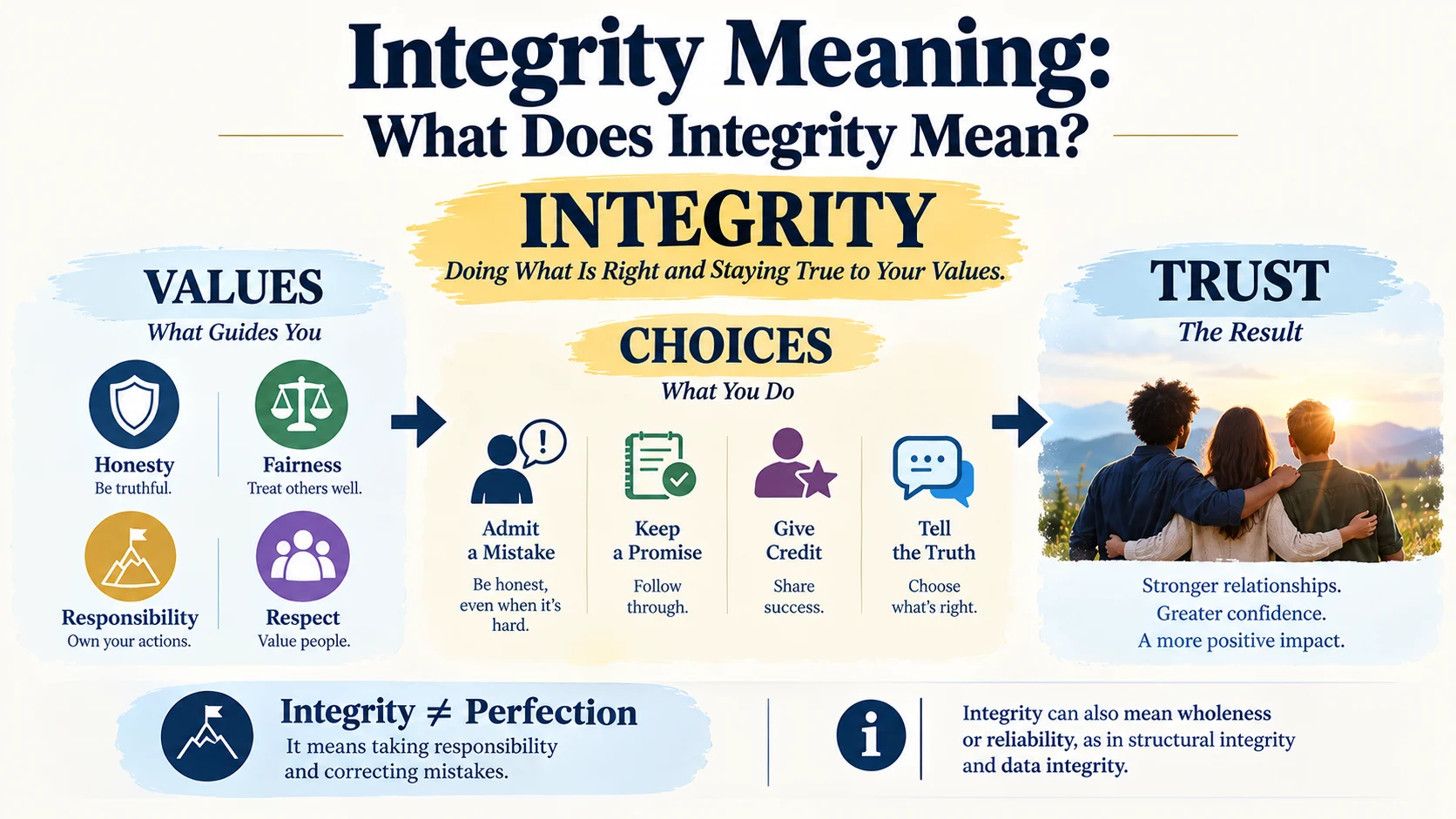
The word integrity describes a quality that helps people earn trust and respect. You may hear someone praised for having integrity at work, school, in relationships, or during difficult situations. However, the integrity meaning goes beyond simply being honest. It involves acting according to your values and principles, even when doing so is difficult or when nobody is watching.
In simple terms, integrity means doing what is right and staying true to your principles. A person with integrity tries to make honest, fair, and responsible choices. They keep their promises when possible, admit mistakes, take responsibility for their actions, and avoid changing their values simply because doing so would be convenient.
Integrity also involves consistency. For example, someone who says honesty matters but regularly lies when it benefits them may not demonstrate strong integrity. On the other hand, a person who tells the truth even when it could create an uncomfortable situation shows a stronger commitment to their principles.
In this guide, we will explore the integrity meaning, its definition, examples, types, importance, related words, workplace uses, common misconceptions, and practical ways to demonstrate integrity in everyday life.
What Does Integrity Mean?
Integrity means being honest, ethical, and consistent with your values and principles.
A person with integrity tries to do the right thing even when there is no reward, nobody is watching, or the easier choice would be to act differently.
For example:
She showed integrity by admitting her mistake instead of blaming someone else.
In this example, integrity involves honesty, accountability, and responsibility.
Integrity Meaning in Simple English
The simplest definition of integrity is:
Integrity means doing the right thing and staying true to your values.
It often involves several qualities:
- Honesty
- Fairness
- Responsibility
- Accountability
- Consistency
- Trustworthiness
- Strong moral principles
Integrity is not about being perfect. Everyone makes mistakes. Instead, a person with integrity takes responsibility for mistakes and tries to correct them.
Integrity Definition
Integrity is the quality of having strong moral principles and behaving consistently with those principles.
It can describe both a person’s character and the way they approach decisions.
For example:
“The manager is known for her integrity.”
This means the manager is trusted because she behaves honestly, responsibly, and according to strong ethical principles.
Integrity can also describe an organization, process, or system.
For example:
“The investigation was conducted with integrity.”
Here, the word suggests that the investigation was conducted honestly, fairly, and without improper influence.
What Does Integrity Mean in Life?
In everyday life, integrity means making choices that match your values.
Suppose you find a wallet on the ground. Nobody saw you pick it up, and you could easily keep the money.
Returning it demonstrates integrity because you choose to do what you believe is right even when there is little chance of being caught.
Similarly, integrity may involve:
- Telling the truth
- Keeping promises
- Respecting other people’s property
- Admitting mistakes
- Following through on commitments
- Treating people fairly
- Standing up for what is right
- Avoiding dishonest shortcuts
Therefore, integrity often becomes most visible when a person faces a difficult choice.
Why Is Integrity Important?
Integrity matters because trust depends on consistent behavior.
People are more likely to trust someone whose words and actions match. Likewise, organizations with ethical leadership can build stronger relationships with employees, customers, and communities.
Integrity can help a person:
- Build trust
- Maintain a strong reputation
- Make ethical decisions
- Earn respect
- Strengthen relationships
- Accept responsibility
- Handle difficult situations
- Create reliable habits
- Develop strong character
For instance, an employee who admits an error quickly gives their manager an opportunity to fix the problem. Hiding the mistake may protect the employee temporarily, but it can create a much bigger problem later.
Examples of Integrity
Integrity can appear in both major decisions and small everyday actions.
Example 1: Admitting a Mistake
A student accidentally submits the wrong file for an assignment. Instead of pretending the system caused the problem, the student tells the teacher what happened.
That shows integrity because the student accepts responsibility.
Example 2: Returning Lost Property
Someone finds a phone in a public place and turns it in rather than keeping it.
This demonstrates honesty and respect for another person’s property.
Example 3: Keeping a Promise
A friend promises to help someone move and follows through even though another opportunity comes up.
This shows reliability and commitment.
Example 4: Giving Credit
An employee uses an idea suggested by a coworker and gives that coworker proper credit.
That action demonstrates fairness and honesty.
Example 5: Telling the Truth
A person admits that they broke something instead of blaming someone else.
This shows accountability.
Example 6: Doing the Right Thing Privately
Someone notices an error in a financial transaction that benefits them. They report the error even though nobody would probably discover it.
This is a strong example of integrity because the decision is made without external pressure.
Personal Integrity Meaning
Personal integrity means behaving according to your own ethical principles in your everyday life.
It can involve:
- Being honest with yourself and others
- Keeping commitments
- Respecting boundaries
- Taking responsibility
- Treating people fairly
- Making consistent choices
- Standing by important values
Personal integrity does not mean that you never change your beliefs. People can learn and develop new perspectives while still acting with integrity.
The key is that your behavior remains guided by sincere principles rather than convenience alone.
Professional Integrity Meaning
Professional integrity means behaving honestly, ethically, responsibly, and fairly in a workplace or professional setting.
Examples include:
- Reporting accurate information
- Protecting confidential information
- Giving coworkers proper credit
- Following professional standards
- Admitting mistakes
- Avoiding conflicts of interest
- Treating customers honestly
- Keeping commitments
- Refusing dishonest practices
For example, an accountant who refuses to alter financial information simply because a manager asks them to demonstrates professional integrity.
Integrity in the Workplace
Integrity is especially important in workplaces because employees and organizations depend on trust.
A person can demonstrate workplace integrity by:
- Being honest about mistakes
- Meeting commitments
- Respecting confidential information
- Giving accurate reports
- Treating coworkers fairly
- Following company policies
- Giving credit to others
- Avoiding dishonest shortcuts
However, workplace integrity does not mean blindly following every instruction. Ethical behavior may sometimes require questioning an unfair or inappropriate request.
Integrity in Leadership
Good leaders often need integrity because their decisions influence other people.
A leader with integrity:
- Keeps promises
- Accepts responsibility
- Communicates honestly
- Treats people fairly
- Applies rules consistently
- Gives credit to others
- Admits when they are wrong
- Avoids abusing authority
For example, a manager who accepts responsibility for a failed project rather than blaming the team demonstrates leadership integrity.
By contrast, a leader who takes credit for others’ work while blaming employees for problems may damage trust.
Integrity in Relationships
Integrity also matters in friendships, families, and romantic relationships.
It can include:
- Being honest
- Keeping promises
- Respecting boundaries
- Communicating openly
- Taking responsibility
- Keeping private information private
- Treating the other person fairly
For example, telling a friend that you cannot keep a promise is often more honest than repeatedly making excuses.
Healthy relationships do not require perfection. Instead, they benefit from honesty, consistency, accountability, and mutual respect.
Integrity in School
Students can demonstrate integrity through academic honesty and responsible behavior.
Examples include:
- Doing your own work
- Citing sources properly
- Avoiding cheating
- Admitting mistakes
- Giving classmates credit
- Following assignment rules
- Being honest with teachers
Academic integrity is particularly important because grades and qualifications are supposed to represent genuine knowledge and effort.
Moral Integrity Meaning
Moral integrity refers to consistency between a person’s moral principles and their actions.
For example, someone who believes that people should be treated fairly and consistently acts according to that belief demonstrates moral integrity.
Moral integrity often involves difficult choices. A person may need to choose between personal benefit and what they believe is ethically right.
That is why integrity is closely connected to character.
Integrity vs. Honesty
Integrity and honesty are closely related, but they are not exactly the same.
Honesty means telling the truth and avoiding deception.
Integrity is broader. It includes honesty but also involves consistency, responsibility, fairness, and adherence to principles.
For example:
Someone may tell the truth in one situation but still behave irresponsibly in other areas.
That person may be honest in that moment without demonstrating strong overall integrity.
A simple distinction is:
Honesty = telling the truth.
Integrity = living according to your principles.
Integrity vs. Morality
These concepts overlap but are different.
Morality concerns ideas about right and wrong.
Integrity concerns whether a person consistently acts according to their principles.
For example, a person may believe that stealing is wrong. Integrity is demonstrated when that person follows the principle even when stealing would be easy and profitable.
Therefore:
Morality = beliefs about right and wrong.
Integrity = consistency between principles and actions.
Integrity vs. Loyalty
Loyalty means showing continued support for a person, group, organization, or cause.
Integrity means acting according to ethical principles.
These qualities can sometimes conflict.
For example, imagine an employee discovers serious wrongdoing by a close colleague. Loyalty might make the employee want to protect the colleague, while integrity might require reporting the problem.
In such a situation, loyalty does not automatically make an action ethical.
Integrity vs. Responsibility
Responsibility means being accountable for duties, actions, or obligations.
Integrity includes responsibility but goes beyond it.
For example, an employee may complete a task because it is their responsibility. An employee who also reports an error honestly and refuses to manipulate the results demonstrates integrity.
Synonyms for Integrity
Some words related to integrity include:
- Honesty
- Trustworthiness
- Principled behavior
- Ethical character
- Decency
- Sincerity
- Uprightness
- Honor
- Reliability
- Moral strength
However, these words are not perfect synonyms in every context.
For example, honesty focuses strongly on truthfulness, while integrity has a broader meaning involving principles and consistent conduct.
How to Show Integrity
Integrity is not something you demonstrate only through major moral decisions. Small habits can strengthen it too.
1. Keep Your Promises
Do what you say you will do. If circumstances change, communicate honestly rather than disappearing or making excuses.
2. Admit Your Mistakes
Nobody gets everything right. Acknowledging mistakes shows accountability.
3. Tell the Truth
Avoid changing facts simply because the truth is uncomfortable.
4. Give Credit
Recognize other people’s work and contributions.
5. Follow Your Principles
Do not abandon important values simply because a dishonest choice is easier.
6. Treat People Fairly
Respect people even when they cannot offer you anything in return.
7. Be Consistent
Try to apply your principles in private as well as public situations.
Is Integrity a Skill or a Character Trait?
Integrity is generally described as a character trait or quality, although people can develop behaviors that support it.
For example, someone can practice:
- Honest communication
- Accountability
- Responsible decision-making
- Keeping commitments
- Ethical reasoning
Over time, these behaviors can become part of a person’s character.
So, integrity is not simply a technical skill. It is a quality reflected through repeated choices.
Is Integrity the Same as Being Perfect?
No.
A person with integrity can make mistakes, change their mind, or fail.
What matters is how they respond.
Someone may demonstrate integrity by saying:
“I made a mistake. I was wrong, and I need to fix it.”
That response can show more integrity than pretending to be perfect.
Therefore, integrity does not require perfection; it requires honesty and accountability.
Can Someone Have Integrity and Still Disagree With You?
Yes.
Integrity does not mean everyone must share the same opinions.
Two people can hold different political, religious, professional, or personal views while both behaving honestly and respectfully.
The important issue is whether their actions are consistent with their stated principles.
In fact, respectful disagreement can sometimes demonstrate integrity because it allows people to remain honest about their beliefs without deceiving or mistreating others.
Common Signs of a Person With Integrity
A person with strong integrity often:
- Keeps their word
- Admits mistakes
- Tells the truth
- Treats people fairly
- Accepts responsibility
- Gives credit to others
- Respects boundaries
- Follows ethical standards
- Avoids dishonest shortcuts
- Acts consistently when nobody is watching
No single behavior proves that someone has or lacks integrity. Instead, integrity is usually visible through a pattern of behavior over time.
Common Misconceptions About Integrity
1. Integrity Means Never Making Mistakes
False.
People with integrity can make mistakes. The important part is taking responsibility and trying to correct them.
2. Integrity Means Always Agreeing With Others
False.
You can disagree while still being honest, respectful, and principled.
3. Integrity Means Being Strict
Not necessarily.
A person can be flexible and compassionate while still maintaining strong principles.
4. Integrity Means Never Changing Your Mind
False.
Changing your opinion after learning new information can actually be responsible and intellectually honest.
5. Integrity Is Only Important at Work
No.
Integrity matters in friendships, families, education, business, leadership, and everyday decisions.
Common Mistakes When Using the Word Integrity
Mistake 1: Using Integrity as a Synonym for Honesty in Every Situation
Honesty is part of integrity, but integrity has a broader meaning.
Mistake 2: Assuming Integrity Means Perfection
Integrity does not require someone to be flawless.
Mistake 3: Using “Integrity” Only for Moral Issues
The word can also describe reliability, consistency, and the preservation of something’s original condition.
Mistake 4: Confusing Personal Integrity With Reputation
A good reputation may result from integrity, but the two are not identical.
Someone can have a good reputation while behaving poorly in private.
Integrity as a Noun
Integrity is a noun.
Common expressions include:
- have integrity
- show integrity
- demonstrate integrity
- act with integrity
- maintain integrity
- personal integrity
- professional integrity
- moral integrity
- academic integrity
Example Sentences
She is respected for her integrity.
He acted with integrity even when nobody was watching.
The company expects employees to maintain professional integrity.
Academic integrity is essential in education.
Another Meaning of Integrity
Integrity does not always refer to morality or character.
The word can also mean wholeness, completeness, or the condition of remaining intact.
For example:
“The structural integrity of the bridge must be inspected.”
Here, integrity means the bridge’s strength and ability to remain sound.
Similarly:
“The data integrity was compromised.”
This means the data was altered, corrupted, or no longer reliable or complete.
Therefore, context matters.
Two Major Meanings of Integrity
1. Personal or moral integrity:
Honesty, strong principles, and ethical consistency.
2. Structural or informational integrity:
Wholeness, accuracy, reliability, or intactness.
Integrity in Data and Technology
In technology, data integrity means that information remains accurate, consistent, complete, and reliable.
For example, if a database changes information incorrectly, its data integrity may be compromised.
Likewise, system integrity can refer to whether a system remains secure, reliable, and intact.
This technical meaning is different from the moral meaning of integrity, although both share the basic idea of wholeness and consistency.
Quick Reference: Integrity Meaning
| Question | Answer |
|---|---|
| What does integrity mean? | Being honest, principled, and consistent with your values |
| What is the simplest meaning? | Doing the right thing even when nobody is watching |
| Is integrity a noun? | Yes |
| Main qualities linked to integrity | Honesty, responsibility, fairness, accountability |
| Is integrity the same as honesty? | No; honesty is one part of integrity |
| Is integrity the same as morality? | No; morality concerns right and wrong, while integrity involves acting consistently with principles |
| Can someone with integrity make mistakes? | Yes |
| Can integrity apply to work? | Yes |
| Can integrity apply to relationships? | Yes |
| Can integrity describe objects or systems? | Yes, meaning wholeness or intactness |
| Opposite ideas | Dishonesty, hypocrisy, corruption, unreliability |
Frequently Asked Questions
What does integrity mean in simple words?
Integrity means doing what is right, being honest, and staying true to your values even when nobody is watching.
What is an example of integrity?
Admitting that you made a mistake instead of blaming another person is a simple example of integrity. It shows honesty and accountability.
Why is integrity important?
Integrity helps build trust, respect, reliability, and strong relationships. It also helps people make consistent ethical decisions.
What are the five qualities of integrity?
Five common qualities associated with integrity are honesty, responsibility, accountability, fairness, and consistency.
Is integrity the same as honesty?
Not exactly. Honesty means being truthful, while integrity is broader and includes honesty, ethical behavior, responsibility, and consistency with your principles.
What does integrity mean in the workplace?
Workplace integrity means behaving honestly, ethically, responsibly, and fairly while respecting professional standards and other people.
What does personal integrity mean?
Personal integrity means making choices that match your values and principles in everyday life.
What is a person with integrity like?
A person with integrity is generally honest, responsible, trustworthy, fair, and consistent. They also tend to accept responsibility for their actions.
Can integrity be learned?
People can develop behaviors that support integrity, such as honest communication, accountability, responsible decision-making, and keeping commitments.
What is the opposite of integrity?
Common opposites include dishonesty, hypocrisy, corruption, deception, unreliability, and lack of principles.
What does “act with integrity” mean?
“Act with integrity” means behaving honestly, ethically, and consistently with your principles.
What does “a person of integrity” mean?
A person of integrity is someone who is trusted because their actions generally match their values and principles.
What does structural integrity mean?
Structural integrity refers to the strength, stability, and soundness of a physical structure.
What does data integrity mean?
Data integrity means that information remains accurate, complete, consistent, and reliable.
Conclusion
The integrity meaning centers on honesty, strong principles, responsibility, and consistency. A person with integrity tries to make ethical choices even when doing so is difficult or when nobody is watching. Importantly, integrity does not require perfection. Instead, it involves accepting responsibility, correcting mistakes, and staying true to meaningful values.
Integrity can appear in almost every area of life. It matters in friendships, families, education, workplaces, leadership, and professional relationships. Furthermore, the word has another important meaning in fields such as technology and engineering, where it refers to something remaining accurate, complete, strong, or intact.
Ultimately, integrity is about the connection between what you believe, what you say, and what you do. When those three things remain consistent, people are more likely to see you as trustworthy and principled.

Charlotte Wilson is a language writer passionate about word meanings, synonyms, and clear communication. She creates accurate and engaging content to help readers expand their vocabulary and language skills.






10 thoughts on “Integrity Meaning| Definition, Examples, Types & Why This Quality Matters in Life 2026”