If you have seen the word Juneteenth on a calendar, social media post, or holiday announcement, you may wonder what it means and why June 19 is important in American history. The Juneteenth meaning is closely connected to freedom, emancipation, and the end of slavery in the United States. The holiday commemorates a major event that took place in Galveston, Texas, on June 19, 1865.
On that day, U.S. Major General Gordon Granger issued General Order No. 3, informing people in Texas that, in accordance with President Abraham Lincoln’s Emancipation Proclamation, enslaved people were free. The announcement came more than two years after the Emancipation Proclamation had taken effect.
The name Juneteenth combines “June” and “19th.” Over time, June 19 became a day of remembrance and celebration, particularly within African American communities in Texas and later across the United States. In 2021, Juneteenth became a federal holiday.
In this guide, we will explain the Juneteenth meaning, its history, why June 19 matters, how it relates to the Emancipation Proclamation and the 13th Amendment, and how people observe the holiday today.
What Does Juneteenth Mean?
Juneteenth is a U.S. holiday that commemorates June 19, 1865, when General Gordon Granger issued General Order No. 3 in Galveston, Texas, announcing that enslaved people in Texas were free.
The name Juneteenth is a combination of “June” and “19th.”
The day is also known as Juneteenth National Independence Day, Freedom Day, or Emancipation Day. The National Archives describes it as the oldest known celebration commemorating the end of slavery in the United States.
Juneteenth Meaning in Simple English
In simple English, Juneteenth means a day of remembrance and celebration connected to freedom from slavery in the United States.
The holiday specifically commemorates the June 19, 1865, announcement in Texas.
A simple way to remember it is:
Juneteenth = June 19 + freedom + emancipation + remembrance
However, Juneteenth does not mean that slavery legally ended throughout the United States on June 19, 1865.
The 13th Amendment, ratified on December 6, 1865, formally abolished slavery throughout the United States, with an exception for punishment for a crime after conviction.
Why Is Juneteenth Celebrated?
Juneteenth is celebrated because June 19, 1865, marked an important moment in the history of emancipation.
By that point, President Abraham Lincoln’s Emancipation Proclamation had been issued more than two years earlier. However, the proclamation did not immediately end slavery everywhere in the United States.
On June 19, 1865, General Gordon Granger arrived in Galveston and issued General Order No. 3. The order informed people in Texas that enslaved people were free under the authority of the United States government.
Therefore, Juneteenth remembers both the announcement of freedom in Texas and the long struggle toward the end of slavery.
What Happened on June 19, 1865?
On June 19, 1865, Major General Gordon Granger issued General Order No. 3 in Galveston, Texas.
The order announced that enslaved people in Texas were free under the Emancipation Proclamation.
This event happened roughly two and a half years after the Emancipation Proclamation was issued. It also occurred about two months after the major fighting of the Civil War had ended.
The date eventually became known as Juneteenth.
The original General Order No. 3 is preserved by the National Archives, making it an important primary document in the history of emancipation.
Who Was General Gordon Granger?
Gordon Granger was a Union Army major general during the American Civil War.
He arrived in Galveston, Texas, in June 1865. On June 19, he issued General Order No. 3, which announced that enslaved people in Texas were free.
His order became central to the history of Juneteenth because its date gave the holiday its name.
Therefore, when learning the history of Juneteenth, Gordon Granger and General Order No. 3 are important names to remember.
Juneteenth and the Emancipation Proclamation
The Emancipation Proclamation and Juneteenth are closely connected, but they are not the same event.
President Abraham Lincoln issued the Emancipation Proclamation on January 1, 1863.
It declared that enslaved people in areas under rebellion against the United States were free. However, its practical reach depended on Union military victory, and it did not immediately free every enslaved person in the country.
More than two years later, General Granger’s order announced the enforcement of that freedom in Texas.
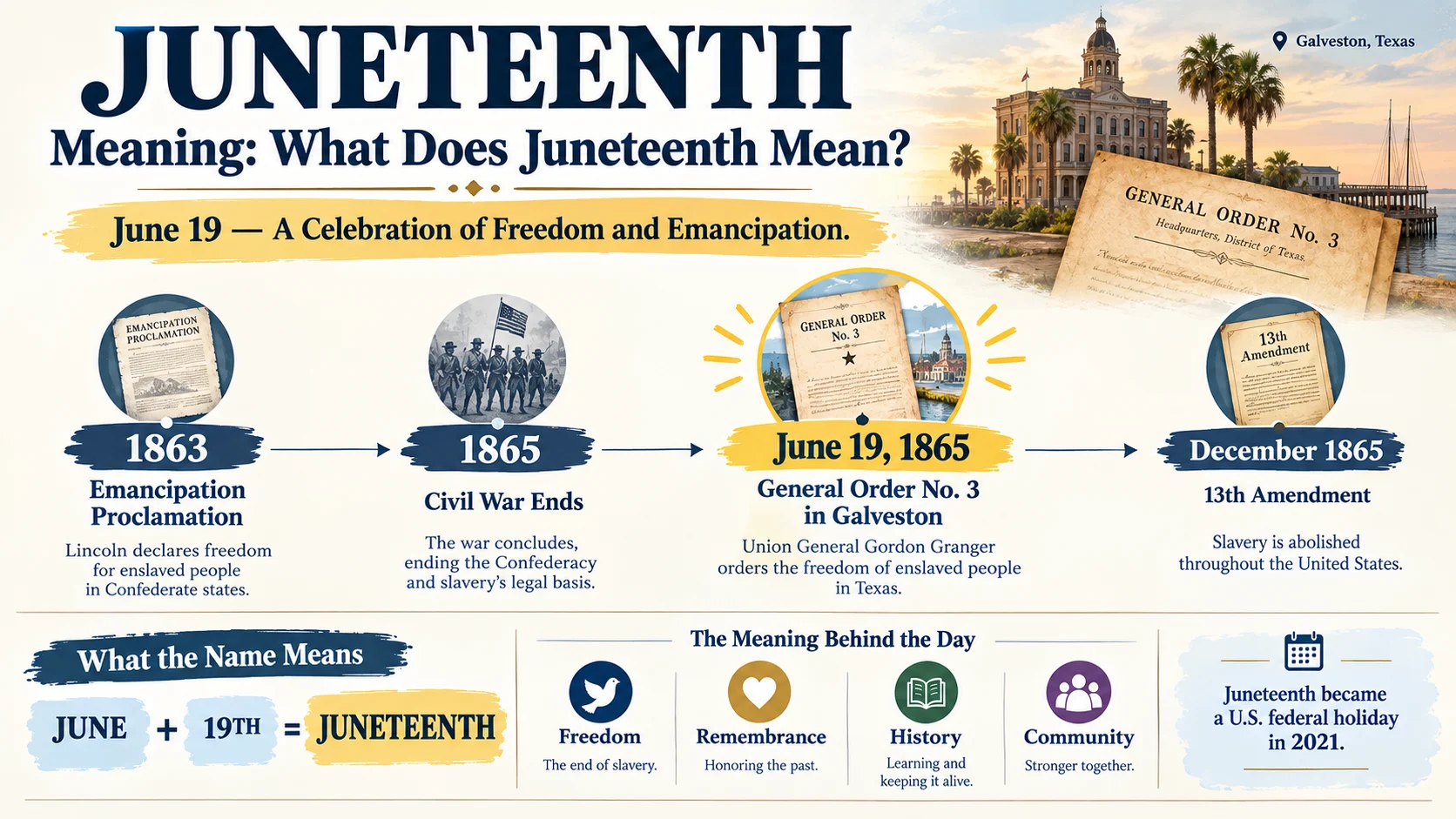
A simple timeline looks like this:
January 1, 1863 → Emancipation Proclamation
April 1865 → Major Confederate forces surrender and the Civil War effectively comes to an end
June 19, 1865 → General Order No. 3 announced freedom in Texas
December 6, 1865 → 13th Amendment ratified and slavery legally abolished nationwide
This timeline helps explain why Juneteenth is an important part of the broader history of emancipation.
Did Juneteenth End Slavery in the United States?
Not technically by itself.
Juneteenth commemorates the announcement of freedom for enslaved people in Texas on June 19, 1865. However, slavery was not legally abolished throughout the United States until the 13th Amendment was ratified later that year.
This distinction matters because Juneteenth represents an important step in emancipation rather than the exact legal date when slavery ended nationwide.
Therefore:
Juneteenth = commemoration of emancipation in Texas and the broader end of slavery
13th Amendment = constitutional abolition of slavery nationwide
What Does the Name Juneteenth Mean?
The name Juneteenth is a combination of:
- June
- 19th
Put them together:
June + nineteenth = Juneteenth
The date refers to June 19, 1865, when General Order No. 3 was issued in Galveston, Texas.
The name is therefore directly connected to the historical event that the holiday commemorates.
Juneteenth History
Juneteenth began as a Texas-centered celebration.
After 1865, African American communities in Texas developed traditions around June 19. The day became associated with freedom, family, remembrance, community gatherings, and celebration.
Over the years, Juneteenth spread beyond Texas.
The National Archives notes that the holiday was long primarily celebrated within African American communities in Texas before gaining broader national recognition.
Its national profile increased significantly in the late 20th and early 21st centuries.
In 2021, the federal government formally recognized Juneteenth as a federal holiday.
When Is Juneteenth?
Juneteenth is celebrated every year on June 19.
The date does not change from year to year.
The federal holiday is officially called Juneteenth National Independence Day. The federal government designated June 19 as a federal holiday in 2021.
Juneteenth Date
| Year | Juneteenth Date |
|---|---|
| 2024 | June 19 |
| 2025 | June 19 |
| 2026 | June 19 |
| 2027 | June 19 |
| 2028 | June 19 |
The date remains June 19 every year.
Is Juneteenth a Federal Holiday?
Yes.
On June 17, 2021, President Joe Biden signed legislation establishing Juneteenth National Independence Day as a federal holiday. It became the 12th federal holiday in the United States.
This recognition gave Juneteenth an official place among U.S. federal holidays.
It also helped bring greater national attention to the history and meaning of the day.
How Is Juneteenth Celebrated?
Juneteenth celebrations vary by community.
Common activities can include:
- Community festivals
- Family gatherings
- Historical education
- Public speeches
- Parades
- Music
- Food
- Cultural performances
- Storytelling
- Readings of historical documents
- Community service
- Discussions about African American history
Some celebrations focus strongly on history and education. Others emphasize family, culture, food, music, and community.
Therefore, there is no single way to celebrate Juneteenth.
What Is the Purpose of Juneteenth?
Juneteenth serves several purposes.
1. Remembering History
The holiday encourages people to remember the history of slavery and emancipation in the United States.
2. Celebrating Freedom
Freedom is central to Juneteenth.
The holiday recognizes the significance of emancipation and the end of slavery.
3. Honoring African American History
Juneteenth highlights an important part of African American history and American history more broadly.
4. Educating Future Generations
The day provides an opportunity to discuss the Civil War, slavery, emancipation, Reconstruction, and the continuing effects of American history.
5. Building Community
Many Juneteenth events bring families and communities together through food, music, education, and cultural activities.
Juneteenth and African American History
Juneteenth is especially important within African American history because it commemorates a major moment in the long struggle for freedom.
The history of emancipation was not limited to one day.
Enslaved people resisted slavery in many ways. Abolitionists worked to end the institution. Black soldiers served in the Union military. Political and military developments during the Civil War also changed the path toward emancipation.
Juneteenth became one important symbol within that larger history.
Consequently, the holiday is about more than a single military order. It also represents freedom, resilience, remembrance, and the continuing importance of understanding the past.
Juneteenth vs. Emancipation Proclamation
These terms are closely related but different.
| Juneteenth | Emancipation Proclamation |
|---|---|
| June 19 holiday | Presidential proclamation |
| Commemorates the 1865 announcement in Texas | Issued January 1, 1863 |
| Connected to General Order No. 3 | Issued by President Abraham Lincoln |
| Became a federal holiday in 2021 | Helped transform the Civil War and emancipation |
| Celebrates and remembers emancipation | Declared freedom for enslaved people in rebellious areas |
The Emancipation Proclamation came first. Juneteenth commemorates a later moment when its freedom message was announced and enforced in Texas.
Juneteenth vs. July 4th
July 4th celebrates American independence from Great Britain.
Juneteenth commemorates emancipation and freedom from slavery.
The two holidays therefore have different historical meanings.
July 4th focuses on the founding of the United States as an independent nation.
Juneteenth focuses on the liberation of enslaved people and the continuing American history of freedom and equality.
Some people discuss the two holidays together because both relate to ideas of freedom and independence, but they commemorate different historical events.
Juneteenth vs. Black History Month
- Juneteenth and Black History Month also have different purposes.
- Juneteenth is a specific holiday connected to June 19, 1865.
- Black History Month is a month-long observance recognizing the history, achievements, experiences, and contributions of Black Americans.
Both provide opportunities to learn about African American history, but they focus on different aspects.
Is Juneteenth a Celebration or a Day of Remembrance?
It is both.
Juneteenth celebrates freedom and emancipation. At the same time, it encourages remembrance of slavery, oppression, struggle, and the difficult path toward freedom.
That combination explains why Juneteenth events can feel both joyful and reflective.
Music, food, and community gatherings may exist alongside historical education, speeches, and remembrance.
Common Juneteenth Symbols
Different communities use different symbols and traditions during Juneteenth celebrations.
Common themes include:
- Freedom
- Family
- Community
- African American heritage
- History
- Equality
- Hope
- Education
- Cultural pride
The Juneteenth flag is also widely associated with the holiday.
The flag commonly features red, white, and blue, reflecting the place of Black Americans within the history and identity of the United States.
A star is included as a symbol connected to Texas and freedom.
Why Is Juneteenth Important Today?
Juneteenth remains important because understanding history helps explain how the United States developed.
The holiday provides an opportunity to discuss:
- Slavery
- Emancipation
- Civil War history
- Reconstruction
- African American experiences
- Freedom and equality
- Historical memory
- Community
Furthermore, Juneteenth encourages people to consider the difference between a legal declaration of freedom and the lived experience of achieving equal rights.
Freedom did not automatically eliminate discrimination or inequality after emancipation.
Therefore, the history surrounding Juneteenth extends beyond June 19, 1865.
Common Misconceptions About Juneteenth
1. Juneteenth Was the Day Lincoln Ended Slavery
Not exactly.
Lincoln issued the Emancipation Proclamation on January 1, 1863.
Juneteenth commemorates the June 19, 1865, announcement in Texas.
2. Slavery Legally Ended on June 19, 1865
Not nationwide.
The 13th Amendment completed the constitutional abolition of slavery in December 1865.
3. Juneteenth Is Only a Texas Holiday
No.
Juneteenth began as a Texas-centered tradition, but it is now recognized nationally as a federal holiday.
4. Juneteenth Is Only About Celebration
Celebration is important, but remembrance and education are also central to the holiday.
5. Juneteenth Is a New Tradition
The federal holiday is recent, but Juneteenth celebrations have a much longer history, particularly in Texas African American communities.
Common Mistakes When Using the Word Juneteenth
Mistake 1: Writing “Juneteenth Day”
The holiday’s name is already Juneteenth. “Juneteenth Day” may appear informally, but Juneteenth or Juneteenth National Independence Day is more precise.
Mistake 2: Saying Juneteenth Means the Exact End of Slavery Nationwide
A more accurate explanation is that Juneteenth commemorates the announcement of freedom in Texas and the broader emancipation process.
Mistake 3: Ignoring the Date
The name is directly tied to June 19.
Mistake 4: Treating It Only as a Party
Juneteenth can include celebration, but it also carries historical and cultural meaning.
Mistake 5: Separating Juneteenth From the Broader History of Emancipation
The holiday makes more sense when viewed alongside the Emancipation Proclamation, the Civil War, and the 13th Amendment.
How to Use Juneteenth in a Sentence
Here are some natural examples:
Juneteenth is celebrated on June 19 each year.
Our community is hosting a Juneteenth festival.
The museum created an exhibit about Juneteenth history.
Students learned about the historical significance of Juneteenth.
Juneteenth National Independence Day is a federal holiday in the United States.
These examples use Juneteenth as a proper name, so it is normally capitalized.
Is Juneteenth Capitalized?
Yes.
Juneteenth is capitalized because it is the name of a specific holiday.
Correct:
We are observing Juneteenth.
Incorrect:
We are observing juneteenth.
The formal federal holiday name is Juneteenth National Independence Day.
What Does Juneteenth Represent?
At its core, Juneteenth represents:
Freedom — the central theme of emancipation.
Remembrance — recognition of the history of slavery and liberation.
Resilience — acknowledgment of the strength of people who endured and resisted slavery.
Community — continuation of traditions that grew within African American communities.
Education — an opportunity to learn about American history.
Hope — recognition of the continuing pursuit of freedom and equality.
These themes help explain why the holiday has significance beyond its historical date.
Quick Reference: Juneteenth Meaning
| Question | Answer |
|---|---|
| What does Juneteenth mean? | A holiday commemorating emancipation and freedom |
| When is Juneteenth? | June 19 |
| What happened on June 19, 1865? | General Gordon Granger issued General Order No. 3 in Galveston, Texas |
| What did the order announce? | That enslaved people in Texas were free under the Emancipation Proclamation |
| What does the name mean? | June + 19th |
| Is Juneteenth a federal holiday? | Yes |
| When did it become a federal holiday? | 2021 |
| Who issued General Order No. 3? | Major General Gordon Granger |
| Is Juneteenth the same as the Emancipation Proclamation? | No |
| Did slavery legally end nationwide on Juneteenth? | No; the 13th Amendment abolished slavery nationally later in 1865 |
| Other names | Freedom Day, Emancipation Day |
| Main themes | Freedom, emancipation, remembrance, history, community |
Frequently Asked Questions
What does Juneteenth mean in simple words?
Juneteenth is a holiday celebrating and remembering freedom from slavery. It specifically commemorates June 19, 1865, when freedom was announced to enslaved people in Texas.
Why is Juneteenth celebrated on June 19?
June 19 marks the date in 1865 when General Gordon Granger issued General Order No. 3 in Galveston, Texas, announcing that enslaved people in Texas were free.
What does the word Juneteenth mean?
Juneteenth combines “June” and “19th.” The name refers to June 19, 1865.
Who announced freedom on Juneteenth?
Union Major General Gordon Granger issued General Order No. 3 in Galveston, Texas, on June 19, 1865.
Is Juneteenth the day slavery ended?
It commemorates a major emancipation event in Texas, but slavery was not constitutionally abolished nationwide until the 13th Amendment was ratified on December 6, 1865.
When did Juneteenth become a federal holiday?
Juneteenth became a federal holiday in 2021 after legislation was signed into law on June 17 of that year.
Is Juneteenth only for Black Americans?
Juneteenth has deep roots in African American history and communities, particularly in Texas. As a federal holiday, however, it is a national observance and an opportunity for all Americans to learn about the history of emancipation and slavery.
What is another name for Juneteenth?
Juneteenth is also known as Freedom Day and Emancipation Day.
Is Juneteenth a religious holiday?
No. Juneteenth is a national historical and cultural holiday, not a religious holiday.
What do people do on Juneteenth?
People may attend festivals, family gatherings, educational programs, parades, cultural events, community activities, and historical presentations.
What is the difference between Juneteenth and July 4th?
July 4th commemorates U.S. independence from Great Britain. Juneteenth commemorates emancipation and the announcement of freedom for enslaved people in Texas in 1865.
What is the difference between Juneteenth and the Emancipation Proclamation?
The Emancipation Proclamation was issued by President Lincoln in 1863. Juneteenth commemorates the June 19, 1865, announcement in Texas that enforced the freedom promised by the proclamation.
Why is Juneteenth important?
Juneteenth is important because it connects American history with themes of emancipation, freedom, African American heritage, remembrance, and the continuing pursuit of equality.
Conclusion
The Juneteenth meaning is rooted in freedom, emancipation, remembrance, and African American history. The holiday commemorates June 19, 1865, when Union Major General Gordon Granger issued General Order No. 3 in Galveston, Texas, announcing that enslaved people in Texas were free.
Although the Emancipation Proclamation had been issued more than two years earlier, the June 19 announcement became a powerful symbol of freedom. The constitutional abolition of slavery followed later in 1865 with the ratification of the 13th Amendment.
Today, Juneteenth is both a celebration and a day of remembrance. People observe it through education, community gatherings, cultural events, family traditions, and reflection on American history. Since becoming a federal holiday in 2021, Juneteenth has gained an official place in the national calendar.
Ultimately, understanding what Juneteenth means requires looking beyond the date itself. It represents a major milestone in the long history of emancipation and serves as a reminder of the meaning, cost, and continuing importance of freedom.

Jack Murphy is a language writer with a passion for word meanings, synonyms, and effective communication. He creates informative and easy to understand content to help readers enhance their vocabulary and language skills.