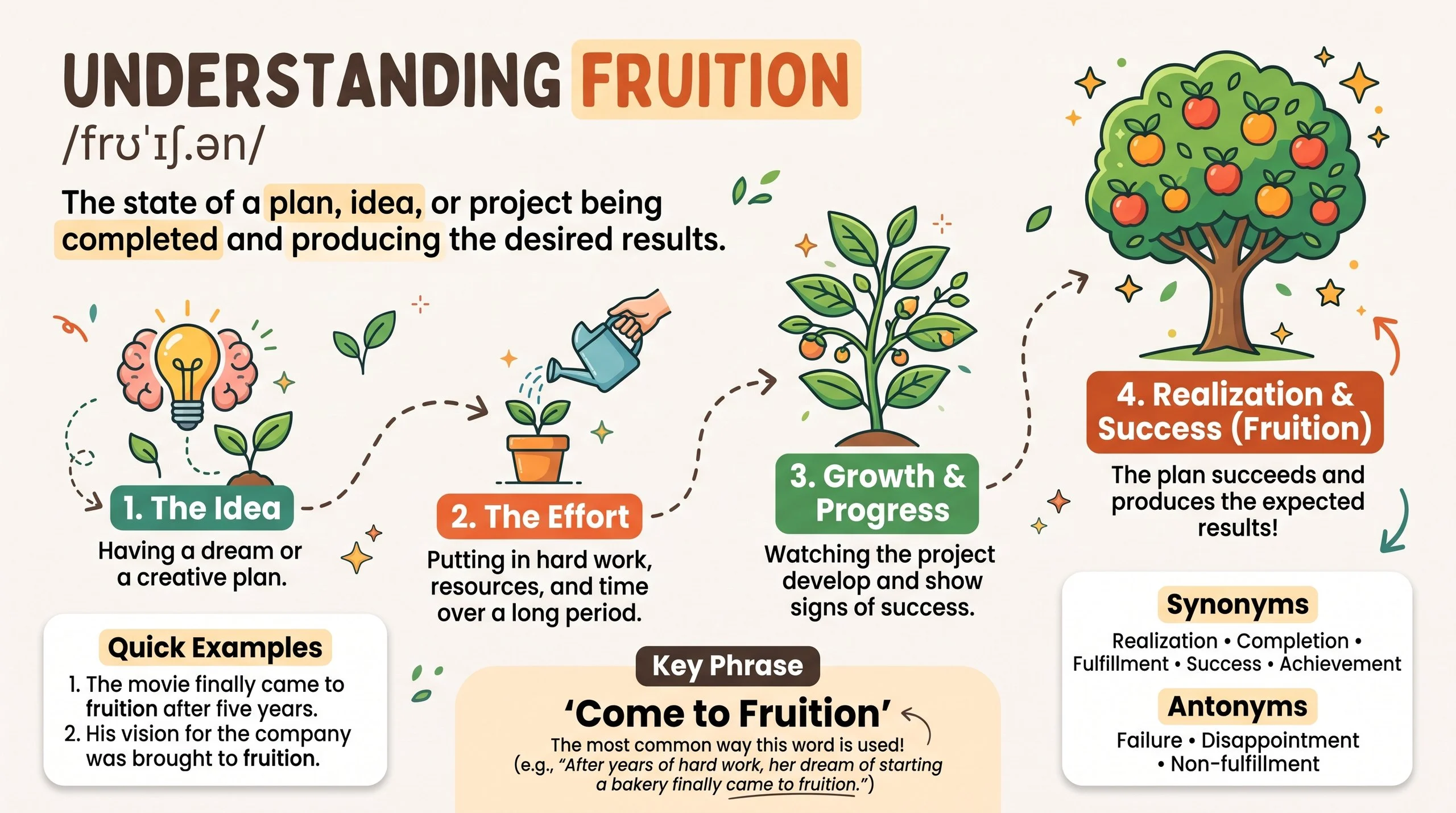
Fruition means the point at which a plan, idea, hope, or effort becomes real, successful, or complete. It often describes a long process reaching its desired result, especially after patience, work, or development, after sustained effort and growth over time.
Fruition meaning refers to the moment when an idea, plan, goal, hope, or long period of effort finally produces its intended result. The word often appears when something has developed gradually and has reached a successful or satisfying outcome.
For example, someone might say, “Years of research finally came to fruition.” This means the research eventually produced the expected result. Similarly, a business plan can come to fruition when the planned project becomes real.
However, this word does more than describe simple success. It often highlights the journey behind the result. Patience, preparation, persistence, and development usually sit in the background.
The term also has a slightly formal tone. You may see it in professional writing, journalism, books, academic discussions, speeches, and thoughtful personal messages. In casual texting, people often choose simpler expressions such as “worked out,” “finally happened,” or “became real.”
Understanding the word therefore requires more than memorizing a dictionary definition. You need to understand its emotional tone, grammatical patterns, common collocations, synonyms, and appropriate contexts.
Quick Answer Box
| Meaning | Context | Primary Platforms | Example | Tone |
| A desired result becoming real | Goals, plans, projects, dreams | Websites, social media, texting, professional communication | “Our plans finally came to fruition.” | Formal, positive, reflective |
What Does Fruition Meaning Mean?
The core idea behind fruition is successful realization.
When something comes to fruition, it reaches the stage where the expected result becomes visible or achievable. Therefore, the word usually connects a process with its outcome.
For example:
“Her years of training came to fruition when she won the competition.”
The sentence suggests more than winning. It connects the victory with years of preparation.
A Simple Definition
In everyday English, you can understand the word as:
Fruition means the successful completion or realization of something that has been planned, hoped for, or developed.
The result does not always need to be dramatic. A small personal goal can also reach fruition.
For instance:
“His plan to renovate the kitchen finally came to fruition.”
The renovation is the realized result of the earlier plan.
Where the Word Comes From
The word comes through English from French and ultimately traces back to Latin roots connected with enjoyment and use. Its history is related to the idea of enjoying the results of something.
That background helps explain why the modern word can suggest both achievement and enjoyment of an achieved result.
Over time, English speakers increasingly used the term for plans, projects, ambitions, and hopes reaching completion.
Fruition as a Noun
Fruition is a noun.
It commonly appears in the phrase:
come to fruition
This is one of its most important patterns.
Examples include:
“The project came to fruition after three years of planning.”
“Her dream of opening a bakery finally came to fruition.”
“The partnership came to fruition after months of negotiations.”
Notice that the phrase usually describes a process that ends in a meaningful outcome.
What Does “Come to Fruition” Mean?
“Come to fruition” means to become real, successful, or fully developed as intended.
It is often used when something requires time or effort.
For example:
“Their investment strategy finally came to fruition.”
This means the strategy eventually produced the desired outcome.
The phrase can describe business plans, creative projects, scientific work, personal ambitions, relationships, policies, and other long term efforts.
What Does “Bring to Fruition” Mean?
“Bring to fruition” has a slightly different structure.
It means to make something planned or hoped for become real or successful.
For example:
“The team worked together to bring the project to fruition.”
Here, the team actively helped make the project successful.
Compare the two expressions:
| Expression | Meaning | Example |
| Come to fruition | Become real or successful | “The plan came to fruition.” |
| Bring to fruition | Make something become real or successful | “They brought the plan to fruition.” |
The distinction is useful because one expression focuses on the result, while the other emphasizes the people or actions that helped create it.
Contextual Dynamics & Nuances of the Term
The exact feeling of the word changes depending on context.
Sometimes it communicates satisfaction. At other times, it emphasizes patience, progress, or delayed success.
In Personal Goals
People often use the term for long term ambitions.
“After years of saving, her dream of buying a home came to fruition.”
The phrase makes the achievement feel meaningful because it connects the result with earlier sacrifice.
In Business
The word is common in professional communication.
“The expansion plan finally came to fruition.”
This sounds polished and appropriate for a company announcement or business report.
However, a casual coworker might simply say:
“The expansion plan finally worked out.”
Both sentences communicate a similar idea, but the first sounds more formal.
In Creative Work
Writers, filmmakers, musicians, designers, and artists can use the word when discussing projects.
“The concept finally came to fruition after months of revisions.”
Here, fruition highlights development.
The project existed as an idea before becoming a finished work.
In Academic and Scientific Writing
Researchers may describe a theory, experiment, or research project reaching a successful result.
“The research initiative came to fruition after several years of collaboration.”
This wording emphasizes the long development period.
In Relationships
The word can describe hopes involving relationships, but it may sound formal.
“Their plans to build a life together eventually came to fruition.”
That sentence sounds reflective or literary.
In a text message, however, most people would say:
“Our plans finally happened.”
Therefore, context matters.
Positive Emotional Meaning
The term usually carries a positive or satisfying feeling.
It suggests that effort was worthwhile.
For example:
“All her hard work came to fruition.”
The sentence implies that the work produced a rewarding outcome.
Still, the word does not guarantee perfect success. Something can come to fruition when it reaches the intended stage, even if the result is simply completion rather than extraordinary achievement.
Real Life Conversation Examples Using Fruition Meaning
The word works naturally in conversation when the speaker wants a thoughtful, polished, or reflective tone.
Example 1: Career Goal
Maya: I finally got the promotion I worked toward for years.
Jordan: That is amazing. All your hard work came to fruition.
Maya: It still feels unreal.
Meaning: Jordan is saying that Maya’s long period of effort finally produced the desired result.
Example 2: Business Project
Alex: Did the new store ever open?
Sam: Yes. The expansion plan finally came to fruition last month.
Alex: Nice. I remember you talking about it ages ago.
Meaning: Sam explains that an earlier business plan eventually became a real project.
Example 3: Personal Dream
Lena: I published my first novel yesterday.
Chris: Congratulations. Your dream finally came to fruition.
Lena: Thank you. It took much longer than I expected.
Meaning: Chris connects the completed book with Lena’s long term ambition.
Example 4: Group Project
Nina: We finally launched the community website.
Evan: After all those meetings, the idea actually came to fruition.
Nina: I know. We nearly gave up twice.
Meaning: Evan emphasizes that an earlier idea eventually became a completed project.
Example 5: Family Plans
Daniel: We are moving closer to my parents next month.
Ryan: So the plan finally came to fruition.
Daniel: Exactly. We have talked about it for years.
Meaning: Ryan refers to a long standing plan that is finally becoming reality.
Platform Specific Breakdown
The word does not function as internet slang in the same way that abbreviations, memes, or trending expressions do. Instead, it appears online as standard English.
Its use can still vary by platform because each platform encourages a different communication style.
How It Is Used on Snapchat
Snapchat conversations usually favor short, informal messages.
Therefore, a person is more likely to write:
“It finally happened!”
than:
“It finally came to fruition.”
However, the word can appear when someone wants to sound humorous, dramatic, thoughtful, or intentionally formal.
For example:
“Our weekend road trip plan has finally come to fruition 😂”
The formal phrase can create a playful contrast with the casual platform.
This works especially well when friends joke about an ordinary event as though it were a major historical achievement.
The Role of Fruition Meaning on TikTok
TikTok content often relies on captions, commentary, storytelling, and educational explanations.
The word may appear in videos about:
- Career growth
- Business launches
- Creative projects
- Personal goals
- Long term relationships
- Academic achievements
- Before and after transformations
A creator might write:
“Three years of work finally came to fruition.”
That caption gives the story a reflective tone.
However, TikTok creators often explain the word because some viewers may consider it formal or unfamiliar.
Instagram and Texting Dynamics
Instagram captions allow more polished language than everyday texting.
For example:
“A dream years in the making has finally come to fruition.”
That sentence fits a graduation, business launch, wedding, book release, or major personal achievement.
In a direct message, the wording may feel too formal.
Instead, a friend might say:
“Your dream finally happened!”
Therefore, the choice depends on your relationship with the reader and the atmosphere of the conversation.
LinkedIn and Professional Communication
Professional platforms provide a stronger environment for this vocabulary.
For example:
“After months of collaboration, the initiative has finally come to fruition.”
This sounds appropriate for a project announcement.
Still, clarity should come first. If a simpler phrase communicates the same idea more directly, use it.
Email and Workplace Communication
The word can work well in professional emails.
For example:
“I am pleased to share that our partnership has finally come to fruition.”
However, avoid using formal vocabulary merely to sound impressive.
A message such as “The partnership is now complete” may be clearer in some situations.
Alternative Meanings & NLP Variations of the Phrase
Search engines and language models may connect the word with several related concepts.
These semantic relationships help explain how people understand the term.
Closest Synonyms
Useful alternatives include:
| Synonym | Best Use | Tone |
| Realization | A goal becoming real | Neutral |
| Achievement | Successful accomplishment | Positive |
| Completion | Something reaching an end | Neutral |
| Fulfillment | A hope or desire being satisfied | Reflective |
| Success | A desired outcome | Direct |
| Attainment | Reaching a goal | Formal |
| Accomplishment | Completing something successfully | Positive |
| Development | Something becoming more complete | Neutral |
| Actualization | Making an idea real | Formal |
| Result | The outcome of an action | Direct |
These words are related, but they are not always interchangeable.
For example, completion emphasizes finishing. Achievement emphasizes success. Fulfillment emphasizes satisfaction.
Fruition vs. Fulfillment
These terms overlap, but their focus differs.
Fruition often describes a plan or effort becoming successful or real.
Fulfillment can describe satisfying a desire, obligation, promise, need, or expectation.
For example:
“The project came to fruition.”
This emphasizes the project becoming real.
“She found fulfillment in teaching.”
This emphasizes personal satisfaction.
Fruition vs. Success
Success is broader.
A person can experience success without talking about a long development process.
For example:
“She passed the exam successfully.”
You would not normally need the word fruition.
However:
“Years of preparation finally came to fruition when she passed the exam.”
The second sentence emphasizes the journey.
Fruition vs. Completion
Completion simply means something finished.
Fruition usually suggests that the completed result was expected, desired, or developed.
Therefore:
“The report reached completion.”
focuses on finishing.
Meanwhile:
“The research project came to fruition.”
suggests that the project developed into its intended result.
NLP Associations
Semantic systems may associate the term with:
- Goals
- Dreams
- Plans
- Results
- Achievement
- Success
- Development
- Realization
- Fulfillment
- Completion
- Effort
- Patience
- Progress
- Ambition
- Outcomes
These related concepts help search engines understand the topic beyond an exact keyword match.
Misinterpretations: When NOT to Use Fruition Meaning
Although the word is useful, it is not appropriate for every situation.
Do Not Use It for Every Small Event
Saying:
“My sandwich order came to fruition.”
would sound unnatural.
The event does not involve the kind of development or intended outcome that normally supports the expression.
Instead, say:
“My sandwich order arrived.”
Avoid Forced Formality
If you are texting a close friend, this may sound unnecessarily formal:
“Your birthday plans have successfully come to fruition.”
A natural alternative is:
“Your birthday plans finally happened!”
The formal version is not grammatically wrong. It simply does not match the conversational setting.
Do Not Treat It as a Synonym for “Happen”
Something happening does not automatically mean it came to fruition.
The word usually implies an earlier expectation, plan, goal, or process.
For example:
“It started raining.”
This does not normally involve fruition.
By contrast:
“Our plans for an outdoor wedding finally came to fruition.”
Here, there is a clear prior plan.
Do Not Confuse It With “Fruit”
The words look related because they share historical roots, but modern English uses them differently.
“Fruit” usually refers to the produce or the edible result of a plant.
“Fruition” refers to realization, successful development, or achievement.
How to Respond in Chat Comfortably
If someone uses the word in a message, you do not need to respond with equally formal vocabulary.
Your response should match the situation.
Casual Response
“Yes! It finally happened.”
This works well with friends.
Supportive Response
“That is awesome. Your hard work paid off!”
This sounds warm and natural.
Professional Response
“Congratulations. It is great to see the project reach this stage.”
This fits workplace communication.
Playful Response
“Look at us actually making the plan happen 😂”
This works in casual group chats.
Thoughtful Response
“You waited a long time for this. I am glad it finally worked out.”
This highlights the emotional journey.
If You Are Unsure What the Person Means
You can simply ask:
“Do you mean the plan finally worked out?”
That is clear and natural.
FAQs
What does fruition mean in simple English?
It means something you planned, hoped for, or worked toward finally becomes real or successful. In simple terms, you can often understand it as “the desired result finally happened.”
What does “come to fruition” mean?
“Come to fruition” means that a plan, idea, goal, project, or hope has developed into its intended result. The expression often suggests time, effort, planning, or patience.
Is fruition a positive word?
Usually, yes. The word generally describes a satisfying or successful outcome. It often suggests that earlier effort, planning, or patience produced something worthwhile.
Is fruition formal or casual?
Fruition is generally more formal than everyday words such as “happen,” “work out,” or “become real.” It fits professional writing, thoughtful conversations, articles, speeches, and reflective captions.
Can you use fruition in a text message?
Yes, but context matters. The word can sound polished or humorous in texting. With close friends, simpler expressions may sound more natural unless you intentionally want a formal or playful tone.
What is a synonym for fruition?
Depending on context, useful alternatives include realization, fulfillment, achievement, completion, attainment, success, and accomplishment. The best choice depends on whether you want to emphasize the result, the process, or personal satisfaction.
What is the difference between fruition and fulfillment?
Fruition usually focuses on something becoming real or reaching its intended result. Fulfillment often focuses on satisfaction, especially when a desire, need, expectation, or personal ambition has been satisfied.
What does “bring to fruition” mean?
“Bring to fruition” means to help make something planned or desired become real or successful. It places more emphasis on the people or actions responsible for achieving the outcome.
Can fruition describe a person?
Usually, fruition describes an idea, plan, project, ambition, effort, or goal reaching a successful result. It is not normally used to describe a person directly.
Is “fruition” an internet slang term?
No. The word is standard English rather than internet slang. Social media users may use it in captions, comments, or jokes, but the word itself is not a modern slang abbreviation or platform specific expression.
Conclusion
Understanding fruition meaning becomes much easier when you connect the word with a simple idea: a goal, plan, hope, or effort finally reaching its intended result.
The word is not really internet slang. Instead, it is established English vocabulary that appears across professional writing, social media captions, articles, books, conversations, and personal reflections.
Its strongest expression is “come to fruition.” This phrase highlights development, patience, and eventual success.
However, everyday communication often favors simpler language. “It finally happened,” “it worked out,” and “the plan became real” can sound more natural in casual conversations.
Therefore, choose the word according to your audience. Use it when you want to emphasize the journey behind a meaningful result. When clarity and simplicity matter most, choose a more familiar alternative.
Ultimately, fruition describes more than an ending. It captures the satisfying moment when earlier effort, planning, hope, or development finally produces something real.