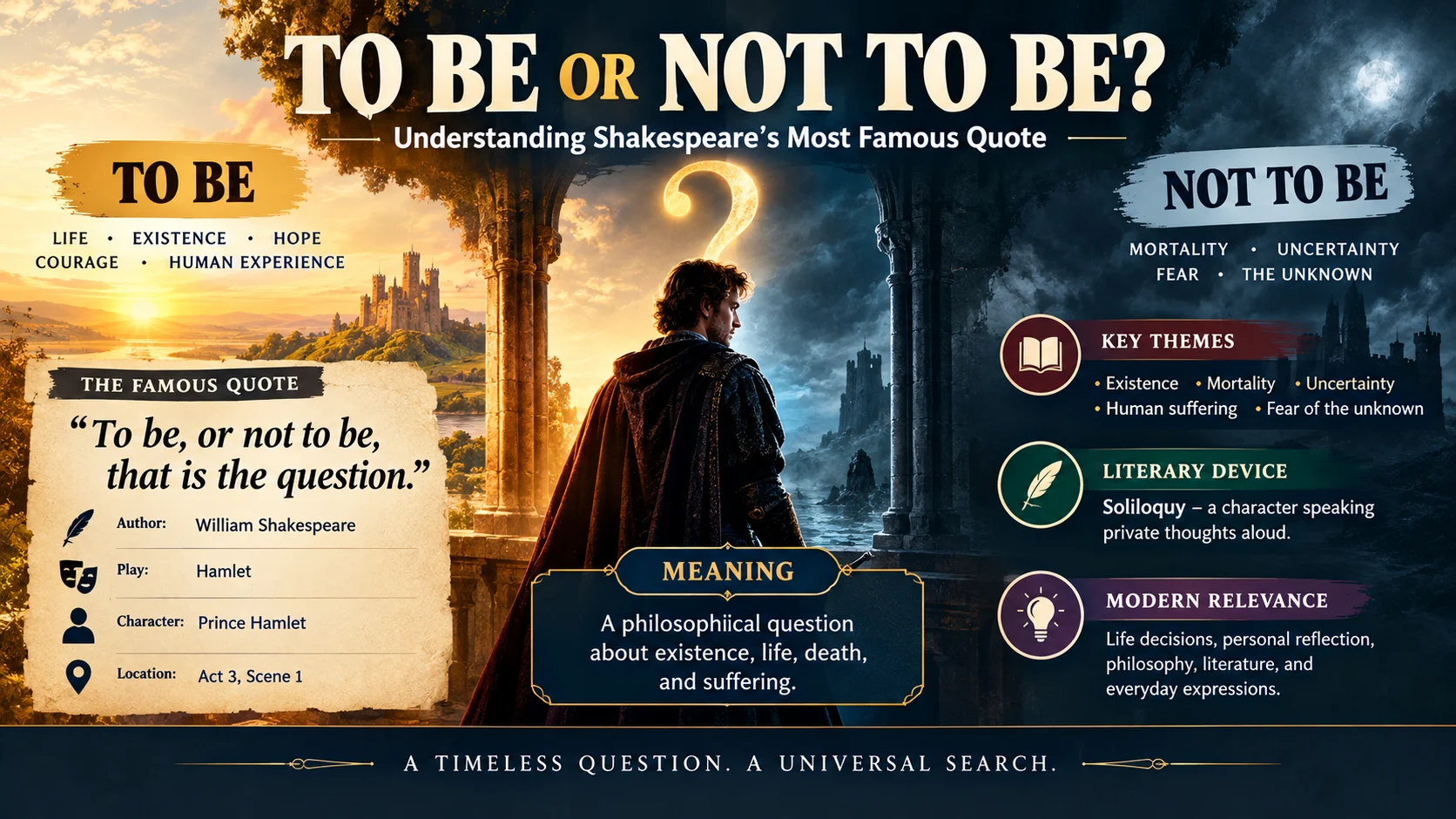
The “To be or not to be” quote is one of William Shakespeare’s most famous lines from his tragedy Hamlet. Spoken by Prince Hamlet in Act 3, Scene 1, the complete opening line is, “To be, or not to be, that is the question.” It explores the difficult choice between continuing to live and facing life’s suffering or escaping that suffering through death. The quote reflects themes of existence, mortality, uncertainty, and the human struggle to find meaning in life.
Have you ever questioned the meaning of life, wondered why people experience suffering, or struggled to make a decision that could change everything? These deep questions connect directly to the famous to be or not to be quote by William Shakespeare. It is one of the most recognizable lines in English literature and continues to inspire discussions about life, death, human nature, and personal struggles.
Originally spoken by Prince Hamlet in Shakespeare’s tragedy Hamlet, the expression introduces a powerful philosophical reflection on existence. Through these simple words, Hamlet considers whether it is better to continue living through pain and uncertainty or escape life’s difficulties. However, the meaning goes beyond a simple choice between life and death. It also explores fear, courage, hope, and the uncertainty of what comes after death.
Today, people use this famous expression in literature, everyday conversations, social media captions, speeches, and philosophical discussions. Therefore, understanding its original context helps readers appreciate its deeper significance. In this guide, you’ll discover the complete quote, its meaning, historical background, literary importance, examples, and how to use it correctly.
What Is the To Be or Not to Be Quote?
The to be or not to be quote comes from Hamlet, a famous tragedy written by William Shakespeare around the turn of the seventeenth century.
The original opening line reads:
“To be, or not to be, that is the question.”
Author: William Shakespeare
Play: Hamlet
Character: Prince Hamlet
Act: Act 3
Scene: Scene 1
Literary Form: Soliloquy
In this scene, Hamlet speaks alone and reflects on the difficulties of human existence. He questions whether people should endure the pain, injustice, disappointment, and suffering of life or consider death as an escape.
Furthermore, the line introduces one of literature’s most important philosophical discussions: why do people continue living despite life’s challenges, and what makes existence worth experiencing?
Although the quote contains only a few words, it introduces questions that remain relevant across generations.
What Does To Be or Not to Be Mean?
The expression to be or not to be represents a question about existence itself. In simple words, it asks whether a person should continue living or choose not to exist.
The word be represents existence, life, and the experience of being alive. Conversely, not to be represents nonexistence or death in Hamlet’s original context.
However, Shakespeare’s expression carries several layers of meaning.
Existence: The phrase asks what it means to live and experience the world.
Suffering: It considers whether enduring life’s difficulties is worth the emotional and physical pain.
Mortality: The expression raises questions about death and the unknown.
Uncertainty: Hamlet struggles because nobody knows with certainty what happens after death.
Decision-making: More broadly, the phrase can represent difficult choices that require deep personal reflection.
Therefore, the quote is not simply about choosing between two options. Instead, it explores the complicated relationship between human existence, suffering, fear, and uncertainty.
Who Said To Be or Not to Be?
William Shakespeare wrote the famous expression, but Prince Hamlet is the character who speaks it in the play.
Hamlet is the central character in Shakespeare’s tragedy Hamlet. He is a Danish prince who faces emotional distress after his father’s death and discovers that his uncle, Claudius, has committed murder to take the throne.
Additionally, Hamlet experiences confusion, anger, grief, and a desire for justice. These circumstances influence his thoughts throughout the play.
During Act 3, Scene 1, he delivers the famous soliloquy while considering the suffering associated with human life.
Although Shakespeare created the words, Hamlet’s emotional conflict gives them their dramatic power.
Original Context of the Famous Shakespeare Quote
To understand the quote properly, readers should consider what happens before Hamlet delivers it.
At the beginning of the play, Hamlet mourns his father’s death. His situation becomes even more complicated when his mother, Gertrude, marries his uncle Claudius shortly after the king’s death.
Later, Hamlet encounters his father’s ghost, who reveals that Claudius murdered him. Consequently, Hamlet becomes determined to uncover the truth and seek revenge.
However, he struggles with his emotions and responsibilities. He questions whether his actions will bring justice or create even more suffering.
During Act 3, Scene 1, Hamlet delivers the famous soliloquy. He reflects on life’s hardships, including injustice, rejection, disappointment, and the unfair treatment people experience.
Moreover, he wonders whether death would end these problems. Nevertheless, the uncertainty surrounding what happens after death makes the decision frightening.
This conflict explains why the quote remains so powerful. It captures a deeply human struggle between the desire to escape suffering and the fear of the unknown.
The Deeper Philosophical Meaning of the Quote
Shakespeare’s famous expression explores several philosophical ideas that extend beyond the story of Hamlet.
The Meaning of Human Existence
The first philosophical idea concerns the purpose of being alive.
People often question why they exist, what gives their lives meaning, and whether their experiences have a greater purpose. Similarly, Hamlet considers whether existence is valuable despite its difficulties.
In this sense, the quote encourages readers to examine their understanding of life.
The Nature of Suffering
Another important theme is the unavoidable presence of suffering.
People experience grief, disappointment, injustice, rejection, and uncertainty. Consequently, Hamlet questions why individuals must endure these experiences.
However, the play also shows that suffering does not always lead to the same response. Some people continue fighting, while others become overwhelmed by their circumstances.
The Fear of Death
Death represents an unknown experience throughout the soliloquy.
Hamlet considers whether dying would bring an end to suffering. Nevertheless, he cannot know what happens afterward.
Therefore, fear of the unknown becomes an important reason behind his hesitation.
The Power of Uncertainty
The quote also explores how uncertainty influences human decisions.
Even when people recognize that their current situation is painful, they may hesitate to change it because they cannot predict the consequences.
Similarly, Hamlet struggles between what he knows about life and what he cannot understand about death.
The Value of Courage
Although the expression sounds like a question about existence, it also raises questions about courage.
Is courage the ability to confront difficult situations, or does it involve making a completely different choice? Shakespeare leaves readers with complicated questions rather than easy answers.
What Is a Soliloquy in Hamlet?
A soliloquy is a dramatic speech in which a character speaks their thoughts aloud, usually while alone on stage.
Shakespeare frequently uses soliloquies to reveal the private emotions, motivations, and conflicts of his characters.
In Hamlet, the famous speech allows the audience to understand the prince’s internal struggle.
Unlike ordinary dialogue, a soliloquy gives viewers direct access to a character’s thoughts. As a result, the audience can understand the questions and fears that influence his decisions.
The “To be, or not to be” speech is particularly important because it reveals Hamlet’s philosophical and emotional conflict.
Why Is To Be or Not to Be So Famous?
Several factors explain why this Shakespearean expression has remained popular for centuries.
Universal themes: Almost everyone encounters questions about existence, purpose, suffering, and mortality at some point in life.
Simple language: The opening line uses familiar English words, making it easy to remember.
Philosophical depth: Despite its simplicity, the expression raises complicated questions about human existence.
Literary importance: The quote comes from one of Shakespeare’s most studied tragedies.
Cultural influence: It appears in books, movies, television, comedy, theater, and popular conversations.
Furthermore, the phrase is flexible enough to apply to situations beyond its original literary context. People can use it humorously when discussing ordinary decisions or seriously when reflecting on major life questions.
How Is To Be or Not to Be Used Today?
Although Shakespeare wrote the expression centuries ago, people continue to reference it in modern communication.
Its meaning depends on the situation and the speaker’s intention.
In Everyday Conversations
People sometimes use the expression when facing a difficult decision.
Example:
“I have two career opportunities, and now it’s a real to-be-or-not-to-be moment.”
Here, the speaker humorously describes an important decision.
On Social Media
The phrase frequently works as a thoughtful caption for philosophical posts, personal reflections, and literary content.
Examples:
- “To be or not to be. That is still the question.”
- “Some days make you question everything. To be or not to be.”
- “Searching for meaning in a world full of questions.”
- “Life is complicated, but the question remains.”
In Literature and Education
Teachers and students use the expression when discussing Shakespeare, philosophical questions, dramatic writing, and literary themes.
For example:
“Our literature discussion focused on the meaning of Hamlet’s famous to-be-or-not-to-be soliloquy.”
In Movies and Entertainment
Writers and filmmakers sometimes reference the expression to create dramatic, humorous, or philosophical moments.
For instance, a character might say the phrase before making an important decision.
In Personal Reflection
People may also use the expression when thinking about their identity, purpose, future, and personal values.
However, its original meaning is much more serious than a simple everyday choice.
Real-Life Examples of To Be or Not to Be
Here are natural examples showing how the expression can appear in different situations.
Example: Career Decision
“After years in the same position, she faced her own to-be-or-not-to-be moment about changing careers.”
Example: Literature Class
“Our teacher explained how Hamlet’s famous quote explores the meaning of human existence.”
Example: Social Media Caption
“To be or not to be: sometimes the biggest questions have no easy answers.”
Example: Personal Reflection
“After experiencing several setbacks, he began asking himself questions about his purpose and future.”
Example: Humor
“To be or not to be? That is the question when deciding whether to get out of bed on Monday.”
Example: Creative Writing
“The main character faced a to-be-or-not-to-be moment before making the decision that would change her life.”
Example: Philosophical Discussion
“The quote encourages readers to consider why people continue living despite the difficulties they experience.”
Example: Theater
“The actor delivered Hamlet’s famous soliloquy with emotion and thoughtful pauses.”
To Be or Not to Be: Tone and Emotional Meaning
The phrase can communicate different emotions depending on its context.
| Tone | Meaning | Example |
|---|---|---|
| Philosophical | Thinking about existence | “To be or not to be remains a timeless question.” |
| Serious | Facing a major decision | “This is my to-be-or-not-to-be moment.” |
| Dramatic | Expressing intense conflict | “To be or not to be! What a choice!” |
| Humorous | Making fun of a small decision | “To be or not to be awake before coffee?” |
| Reflective | Considering life’s purpose | “Sometimes I wonder what it means to truly be.” |
| Literary | Discussing Shakespeare | “Hamlet’s soliloquy explores mortality.” |
Consequently, understanding the tone helps readers recognize whether someone is making a serious literary reference or using the phrase playfully.
Synonyms and Similar Expressions
Several English expressions communicate ideas similar to the famous quote, although they do not share exactly the same philosophical meaning.
| Expression | Meaning |
|---|---|
| To live or not to live | A direct question about continuing life |
| Exist or not exist | A philosophical question about existence |
| Life or death | A situation involving survival or mortality |
| To live or die | A choice involving life and death |
| Make or break | A situation that determines success or failure |
| All or nothing | A situation involving complete commitment |
| Sink or swim | Succeed through your own efforts or fail |
| Do or die | A situation requiring an urgent effort |
| What is the meaning of life? | A philosophical question about existence |
| The human condition | The shared experiences of human life |
Important distinction: These expressions may share ideas about difficult choices or existence, but they are not perfect replacements for Shakespeare’s original line.
To Be or Not to Be vs. Do or Die
People sometimes confuse these expressions because both describe serious situations. However, their meanings are different.
| Feature | To Be or Not to Be | Do or Die |
|---|---|---|
| Meaning | A question about existence and mortality | A situation requiring urgent action |
| Origin | Shakespeare’s Hamlet | Traditional English expression |
| Main Theme | Life, death, and uncertainty | Survival, determination, and success |
| Tone | Philosophical and reflective | Urgent and motivational |
| Example | “To be or not to be, that is the question.” | “We must win this game. It’s do or die.” |
While Shakespeare’s expression explores the meaning of existence, do or die emphasizes the importance of taking action in a critical situation.
Common Misunderstandings About the Quote
Even though the expression is famous, people sometimes misunderstand its original meaning.
Thinking It Is Only About Making Ordinary Decisions
The quote is sometimes used for everyday choices, such as selecting a meal or deciding what to wear.
Although this humorous usage is common, Shakespeare’s original discussion concerns existence, suffering, and death.
Assuming It Is a Motivational Slogan
Some people interpret the expression as encouragement to take risks or pursue success.
However, the original soliloquy is much more reflective and uncertain than a straightforward motivational statement.
Confusing the Speaker With the Author
William Shakespeare wrote the play, but Prince Hamlet speaks the words.
Therefore, the correct attribution distinguishes between the playwright and the fictional character.
Ignoring the Original Context
Understanding the phrase without considering Hamlet’s circumstances can lead to an incomplete interpretation.
His grief, family conflict, and uncertainty influence the meaning of the soliloquy.
Assuming the Quote Provides a Definite Answer
The expression introduces a difficult question rather than offering a simple solution.
In fact, the uncertainty surrounding existence is central to its philosophical significance.
How to Use To Be or Not to Be Correctly
You can use the expression in writing, conversations, captions, and literary discussions. Nevertheless, the situation should determine whether you use its original meaning or a humorous interpretation.
Use it for philosophical discussions:
“Shakespeare’s to-be-or-not-to-be quote explores the complexity of human existence.”
Use it when discussing difficult choices:
“She faced a to-be-or-not-to-be moment when deciding whether to leave her hometown.”
Use it in creative writing:
“The character whispered, ‘To be or not to be,’ before confronting his greatest fear.”
Use it humorously:
“To be or not to be productive today? That is the question.”
Use it in academic writing:
“Hamlet’s soliloquy examines mortality, suffering, and the uncertainty surrounding death.”
For formal academic work, identify the play, act, and scene when discussing the quotation. Additionally, use the edition required by your teacher or publication when providing a full literary citation.
The Literary Importance of Hamlet’s Famous Quote
The expression is important because it captures several major themes of Shakespeare’s tragedy.
It Reveals Hamlet’s Internal Conflict
Hamlet’s speech allows the audience to understand his thoughts rather than judging his actions from the outside.
It Develops the Theme of Mortality
The soliloquy explores the relationship between life and death, making mortality one of the play’s central philosophical concerns.
It Highlights Human Fear
Hamlet’s uncertainty demonstrates how fear of the unknown can influence even the most important decisions.
It Encourages Critical Thinking
The expression invites readers to question their assumptions about existence, happiness, suffering, and the meaning of life.
It Connects Different Generations
Although the play belongs to a different historical period, its central questions remain relevant to modern audiences.
What Can We Learn From To Be or Not to Be?
Shakespeare’s expression offers several lessons about human nature and the complexity of life.
Life involves difficult questions: People do not always have clear answers when facing complicated situations.
Uncertainty influences decisions: Fear of unknown consequences can make important choices difficult.
Suffering is part of human experience: The play recognizes that life can involve pain, injustice, and disappointment.
Thoughts influence actions: Hamlet’s reflections demonstrate how internal conflict can affect behavior.
Literature encourages reflection: A powerful quote can help readers explore ideas they might otherwise overlook.
Most importantly, the expression reminds us that questions about existence are deeply personal. Different people may interpret them according to their experiences, beliefs, and circumstances.
Exercises: Test Your Understanding
Try these questions to check your understanding of the famous Shakespeare expression.
Fill in the blanks
- The famous quote “To be or not to be” comes from the play ______.
- The author of Hamlet was ______.
- The character who speaks the quote is ______.
- The famous soliloquy appears in Act ______, Scene ______.
- The word “be” represents ______ in the original context.
Multiple-Choice Questions
What is the central idea of “To be or not to be”?
A. Friendship and loyalty
B. Existence and mortality
C. Wealth and success
D. Love and marriage
Who speaks the famous expression?
A. Claudius
B. Horatio
C. Hamlet
D. Polonius
What literary technique does Hamlet use when speaking his private thoughts aloud?
A. Metaphor
B. Soliloquy
C. Alliteration
D. Satire
What makes Hamlet uncertain about death?
A. His financial situation
B. His fear of the unknown
C. His lack of friends
D. His desire for power
Answers
- Hamlet
- William Shakespeare
- Prince Hamlet
- Act 3, Scene 1
- Existence or life
- B. Existence and mortality
- C. Hamlet
- B. Soliloquy
- B. His fear of the unknown
Frequently Asked Questions
What Is the Full To Be or Not to Be Quote?
The complete opening line of the famous Shakespeare expression is, “To be, or not to be, that is the question.” Prince Hamlet speaks these words in Act 3, Scene 1 of Hamlet.
Who Originally Said To Be or Not to Be?
Prince Hamlet speaks the expression in William Shakespeare’s tragedy Hamlet. Shakespeare wrote the play, while Hamlet is the character who delivers the famous soliloquy.
What Does To Be or Not to Be Mean in Simple Words?
It means questioning whether to continue living or not to exist. In its original context, Hamlet considers life’s suffering, the possibility of death, and the uncertainty of what comes afterward.
Why Did Hamlet Say To Be or Not to Be?
Hamlet says these words while reflecting on life’s difficulties and whether death might end human suffering. However, he fears the uncertainty of what happens after death, which makes his decision more complicated.
Is To Be or Not to Be About Suicide?
The original soliloquy includes Hamlet’s contemplation of death and whether nonexistence might end suffering. Therefore, the speech raises questions related to suicide, mortality, and human suffering. However, its broader literary meaning concerns existence, fear, uncertainty, and the human condition.
What Is the Main Message of the Quote?
The expression highlights the complexity of human existence and the difficulty of facing uncertainty. It encourages readers to reflect on life, suffering, mortality, and the decisions people make.
What Play Is To Be or Not to Be From?
The famous expression comes from Hamlet, a tragedy written by William Shakespeare. It appears in Act 3, Scene 1.
Is To Be or Not to Be a Metaphor?
The expression is primarily a philosophical question rather than a single metaphor. However, its contrast between being and not being creates a symbolic exploration of existence and nonexistence.
Why Is the Quote Still Popular Today?
The expression remains popular because it explores universal human questions. Moreover, its memorable wording and philosophical depth make it relevant to literature, entertainment, education, and everyday conversations.
Can I Use To Be or Not to Be as a Social Media Caption?
Yes. You can use it as a thoughtful, dramatic, or humorous caption. For example, “To be or not to be productive today?” adapts Shakespeare’s original wording to a modern situation.
What Is the Difference Between To Be or Not to Be and Do or Die?
“To be or not to be” explores existence and mortality, while “do or die” describes a situation requiring urgent action or effort. Although both sound dramatic, their meanings and original contexts differ.
What Is a Soliloquy?
A soliloquy is a speech in which a character expresses private thoughts aloud, usually while alone on stage. Shakespeare uses this technique to reveal Hamlet’s internal struggles and emotions.
Is To Be or Not to Be a Famous Quote by Shakespeare?
Yes. It is one of William Shakespeare’s most recognizable literary expressions and comes from his tragedy Hamlet.
Key Takeaways and Summary
The to be or not to be quote remains one of the most powerful expressions in English literature. Its simple wording introduces complex questions about life, death, suffering, fear, and human existence.
Here are the most important points to remember:
- William Shakespeare wrote the famous expression in Hamlet.
- Prince Hamlet speaks the line in Act 3, Scene 1.
- The complete opening line is “To be, or not to be, that is the question.”
- The expression explores existence, mortality, and uncertainty.
- Hamlet questions whether continuing to live through suffering is better than facing the unknown of death.
- The quote is delivered as part of a soliloquy.
- Modern speakers use it in serious discussions, literature, entertainment, and humorous situations.
- Its meaning extends beyond ordinary decision-making.
Ultimately, the quote remains meaningful because it addresses questions that people have considered throughout human history.
Conclusion
The to be or not to be quote by William Shakespeare is much more than a memorable line from a famous play. It represents a profound reflection on human existence, suffering, mortality, and the uncertainty of life. Through Prince Hamlet’s soliloquy, Shakespeare explores the difficult questions people face when trying to understand their purpose and the world around them.
Although the expression originated centuries ago, its central themes remain relevant today. People continue to use it in literature, education, personal reflections, and everyday conversations. Moreover, its simple wording makes it easy to remember, while its deeper meaning encourages thoughtful discussion.
Whether you encounter the phrase in a classroom, a book, a movie, or a social media caption, understanding its original context makes it even more meaningful. Ultimately, “To be, or not to be, that is the question” reminds us that some of life’s most important questions do not have simple answers.