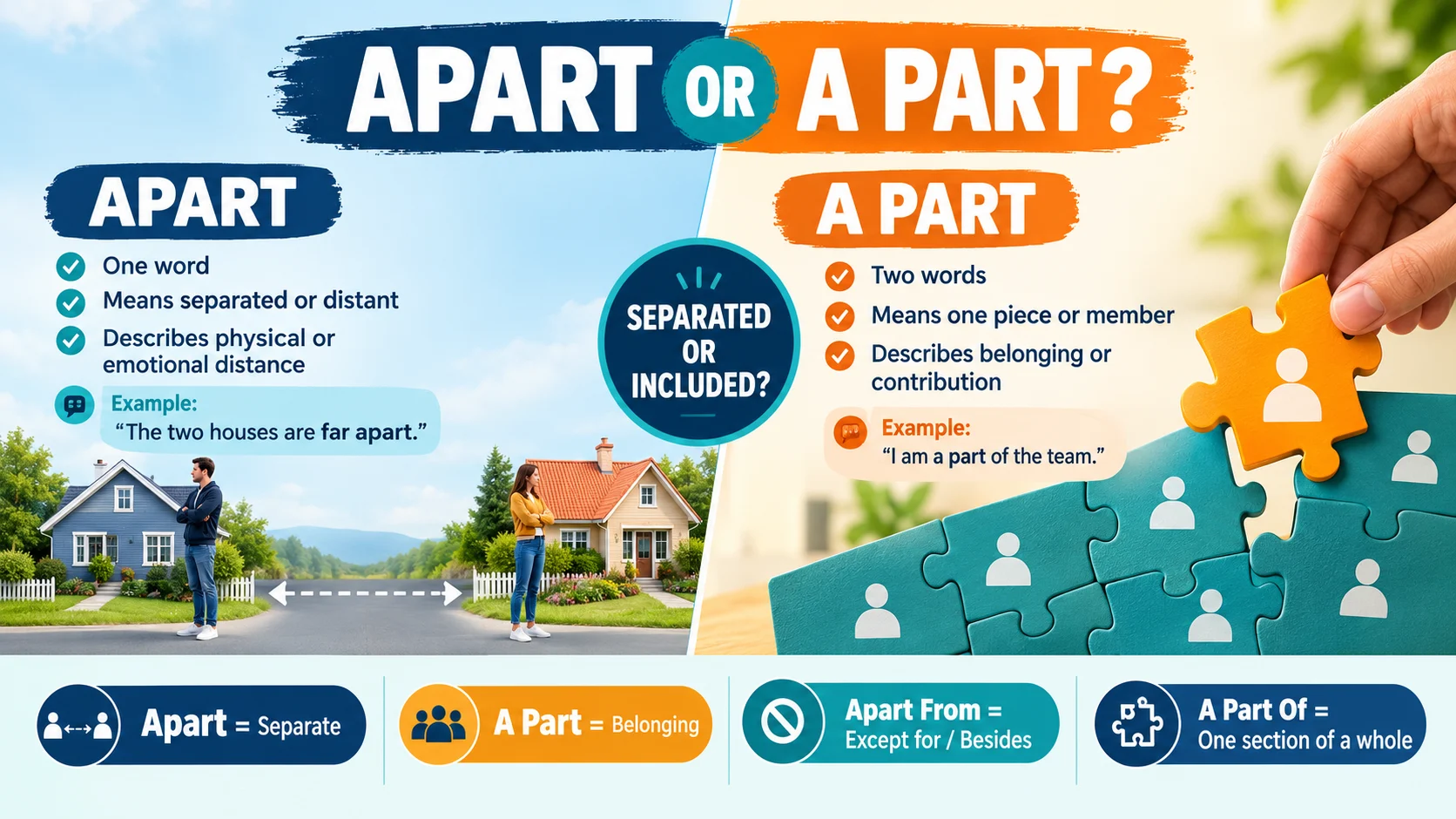
Apart and a part have different meanings and uses. Apart is an adverb that means separated, at a distance, or independently. In contrast, a part is a two-word phrase that means one piece, section, or member of something larger. For example, “The two houses are far apart” describes distance, while “I am a part of the team” describes belonging.
Choosing between apart or a part can be confusing because both expressions sound exactly the same when spoken. However, their meanings, spelling, and grammatical functions are different. One describes separation or distance, while the other refers to belonging to something or being one piece of a larger whole. Although the difference seems small, using the wrong expression can change the meaning of an entire sentence.
For example, consider these two sentences: “We live apart” and “We are a part of the same family.” The first describes two people living separately, whereas the second explains their connection to a family. Therefore, understanding when to use each expression can make your writing clearer and more accurate.
Whether you’re writing an email, completing a school assignment, preparing a professional document, or communicating online, knowing the difference between apart or a part will help you avoid common grammar mistakes. In this guide, you’ll discover their definitions, grammatical functions, practical examples, usage rules, common errors, and easy memory tricks to help you choose the correct expression every time.
What Does Apart Mean?
Apart is an adverb that describes something separated, distant, or divided from another thing. It can refer to physical distance, emotional separation, differences, or the condition of being divided into individual pieces.
In simple words, when two or more things are not together, you can often use apart.
For example:
- My grandparents live apart from each other.
- Keep the books apart on different shelves.
- The two buildings stand several miles apart.
- Their opinions are completely apart.
- The old machine fell apart after years of use.
Additionally, apart appears in several common English expressions, including “fall apart,” “set apart,” “grow apart,” and “take apart.”
Different Meanings of Apart
The word apart can communicate several related ideas depending on the sentence.
Separation or distance: It describes two things that are physically separated.
Example: “The two schools are five miles apart.”
Emotional distance: It can describe people who no longer share a close relationship.
Example: “The couple slowly grew apart.”
Individual differences: It can highlight how something differs from another thing.
Example: “Their opinions set them apart.”
Breaking into pieces: It can describe something that separates or breaks.
Example: “The old chair started falling apart.”
Exclusion or exception: In the expression “apart from,” it can mean except for or in addition to, depending on context.
Example: “Apart from Monday, I am available every day.”
What Does A Part Mean?
A part is a two-word phrase consisting of the article “a” and the noun “part.” It means one piece, section, element, or member of a larger whole.
In simple terms, if something belongs to a group, contributes to a larger system, or forms one section of something bigger, you can use a part.
For example:
- I am a part of this community.
- The engine is a part of the vehicle.
- Everyone plays a part in the project.
- She wants to be a part of the celebration.
- This chapter is a part of the complete story.
Furthermore, a part can refer to a person’s role or contribution to an activity.
Different Meanings of A Part
The phrase a part has several common uses.
A section of something: It identifies one portion of a larger object or subject.
Example: “The introduction is a part of the article.”
Membership or belonging: It describes someone or something that belongs to a group.
Example: “He is a part of our organization.”
A contribution or role: It explains someone’s involvement in an activity.
Example: “Every employee has a part to play.”
A component: It identifies an individual piece of a larger structure.
Example: “The battery is a part of the device.”
A role in a performance: It can refer to a character or role in a play, movie, or other production.
Example: “She received a part in the school musical.”
Apart vs. A Part: Key Differences
Although these expressions sound identical, their meanings and grammatical functions are not the same.
| Feature | Apart | A Part |
|---|---|---|
| Word type | Adverb | Article + noun |
| Main meaning | Separated or distant | One piece or member |
| Spelling | One word | Two words |
| Main purpose | Describes separation | Describes belonging or a section |
| Example | They live apart. | I am a part of the team. |
| Opposite idea | Together | The whole |
| Common expressions | Fall apart, grow apart | A part of, play a part |
The easiest way to remember the difference is to focus on the meaning. Apart indicates separation, whereas a part indicates connection or inclusion.
When to Use Apart
Use apart when you want to describe distance, separation, differences, or something that has broken into pieces.
Here are the most common situations where this word fits naturally.
When Describing Physical Distance
Use apart when two objects, buildings, people, or locations are separated by a particular distance.
Examples:
- The two houses are 100 feet apart.
- Keep the chairs six inches apart.
- Our offices are several blocks apart.
- The twins live miles apart.
When Describing Relationships
Additionally, apart can describe emotional or relationship separation.
Examples:
- They decided to live apart.
- The couple grew apart over time.
- Distance kept the two friends apart.
- Their disagreements eventually drove them apart.
When Describing Differences
Use the word to show that two people, ideas, or things are different.
Examples:
- Their opinions are far apart.
- What sets this product apart is its quality.
- The two designs are worlds apart.
- Their personalities are completely different, although they grew up together.
When Describing Something Breaking
The expression “fall apart” describes something breaking into pieces or losing its structure.
Examples:
- The old book is falling apart.
- My shoes started falling apart after months of use.
- The organization began to fall apart.
- The sandwich came apart when I picked it up.
When Using Apart From
The expression apart from can mean “except for” or “besides,” depending on the context.
Examples:
- Apart from one small mistake, your work is excellent.
- Apart from English, she speaks Spanish and French.
- Apart from the weather, everything went perfectly.
When to Use A Part
Use a part when referring to one section, component, member, or contribution within something larger.
Here are the most useful situations.
When Describing Membership
Use a part when someone belongs to a group, organization, family, or community.
Examples:
- I am a part of the school team.
- She is a part of our family.
- They want to become a part of the community.
- He feels proud to be a part of this organization.
When Describing a Section of Something
Use the phrase to identify one piece of a larger object, document, story, or structure.
Examples:
- This chapter is a part of the book.
- The kitchen is a part of the house.
- The final paragraph is a part of the introduction.
- This section is a part of the complete report.
When Describing Someone’s Contribution
The phrase can also describe a person’s involvement or responsibility.
Examples:
- Everyone has a part to play in this project.
- She played a major part in our success.
- My parents were a part of my journey.
- Your support is a part of our achievement.
When Describing a Role
Use a part when discussing an acting role or character in a performance.
Examples:
- He wants a part in the school play.
- She received a part in the movie.
- The director offered him a part in the production.
Apart or A Part: Real-Life Examples
The following examples demonstrate how each expression works in everyday American English.
| Sentence | Correct Expression | Explanation |
|---|---|---|
| We live five miles ___ . | Apart | Describes physical distance. |
| I am ___ of the team. | A part | Describes membership. |
| The old building is falling ___ . | Apart | Describes breaking. |
| She wants to be ___ of the group. | A part | Describes belonging. |
| The two friends grew ___ . | Apart | Describes emotional separation. |
| Everyone plays ___ in the project. | A part | Describes contribution. |
| Keep the two boxes ___ . | Apart | Describes separation. |
| This chapter is ___ of the novel. | A part | Describes a section. |
Apart in Everyday Sentences
- My brother and I live apart because of our jobs.
- The two restaurants are located several streets apart.
- Their friendship began to fall apart after the argument.
- Please keep the fragile items apart from the heavy boxes.
- Her unique personality sets her apart from everyone else.
- The students sat far apart during the examination.
- The company and its former partner went their separate ways and remained apart.
- The old painting started coming apart around the edges.
A Part in Everyday Sentences
- I want to become a part of your team.
- Education is a part of personal development.
- My sister played a major part in organizing the event.
- Every member is a part of this community.
- The final scene is a part of the movie’s biggest moment.
- Good communication is a part of a healthy relationship.
- She wants to be a part of something meaningful.
- Your feedback is an important part of our improvement.
Apart From vs. A Part Of
One of the most confusing comparisons involves apart from and a part of. Although they sound similar, they communicate different ideas.
Apart from is a phrase that usually means “except for” or “besides.” On the other hand, a part of means belonging to or being one section of something.
Compare these examples:
| Apart From | A Part Of |
|---|---|
| Apart from John, everyone attended. | John is a part of the team. |
| Apart from the cost, I like the house. | The kitchen is a part of the house. |
| Apart from English, she speaks French. | French is a part of her language studies. |
| Apart from one issue, everything is fine. | This issue is a part of the larger problem. |
Remember: Use apart from when introducing an exception or additional information. Use a part of when describing membership, inclusion, or a component.
Can You Write Apart as A Part?
No, not when you want to describe the same meaning. These expressions are not interchangeable.
For example:
Incorrect: “I want to be apart of your team.”
Correct: “I want to be a part of your team.”
The first sentence suggests separation rather than membership. However, the second correctly explains that the speaker wants to belong to the team.
Likewise:
Incorrect: “The two houses are a part.”
Correct: “The two houses are apart.”
The correct expression depends on the meaning you want to communicate.
Is Apart One Word or Two?
Apart is one word. It is an adverb that generally describes something separated, distant, or divided.
However, a part consists of two separate words: the article “a” and the noun “part.”
For example:
- The children sat apart from each other.
- Every child is a part of the school community.
Although the pronunciation is identical, the spelling changes the meaning of the sentence.
Is A Part One Word or Two?
A part is always written as two words when it means one section, member, or component of something.
The article “a” introduces the singular countable noun “part.”
For example:
- She wants to play a part in the event.
- This is a part of the larger collection.
However, the noun “part” can also appear without the article in certain expressions, such as “take part,” “play part,” or “part of the process,” depending on the grammatical construction.
A Part vs. Part: Is There a Difference?
Yes. A part and part can have related meanings, but their grammatical use differs.
A part emphasizes one individual piece or member of a larger whole.
Example: “I am a part of the organization.”
Part without the article can describe a section, role, or contribution more generally.
Example: “I played part in the decision.”
In many everyday sentences, both forms can work, but the meaning and naturalness may change.
Compare:
- She played a part in the company’s success.
- She played an important part in the company’s success.
- She took part in the company’s annual meeting.
The expression “take part” is a common fixed phrase meaning to participate. Therefore, you should not automatically add “a” before every use of the word part.
Common Expressions With Apart and A Part
Both expressions appear in frequently used English phrases.
Common Expressions With Apart
| Expression | Meaning | Example |
|---|---|---|
| Fall apart | Break into pieces or stop functioning | My old phone is falling apart. |
| Grow apart | Become emotionally distant | The friends grew apart. |
| Set apart | Make something distinctive | Her talent sets her apart. |
| Take apart | Separate something into pieces | He took apart the machine. |
| Far apart | Separated by a large distance | Their homes are far apart. |
| Tear apart | Separate or damage forcefully | The storm tore the roof apart. |
| Keep apart | Maintain separation | Keep the chemicals apart. |
Common Expressions With A Part
| Expression | Meaning | Example |
|---|---|---|
| A part of | One section or member | I am a part of the team. |
| Play a part | Contribute or have a role | She played a part in the victory. |
| Be a part of | Belong to something | He is a part of our family. |
| A major part | An important contribution | Trust is a major part of friendship. |
| A small part | A minor section | This is a small part of the project. |
| A crucial part | An essential component | Practice is a crucial part of learning. |
Why Do People Confuse Apart and A Part?
There are several reasons these expressions create confusion, especially for English learners and people writing quickly.
Identical pronunciation: Both expressions sound the same when spoken. Consequently, listeners cannot identify the correct spelling through pronunciation alone.
Similar spelling: The only visible difference is the space between “a” and “part.” This small difference can easily go unnoticed.
Related meanings: Both expressions can appear when discussing groups, objects, or relationships. However, one communicates separation while the other describes inclusion.
Autocorrect mistakes: Typing tools sometimes fail to recognize the intended meaning, particularly when a sentence is grammatically possible but contextually incorrect.
Lack of grammatical understanding: Some writers memorize spelling rules without learning the grammatical role of each expression.
Therefore, understanding the meaning of your sentence is more useful than relying on pronunciation.
Easy Tricks to Remember Apart or A Part
You do not need complicated grammar rules to remember the difference. These simple tricks can help.
Remember That Apart Means Separate
Think of apart as the opposite of together.
Example:
“The two chairs are apart.”
You can replace the word with “separated” without changing the basic meaning.
Remember That A Part Means Belonging
Think of a part as one piece of a bigger whole.
Example:
“I am a part of the family.”
You can understand it as “I belong to the family.”
Look for the Word Together
If the sentence describes distance or separation, apart is usually the correct choice.
Example: “The two roads are several miles apart.”
Look for Membership or Contribution
If the sentence describes being included in something, use a part.
Example: “She is a part of the school team.”
Use the Opposite Test
Try replacing the expression with its opposite idea.
- Apart → Together
- A part → The whole or something outside the group, depending on context
This simple comparison makes the difference easier to remember.
Synonyms for Apart and A Part
- Synonyms can help you understand the meaning of both expressions and choose suitable alternatives in different situations.
Synonyms for Apart
Depending on the context, useful alternatives include:
- Separated
- Distant
- Divided
- Isolated
- Disconnected
- Independent
- Away
- Aside
- Distinct
- Separate
Examples:
- The two houses are separated by a road.
- Their opinions are different.
- The children stood at a distance from each other.
Synonyms for A Part
Depending on the intended meaning, useful alternatives include:
- A section
- A piece
- A portion
- A component
- A member
- An element
- A segment
- A participant
- A contributor
- A role
Examples:
- This section belongs to the larger report.
- She is a member of the organization.
- The engine is one component of the vehicle.
Important: These synonyms are context-dependent. For example, “separated” can replace apart in a distance-related sentence, but “member” may be a better alternative to a part when discussing group membership.
Apart or A Part in American English
Both expressions are standard in American English. Their meanings and spelling do not change between American and British English.
However, American writers commonly use apart in everyday expressions such as:
- We grew apart.
- Keep the children apart.
- The buildings are far apart.
- Their opinions are worlds apart.
Meanwhile, a part appears naturally in sentences involving family, education, work, relationships, and social groups.
For example:
- I want to be a part of this community.
- Teamwork is a part of our company culture.
- Everyone has a part to play.
Whether you are writing a school essay, a business email, a blog post, or a social media caption, the same spelling distinction applies.
Common Mistakes to Avoid
Even experienced English speakers sometimes confuse these expressions. Here are common errors and their corrections.
| Incorrect Sentence | Correct Sentence | Reason |
|---|---|---|
| I want to be apart of the team. | I want to be a part of the team. | Describes membership. |
| The houses are a part from each other. | The houses are apart from each other. | Describes separation. |
| She is apart of my family. | She is a part of my family. | Describes belonging. |
| The two friends live a part. | The two friends live apart. | Describes separate living arrangements. |
| This chapter is apart of the book. | This chapter is a part of the book. | Describes a section. |
| Keep the objects a part. | Keep the objects apart. | Describes separation. |
Mistake: Writing Apart of
One of the most common errors is writing “apart of” when the intended meaning is membership or inclusion.
Incorrect: “He is apart of the group.”
Correct: “He is a part of the group.”
Remember that the phrase needs the article “a” to introduce the noun part.
Mistake: Using A Part for Physical Distance
Another common error occurs when someone uses a part instead of apart to describe distance.
Incorrect: “The two schools are a part.”
Correct: “The two schools are apart.”
The correct choice depends on whether you mean separation or belonging.
Mistake: Ignoring the Context
Sometimes, writers choose the expression based only on how it sounds. However, pronunciation cannot tell you whether to use one word or two.
Instead, ask yourself whether the sentence describes something separated or something included in a larger whole.
Practice Exercises: Apart or A Part
Test your understanding with the following exercises. Choose the correct expression for each sentence.
Fill in the blanks with Apart or A Part.
- My office is two miles ______ from my house.
- I want to become ______ of the organization.
- The old sofa is falling ______.
- She is ______ of our school community.
- The two brothers live ______ from each other.
- Every employee plays ______ in the company’s success.
- Keep the glasses ______ from the plates.
- This paragraph is ______ of the introduction.
- Their relationship slowly fell ______.
- He wants to be ______ of the winning team.
- The two cities are 50 miles ______.
- Trust is ______ of every healthy relationship.
- The machine came ______ during the repair.
- She played ______ in organizing the event.
- Their ideas are worlds ______.
Answers and Explanations
Apart
- My office is two miles apart from my house. (Describes distance.)
- The old sofa is falling apart. (Describes breaking.)
- The two brothers live apart from each other. (Describes separation.)
- Keep the glasses apart from the plates. (Describes separation.)
- Their relationship slowly fell apart. (Describes a breakdown.)
- The two cities are 50 miles apart. (Describes distance.)
- The machine came apart during the repair. (Describes separation into pieces.)
- Their ideas are worlds apart. (Describes major differences.)
A Part
- I want to become a part of the organization. (Describes membership.)
- She is a part of our school community. (Describes belonging.)
- Every employee plays a part in the company’s success. (Describes contribution.)
- This paragraph is a part of the introduction. (Describes a section.)
- He wants to be a part of the winning team. (Describes membership.)
- Trust is a part of every healthy relationship. (Describes an element.)
- She played a part in organizing the event. (Describes involvement.)
Related Comparisons: Commonly Confused Words
Apart from learning this expression, understanding other commonly confused English words can improve your grammar and writing skills.
Everyday or Every Day: Everyday is an adjective describing something ordinary, while every day refers to each day.
Alot or A Lot: A lot is the correct two-word expression meaning many or much. “Alot” is a common spelling mistake.
Into or In To: Into generally indicates movement or a change of state, while in to consists of two separate words with different grammatical functions.
Your or You’re: Your indicates possession, while you’re is the contraction of “you are.”
There, Their, or They’re: There indicates a place or introduces a statement, their shows possession, and they’re means “they are.”
Everytime or Every Time: Every time is the standard two-word expression used to refer to each occasion.
All Together or Altogether: All together means everyone or everything in one group, while altogether means completely or entirely.
Frequently Asked Questions
Is it apart or a part?
Both are correct, but they have different meanings. Apart means separated or distant, while a part means one piece, section, or member of a larger whole.
Is apart one word?
Yes. Apart is one word, usually functioning as an adverb to describe separation, distance, or division.
Is a part two words?
Yes. A part consists of the article “a” and the noun “part.” It refers to one section or member of something larger.
What is the difference between apart and a part?
The main difference is their meaning. Apart describes separation, whereas a part describes belonging, inclusion, or a section of something.
Is it a part of or apart of?
Use a part of when you mean belonging to or being included in something.
Correct: “She is a part of the team.”
The expression “apart of” is generally incorrect when you intend to describe membership.
Is apart the opposite of together?
Yes. In many contexts, apart is the opposite of together because it describes separation or distance.
Example: “The children sat apart instead of sitting together.”
Can apart mean different?
Yes. In certain expressions, apart can describe differences between people, objects, or ideas.
Example: “Their opinions are far apart.”
However, “different” is often a more direct synonym.
What does apart from mean?
Apart from can mean “except for” or “besides,” depending on the context.
Example: “Apart from one spelling mistake, the essay is excellent.”
Is a part of grammatically correct?
Yes. A part of is grammatically correct when describing a section, component, role, or member of a larger whole.
Example: “Exercise is a part of a healthy lifestyle.”
How do you remember apart vs. a part?
Remember that apart means separated, while a part means included in something. If you can replace the expression with “separated,” choose apart. If you mean “one piece of a whole,” choose a part.
Is apart from the same as a part of?
No. Apart from usually means except for or besides, while a part of means belonging to or forming one section of something.
Which is correct: I want to be apart of it or a part of it?
“I want to be a part of it” is correct when you mean that you want to participate or belong to something.
Can apart and a part be used in the same sentence?
Yes. Both expressions can appear in one sentence when they communicate different ideas.
Example: “Although the team members live far apart, they are all a part of the same organization.”
Key Takeaways: Apart or A Part
Here are the most important points to remember:
- Apart is one word that means separated, distant, or divided.
- A part is two words that mean one section, piece, or member of something larger.
- Use apart to describe physical distance, emotional separation, or differences.
- Use a part to describe belonging, membership, contribution, or a component.
- Apart from usually means except for or besides.
- A part of means belonging to or forming a section of something.
- Both expressions sound identical, so context determines the correct spelling.
The easiest memory trick: Apart means separate, while a part means included.
Conclusion
Understanding the difference between apart or a part is simple once you recognize what each expression communicates. Although they sound identical, their meanings are quite different. Apart describes separation, distance, or division, while a part refers to one section, component, or member of something larger.
For example, you can say, “The two friends live apart” when describing physical separation. However, when describing their connection, you can write, “They are a part of the same community.” Similarly, remember that apart from usually means except for or besides, while a part of describes inclusion or belonging.
Ultimately, the easiest way to choose the correct expression is to consider your sentence’s meaning before writing. If you are describing something separate, use apart. If you are describing something included in a larger whole, use a part. With these simple rules and regular practice, you’ll be able to use both expressions confidently in everyday conversations and professional writing.