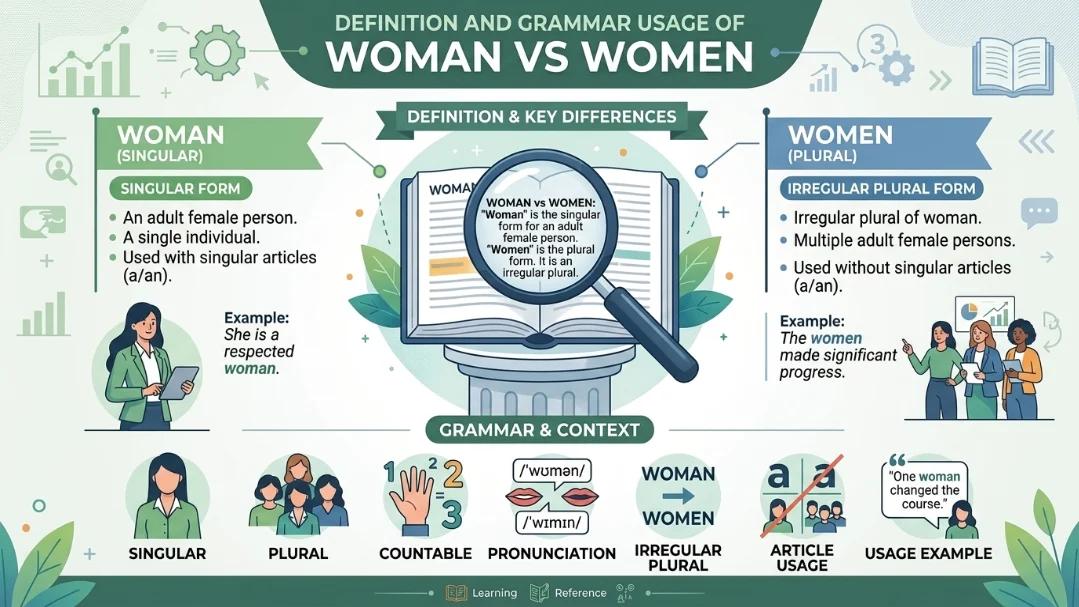
“Woman” is a singular noun referring to an adult female human, whereas “women” is the plural form used for two or more adult females. Mixing up these two terms remains a frequent spelling and grammatical error in written English. Writers can easily avoid mistakes by remembering that “woman” contains “man” for one person, while “women” changes the middle vowel for multiple people.
Words build our world. Small spelling errors can change meaning fast. Writers often mix up terms that look alike. A clear example involves choosing between women or woman. Many people type the wrong word by mistake. Grammar rules guide us toward correct usage every single time.
Mastering these words boosts your writing confidence. Clear sentences help readers understand your message instantly. Everyone benefits from strong communication skills. Let us explore the simple rules behind these terms right now.
Understanding basic grammar rules prevents awkward writing mistakes. “Woman” serves as a singular noun representing one adult human female. “Women” functions as the plural noun representing multiple adult human females. Pronunciation differs noticeably between both terms, which aids spoken communication.
Writers must check their context before typing. Singular subjects require the singular term. Plural subjects demand the plural counterpart. Consistent accuracy creates professional and polished documents.
Definition and Explanation
What Does Woman Mean
The singular noun refers to one adult human female. This word establishes individual identity and biological or social categorization. For example, a single person attending a meeting is described correctly using this term.
What Does Women Mean
The plural noun indicates two or more adult human females. Groups, teams, and populations require this plural form. For instance, an entire committee of female professionals receives description through this term.
Pronunciation and Spelling Differences
Pronunciation rules separate these two vocabulary entries completely. The singular form sounds like “woom-uhn.” The plural form sounds like “wim-ihn.” Changing the middle letter shifts the vowel sound drastically.
| Term | Grammatical Number | Target Count | Pronunciation Guide |
| Woman | Singular | Exactly one adult female | Woom-uhn |
| Women | Plural | Two or more adult females | Wim-ihn |
Advantages and Disadvantages
Benefits of Correct Usage
Precise grammar elevates your professional reputation. Academic papers and business reports require absolute accuracy. Readers trust authors who master fundamental language rules.
Drawbacks of Careless Mistakes
Typos distract audiences immediately. Spell check software sometimes misses grammatical context errors. Readers might judge your competence based on simple mistakes.
Real World Examples
Professional Workplace Scenarios
Corporate environments demand clear communication. A company might host a leadership summit. Organizers invite multiple successful female executives to speak at the conference. Therefore, reports describe the panel using the plural term correctly.
Educational Settings
Schools celebrate historical achievements annually. Textbooks highlight specific historical figures. A biography about a single scientist uses the singular term. Another chapter covering multiple activists requires the plural form.
Regional and Global Usage
Global English Standards
English grammar remains uniform across global regions. Whether writing in London, New York, or Sydney, these rules apply identically. Standard dictionaries maintain identical definitions worldwide.
Cultural and Social Contexts
Language reflects cultural values and historical contexts. Modern discourse emphasizes respectful terminology across all publications. Writers must select words that honor human dignity and proper grammar.
Common Mistakes
Swapping Singular and Plural Forms
Authors frequently insert the plural form when discussing a single person. Proofreading catches these typos easily. Always count your subjects before writing.
Pronunciation Confusion
Spoken language sometimes causes spelling errors. Because the plural sounds like “wim-ihn,” writers might guess incorrect spellings. Memorizing the visual structure of each word prevents future mistakes.
Exercises with Answers
Practice Questions
- Fill in the blank with the correct option: She is a brilliant ________ scientist.
- Fill in the blank with the correct option: Several ________ attended the board meeting.
- True or False: “Woman” is the plural form.
- Correct the sentence: Three woman walked into the room.
Answer Key
- woman
- women
- False
- Three women walked into the room.
Related Concepts and Comparisons
Linguistic Gender and Pronouns
Grammar relies on agreement rules. Pronouns must match their antecedents in number and gender. Selecting appropriate vocabulary ensures logical coherence across paragraphs.
Synonyms and Alternative Terms
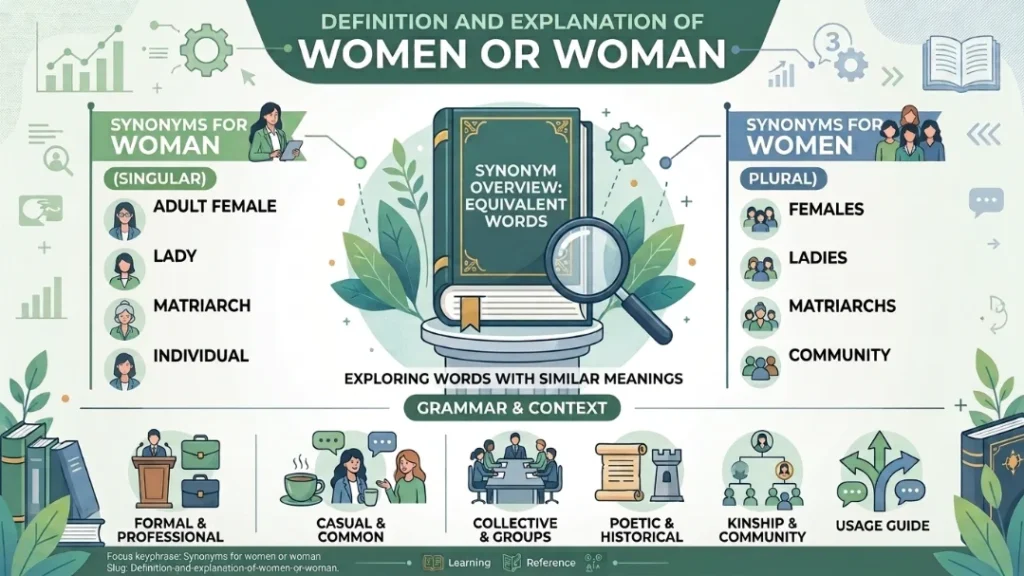
Writers expand their vocabulary using alternatives. Rich descriptions improve storytelling quality.
| Synonym | Definition | Tone |
| Female | Of or denoting the sex that can bear offspring | Biological / Neutral |
| Lady | A polite or formal term for a woman | Formal / Polite |
| Matriarch | A woman who is the head of a family or group | Respectful / Authoritative |
| Gents and Dames | Informal or traditional group references | Informal |
FAQs
What is the main difference between woman and women?
“Woman” is singular and refers to one adult female. “Women” is plural and refers to two or more adult females.
How do I pronounce woman?
The singular term is pronounced like “woom-uhn” with a clear “oo” sound in the first syllable.
How do I pronounce women?
The plural term sounds like “wim-ihn” with a short “i” sound in the first syllable.
Can woman be used as an adjective?
Yes, it often acts as an attributive noun functioning like an adjective, such as in the phrase “woman engineer.”
Why do people confuse these words?
Typing fast on keyboards often leads to transposition errors, and similar visual appearances cause accidental mix-ups.
Are these words used in all English dialects?
Yes, these fundamental terms are universal across American, British, Australian, and global English dialects.
What is the plural of woman?
The correct plural form is “women.”
How can I remember the difference?
Notice that “woman” contains the word “man” inside it for a single person, while “women” changes the middle vowel.
Is female a good substitute?
Female can be used, but using it as a noun can sometimes sound clinical or robotic compared to using woman.
Do spell checkers catch this mistake?
Spell checkers often miss context errors if the misspelled word itself is a correctly spelled dictionary word.
Conclusion
Mastering fundamental vocabulary strengthens your overall writing performance. Distinguishing between women or woman prevents embarrassing communication errors. Consistent practice builds reliable editing habits over time.
Review your drafts carefully before publishing any content. Small details matter significantly in professional environments. Apply these lessons daily to achieve complete grammatical clarity.