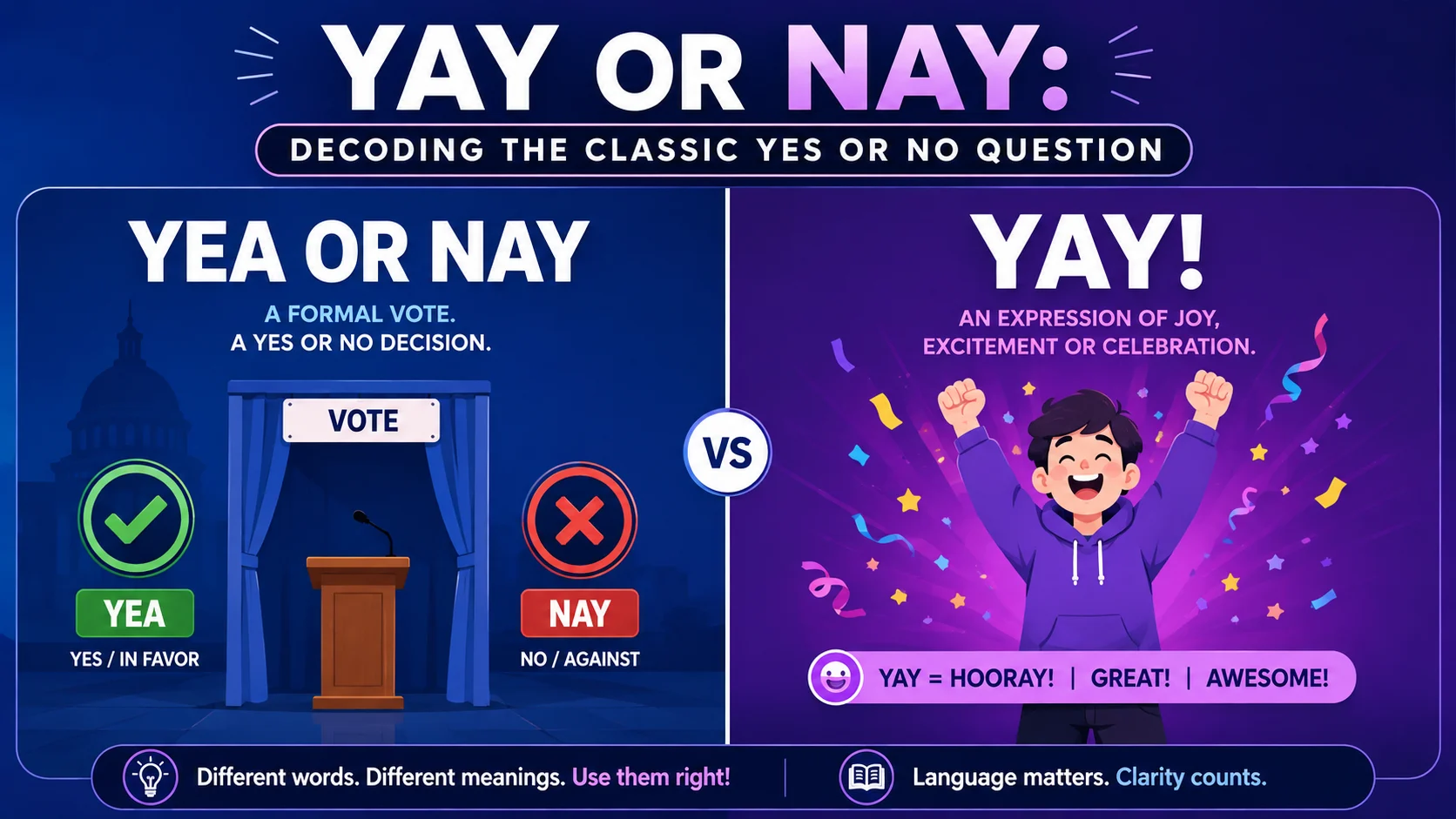
Are you trying to figure out if it’s “yay or nay” or “yea or nay”? The correct spelling for voting is “yea or nay” . “Yay” is a separate word used to express excitement. While you will often see “yay or nay” online, it is considered a common misspelling of the formal phrase “yea or nay” .
Have you ever typed “yay or nay” in a text or email and wondered if you got it right? This small phrase pops up everywhere. People use it to make decisions, ask for opinions, and vote on everything from lunch spots to major business deals. The meaning seems obvious, but the spelling can trip you up.
The problem stems from two words that sound identical but have different meanings and spellings. You hear “yay” and “yea” pronounced the same way. Therefore, many people assume they are the same word, but they are not. This confusion leads to widespread misspellings and some debate among grammar experts.
This article clears up the confusion once and for all. You will learn the correct spelling for formal voting, discover why you see “yay or nay” so often, and understand the different contexts where each word belongs. Good writing depends on these small details, and now you can get this one right every time.
Key Takeaway
The main takeaway is that formal English distinguishes between “yea” and “yay.” For an affirmative vote or a formal yes/no question, the correct spelling is “yea or nay . In contrast, “yay” is an interjection that shows excitement, similar to “hooray!” . The common internet spelling “yay or nay” is technically incorrect, but its widespread use makes it an accepted informal variant .
Definitions and Explanations
What Does “Yea or Nay” Mean?
The phrase “yea or nay” means “yes or no . It asks someone to express their choice or opinion. This expression has a formal and often historical feel.
“Yea” means yes . It signals agreement, approval, or an affirmative vote. “Nay” means no . It signals disagreement, disapproval, or a negative vote. Together, they form a classic way to ask for a binary choice. For example, you might ask, “Do you want pizza for dinner, yea or nay?”
This pair of words is deeply connected to voting. The United States Senate still uses “yea” and “nay” for roll call votes . When a senator’s name is called, they respond with “yea” to vote yes and “nay” to vote no. This formal usage keeps the phrase alive in modern politics. Smaller governing bodies, like city councils, also use these terms during official votes .
What Does “Yay” Mean?
“Yay” is an interjection that people use to express joy, excitement, or approval . You say “yay” when you get good news. It is a synonym for “woohoo!” or “hooray! . For example, you might say, “Yay! We are getting pizza tonight!” This word is informal and expresses a positive emotion.
Another less common meaning of “yay” relates to size or measurement . People use it to indicate “this much” while gesturing. For instance, you might say, “The fish I caught was yay big,” while holding your hands apart to show the size. This usage is also informal.
| Word | Part of Speech | Primary Meaning | Common Usage |
| Yea | Adverb | Yes (often for voting) | Formal, voting, polls |
| Nay | Adverb/ Noun | No | Formal, voting, older English |
| Yay | Interjection | Expresses excitement | Informal, casual conversation |
The Etymology and Origin
Understanding where these words come from can help you remember the difference.
- Yea: This word traces back to Middle English, where it was spelled ye or ya . It evolved from the Old English word gēa, which meant “yes.” The word “yes” itself comes from a different Old English word, gēse. Both “yea” and “yes” have existed in English for over a thousand years, dating back to before the 12th century .
- Nay: “Nay” appeared later, around the 13th century . It comes from the Old Norse word nei, which translates to “not ever.” Interestingly, “no” is an even older word, predating “nay” by several centuries. It has roots in Old Norse, Old High German, Latin, and Greek .
- Yay: This is a recent addition to the English language . It only appeared in the 1960s . It likely evolved as a variant of “yea” but took on a different meaning as an exclamation of excitement.
Advantages and Disadvantages
This phrase has its uses and its pitfalls. Understanding these can improve your communication.
When “Yea or Nay” Is the Right Choice
Using “yea or nay” gives your writing a formal and authoritative tone. It is the correct choice in official contexts. For instance, in a business meeting, the chairperson might ask, “All in favor, say ‘yea.’ All opposed, say ‘nay’.” This language is precise and carries a sense of tradition. It is also the standard in legislative bodies.
Another advantage is clarity. “Yea” and “nay” are unambiguous. They leave no room for confusion about what a yes or no vote means. This clarity is why the United States Senate and other deliberative bodies continue to use them . The disadvantage is that this language can sound overly formal or even pretentious in casual conversation . If you ask a friend, “Do you want coffee, yea or nay?” it might sound odd or like you are joking.
When “Yay or Nay” Works
The advantage of using “yay or nay” is that it feels more modern and casual. It fits well in informal settings like text messages, social media posts, or blog comments. The spelling “yay” also rhymes perfectly with “nay,” making the phrase feel more catchy and balanced. This is likely one reason for its popularity . It is widely understood to mean “yes or no” in everyday language .
However, the clear disadvantage is its grammatical incorrectness. It is a misspelling of “yea or nay” . Using it in formal writing can make you appear less educated or careless. Many style guides and dictionaries do not accept “yay” as a synonym for “yea . Therefore, in a professional report or an academic paper, “yay or nay” would be a mistake.
Real-World Examples
Seeing these words in action helps clarify the correct usage.
Formal Contexts for “Yea or Nay”
- “The Senator from Ohio voted ‘yea’ on the bill.” This shows a formal yes vote.
- “The motion was defeated with 50 votes ‘nay’ and 49 votes ‘yea’.” This demonstrates official vote counting.
- “All in favor of the new policy, say ‘yea’.” This is a standard call for a vote.
- “The committee chairperson asked for a ‘yea or nay’ on the proposal.” This is a formal request for a decision .
Modern Informal Contexts for “Yay or Nay”
- “What do you think of this dress, yay or nay?” This is a casual way to ask for an opinion .
- “Pizza for dinner, yay or nay?” You might ask this question in a family group chat.
- “Yay or nay on the new iPhone?” This is a common way to solicit opinions on social media.
- “A new haircut, yay or nay?” This is asking for approval on a personal change.
Correct Use of “Yay” as Excitement
- “We are going to Disneyland! Yay!” Here, “yay” expresses pure joy.
- “Yay, I got the job!” This is a celebration.
- “Yay, it is Friday!” People use it to show enthusiasm for the weekend.
| Context | Correct Choice | Example |
| Official Voting | Yea or Nay | “The Senator cast a ‘yea’ vote.” |
| Formal Question | Yea or Nay | “The committee asked for a ‘yea or nay’ decision.” |
| Casual Text/Email | Yay or Nay (informal) | “Pizza, yay or nay?” |
| Expressing Joy | Yay | “Yay! We won the game!” |
Regional and Global Usage
The confusion between these words is a global phenomenon, but there are regional variations.
“Yay or Nay” vs. “Yea or Nay” in the United States
The United States Senate uses “yea” and “nay” for its roll call votes . This official usage makes “yea or nay” the formal standard in American politics. However, in everyday American speech, many people use “yay or nay” because they are more familiar with the word “yay” as a positive exclamation. The internet has only amplified this trend. You will often see “yay or nay” on American websites, in blog posts, and on social media . This widespread use in informal contexts has made “yay or nay” a common, if technically incorrect, variant in American English.
“Aye or Nay” in Other English-Speaking Countries
In other parts of the English-speaking world, you might encounter “aye or nay” instead of “yea or nay.” The United States House of Representatives, for instance, uses “aye” for a yes vote, while the Senate uses “yea” . The UK Parliament also uses “aye” . In Scotland and the north of England, “aye” is even a common everyday word for “yes” . Therefore, the phrase “aye or nay” is perfectly valid and even preferred in some regions. This shows that the concept of a yes/no vote exists across cultures, but the specific vocabulary can vary.
Common Mistakes
This section highlights the most frequent errors people make with this phrase. Learning them will help you avoid them.
Mistake 1: Using “Yay” for “Yea”
This is the most common error. People write “yay or nay” when they mean “yea or nay.” The confusion arises because both words are pronounced the same way. Many people have never even encountered the word “yea” in written form, so they assume “yay” is the correct spelling for an affirmative answer. This mistake is an “eggcorn,” a reinterpretation of a word or phrase based on a similar-sounding word . The best way to avoid this is to remember that “yea” is the word for voting. Save “yay” for celebrating.
Mistake 2: Confusing “Yea” and “Yeah”
Although both mean yes, “yea” and “yeah” are not interchangeable. “Yeah” is an informal version of “yes.” It is a casual agreement. “Yea” is more formal and is used for voting. Additionally, they are pronounced differently. “Yea” rhymes with “nay,” while “yeah” rhymes with “yeh” . Do not use “yeah or nay.” The correct pairing is “yea or nay.”
Mistake 3: Using “Nay” Incorrectly
“Nay” is a very specific word. It is not a direct synonym for “no” in all situations. Using it casually can sound old-fashioned or strange. For instance, saying “Nay, I don’t want any ice cream” would sound like you are acting in a play. It is best to reserve “nay” for formal votes or for stylized writing. Remember that a horse’s sound is “neigh,” not “nay” . Mixing these up would be a serious error.
Exercises
Test your knowledge with these exercises.
Exercise 1: Fill in the Blanks
Choose the correct word: “yea,” “yay,” or “nay.”
- We are finally going on vacation! ______!
- All in favor of the motion, say “_____.”
- All opposed to the motion, say “_____.”
- Do you think we should get a cat, _____ or nay?
- I love chocolate, _____ I am trying to cut back on sugar. (Hint: this is a rhetorical use of “nay”)
Exercise 2: Correct the Mistakes
Each sentence has a misspelling. Identify the error and correct it.
- “I don’t know what to order. Pizza, yay or neigh?”
- “The mayor voted yay on the city budget.”
- “Yea! I got an A on my test!”
Answer Key
Exercise 1 Answers:
- Yay (excitement)
- Yea (formal yes vote)
- Nay (formal no vote)
- Yea (formal yes/no choice)
- Nay (used for emphasis, meaning “no, rather”)
Exercise 2 Corrections:
- “Pizza, yea or nay?” (Not “yay or neigh.” “Neigh” is a horse sound) .
- “The mayor voted yea on the city budget.” (“Yea” is for voting) .
- “Yay! I got an A on my test!” (“Yay” expresses excitement) .
Related Concepts and Comparisons
Understanding how this phrase relates to other words helps build a complete picture.
Yea vs. Aye
Both “yea” and “aye” mean yes. However, their usage varies by region and institution. In the US Senate, they use “yea” . In the US House of Representatives, they use “aye” . The UK Parliament also uses “aye” . In casual conversation, “aye” is used in Scotland and northern England as an everyday “yes” .
Yea vs. Yeah
This is another common point of confusion. “Yeah” is the informal word for yes that people use in conversation. It is a casual response. “Yea” is the formal word for a yes vote. They are not interchangeable. “Yeah” also has a different pronunciation. It does not rhyme with “nay” like “yea” does .
| Word | Meaning | Pronunciation | Context |
| Yea | Yes (affirmative vote) | Rhymes with “hay” | Formal, Voting |
| Nay | No | Rhymes with “hay” | Formal, Voting |
| Aye | Yes | Rhymes with “eye” | Formal (UK, US House) |
| Yeah | Yes (informal) | Rhymes with “yell” | Casual, everyday |
FAQs
What is the correct way to say yes or no: yay or nay?
The correct formal spelling is “yea or nay” for a yes or no choice . “Yay” is a separate word that means “hooray!” It is a common mistake to use “yay” in place of “yea” .
Is “yay or nay” grammatically correct?
Grammatically, no. However, it is so widely used in informal settings that many people accept it. For formal writing and professional contexts, you should use “yea or nay” .
Why do people say “yay or nay” if it is wrong?
People say it because “yay” and “yea” are homophones (sound the same). Many people also are more familiar with “yay” as a positive exclamation. This makes “yay or nay” feel like the natural spelling .
What does “yea” mean?
“Yea” means yes. People use it primarily in formal voting. A vote of “yea” is a vote in favor of a proposal .
What does “nay” mean?
“Nay” means no. It is the formal opposite of “yea” in a vote . You can also use it for emphasis to replace a previous word with a more accurate one . An example is, “It was a successful year, nay, a brilliant one.”
What is the difference between “yea” and “yay”?
“Yea” is for voting and means yes. “Yay” is an exclamation of joy or excitement. The two words sound the same but have different uses and spellings .
What is the difference between “yea” and “yeah”?
“Yea” is a formal word for a yes vote. “Yeah” is a casual, informal version of yes. “Yea” rhymes with “nay,” while “yeah” rhymes with “yell” .
How do you use “nay” in a sentence?
You use “nay” in a vote: “The bill was defeated by 200 nays to 150 yeas.” You can also use it for emphasis: “He was handsome, nay, beautiful” . Do not use it as a direct synonym for “no” in casual conversation .
Do they say “yea or nay” or “yay or nay” in court?
In American courts, the common term is “yea or nay” for a vote. However, “aye” is also frequently used. Both are considered acceptable in a formal setting like a courtroom .
Conclusion
The difference between “yay” and “yea” is small but significant. “Yea or nay” is the correct formal spelling for a yes or no choice. It is the language of voting, of official decisions, and of formal grammar. “Yay,” on the other hand, is a word for celebration and excitement.
For your own writing, consider the context. If you are writing a formal email, a business report, or a research paper, use “yea or nay.” This choice shows attention to detail and respect for standard grammar rules. If you are sending a quick text to a friend or posting on social media, “yay or nay” is perfectly fine and widely understood. The key is knowing the difference and making a conscious choice.
Ultimately, language is a tool for communication. While it is important to know the rules, the most important thing is to be clear. Both “yay or nay” and “yea or nay” will be understood as a request for a yes or no answer. By reading this guide, you now have the knowledge to choose the correct spelling for any situation.