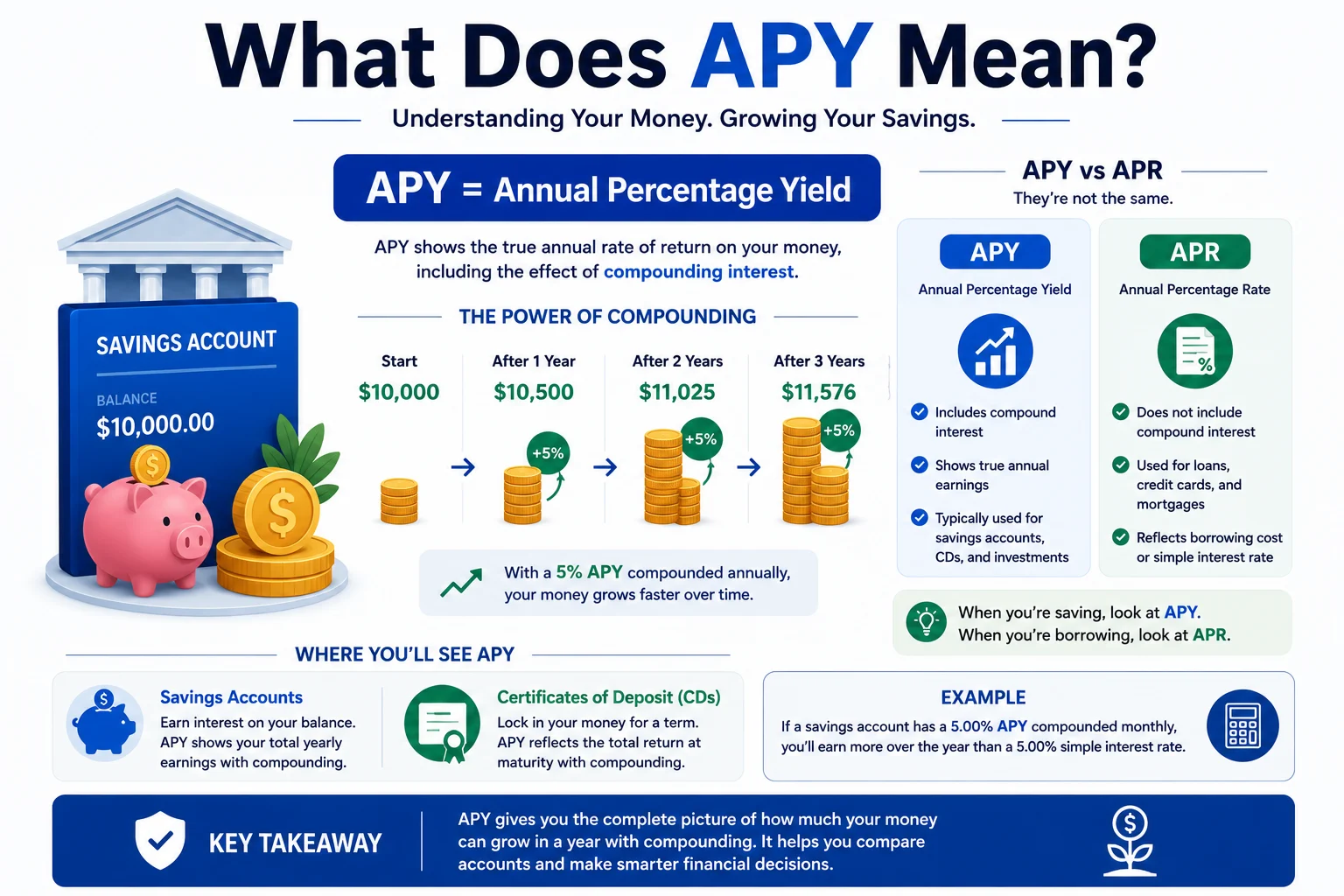
APY means Annual Percentage Yield. It shows how much a deposit can earn over one year, including the effect of compound interest. Banks and financial institutions use APY to help consumers compare savings accounts, CDs, and similar products.
what does apy mean is a common question when people compare savings accounts, certificates of deposit, or other interest bearing products. The short answer is simple: APY stands for Annual Percentage Yield.
However, APY does more than show an advertised interest rate. It also accounts for compounding during a one year period. Therefore, APY can give you a more realistic picture of how much your money may earn.
For example, two accounts might advertise similar rates but offer different compounding schedules. One account could compound daily, while another compounds monthly. As a result, their effective annual yields may differ.
APY matters because small differences can become meaningful over time. Furthermore, banks commonly display APY prominently when they advertise deposit accounts. Understanding the term helps you compare financial products without relying only on a headline interest rate.
Quick Answer Box
| Category | Answer |
| Meaning | Annual Percentage Yield |
| Context | Savings, CDs, money market accounts, and other deposit products |
| Primary Platforms | Bank websites, banking apps, financial comparison sites, and account advertisements |
| Example | A 5.00% APY means a $1,000 balance could earn about $50 over one year if the stated APY remains applicable and no withdrawals occur |
| Tone | Financial, informational, and commonly used in consumer banking |
What Does what does apy mean? Full Definition and Origin
APY means Annual Percentage Yield. It represents the amount an interest bearing deposit can earn over one year when compounding is included.
The word “annual” refers to a one year period. “Percentage” expresses the return as a percentage of the deposited amount. “Yield” describes what the account produces over that period.
Therefore, APY gives consumers an annualized way to evaluate an account’s earning potential.
APY vs. Interest Rate
A standard interest rate tells you the rate used to calculate interest. APY goes one step further because it reflects the impact of compounding.
Consider a simple example:
| Account | Stated Interest Rate | Compounding | Approximate APY |
| Account A | 5.00% | No compounding | 5.00% |
| Account B | 5.00% | Monthly | Slightly above 5.00% |
| Account C | 5.00% | Daily | Slightly above 5.00% |
The exact APY depends on the institution’s calculation and applicable terms.
Consequently, you should not assume that a stated interest rate and APY are interchangeable. The interest rate describes the underlying rate, while APY incorporates compounding.
Why Banks Advertise APY
Banks use APY because it gives customers a standardized way to evaluate deposit products.
For example, imagine a bank advertises a savings account with an attractive interest rate. Without knowing the APY, you might have difficulty comparing it with another account that compounds at a different frequency.
APY simplifies that comparison.
Furthermore, financial institutions commonly present APY alongside account terms, minimum balance requirements, promotional conditions, and fees. You should review all of those details before choosing an account.
How Compounding Changes Your Earnings
Compounding means previously earned interest can become part of the balance used to calculate future interest.
Suppose you deposit $1,000. The account earns interest. Then, the institution adds that interest to your balance. Future interest calculations may include the additional amount.
Over time, this creates a compounding effect.
The difference may appear small over a short period. However, larger balances and longer time periods can make compounding more noticeable.
A Basic APY Formula
A commonly used formula is:
APY = (1 + r/n)ⁿ − 1
Here:
| Symbol | Meaning |
| r | Nominal annual interest rate expressed as a decimal |
| n | Number of compounding periods per year |
For example, if a nominal rate is 5% and interest compounds monthly, the calculation reflects twelve compounding periods.
Most consumers do not need to calculate APY manually. Banks generally provide the APY for advertised deposit products.
Contextual Dynamics and Nuances of the Term
The meaning of APY stays consistent in banking, but its practical importance changes depending on the financial product.
APY on Savings Accounts
Savings accounts often advertise an APY because customers generally keep money in the account while earning interest.
A higher APY can increase your potential earnings. However, the highest advertised APY is not automatically the best option.
Check the account’s minimum balance rules, monthly fees, withdrawal conditions, promotional periods, and eligibility requirements.
For example, an account might advertise a high APY but require a substantial minimum balance. Another account might offer a slightly lower APY with no monthly fee.
In that situation, the second account could be more practical.
APY on Certificates of Deposit
Certificates of deposit, commonly called CDs, also use APY.
With a CD, you generally deposit money for a specified period. The institution pays interest according to the account’s terms.
A CD’s APY helps you compare its potential annualized yield with other deposit options.
However, do not compare the APY alone. A CD may impose an early withdrawal penalty. Therefore, the account’s liquidity matters as well.
APY on Money Market Accounts
Money market accounts can also advertise APY. These accounts may combine interest earning features with certain transaction capabilities.
Again, the APY provides a useful comparison point. Yet account requirements can vary significantly between institutions.
Always examine the full account disclosure before moving money.
APY and Variable Rates
Some deposit accounts have variable rates.
That means the advertised APY can change after you open the account. Consequently, today’s APY may not remain the same throughout the entire time you hold the account.
This distinction matters when comparing promotional offers.
A temporary introductory APY may look attractive. Nevertheless, you should determine what rate applies after the promotional period ends.
Real Life Conversation Examples Using what does apy mean
People often ask about APY in casual conversations when discussing banking, savings, or personal finance. Here are five realistic examples.
Conversation 1: Comparing Savings Accounts
Alex: I’m opening a new savings account.
Jordan: What APY does it offer?
Alex: It says 4.75%.
Jordan: That’s the annual percentage yield. Check whether the rate is variable or promotional.
Alex: Good point. I’ll check the account terms too.
Conversation 2: Asking a Friend
Mia: what does apy mean? I keep seeing it in my banking app.
Chris: It means Annual Percentage Yield.
Mia: So is that the same as the interest rate?
Chris: Not exactly. APY accounts for compounding, so it can be higher than the stated interest rate.
Conversation 3: Comparing CDs
Sam: This CD has a 4.50% APY.
Taylor: How long is the term?
Sam: Twelve months.
Taylor: Then compare that APY with other one year CDs. Also check the early withdrawal rules.
Conversation 4: Discussing a High Yield Account
Nina: My bank says I can get 5% APY.
Evan: Is that permanent?
Nina: I’m not sure.
Evan: Check the conditions. Some offers have balance limits or promotional periods.
Conversation 5: Explaining It Simply
Chris: What does APY actually tell me?
Dana: It estimates the annual yield on your deposit while accounting for compounding.
Chris: So it’s useful for comparing accounts?
Dana: Exactly. Just make sure you also compare fees and account restrictions.
Platform Specific Breakdown
APY is primarily a financial term rather than internet slang. Still, people frequently encounter it through digital platforms.
How It Is Used on Snapchat
Snapchat does not give APY a special slang meaning simply because users type the acronym in a message.
If someone sends “What APY are you getting?” they probably mean the annual percentage yield on a financial account.
For example:
Person A: What APY does your savings account have?
Person B: Around 4.5% right now.
The context makes the meaning clear.
However, short acronyms can create confusion when users remove context. If someone simply writes “APY?” you may need to ask what they mean.
The Role of what does apy mean on TikTok
TikTok content about saving, investing, budgeting, and personal finance often uses APY.
Creators may discuss high yield savings accounts, CDs, compound interest, or banking promotions. Therefore, viewers can encounter APY without having a financial background.
If a video says, “This account offers 5% APY,” the creator is discussing the account’s annual percentage yield.
Still, social media explanations can oversimplify financial products. Before opening an account, verify the current terms directly with the financial institution.
Instagram and Texting Dynamics
Instagram captions, comments, direct messages, and text conversations can also use APY in its standard financial sense.
For example:
“Does your savings account have a good APY?”
That sentence uses APY correctly.
In contrast, someone might write:
“This stock has a 7% APY.”
That statement requires more context. APY generally applies to products where an annual yield calculation is appropriate, especially deposit accounts. Investments may use different return measurements.
Consequently, do not assume that every percentage return should be called APY.
Alternative Meanings and NLP Variations of the Phrase
APY has a strong standard meaning in consumer banking. However, search queries can use many variations.
Common variations include:
| Search Variation | Intended Meaning |
| APY meaning | Definition of Annual Percentage Yield |
| APY definition | Formal explanation of APY |
| APY vs APR | Difference between deposit yield and borrowing cost |
| APY interest | Interest earnings expressed through APY |
| annual percentage yield meaning | Full expansion of the acronym |
| APY savings account | Yield offered by a savings account |
| APY rate | Common but somewhat redundant phrase |
| high APY meaning | Explanation of a high annual yield |
| APY calculator | Tool for estimating annualized yield |
| APY compound interest | Relationship between yield and compounding |
APY vs APR
One of the most important distinctions involves APR.
APY usually describes the annualized yield earned on qualifying deposit products.
APR, or Annual Percentage Rate, commonly describes the annualized cost of borrowing and may be used for credit cards, loans, and other credit products.
The two terms can look similar because both use annualized percentages.
However, they serve different purposes.
| Term | Full Name | Common Use |
| APY | Annual Percentage Yield | Savings and deposit earnings |
| APR | Annual Percentage Rate | Loans, credit cards, and borrowing costs |
Understanding the difference prevents a common financial mistake.
APY, Yield, and Return
The words “yield” and “return” can overlap in everyday financial discussions, but they are not always interchangeable.
APY follows a particular annualized calculation framework. Investment returns can depend on price changes, dividends, distributions, fees, taxes, and other factors.
Therefore, a stock’s expected return should not automatically be described as APY.
Misinterpretations: When NOT to Use what does apy mean
APY is easy to understand once you know its purpose. However, several common mistakes can lead to inaccurate comparisons.
Do Not Treat APY as a Guaranteed Investment Return
A deposit account may advertise an APY according to its terms. An investment product can involve market risk and does not necessarily provide the same type of yield calculation.
Therefore, do not assume that an APY figure means a guaranteed investment return in every financial context.
Do Not Ignore Fees
An account with a higher APY may still cost more if it charges significant fees.
For example, imagine two accounts:
| Account | APY | Monthly Fee |
| Account A | 4.80% | $10 |
| Account B | 4.50% | $0 |
The higher advertised APY does not automatically make Account A better.
Your actual financial outcome depends on your balance, fees, account conditions, and how long you keep the money there.
Do Not Assume the Rate Will Stay Constant
Many savings accounts have variable rates.
Consequently, an institution can change the rate according to the account’s terms and market conditions.
Check whether the advertised figure represents a promotional offer or a standard ongoing rate.
Do Not Confuse APY With APR
The acronyms look similar. Their purposes differ.
If you are evaluating a savings account, APY usually matters. If you are evaluating the cost of borrowing, APR may be more relevant.
Do Not Ignore Balance Requirements
Some accounts offer different yields depending on your balance.
An advertised APY may apply only to a particular balance range. Therefore, read the rate tiers carefully.
How to Respond in Chat Comfortably
If someone asks what APY means, you do not need to give them a textbook definition.
A short response usually works best.
Casual Response
“APY means Annual Percentage Yield. It shows what you can earn on a deposit over a year, including compounding.”
Very Simple Response
“It’s basically the yearly yield on your savings, with compounding included.”
More Detailed Response
“APY stands for Annual Percentage Yield. It helps you compare savings accounts because it factors in compounding.”
When You Are Unsure
If someone simply types “APY?” without context, respond:
“Do you mean Annual Percentage Yield?”
That approach works especially well in short text conversations.
If Someone Asks About a Specific Rate
You could say:
“A 5% APY means the account’s annual percentage yield is 5%, assuming the stated rate and account conditions apply.”
This wording avoids promising a fixed dollar amount without knowing the account terms.
FAQs
1. what does apy mean?
APY means Annual Percentage Yield. It measures the annualized yield on an interest bearing deposit while accounting for compounding.
2. Is APY the same as an interest rate?
Not exactly. The stated interest rate describes the rate used to calculate interest. APY incorporates the effect of compounding over a year.
3. What does a 5% APY mean?
A 5% APY represents a 5% annualized yield under the applicable account terms and calculation method. The actual amount you earn depends on your balance and other conditions.
4. Is a higher APY always better?
No. A higher APY can increase potential earnings, but fees, minimum balances, withdrawal rules, promotional periods, and rate changes can affect the overall value.
5. Where do people see APY?
People commonly see APY on savings accounts, CDs, money market accounts, banking websites, financial comparison platforms, and banking apps.
6. Why does APY include compounding?
Compounding allows previously earned interest to become part of the balance used for future interest calculations. APY reflects that effect in its annualized figure.
7. What is the difference between APY and APR?
APY commonly describes the annualized yield earned on deposit products. APR commonly describes the annualized cost of borrowing. They serve different financial purposes.
8. Can APY change?
Yes. Some deposit accounts have variable rates. Therefore, the advertised APY can change according to the institution’s account terms.
9. Does APY apply to stocks?
APY is not the standard way to describe every stock investment. Stocks can produce returns through price appreciation, dividends, and other factors. Investment returns involve different concepts and risks.
10. How should I compare APYs?
Start by comparing the APY itself. Then examine fees, minimum balances, rate conditions, promotional periods, withdrawal restrictions, and whether the rate can change.
Conclusion
what does apy mean may look like a slang question because people often search financial acronyms in the same conversational style they use for internet terminology. However, APY is not primarily slang. It is a standardized financial term.
APY stands for Annual Percentage Yield. It helps consumers understand the annualized earning potential of qualifying interest bearing accounts.
The most important distinction is between APY and a basic interest rate. APY incorporates compounding, which can affect the amount earned over time.
Furthermore, APY should never be viewed in isolation. Fees, balance requirements, promotional rates, account restrictions, and rate changes can influence the real value of a financial product.
When comparing savings accounts or CDs, use APY as an important starting point. Then examine the complete account terms.
In everyday conversation, a simple explanation usually works:
“APY means Annual Percentage Yield. It shows the annualized yield on a deposit while accounting for compounding.”
That definition covers the core idea without unnecessary financial jargon.
Ultimately, understanding APY gives consumers a clearer way to compare interest bearing products. It also makes banking advertisements, financial apps, and personal finance discussions much easier to understand.

Jack Murphy is a language writer with a passion for word meanings, synonyms, and effective communication. He creates informative and easy to understand content to help readers enhance their vocabulary and language skills.








16 thoughts on “what does apy mean| The Ultimate Guide to APY”