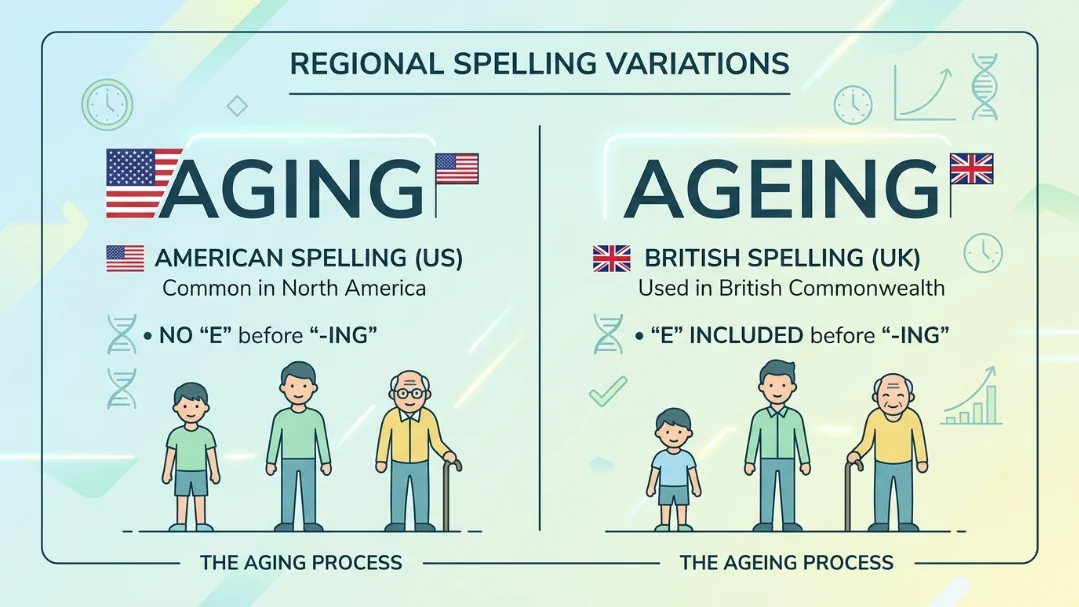
The difference between ageing and aging is purely a matter of regional spelling preference. Aging is the standard spelling in American English, while ageing is the preferred spelling in British English and other Commonwealth countries. Both spellings mean exactly the same thing: the process of growing older.
Have you ever paused while writing and wondered whether to type ageing or aging? This small spelling difference trips up writers across the English-speaking world. The two versions look similar, but one has an extra letter. Many people are unsure which one is correct.
This confusion matters more than you might think. These are common words that appear in everyday writing. You will need them in health articles, business documents, and academic papers. Getting them right shows attention to detail and awareness of your audience. It also helps you match the expectations of your readers.
The challenge comes from the different spelling conventions in American and British English. Aging is the American spelling, while ageing is the British spelling. Neither spelling is wrong. The choice depends on where you are writing and who your audience is. Many people simply do not know which spelling to use.
This article clears up the confusion once and for all. You will learn the definitions, see real examples, and discover which spelling to use in different contexts. By the end, you will know exactly which spelling is appropriate for your writing. Good writing depends on these small but important details.
The main takeaway is that both ageing and aging are correct spellings. Aging is the standard in American English. Ageing is the standard in British English and many other English-speaking countries. The choice depends on your audience and the style guide you are following. Consistency is more important than which spelling you choose.
Definitions and Explanations
What Does “Aging” Mean?
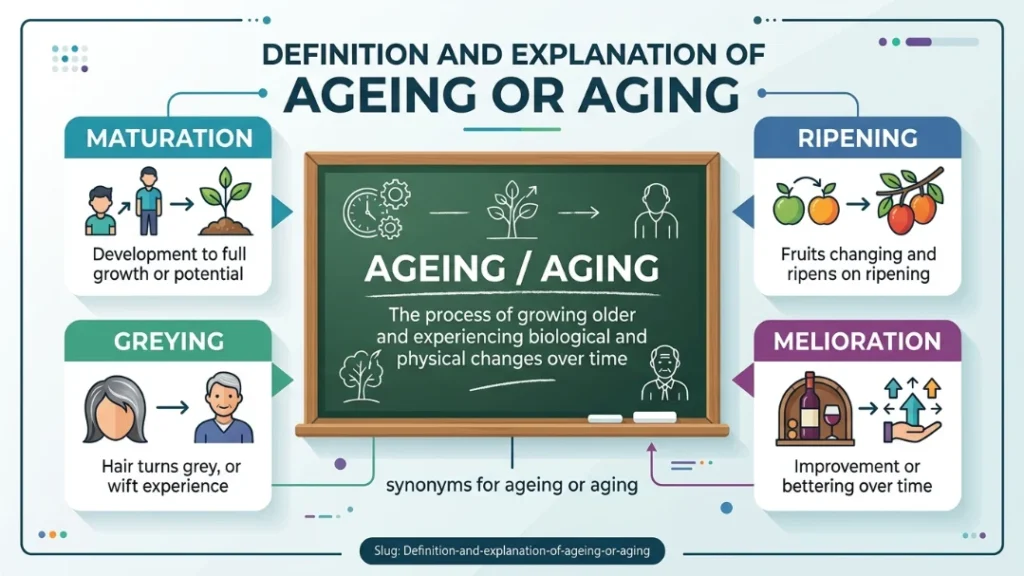
Aging is the present participle and gerund of the verb age. It means the process of growing older or becoming more mature. It can also mean the process of making something appear older or the process of maturation in other contexts.
For example, “The aging population requires more healthcare services” describes people growing older. “The aging of wine improves its flavor” describes a maturation process. “Aging gracefully is an admirable goal” describes the process of growing older with dignity.
Aging is the standard spelling in American English. It follows the typical American pattern of dropping the silent “e” before adding “-ing.” This is the more common spelling in American publications and style guides.
| Feature | Description |
| Spelling | Aging (without the “e”) |
| Part of speech | Present participle or gerund |
| Meaning | The process of growing older |
| Regional preference | American English |
What Does “Ageing” Mean?
Ageing is the present participle and gerund of the verb age. It means exactly the same thing as aging: the process of growing older or becoming more mature. There is no difference in meaning between the two spellings.
For example, “The ageing population requires more healthcare services” means the same as the American version. The ageing of wine improves its flavor” has the same meaning. Ageing gracefully is an admirable goal” is identical in meaning.
Ageing is the standard spelling in British English and many Commonwealth countries. It follows the British pattern of keeping the silent “e” before adding “-ing.” This spelling is more common in British publications and style guides.
| Feature | Description |
| Spelling | Ageing (with the “e”) |
| Part of speech | Present participle or gerund |
| Meaning | The process of growing older |
| Regional preference | British English |
The Core Difference Explained
The difference between ageing and aging is purely a matter of spelling convention. There is no difference in meaning, pronunciation, or usage. Both words are correct and acceptable.
The difference comes from the rules of dropping silent “e”s before adding “-ing.” In American English, the rule is generally to drop the silent “e.” In British English, the rule is often to keep the silent “e” when it helps with pronunciation or when the root word ends in certain sounds.
| Form | Regional Preference | Rule |
| Aging | American English | Drop the silent “e” |
| Ageing | British English | Keep the silent “e” |
The Silent “E” Rule Explained
The different spellings come from different approaches to the silent “e” rule.
In American English, the rule is to drop the silent “e” before adding a suffix that begins with a vowel. This is a consistent rule. For example:
- Age → Aging (drop the “e”)
- Like → Liking (drop the “e”)
- Love → Loving (drop the “e”)
- Hope → Hoping (drop the “e”)
In British English, the rule is less consistent. Sometimes the “e” is dropped, and sometimes it is kept. The “e” is often kept when it helps with pronunciation or when the root word ends in certain sounds. For example:
- Age → Ageing (keep the “e”)
- Like → Liking (drop the “e”)
- Love → Loving (drop the “e”)
- Hope → Hoping (drop the “e”)
| Word | American (Drop “e”) | British (Keep or Drop) |
| Age | Aging | Ageing |
| Like | Liking | Liking |
| Love | Loving | Loving |
| Hope | Hoping | Hoping |
| Rage | Raging | Raging |
| Manage | Managing | Managing |
| Travel | Traveling | Travelling |
The Etymology and Origin
Understanding where these words come from helps you understand the spelling difference.
- Age: This word comes from Old French aage, which came from Latin aetaticum (from aetas, meaning “lifetime” or “age”). It has been in English since the 13th century.
- Aging: This American spelling follows the pattern of dropping the silent “e” before adding “-ing.” This pattern became standardized in American English in the 19th century.
- Ageing: This British spelling keeps the silent “e.” This pattern reflects older English spelling conventions that were preserved in British English.
Advantages and Disadvantages
Both spellings have their advantages and disadvantages. This section explores both sides.
Advantages of Using “Aging”
- Simplicity: Aging follows the standard American rule of dropping silent “e”s before adding “-ing.” This makes it easier to remember and apply consistently.
- Consistency: If you are writing for an American audience, aging is the expected spelling. Using it matches the expectations of your readers.
- Conciseness: Aging has fewer letters, which some people prefer for brevity.
- Modern feel: Some people feel that aging looks more modern and streamlined.
- Dictionaries: Major American dictionaries list aging as the primary spelling.
Advantages of Using “Ageing”
- Clarity: The extra “e” in ageing can help with pronunciation. It reminds readers that the “g” is soft, not hard.
- Tradition: Ageing reflects older English spelling conventions. Some people prefer the traditional look.
- British standards: If you are writing for a British audience, ageing is the expected spelling. Using it matches the expectations of your readers.
- Avoiding confusion: The “e” in ageing helps distinguish it from “aging” in contexts where the extra “e” is significant.
- Dictionaries: Major British dictionaries list ageing as the primary spelling.
| Aspect | Aging | Ageing |
| Simplicity | Simple, consistent rule | Less consistent rule |
| Regional preference | American | British |
| Traditional feel | Modern | Traditional |
| Clarity | Clear to Americans | Clear to Britons |
Disadvantages of Using Each Spelling
Using the wrong spelling for your audience can create problems.
- Confusion: If you use aging in a British document, it might look like a spelling error to British readers. Conversely, using ageing in an American document might look like a spelling error to American readers.
- Inconsistency: Switching between aging and ageing in the same document looks unprofessional and careless.
- Professional perception: Some readers might perceive the “wrong” spelling as a lack of attention to detail.
- Stylistic issues: Some style guides or publishers require one spelling over the other. Using the wrong one could cause your writing to be rejected or require correction.
Real-World Examples
Seeing these words used correctly in real-world contexts helps solidify the difference.
Examples of “Aging” in American Contexts
- “The aging population presents challenges for healthcare systems.” This is a common topic in American health policy.
- “Aging gracefully is a goal for many people.” This phrase appears frequently in American lifestyle writing.
- “The aging of the baby boomer generation affects the economy.” This is a typical American economic analysis.
- “Aging research is a growing field of study.” This is an American academic usage.
- “The aging process affects everyone differently.” This is a neutral, American-style statement.
Examples of “Ageing” in British Contexts
- “The ageing population presents challenges for healthcare systems.” This is the same idea in British spelling.
- “Ageing gracefully is a goal for many people.” This appears in British lifestyle writing.
- “The ageing of the baby boomer generation affects the economy.” This is the British version of the economic analysis.
- “Ageing research is a growing field of study.” This is the British academic usage.
- “The ageing process affects everyone differently.” This is a neutral, British-style statement.
Common Phrases
These common phrases appear in both American and British English with their respective spellings.
| American Phrase | British Phrase | Meaning |
| Aging population | Ageing population | Older people in a society |
| Aging process | Ageing process | The process of getting older |
| Aging gracefully | Ageing gracefully | Growing older with dignity |
| Anti-aging cream | Anti-ageing cream | Skincare product for older skin |
| Aging research | Ageing research | Scientific study of aging |
| Aging workforce | Ageing workforce | Older workers in the economy |
Regional and Global Usage
The choice between ageing and aging depends on where you are writing and who your audience is.
American English Usage
In the United States, aging is the standard and preferred spelling. It appears in all major American publications, including newspapers, magazines, and academic journals. American style guides, such as the Chicago Manual of Style and AP Style, recommend aging.
Americans encounter aging every day. It appears in health articles, business reports, and government documents. Using ageing in American writing can look like a spelling error or British affectation.
| Country | Preferred Spelling |
| United States | Aging |
| Canada (American-influenced) | Varies |
| Mexico (English writing) | Varies |
British English Usage
In the United Kingdom, ageing is the standard and preferred spelling. It appears in all major British publications, including newspapers, magazines, and academic journals. British style guides, such as the Oxford Style Guide, recommend ageing.
Britons encounter ageing every day. It appears in health articles, business reports, and government documents. Using aging in British writing can look like a spelling error or Americanism.
| Country | Preferred Spelling |
| United Kingdom | Ageing |
| Ireland | Ageing |
| Australia | Ageing |
| New Zealand | Ageing |
| South Africa | Ageing |
| India (British-influenced) | Ageing |
Commonwealth Countries
Most Commonwealth countries follow British spelling conventions. This includes Australia, New Zealand, South Africa, and many Caribbean nations. They use ageing as the standard spelling.
However, some Commonwealth countries show American influence. Canada, for example, often uses American spellings, including aging. This is especially true in business and technical writing. Some Canadian publications use ageing, while others use aging.
International English
In international contexts, the choice can vary. Many international organizations use American English by default. Others use British English. Some organizations have their own style guides that specify a preferred spelling.
When writing for an international audience, the best approach is to choose one spelling and be consistent. This is more important than which spelling you choose.
| Context | Typical Spelling | Reason |
| United Nations (official) | Aging | American English convention |
| World Health Organization | Ageing | British English convention |
| International Business | Varies | Depends on audience |
| Online Content | Varies | Often follows American convention |
Common Mistakes
This section highlights the most frequent errors people make with these words. Learning about them will help you avoid them.
Mistake 1: Inconsistent Spelling
This is the most common error. People switch between aging and ageing in the same document. This inconsistency looks unprofessional and confusing.
Correction: Choose one spelling and stick with it throughout your writing. Be consistent. If you are writing for an American audience, use aging. If you are writing for a British audience, use ageing.
Mistake 2: Using the Wrong Spelling for Your Audience
Using aging for a British audience or ageing for an American audience can look like an error. It can also make you appear unaware of your audience’s expectations.
Correction: Know your audience. Use aging when writing for an American audience. For British or Commonwealth readers, ageing is the preferred spelling. When in doubt, consult the publication’s style guide or follow the organization’s preferred style.
Mistake 3: Thinking One Spelling Is Wrong
Some people believe that one spelling is correct and the other is wrong. This is not true. Both spellings are correct and acceptable. The choice is a matter of regional preference, not correctness.
Correction: Accept that both spellings are correct. The key is to choose the one that fits your audience and context. Neither spelling is a mistake.
Mistake 4: Overcorrection
Some people try to be consistent with British spelling and overcorrect. They might use ageing even when the American spelling is more appropriate. This can look like an attempt to sound more British than necessary.
Correction: Use the spelling that matches your context and audience. Do not force a spelling that does not fit your writing style or purpose.
Exercises
Test your knowledge with these exercises.
Exercise 1: Fill in the Blank
Choose aging or ageing to complete each sentence. Consider the context.
- The _________ population requires more healthcare resources. (American context)
- The _________ of wine improves its flavor. (British context)
- Anti-_________ cream is a popular skincare product. (American context)
- _________ gracefully is an admirable goal. (British context)
- The _________ process affects everyone differently. (American context)
- _________ research is a growing field. (British context)
- The _________ workforce needs more training. (American context)
- _________ is a natural part of life. (International context – choose one)
Exercise 2: Identify the Error
Each sentence has a mistake. Identify the incorrect word and correct it.
- “The ageing population in the United States is growing.” (American context)
- “Anti-aging cream is popular in the UK.” (British context)
- “The aging of the British population is a concern.” (British context)
- “She wrote about aging gracefully in her book.” (British context)
Exercise 3: Choose the Correct Form
Select the correct word for each context.
- A document for an American university: (Aging/Ageing)
- A document for a British government agency: (aging/ageing)
- A document for an Australian company: (aging/ageing)
- A document for an international organization using American English: (aging/ageing)
Answer Key
Answers of Exercise 1:
- Aging (American context)
- Ageing (British context)
- Aging (American context)
- Ageing (British context)
- Aging (American context)
- Ageing (British context)
- Aging (American context)
- Choose either, but be consistent
Exercise 2 Corrections:
- “The aging population in the United States is growing.” (American context, use aging)
- “Anti-ageing cream is popular in the UK.” (British context, use ageing)
- “The ageing of the British population is a concern.” (British context, use ageing)
- “She wrote about ageing gracefully in her book.” (British context, use ageing)
Exercise 3 Answers:
- Aging (American university)
- ageing (British government)
- ageing (Australian company)
- aging (International with American English)
Related Concepts and Comparisons
Understanding how these words relate to other concepts helps build a complete picture.
Aging vs. Age
These words are closely related but have different uses.
- Age: A noun meaning the length of time a person or thing has existed. It can also be a verb meaning to grow older.
- Aging/Ageing: The present participle and gerund of the verb age. It describes the process of growing older.
| Word | Part of Speech | Usage |
| Age | Noun/Verb | “What is your age?” / “He aged quickly.” |
| Aging/Ageing | Present participle/Gerund | “The aging process is natural.” |
Aging vs. Old
These terms are often used interchangeably but have different meanings.
- Aging: The process of growing older. It focuses on the process.
- Old: A state of being. It focuses on the result.
| Term | Focus | Example |
| Aging | Process | “She is aging gracefully.” |
| Old | State | “She is old.” |
Aging vs. Elderly
These terms have different connotations.
- Aging: A neutral term for the process of growing older.
- Elderly: A term often used to describe older people. It can be considered respectful or sometimes patronizing.
| Term | Connotation | Usage |
| Aging | Neutral, process-oriented | Academic, professional |
| Elderly | Describes older people | General, sometimes respectful |
Aging vs. Maturation
These terms are sometimes used interchangeably but have different meanings.
- Aging: The process of growing older. It applies to all living things.
- Maturation: The process of developing and maturing. It applies to growth and development, not just age.
| Term | Focus | Context |
| Aging | Getting older | All living things |
| Maturation | Developing and growing | Often used for living things |
FAQs
What is the difference between aging and ageing?
There is no difference in meaning. Aging is the American spelling. Ageing is the British spelling. Both mean the process of growing older.
Is it aging or ageing in Canada?
Canadian usage varies. Some Canadian publications use aging, while others use ageing. The choice often depends on the publisher’s style guide. Many Canadian sources prefer ageing to align with British tradition.
Is it aging or ageing in Australia?
Australia follows British spelling conventions. Ageing is the preferred spelling in Australian English. You will see ageing in Australian publications and government documents.
Is it aging or ageing in the UK?
In the United Kingdom, ageing is the standard and preferred spelling. British publications, including newspapers, magazines, and academic journals, use ageing.
Is it aging or ageing in the US?
In the United States, aging is the standard and preferred spelling. American publications, including newspapers, magazines, and academic journals, use aging.
Which spelling is correct, aging or ageing?
Both spellings are correct. Neither is wrong. The choice is a matter of regional preference and consistency. Use aging for American audiences and ageing for British and Commonwealth audiences.
Why do people spell it ageing?
People spell it ageing because it follows British English spelling conventions. The British tradition often keeps the silent “e” before adding “-ing” to help with pronunciation and maintain the soft “g” sound.
Why do people spell it aging?
People spell it aging because it follows American English spelling conventions. The American tradition drops the silent “e” before adding “-ing” for simplicity and consistency.
What is the plural of aging?
Aging is a gerund or present participle, so it does not have a plural form. You can use it with plural subjects, but the word itself does not change. For example, “The aging of the population” (singular) and “The aging of different groups” (plural).
Is aging a word?
Yes, aging is a standard English word. It is the American spelling of the present participle and gerund of the verb age. It means the process of growing older.
Is ageing a word?
Yes, ageing is a standard English word. It is the British spelling of the present participle and gerund of the verb age. It means the process of growing older.
Should I use aging or ageing in my writing?
Choose the spelling that matches your audience and context. Use aging when writing for an American audience. For British or Commonwealth readers, ageing is the preferred spelling. When writing for an international audience, choose one spelling and use it consistently throughout your content.
Conclusion
This guide has clarified the simple but important spelling difference between ageing and aging. Both spellings mean the same thing: the process of growing older. The difference is purely a matter of regional spelling preference. Aging is the American spelling, and ageing is the British spelling.
The best practical advice is to know your audience and choose the spelling that matches their expectations.Use aging when writing for an American audience. For British or Commonwealth readers, ageing is the preferred spelling. When you’re unsure, consult your organization’s style guide or choose one spelling and use it consistently throughout your writing. Consistency is more important than which spelling you choose.
Good writing depends on these small but important details. Getting them right shows awareness of your audience and attention to your craft. Now you have the knowledge to choose the correct spelling every time. Use this guide as a reference whenever you are unsure. Over time, the correct usage will become second nature to you.