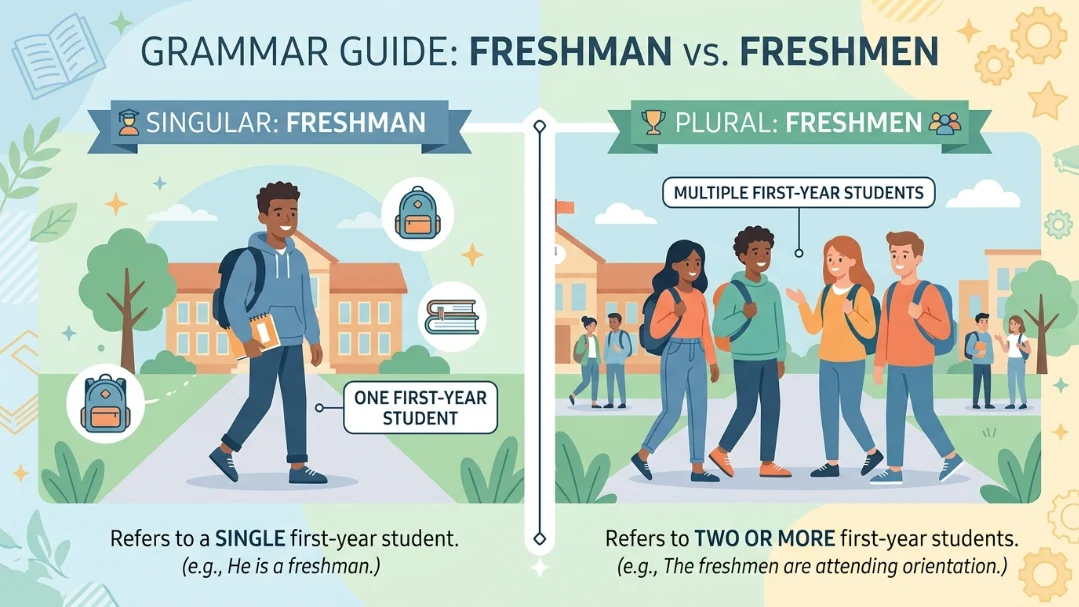
The difference between freshman and freshmen is simple. Freshman is singular and refers to one first-year student. Freshmen is plural and refers to two or more first-year students. Use freshman when talking about one person and freshmen when talking about a group.
Have you ever paused while writing about school and wondered whether to use freshman or freshmen? This small difference trips up students, teachers, and parents alike. The two words look similar, but they serve different purposes. Using the wrong one can make your writing look careless and unprofessional.
This confusion matters more than you might think. These words appear constantly in educational contexts. You will need them in school newspapers, college applications, parent newsletters, and academic writing. Getting them right shows attention to detail and respect for your readers. It also helps you communicate clearly without causing confusion.
The challenge comes from the irregular plural form. Unlike most English plurals, which simply add an “s,” freshmen changes the vowel sound. This pattern also appears in other words like man to men. Many people do not fully understand the grammar behind these words. Others simply confuse the spellings because the words are so similar.
This article clears up the confusion once and for all. You will learn the definitions, see real examples, and discover easy memory tricks to choose correctly every time. By the end, you will never second-guess this choice again. Good writing depends on these small but important distinctions.
The main takeaway is that freshman is always singular (one person) and freshmen is always plural (more than one person). Freshman refers to one first-year student. Freshmen refers to two or more first-year students. Remember that freshman has an “a” like “alone” (one person), while freshmen has an “e” like “everyone” (multiple people).
Definitions and Explanations
What Does “Freshman” Mean?
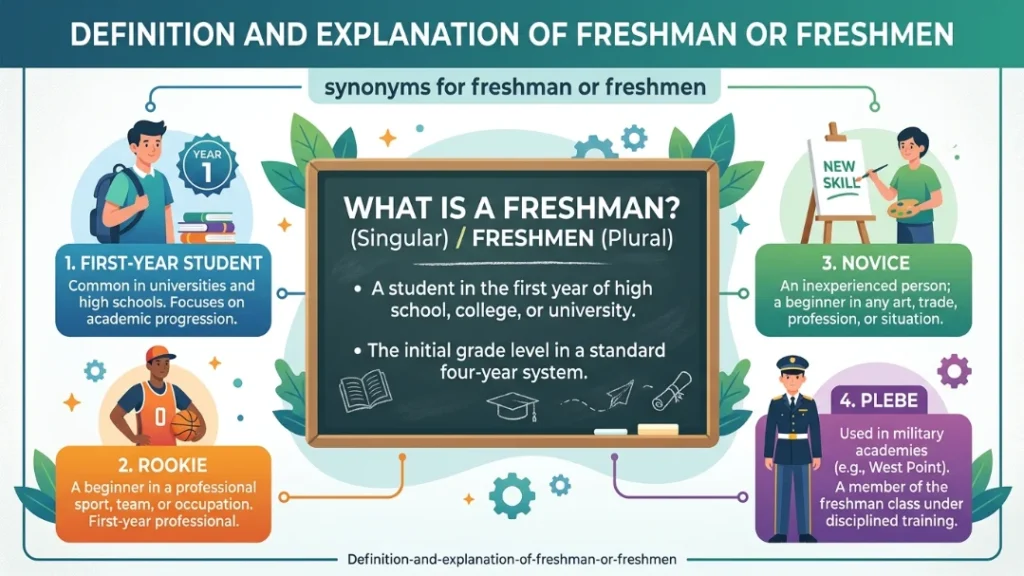
Freshman is a singular noun. It refers to one student in their first year of high school, college, or university. It can also refer to someone who is new to an activity or profession.
For example, “The freshman walked into the classroom” describes one student. “She is a freshman at Harvard” describes one individual. “He is a freshman in Congress” describes someone in their first term. In all these cases, freshman is singular because it refers to one person.
The word freshman can also be used as an adjective. For example, “The freshman class is large” uses freshman as an adjective to describe the class. “She lives in the freshman dormitory” uses freshman as an adjective. In these cases, freshman remains singular even though it refers to a group. This is an important distinction to remember.
| Feature | Description |
| Part of speech | Noun or adjective |
| Number | Singular |
| Meaning | One first-year student |
| Example (noun) | “The freshman is excited.” |
| Example (adjective) | “The freshman class is large.” |
What Does “Freshmen” Mean?
Freshmen is a plural noun. It refers to two or more students in their first year of high school, college, or university. It can also refer to multiple people who are new to an activity or profession.
For example, “The freshmen walked into the classroom” describes multiple students. “They are freshmen at Harvard” describes several individuals. “The freshmen in Congress are making their mark” describes multiple new members. In all these cases, freshmen is plural because it refers to more than one person.
Unlike freshman, freshmen is almost always used as a noun. It is rarely used as an adjective because adjectives in English are usually singular. However, you might see phrases like “freshmen orientation” in informal usage. In formal writing, it is better to use “freshman orientation” or “freshman class.”
| Feature | Description |
| Part of speech | Noun |
| Number | Plural |
| Meaning | Two or more first-year students |
| Example | “The freshmen are excited.” |
The Pronunciation Difference
The pronunciation difference is important for remembering the spelling.
- Freshman is pronounced “FRESH-mun.” The second syllable sounds like “mun” (like “man” but with a “u” sound).
- Freshmen is pronounced “FRESH-men.” The second syllable sounds like “men” (the plural of “man”).
The difference is subtle but distinct. Freshman has a short, softer “u” sound in the second syllable. Freshmen has a clearer “e” sound like in “men.”
| Word | Number | Pronunciation | Meaning |
| Freshman | Singular | FRESH-mun | One first-year student |
| Freshmen | Plural | FRESH-men | Two or more first-year students |
The Etymology and Origin
Understanding where these words come from helps you remember the difference.
- Freshman: This word comes from the combination of “fresh” and “man.” It first appeared in English in the 16th century. It originally meant a newcomer or a new student. The word follows the pattern of man becoming men in the plural.
- Freshmen: This plural form appeared as the plural of freshman. The vowel change from man to men follows an old English pattern. This pattern also appears in other words like woman to women and man to men. The irregular spelling comes from this historical linguistic change.
| Singular | Plural | Pattern |
| Man | Men | Vowel change |
| Woman | Women | Vowel change |
| Freshman | Freshmen | Vowel change |
Advantages and Disadvantages
Using the correct form offers several advantages. Getting it wrong creates problems. This section explores both sides.
Advantages of Using the Correct Form
Using the right word improves your writing in several ways.
- Clarity: Your readers will understand exactly what you mean. There is no confusion about whether you are describing one student or multiple students.
- Professionalism: Correct grammar builds trust with your readers. It shows that you care about your writing and respect your audience. This is especially important in academic and educational settings.
- Credibility: Mistakes can make you look less educated or careless. Using the correct form helps you maintain your credibility.
- Respect: Using accurate language shows respect for the people you are describing. It also follows standard English usage, which is expected in most professional contexts.
Disadvantages of Using the Wrong Form
Using the wrong form can create problems for your communication.
- Confusion: Your reader might not know whether you mean one student or several. For example, “The freshmen is here” is grammatically incorrect and confusing.
- Unprofessionalism: Simple grammar errors can make you appear careless. This can harm your reputation in academic and professional settings.
- Misunderstanding: In some cases, the wrong word might change your sentence’s meaning entirely. A group of freshman” is unclear because it could mean one student or a group.
- Embarrassment: Making this mistake in public can be embarrassing and undermine your confidence as a writer.
| Aspect | Freshman (Singular) | Freshmen (Plural) |
| Clarity | Clear when correct | Clear when correct |
| Professionalism | Professional when used correctly | Professional when used correctly |
| Credibility | Builds credibility | Builds credibility |
| Common mistake | Using “freshmen” for one person | Using “freshman” for multiple people |
Real-World Examples
Seeing these words used correctly in real-world contexts helps solidify the difference.
Examples of “Freshman” in Action
- “The freshman sat alone in the cafeteria.” This example describes one first-year student.
- “My daughter is a freshman at the University of Texas.” This describes one individual.
- “The freshman orientation program starts next week.” This uses freshman as an adjective.
- “He is the only freshman on the varsity team.” This describes one person.
- “The freshman class has 500 students.” This uses freshman as an adjective.
- “She was voted freshman class president.” This uses freshman as an adjective.
Examples of “Freshmen” in Action
- “The freshmen sat together in the cafeteria.” This describes multiple first-year students.
- “All the freshmen at the University of Texas attended orientation.” This describes multiple individuals.
- “The freshmen participated in the school rally.” This describes a group.
- “Many freshmen are nervous about their first exams.” This describes multiple students.
- “The freshmen were assigned to different dormitories.” This describes multiple students.
- “The freshmen formed a study group together.” This describes multiple students.
Contrasting Examples
Seeing these words side by side shows the difference clearly.
| Sentence with “Freshman” | Meaning | Sentence with “Freshmen” | Meaning |
| “The freshman is excited.” | One student is excited. | “The freshmen are excited.” | Multiple students are excited. |
| “I am a freshman.” | I am one student. | “We are freshmen.” | We are multiple students. |
| “The freshman class is large.” | The class of one year is large. | “The freshmen are large in number.” | The students are many. |
Common Phrases and Usage
Certain common phrases use either freshman or freshmen correctly. Learning these can help you remember the usage.
| Phrase | Correct Form | Meaning |
| “The freshman class” | Freshman | The entire first-year class |
| “A freshman student” | Freshman | One first-year student |
| “Freshman orientation” | Freshman | Orientation for first-year students |
| “The freshmen are here” | Freshmen | Multiple first-year students |
| “Freshmen orientation” (informal) | Freshmen | Sometimes used informally |
| “Freshman year” | Freshman | The first year |
The Adjective Exception
One of the most confusing aspects is using freshman as an adjective. When you use freshman to describe a noun, it stays singular even when it refers to a group.
For example:
- “The freshman class” is correct (not “freshmen class”).
- “The freshman dormitory” is correct (not “freshmen dormitory”).
- “Freshman orientation” is correct (not “freshmen orientation”).
This is because adjectives in English do not change for number. You would say “red cars” not “reds cars.” Similarly, you say “freshman class” not “freshmen class.”
Regional and Global Usage
The distinction between freshman and freshmen is consistent across all English-speaking regions.
Global Consistency
English speakers worldwide follow the same rule. Whether you are writing for an American, British, Australian, or Canadian audience, the distinction is identical. Freshman is singular, and freshmen is plural. There is no regional variation in this rule.
Educational Systems Around the World
Different educational systems use different terms for first-year students. The term freshman is most common in the United States. However, other countries have their own terms.
| Country | Term for First-Year Student |
| United States | Freshman |
| United Kingdom | First-year, fresher |
| Australia | First-year student |
| Canada | Freshman (in some contexts) |
| India | First-year student |
Formal vs. Informal Usage
Both words appear in formal and informal contexts. Freshman is neutral and appears in all types of writing. Freshmen is also neutral and appears in all types of writing. The choice depends on whether you need a singular or plural form, not on formality.
| Context | Preferred Form | Example |
| Formal academic | Both (correctly) | “The freshman completed the exam.” |
| Formal academic | Both (correctly) | “The freshmen completed the exam.” |
| Informal conversation | Both (correctly) | “I’m a freshman.” |
| Informal conversation | Both (correctly) | “They’re freshmen.” |
Common Mistakes
This section highlights the most frequent errors people make with these words. Learning about them will help you avoid them.
Mistake 1: Using “Freshmen” for Singular
This is the most common error. People write or say “freshmen” when they mean only one freshman. For example, “The freshmen walked into the classroom” should be “The freshman walked into the classroom” if there is only one person. This mistake often happens because people are not paying attention to the number of people they are describing.
Correction: Always check whether you are describing one person or more than one. If you mean one, use freshman. If you mean more than one, use freshmen.
Mistake 2: Using “Freshman” for Plural
This error is less common but still happens. People use freshman to refer to multiple first-year students. For example, “The freshman were all wearing red” is incorrect. It should be “The freshmen were all wearing red.” This mistake often happens because people write quickly and do not proofread their work.
Correction: If your sentence has a plural verb (like “were” or “are”), you need the plural noun freshmen. The subject and verb must agree in number.
Mistake 3: Using “Freshmen” as an Adjective
Many people incorrectly use freshmen as an adjective. For example, “The freshmen class” is incorrect. It should be “The freshman class.” The adjective form is always singular.
Correction: When using the word to describe a noun, always use freshman. For example, “freshman orientation,” “freshman dormitory,” and “freshman year.” The adjective form does not change for plural.
Exercises
Test your knowledge with these exercises.
Exercise 1: Fill in the Blank
Choose freshman or freshmen to complete each sentence.
- The _________ sat in the front row.
- All the _________ attended the orientation.
- My sister is a _________ at Yale.
- The _________ class had a picnic.
- Many _________ are nervous about exams.
- He is the only _________ on the team.
- The _________ were excited about the football game.
- She was voted _________ class president.
Exercise 2: Identify the Error
Each sentence has a mistake. Identify the incorrect word and correct it.
- “The freshmen is sitting in the front row.” (Assume only one person)
- “The freshman are meeting in the auditorium.”
- “All the freshman in the department received the email.”
- “He is one of the most talented freshmen I know.” (Assume one person)
Exercise 3: Choose the Correct Form
Select the correct word to complete each sentence.
- “She is a _________ at the university.” (Freshman/Freshmen)
- “The _________ are arriving tomorrow.” (freshman/freshmen)
- “The _________ orientation is mandatory.” (freshman/freshmen)
- “We have many _________ in our class.” (freshman/freshmen)
Answer Key
Answers of Exercise 1:
- Freshman (one person)
- Freshmen (more than one)
- Freshman (one person, sister)
- Freshman (adjective, class)
- Freshmen (many people)
- Freshman (one person)
- Freshmen (more than one)
- Freshman (adjective, class president)
Exercise 2 Corrections:
- “The freshman is sitting in the front row.” (If only one person)
- “The freshmen are meeting in the auditorium.” (Plural verb requires plural noun)
- All the freshmen in the department received the email.” (All means more than one)
- “He is one of the most talented freshmen I know.” (One of many requires plural)
Exercise 3 Answers:
- Freshman (singular)
- freshmen (plural)
- freshman (adjective)
- freshmen (plural)
Related Concepts and Comparisons
Understanding how these words relate to other terms helps build a complete picture.
Freshman vs. First-Year Student
Both terms describe the same person, but they have different connotations.
- Freshman: The traditional term, most common in the United States.
- First-year student: A more inclusive and descriptive term. Some educational institutions use this instead of freshman to avoid gendered language.
| Term | Usage | Preference |
| Freshman | Traditional, common in US | Common but debated |
| First-year student | Inclusive, descriptive | Increasingly preferred |
Freshman vs. Freshmen in Academic Contexts
In academic writing, the distinction is especially important. Professors and administrators expect correct usage. Mistakes can reflect poorly on your writing skills.
| Context | Correct Usage | Example |
| Referring to one student | Freshman | “The freshman presented her research.” |
| Referring to multiple students | Freshmen | “The freshmen presented their research.” |
| Describing a class | Freshman (adjective) | “The freshman class is diverse.” |
Freshman vs. Frosh
Frosh is an informal term for a freshman or freshmen. It is commonly used in college slang.
- Frosh: A singular or plural slang term for a first-year student.
- Usage: “The frosh are arriving this weekend.”
| Term | Formality | Usage |
| Freshman | Neutral, formal | Singular |
| Freshmen | Neutral, formal | Plural |
| Frosh | Informal, slang | Singular or plural |
Freshman vs. Sophomore
These are related terms for different years of study.
- Freshman: First-year student
- Sophomore: Second-year student
- Junior: Third-year student
- Senior: Fourth-year student
| Year | Term | Plural |
| First | Freshman | Freshmen |
| Second | Sophomore | Sophomores |
| Third | Junior | Juniors |
| Fourth | Senior | Seniors |
The Debate Around “Freshman”
Some people argue that freshman is gendered language because it ends in “man.” Many institutions now use “first-year student” instead. This is a legitimate consideration in modern writing.
| Term | Debate | Recommendation |
| Freshman | Potentially gendered | Use “first-year student” for inclusivity |
| First-year student | Inclusive | Preferred in many contexts |
FAQs
What is the difference between freshman and freshmen?
The difference is simple. Freshman is singular and refers to one first-year student. Freshmen is plural and refers to two or more first-year students. This follows the same pattern as man and men.
Why do people confuse freshman and freshmen?
People confuse them because the words sound similar in casual speech. The spelling is also irregular, which makes it harder to remember. Many people simply do not think about the difference when writing quickly.
Is it a freshman or freshmen?
It depends on how many people you are describing. Use a freshman for one person. Use freshmen for more than one. For example, “I saw a freshman” (one) and “I saw some freshmen” (more than one).
How do you pronounce freshman vs freshmen?
Freshman is pronounced “FRESH-mun.” Freshmen is pronounced “FRESH-men.” The second syllable changes from “mun” to “men.” Practice saying them aloud to hear the difference.
Is it freshman or freshmen in “freshman class”?
It is “freshman class.” In this phrase, freshman is an adjective describing the class. Adjectives in English do not change for number. You would not say “freshmen class” because the adjective is always singular.
Is it freshman or freshmen in “freshmen orientation”?
In formal writing, it should be “freshman orientation.” However, you will often see “freshmen orientation” in informal contexts. For formal and professional writing, use the singular adjective form.
What is the plural of freshman?
The plural of freshman is freshmen. This is an irregular plural form, like man to men and woman to women. You cannot simply add an “s” to freshman to make it plural.
Can freshman be used as an adjective?
Yes, freshman can be used as an adjective. For example, “freshman year,” “freshman class,” and “freshman orientation.” When used as an adjective, freshman stays singular even when describing a group.
Is freshman a gendered term?
Yes, freshman contains the word “man.” Some people consider this gendered language. Many institutions now prefer “first-year student” to be more inclusive. The plural “freshmen” also contains the gendered element.
What is a more inclusive term for freshman?
“First-year student” is the most inclusive alternative. “First-year” and “fresh” are also used. Many universities and schools have adopted these terms to avoid gendered language.
Is it freshman or freshmen in “one of the freshmen”?
Use freshmen in the phrase “one of the freshmen.” You are saying that the person is one among a group. For example, “She is one of the freshmen in the department.” The plural form is correct because you are referring to a group.
When should I use first-year student instead of freshman?
Use “first-year student” when you want to be inclusive or formal. Many academic institutions prefer this term. It is especially appropriate in official documents, academic writing, and professional communications.
Conclusion
This guide has clarified the simple but important difference between freshman and freshmen. Freshman means one first-year student. Freshmen means more than one first-year student. The pronunciation also differs, with freshman sounding like “FRESH-mun” and freshmen sounding like “FRESH-men.” Remember that freshman is both a singular noun and an adjective. When used as an adjective, it stays singular.
The best practical advice is to always check your sentence for number agreement. Use freshman when referring to one person. For more than one person, use freshmen. As an adjective, always use freshman, as in freshman student. This simple check will eliminate most errors. Take a moment to proofread your writing and ensure you have used the correct form. With practice, this distinction will become automatic.
Good writing depends on these small but important details. Getting them right shows respect for your readers and attention to your craft. Now you have the knowledge to choose the correct word every time. Use this guide as a reference whenever you are unsure. Over time, the correct usage will become second nature to you.