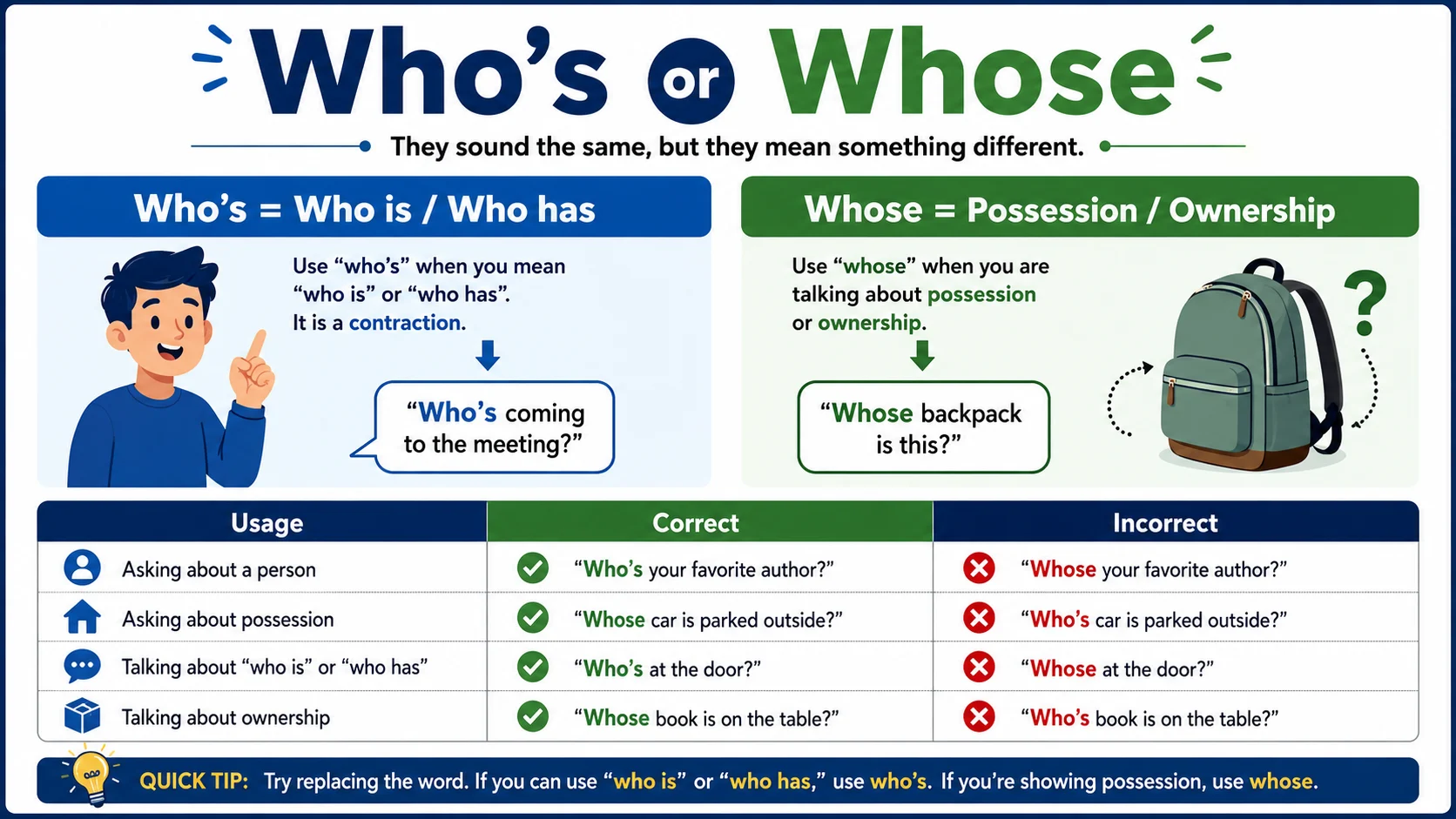
“Who’s” is always a contraction of “who is” or “who has,” while “whose” is a possessive pronoun meaning “belonging to whom.” The simple test is to replace the word with “who is” if the sentence makes sense, use “who’s”; otherwise, use “whose.”
Have you ever paused mid-sentence, fingers hovering over the keyboard, unsure whether to type “who’s” or “whose”? This tiny apostrophe creates one of the most persistent grammar challenges in the English language. Even experienced writers occasionally stumble over this distinction. The confusion is understandable since both words sound identical when spoken. However, their meanings and grammatical functions are completely different. Using the wrong one can make your writing appear careless and unprofessional. This guide will demystify the difference between who’s and whose once and for all. With clear explanations, helpful memory tricks, and plenty of examples, you will never hesitate again when choosing between these commonly confused words.
Key Takeaway
The fundamental rule is remarkably straightforward. “Who’s” is a contraction that stands for “who is” or “who has.” Conversely, “whose” is a possessive pronoun that indicates ownership or belonging. If you can substitute “who is” into your sentence and it still makes sense, then “who’s” is the correct choice. If not, you must use “whose.” This simple test resolves nearly every instance of confusion between who’s or whose.
Definition and Explanation
Understanding the distinct grammatical roles of these words is essential for correct usage.
Who’s
“Who’s” functions as a contraction, combining two words into one. Specifically, it represents either “who is” or “who has.” This abbreviation is common in informal and formal writing alike, although it appears more frequently in casual contexts. When you write “who’s,” you are essentially telling your reader that you have shortened two words into a single, more efficient form. The apostrophe marks the missing letters, which is a standard feature of English contractions.
Examples of who’s in action:
- “Who’s coming to the party tonight?” (Who is)
- “Who’s finished their homework already?” (Who has)
- “I wonder who’s going to win the competition.” (Who is)
- “Who’s been eating all the cookies?” (Who has)
Whose
“Whose” operates as a possessive pronoun. Its primary function is to show ownership or association with a person or thing. Unlike “who’s,” “whose” does not contain a missing letter and therefore has no apostrophe. It asks the question “to whom does this belong?” or indicates that something belongs to a specific person. For example, when you ask “Whose book is this?” you are inquiring about the owner of the book. Similarly, “The woman whose car was stolen” indicates that the car belongs to the woman.
Examples of whose in action:
- “Whose jacket is hanging on the chair?”
- “The student whose essay won the award was ecstatic.”
- “I met a man whose sister works at the hospital.”
- “Whose turn is it to wash the dishes?”
The Core Difference
The distinction between who’s or whose ultimately comes down to a question of function. “Who’s” always acts as a verb contraction, while “whose” always shows possession. Remember that contractions are about actions or states of being, whereas possessives are about ownership or relationships.
Advantages and Disadvantages
Understanding the correct usage of who’s and whose offers several benefits while also presenting some challenges.
Advantages of Correct Usage
Using who’s and whose correctly significantly enhances your writing clarity. When readers encounter the right word, they understand your meaning immediately without confusion. This precision demonstrates professionalism and attention to detail, traits that are valuable in academic, business, and personal communication. Furthermore, mastering this distinction builds confidence in your overall writing ability, allowing you to focus on content rather than grammar.
Disadvantages of Incorrect Usage
The primary disadvantage of confusing who’s or whose is the potential for miscommunication. When you write “who’s” instead of “whose,” your sentence may become confusing or even nonsensical. Consider the difference between “Whose car is that?” and “Who’s car is that?” The first is grammatically correct and clear. The second is jarring and suggests a lack of grammatical knowledge. Such errors can undermine your credibility, especially in professional settings where precision matters.
Common Challenges
One challenge is that both words sound exactly the same in speech, making it difficult to build the correct habit through listening alone. Additionally, the apostrophe in “who’s” can be misleading because we often associate apostrophes with possession, as in “the dog’s bone.” This association creates confusion because “whose” is the possessive form but lacks an apostrophe.
Real-World Examples
Seeing who’s or whose used correctly in various contexts reinforces the proper usage.
Who’s in Professional Communication
In business writing, contractions like “who’s” are common in emails and informal reports. For instance, you might write: “I need to confirm who’s attending the meeting tomorrow.” Here, “who’s” stands for “who is” and fits naturally into the sentence. Similarly, in a team update, you might say: “Who’s completed their quarterly review?” In this case, “who’s” means “who has” and asks about completed actions.
Whose in Professional Communication
Possessive pronouns like “whose” appear frequently in formal documents. Consider this example from a legal context: “The company whose trademark was infringed filed a lawsuit.” In this sentence, “whose” shows that the trademark belongs to the company. Another business example: “The manager whose team exceeded targets received a bonus.” Here, “whose” links the manager to their team.
Everyday Usage Examples
- “Whose phone is ringing?” (shows ownership of the phone)
- “Who’s going to answer it?” (asks who will perform the action)
- “I know the author whose book won the prize.” (links author to their book)
- “Who’s read that book already?” (asks who has performed the action)
- “Whose idea was this?” (asks about the originator of the idea)
- “Who’s responsible for this project?” (asks who bears responsibility)
Problematic Sentences
- Incorrect: “Who’s car is parked outside?”
- Correct: “Whose car is parked outside?”
- Incorrect: “I wonder whose going to arrive first.”
- Correct: “I wonder who’s going to arrive first.”
Regional and Global Usage
While the distinction between who’s or whose is consistent across English-speaking regions, there are subtle variations in usage patterns.
American English
In American English, contractions like “who’s” are widely accepted in both spoken and written contexts. American writers tend to use contractions more freely, even in semi-formal business communication. However, academic writing and formal publications generally avoid contractions, preferring the full “who is” or “who has” instead. This preference means that “who’s” appears less frequently in scholarly work.
British English
British English generally follows the same rules for who’s or whose, but there is a slightly stronger preference for avoiding contractions in formal writing. British publishers often favor the expanded forms “who is” and “who has” in books and newspapers. However, in everyday communication, British speakers use “who’s” just as frequently as Americans.
Global Variations
In international English, particularly in countries where English is a second language, writers sometimes struggle more with who’s or whose because the distinction may not exist in their native language. This challenge underscores the importance of clear teaching and practice materials for learners worldwide.
Common Mistakes and Corrections
Identifying and correcting common errors is crucial for mastering the use of who’s or whose.
The Apostrophe Trap
One of the most frequent mistakes involves using “who’s” when “whose” is required. Writers often assume that because “who’s” has an apostrophe, it must show possession, similar to “the cat’s toy.” However, this assumption is incorrect. The apostrophe in “who’s” indicates a missing letter, not ownership. The real possessive form is “whose” and it does not use an apostrophe.
The Substitution Test Failure
Many writers fail to apply the “who is” substitution test. Before committing to “who’s,” try replacing it with “who is.” If the sentence becomes grammatical, “who’s” is correct. If not, “whose” is needed. This simple test catches most errors before they reach your final draft.
Common Errors Table
| Incorrect Usage | Correction | Explanation |
| “Who’s turn is it?” | “Whose turn is it?” | Shows possession of the turn. |
| “The man whose going to speak.” | “The man who’s going to speak.” | Contraction of “who is” going. |
| “Do you know whose coming?” | “Do you know who’s coming?” | Contraction of “who is” coming. |
| “I found the wallet who’s owner was missing.” | “I found the wallet whose owner was missing.” | Shows possession of the wallet. |
| “Whose been working on this?” | “Who’s been working on this?” | Contraction of “who has” been working. |
Advanced Error Patterns
Even experienced writers sometimes make mistakes with who’s or whose when dealing with complex sentences. A particularly tricky situation involves indirect questions or embedded clauses. For example, “I don’t know who’s responsible” is correct because “who is” fits. However, “I don’t know whose responsibility it is” is also correct because “whose” modifies “responsibility.” Careful analysis of the sentence structure is essential in these cases.
Exercises with Answers
Practice is essential for developing confidence with who’s or whose.
Fill in the Blank Exercise
- ________ going to the conference next week?
- ________ car is blocking the driveway?
- I met a woman ________ daughter is a doctor.
- Do you know ________ already finished?
- ________ coat is hanging on the door?
- ________ been using my computer?
- The professor ________ class I attended was excellent.
- ________ ready to present their findings?
Answer Key
- Who’s (Who is)
- Whose (Belongs to whom)
- Whose (Daughter belongs to the woman)
- Who’s (Who has)
- Whose (Coat belongs to whom)
- Who’s (Who has)
- Whose (Class belongs to the professor)
- Who’s (Who is)
Sentence Correction Exercise
Rewrite the following sentences, correcting any errors in who’s or whose.
- Whose going to the store later?
- The company who’s CEO retired last year is struggling.
- Who’s laptop is this?
- I wonder whose going to win.
- The employee whose worked here longest received an award.
Answer Key
- Who’s going to the store later? (Who is going)
- The company whose CEO retired last year is struggling. (CEO belongs to the company)
- Whose laptop is this? (Possession)
- I wonder who’s going to win. (Who is going)
- The employee who’s worked here longest received an award. (Who has worked)
Related Concepts and Comparisons
Understanding how who’s or whose relates to other grammatical concepts deepens your overall language knowledge.
Who vs. Whom
The distinction between “who” and “whom” parallels the challenge of who’s or whose in some ways. “Who” functions as a subject pronoun, while “whom” serves as an object pronoun. Similarly, “who’s” (containing “who”) is a verb contraction, while “whose” is a possessive. Understanding “who” versus “whom” can help you better understand “who’s” versus “whose.”
Contractions vs. Possessives
The confusion between who’s or whose represents a broader pattern in English. Many writers confuse contractions and possessives because apostrophes appear in both. For example, “it’s” (contraction of “it is”) is often confused with “its” (possessive). “You’re” (contraction of “you are”) is frequently confused with “your” (possessive). The same principle applies to who’s or whose: contractions use apostrophes, possessives do not.
Relative Clauses
“Whose” frequently appears in relative clauses that provide additional information about a noun. For example, “The man whose car was stolen reported it to the police.” In this sentence, the relative clause “whose car was stolen” adds information about the man. “Who’s” can also appear in relative clauses but only as a contraction: “The man who’s coming to dinner is my uncle.”
The “Who Is” Test in Context
Applying the “who is” test requires understanding of sentence structure. Sometimes you need to read the entire sentence to determine whether “who is” fits. For example, “I know the person who’s going to help” works because “who is going” fits. However, “I know the person whose help I need” works because “whose” shows possession of the help.
Exercises with Answers
More practice reinforces your learning.
Multiple Choice Exercise
Choose the correct word for each sentence.
- (Who’s / Whose) been working on this project?
- Do you know (who’s / whose) laptop this is?
- The musician (who’s / whose) album just dropped is amazing.
- (Who’s / Whose) turn is it to lead the meeting?
- I’m looking for the person (who’s / whose) car was towed.
Answer Key
- Who’s (Who has)
- Whose (Possession of laptop)
- whose (Album belongs to the musician)
- Whose (Possession of the turn)
- whose (Car belongs to the person)
Advanced Sentence Completion
Complete these sentences with the correct choice of who’s or whose.
- ________ responsible for this mess?
- ________ dog keeps barking at night?
- The teacher ________ class is canceled will notify us.
- ________ already eaten dinner?
- The artist ________ painting you admire is here.
Answer Key
- Who’s (Who is)
- Whose (Dog belongs to whom)
- whose (Class belongs to the teacher)
- Who’s (Who has)
- whose (Painting belongs to the artist)
FAQs
What is the difference between who’s and whose?
“Who’s” is a contraction of “who is” or “who has,” while “whose” is a possessive pronoun meaning “belonging to whom.” The key distinction is that “who’s” involves an action or state of being, whereas “whose” indicates ownership or relationship.
How can I remember when to use who’s or whose?
The easiest memory trick is the “who is” substitution test. If you can replace the word with “who is” and the sentence still makes sense, write “who’s.” If not, use “whose.” This simple test resolves almost all cases of confusion.
Is it “whose” or “who’s” when referring to objects?
Use “whose” when referring to objects as well as people. For example, “The book whose cover is torn” is correct. “Who’s” cannot be used for objects because it must stand for “who is” or “who has,” which requires a person.
When should I avoid using “who’s”?
Avoid “who’s” in formal academic writing, legal documents, and professional reports where contractions are generally discouraged. Instead, write out “who is” or “who has” in full to maintain a formal tone.
What is the rule for who’s or whose in questions?
In questions, use “who’s” when you are asking about an action or state of being, such as “Who’s going?” Use “whose” when you are asking about ownership or possession, such as “Whose is this?”
Can “whose” be used for inanimate objects?
Yes, “whose” can be used for objects, animals, and abstract concepts. For example, “The building whose facade was restored” is grammatically correct. This is one of the few possessive forms that works equally well with people and objects.
What is the most common mistake with who’s or whose?
The most frequent error is using “who’s” where “whose” is needed, such as writing “who’s car” instead of “whose car.” This mistake often occurs because writers incorrectly assume the apostrophe indicates possession.
How do I teach children about who’s or whose?
Start by explaining the “who is” test in simple terms. Give children examples of each word and have them practice with sentences. Make the learning interactive by having them identify correct and incorrect usage in sentences.
What is the difference between “whom” and “whose”?
“Whom” is an object pronoun used when referring to the object of a verb or preposition, while “whose” is a possessive pronoun showing ownership. For example, “To whom should I speak?” versus “Whose phone is this?”
Are “who’s” and “whose” interchangeable in any context?
No, “who’s” and “whose” are never interchangeable. Using the wrong word always creates a grammatical error. The only way to be certain is to apply the “who is” substitution test every time.
Conclusion
Mastering the distinction between who’s and whose is an achievable goal that significantly improves your writing clarity. The core rule is simple: “who’s” is always a contraction for “who is” or “who has,” while “whose” always shows possession. By consistently applying the “who is” substitution test, you can eliminate errors from your writing. Professional writers, students, and business professionals all benefit from this knowledge because it demonstrates attention to detail and grammatical precision.
Practice with the exercises provided, review the examples regularly, and soon the correct choice between who’s or whose will become second nature. Remember that confidence in grammar builds overall communication skills. Whether you are composing an important business email, writing a college essay, or simply crafting a social media post, using who’s or whose correctly makes your message more powerful and credible.