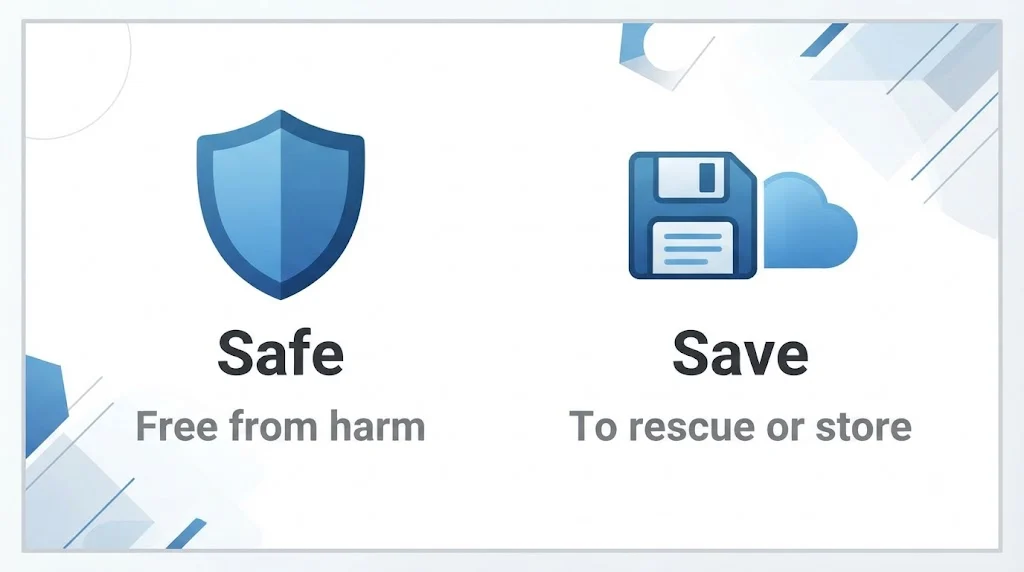
The word “safe” is an adjective used to describe something free from danger or harm, while “save” is a verb that means to rescue someone or store data for later use. Understanding this distinction prevents common grammatical errors and ensures you choose the right term for your intended meaning.
Many people often confuse the words safe and save because they look and sound quite similar. However, these two terms serve very different purposes in English grammar. One describes a state of being, while the other describes an action. If you mix them up, your sentences might sound confusing or incorrect.
This guide will help you master both terms quickly and easily. We will look at clear definitions, helpful examples, and simple exercises to build your confidence. Whether you are writing a professional email or just want to improve your vocabulary, you will find the answers here. By the end of this article, you will know exactly when to use each word without any hesitation. Let’s dive in and clear up the confusion surrounding safe and save once and for all.
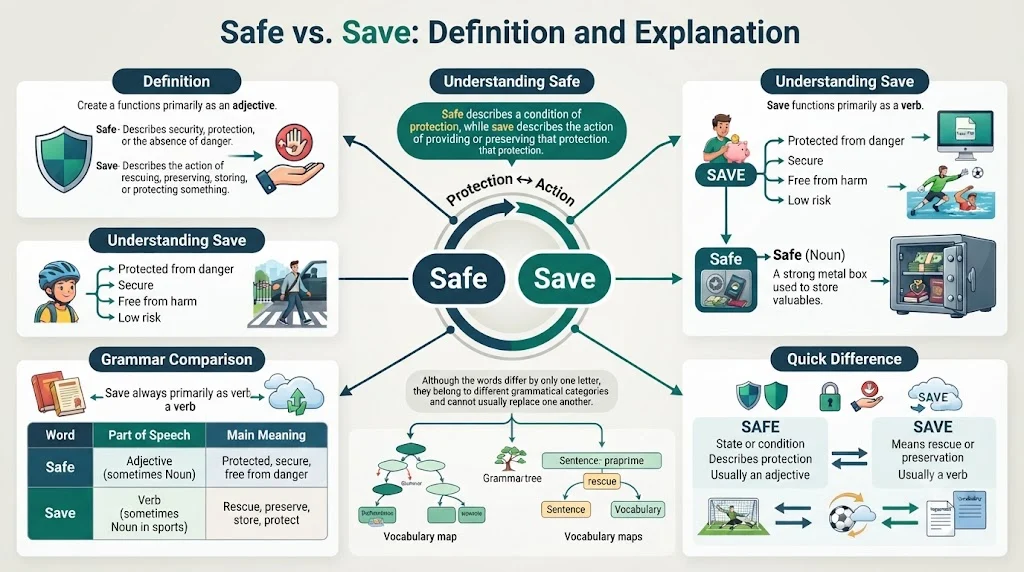
To put it simply, remember that safe is a condition, whereas save is an action. You feel safe when you are protected from harm. You save a file on your computer to keep it from disappearing. Always check if you are describing a person, place, or thing (use safe) or if you are performing a task (use save).
Definition and Explanation
Understanding Safe
As an adjective, safe indicates that someone or something is not in danger. It implies security and the absence of risk. You might say a neighborhood is safe, or a child is safe from harm. In some contexts, it can also function as a noun, referring to a strong metal box used to store valuables like cash or important documents.
Understanding Save
As a verb, save denotes the act of rescuing, keeping, or preserving. It is a dynamic word that implies effort or intention. For example, you save money for a vacation, or you save a document to your hard drive. Furthermore, in sports, a goalkeeper makes a save to prevent the opposing team from scoring a goal.
Advantages and Disadvantages
Using the correct term enhances your communication, but there are nuances to consider.
| Feature | Safe (Adjective/Noun) | Save (Verb) |
| Primary Role | Describes a state or condition. | Describes an action or process. |
| Common Use | Evaluating security or risk. | Rescuing or storing items. |
| Key Benefit | Provides clarity on safety levels. | Shows active effort or preservation. |
| Potential Pitfall | Can be vague if not specific. | Can be confused with “saving” as a noun. |
Real-World Examples
Using Safe
- “Please drive slowly to ensure you arrive safe and sound.”
- “We keep our jewelry locked in a heavy steel safe.”
- “Is it safe to drink the water in this city?”
Using Save
- “I need to save this presentation before the laptop dies.”
- “The lifeguard jumped into the pool to save the swimmer.”
- “She wants to save enough money to buy a new car.”
Regional and Global Usage
In most English-speaking regions, these words remain consistent. However, context can shift depending on the industry. In computer technology, “save” is universally understood as the act of writing data to a storage device. Meanwhile, in workplace environments, “safety” (a derivative of safe) is the standard term for protocols designed to keep employees secure from workplace hazards. There are no major dialectal differences, making these words reliable tools for global communication.
Common Mistakes
A frequent error occurs when speakers use the adjective form as a verb. For instance, saying “I need to safe my work” is grammatically incorrect. The correct verb form is “save.”
Conversely, some people mistakenly say “I want to keep my money in a save.” Since “save” is not a noun, you should use the noun form, “savings,” or refer to the object as a “safe.” Always double-check your sentence structure to ensure the word aligns with its grammatical category.
Exercises with Answers
Test your knowledge by filling in the blanks with the correct word.
- It is important to _______ your progress in the game.
- The hikers reached the camp feeling _______.
- My father keeps his passport in a small _______.
- We must _______ energy to help the planet.
Answers:
- Save
- Safe
- Safe
- Save
Related Concepts and Comparisons
It is helpful to look at synonyms to expand your vocabulary.
Synonyms for Safe
- Secure
- Protected
- Harmless
- Shielded
Synonyms for Save
- Rescue
- Preserve
- Store
- Hoard
Understanding these synonyms allows you to vary your writing and avoid repetition while maintaining the precise meaning you intend.
FAQs
What is the main difference between safe and save?
Safe is an adjective used to describe a state of being secure, while save is a verb used to describe an act of rescuing or storing.
Can I use safe as a verb?
No, safe is generally used as an adjective or a noun. Use “secure” or “save” depending on your intended meaning.
Is it correct to say “safe the file”?
No, that is incorrect. You should say “save the file” when working with digital documents.
How do I use safe as a noun?
You can use it to describe a locked, fireproof container, such as: “The cash was locked in the office safe.”
What does it mean to save money?
This means setting aside a portion of your income for future use rather than spending it immediately.
Are there different types of saves in sports?
Yes, in sports like soccer or hockey, a save refers to the goalie stopping the ball or puck from entering the net.
Why is it important to use these words correctly?
Proper usage ensures clarity and professionalism, helping others understand your instructions or descriptions without confusion.
Can safe mean something else?
Yes, it can also describe something that is not harmful, such as “a safe cleaning product.”
How can I remember the difference?
Think of “Save” as having an “S” for storage or “A” for action, and “Safe” as describing a “Safe-ty” condition.
Conclusion
Mastering the difference between safe and save is a foundational step in improving your English communication. By identifying whether you are describing a state of being or an action, you can avoid common grammatical pitfalls. Remember, you keep things in a safe, and you perform the action to save them.
Effective writing relies on precision. When you choose the right word, your message becomes clearer and more impactful. Practice these terms in your daily conversations or emails to reinforce your learning. If you find yourself doubting, simply pause and ask, “Am I describing a condition or an action?” This simple technique will help you gain confidence over time. Keep practicing, stay observant of how others use these terms, and your writing will surely improve. Consistency is the secret to success in language mastery.

Harry Edwards is a language writer specializing in word meanings, synonyms, and language usage. He creates clear, accurate, and engaging content to help readers improve their vocabulary and communication skills.








8 thoughts on “Safe or Save| Understanding the Difference and Correct Usage”