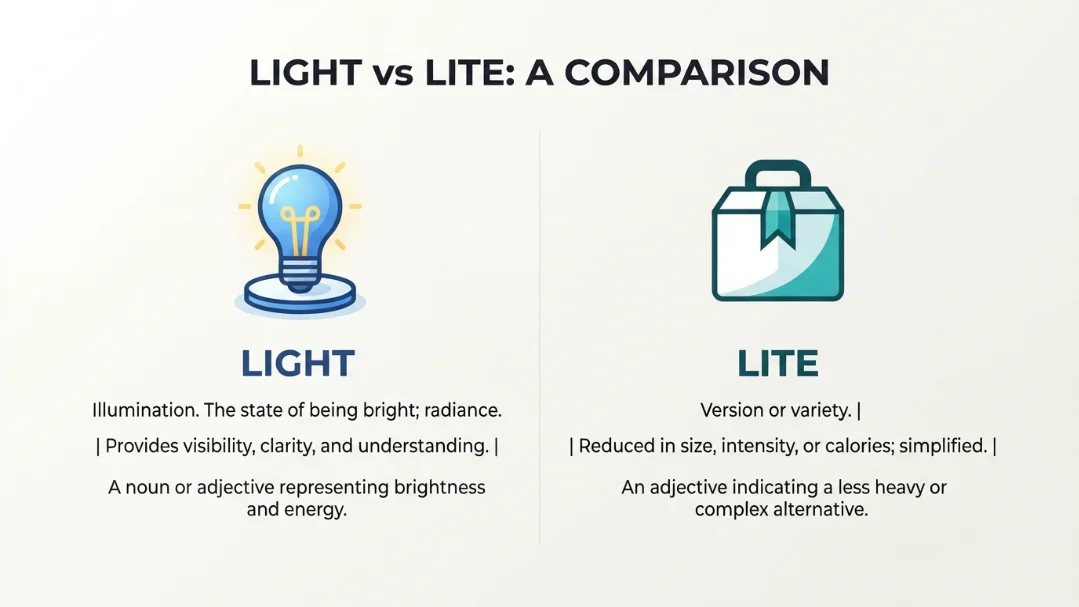
The term light serves as the standard spelling for weight, illumination, and color, while lite is a simplified marketing variant used primarily for food, software, or slimmed-down products. You should choose light for formal writing and lite only when referring to specific commercial brand names or simplified tech versions.
Many people struggle when they decide between the words lite or light. These two terms often cause confusion because they sound exactly the same. However, their meanings and proper contexts differ quite significantly. If you want to improve your writing, you must understand the subtle rules governing these spellings. This guide explores the historical background, professional usage, and common mistakes associated with these terms.
You will frequently encounter light in everyday language, ranging from scientific discussions about photons to descriptions of heavy objects. Conversely, you will mostly see lite on grocery store shelves or when downloading simplified computer applications. Using the wrong term might make your professional documents appear informal or incorrect. Fortunately, mastering this distinction takes very little time. We will provide clear definitions and practical tips to ensure you use the right word for every situation. By the end of this article, you will possess the knowledge to choose between them with total confidence and precision.
To summarize, light is the standard, dictionary-approved spelling for almost all contexts involving weight, brightness, or physics. You should always default to this spelling unless you are specifically naming a commercial product that uses the branding lite. Using the standard spelling ensures that your work remains professional, grammatically accurate, and easy for every reader to understand.
Definition and Explanation
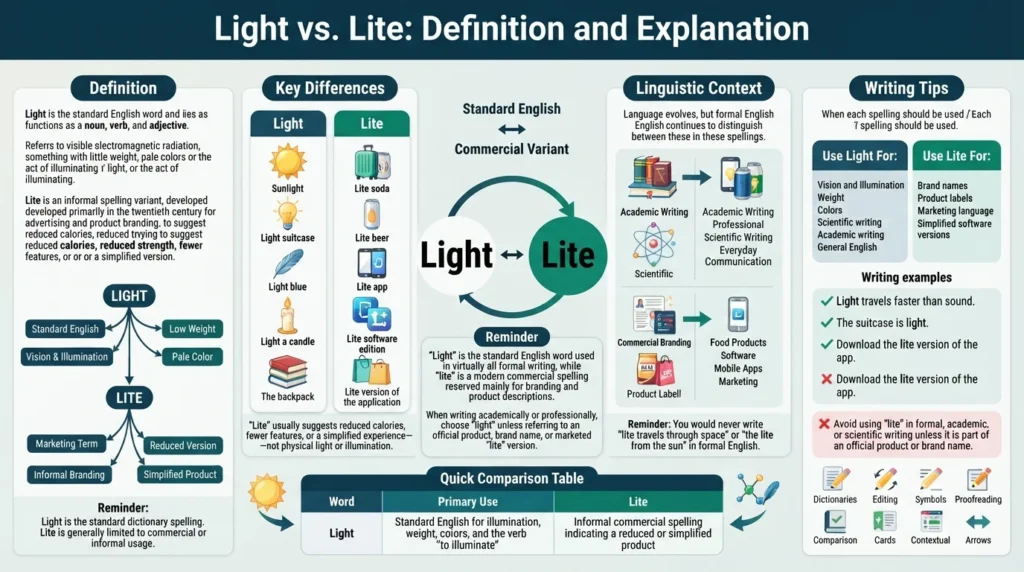
The word light functions as a noun, verb, and adjective with a long history in the English language. It describes electromagnetic radiation that makes vision possible, the lack of heavy weight, and pale colors. It remains the correct choice for academic, formal, and general writing tasks.
In contrast, lite exists primarily as a modern, commercial variant. Marketers created this shortened spelling during the twentieth century to imply a “slimmer” or “less intense” version of a product. While it has become common in retail, dictionaries generally categorize it as an informal or non-standard variation.
Linguistic Context
Language evolves through usage, yet formal standards remain important for clarity. Think of light as the original version and lite as a specialized, restricted version. You would not describe a bright sun as “lite,” nor would you describe a feather as “lite” in a scientific paper.
Advantages and Disadvantages
| Term | Advantage | Disadvantage |
| Light | Correct for almost all professional and formal contexts. | Can seem slightly longer or less “modern” in some marketing. |
| Lite | Effective for branding and suggesting simplified products. | Often considered informal or incorrect in academic writing. |
Understanding these pros and cons helps you decide which version fits the tone of your specific project.
Real-World Examples
To see how these words function, consider how they appear in different parts of our daily lives.
Food and Beverage Industry
Companies often use the alternative spelling to indicate products with fewer calories.
- “This soda is a lite version of the original drink.”
Physics and Technology
In formal, technical fields, you must stick to the standard spelling.
- “The device weighs very little because it uses lightweight materials.”
- “He turned on the light to examine the circuit board.”
Software Development
Developers sometimes release a version of their software that uses fewer resources.
- “We offer a light version of our application for older smartphones.”
Regional and Global Usage
English speakers worldwide generally prioritize the standard spelling. In the United Kingdom and Australia, the use of lite is even less common than in the United States. You will find that global audiences expect the standard spelling in most business, news, and academic documentation. When communicating internationally, choosing the standard version prevents confusion and maintains your professional credibility across all borders.
Common Mistakes
The most frequent error occurs when writers use the marketing spelling in formal essays or reports.
Incorrect Usage
- “The room was filled with soft lite.” (Incorrect)
- “She carried the lite bag to the car.” (Incorrect)
Corrected Usage
- “The room was filled with soft light.” (Correct)
- “She carried the light bag to the car.” (Correct)
Always remember that if you are discussing weight or brightness, you should avoid the marketing variant entirely.
Exercises with Answers
Test your knowledge to ensure you understand when to use these terms correctly.
1.Question: Choose the correct word: “The package was surprisingly (lite / light) for its size.
2. Question: True or False: “Lite” is the preferred spelling for a scientific article about energy.
3.Question: Rewrite this sentence to be more professional: “Check out this new lite version of our training app.”
Answer Key
Answer 1: Light. (Because it refers to weight).
Answer 2: False. (The standard spelling is required for scientific content).
Answer 3: “Check out this new light version of our training app.” (Using the standard spelling is more professional).
Related Concepts or Comparisons
Synonyms for light include bright, luminous, weightless, and airy. Synonyms for lite are limited to commercial terms like reduced, slim, or basic. When you write, always consider if a synonym might express your meaning more clearly than choosing between these two similar words.
FAQs
Is it acceptable to use lite in formal writing?
No, you should avoid using it in formal, academic, or professional writing. Stick to the standard spelling to maintain high quality.
Does lite mean the same thing as light?
While they are often used interchangeably in marketing, they have different levels of formality. One is standard, while the other is an informal brand variant.
Can I use lite when describing a color?
You should always use the standard spelling for colors. For example, use “light blue” rather than “lite blue.”
Why do companies use lite for their products?
Companies use this spelling to make a product sound modern, low-calorie, or easy to use. It acts as a marketing gimmick.
Are there any software programs that use the term light?
Yes, many developers use “Light” to denote a version that consumes fewer system resources. It is standard industry terminology.
Which spelling is better for SEO purposes?
The standard spelling usually receives significantly more search traffic and is better for SEO. Use the correct version to reach the widest audience.
How do I know if I should use lite?
Only use it if it is the official name of a product. If you are describing an object, use the standard version.
Is light a noun and a verb?
Yes, “light” can be a noun (a light source), a verb (to light a fire), or an adjective (not heavy).
Does this rule apply to all English dialects?
Yes, the preference for the standard spelling remains consistent across American, British, and international English.
What should I do if my client prefers the marketing spelling?
You should follow your client’s branding guidelines. However, you should suggest the standard version for any non-branded text.
Conclusion
Distinguishing between these two terms is a simple yet essential step toward writing with greater authority. You now know that light serves as the standard, versatile word for almost all situations. Meanwhile, you understand that lite serves as a specific, informal branding tool that has little place in formal documents.
By applying these insights, you will avoid the common pitfalls that often confuse less experienced writers. Remember to prioritize clarity and standard usage in your reports, emails, and creative work. If you ever feel uncertain, simply ask yourself if you are referring to a specific commercial brand or to a physical property. When in doubt, always choose the standard spelling. This small adjustment significantly elevates the professionalism of your communication. Start implementing these rules today, and watch how your writing becomes sharper, more precise, and more effective for your target audience.

Harry Edwards is a language writer specializing in word meanings, synonyms, and language usage. He creates clear, accurate, and engaging content to help readers improve their vocabulary and communication skills.







9 thoughts on “Lite or Light| Understanding the Usage and Differences”