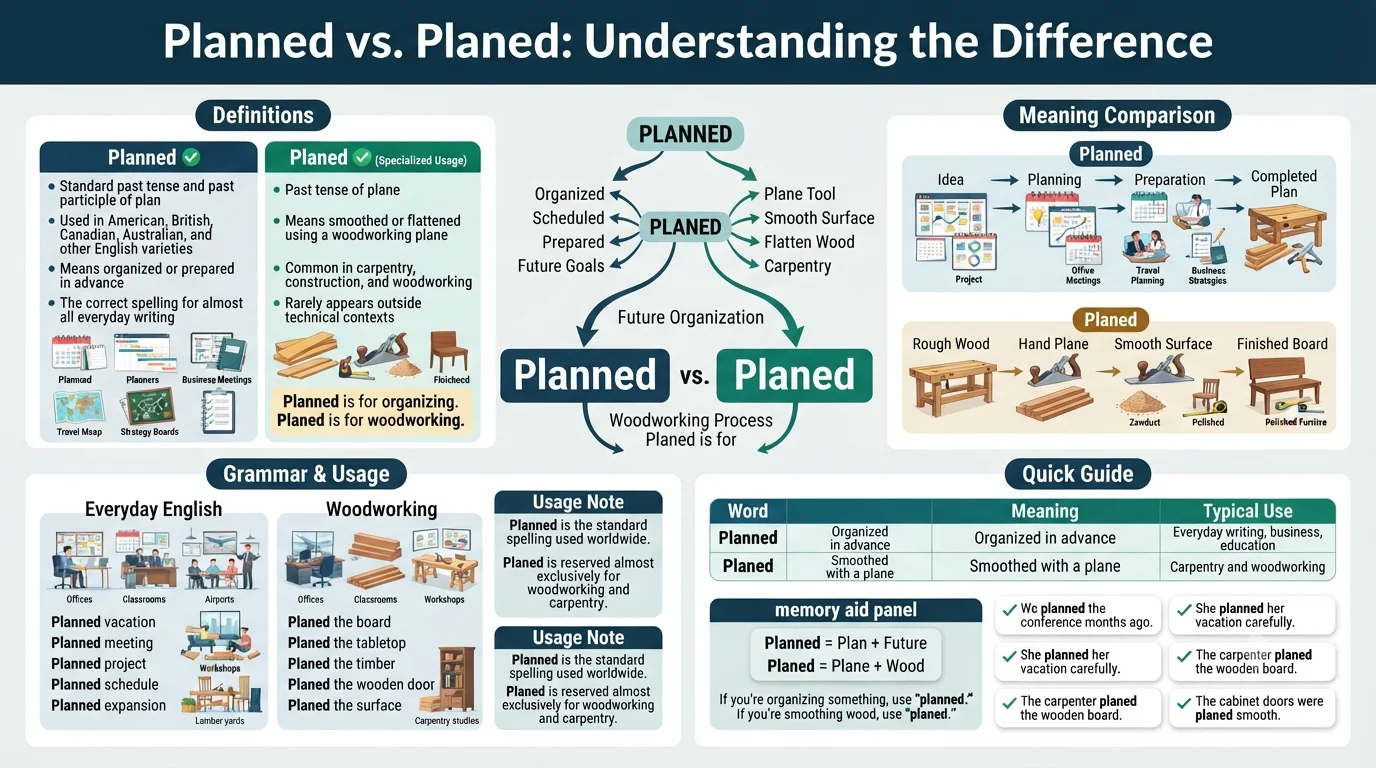
Planned is the standard past tense and past participle spelling of the verb plan, used in nearly all global English variants. Conversely, planed is a specialized woodworking term meaning smoothed with a tool called a plane, though it occasionally appears as a rare spelling variant in British English.
Do you ever write a sentence and stop because a word looks wrong? People often get stuck on whether to use planned or planed. Both words sound the same when you say them out loud. This spelling choice causes trouble for writers, students, and professionals every single day. Writers want to make sure they use the right term. Clear writing helps everyone understand your main idea right away. You can easily learn the difference with a few simple tips. Mastering these rules will boost your writing confidence.
- The spelling planned represents the standard past tense and past participle of the verb plan.
- You use planned when organizing events, strategies, projects, or future actions.
- The spelling planed applies almost exclusively to woodworking tasks involving a hand plane or machine planer.
- British English occasionally permits planed as a secondary variant for the verb plan, but planned remains far more common globally.
- Context serves as your primary tool to determine which spelling fits your sentence.
Definition and Explanation
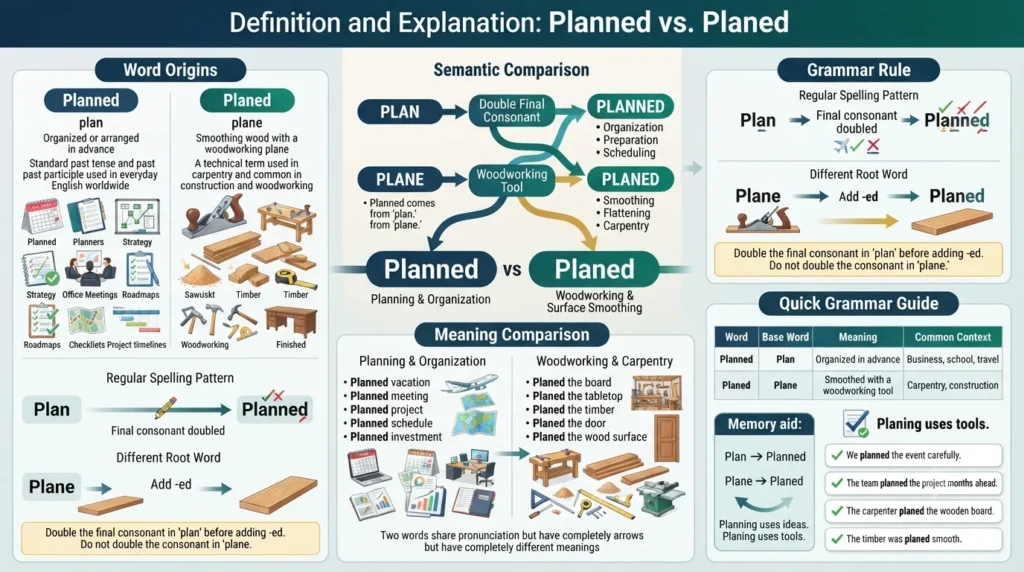
Language learners frequently encounter spelling choices that sound identical yet possess distinct meanings and origins. Understanding the background of planned or planed requires looking at standard English morphology and orthography. The base word plan involves thinking about or arranging parts ahead of time. When turning this verb into the past tense, standard English rules usually require doubling the final consonant before adding the suffix ed. Therefore, planned becomes the default choice for organization and intent.
Conversely, the word plane has a completely different root when used as a woodworking verb. Carpenters use a tool called a plane to shave thin layers of wood and make surfaces flat. The past tense of this specific tool operation is planed. Recognizing this distinction prevents embarrassing typos in professional woodworking logs and everyday correspondence alike.
| Term Variant | Primary Definition | Grammatical Category | Correct Context Example |
| Planned | Arranged or designed ahead of time | Past tense verb / Adjective | We planned our summer vacation carefully. |
| Planed | Smoothed wood using a plane tool | Past tense verb | The carpenter planed the rough oak board. |
Advantages and Disadvantages
Advantages of Using Correct Spelling
- Accurate spelling protects your professional reputation in business communications and academic papers.
- Clean text prevents reader distraction and improves overall comprehension.
- Search engines reward properly spelled content with better visibility and higher search rankings.
Disadvantages of Incorrect Spelling
- Typographical errors reduce your credibility among discerning readers.
- Poor spelling lowers search engine optimization performance for digital content.
- Confusing words misinform language learners who rely on accurate guidance.
Real-World Examples
Writers encounter these terms across various industries, from corporate boardrooms to carpentry workshops. Consider how professionals use each form in daily contexts.
1: The management team planned a comprehensive marketing strategy for the product launch.
2: The woodworker planed the cedar planks until they felt completely smooth to the touch.
3: Our city engineers planned a new transit route to reduce downtown traffic congestion.
Each scenario demonstrates that planned handles organizational concepts, whereas planed deals strictly with physical woodworking tasks. Writers never utilize the woodworking spelling when discussing future schedules or strategic blueprints.
Regional and Global Usage
Standard international English dictionaries heavily favor planned for all organizational duties. American English strictly separates planned for strategy and planed for woodworking. British, Canadian, and Australian English dictionaries occasionally list planed as a rare acceptable secondary past-tense variant for plan, but editors strongly discourage its use to avoid ambiguity. Global communication networks demand strict adherence to these established boundaries. Digital spell check tools automatically flag planed as an error when used in an organizational sentence.
Common Mistakes
Writers frequently commit errors when applying regular past-tense rules to words ending in silent vowels or consonants. People assume that because plane ends in an e, they must simply add a d, forgetting that the organizational verb plan requires doubling the n.
| Incorrect Usage | Correct Correction | Explanation |
| We planed a surprise party. | We planned a surprise party. | Organizing an event requires the double n spelling. |
| The builder planned the lumber. | The builder planed the lumber. | Smoothing wood surfaces requires the single n spelling. |
| They planed their escape route. | They planned their escape route. | Strategic preparation calls for the standard past tense. |
Exercises with Answers
Test your understanding of planned or planed by completing the following sentences with the correct word form.
Practice Questions
- The architect _______ the new office layout over the weekend.
- The cabinet maker _______ the door edges so they closed smoothly.
- Marketing executives _______ a nationwide advertising campaign.
- The artisan _______ the workbench top to remove imperfections.
Answer Key
- planned (Standard past tense for organizing or designing)
- planed (Woodworking action using a plane tool)
- planned (Strategic organization of a campaign)
- planed (Smoothing a wooden surface)
Related Concepts or Comparisons
Grammar comparisons help clarify tricky spelling choices. Similar words ending in consonants often require doubled letters in their past tense forms, such as shop turning into shopped or stop turning into stopped. Recognizing these patterns eliminates confusion between planned or planed and other linguistic variants. Furthermore, understanding tool-based verbs versus cognitive verbs sharpens your overall writing precision.
FAQs
What is the main difference between planned and planed?
The term planned refers to organizing or preparing something ahead of time. Meanwhile, planed describes the act of smoothing a piece of wood with a woodworking plane.
Is planed ever used for future arrangements?
Standard English rules dictate that planed is strictly reserved for woodworking. You should always use planned when discussing events, trips, or strategies.
Why does planned double the letter n?
English spelling conventions double the final consonant of a short vowel word ending in a single consonant before adding a vowel suffix like ed. This rule keeps the vowel sound short.
Can British English accept planed as a past tense of plan?
Some older British dictionaries list planed as a rare alternative variant, but modern professional editors universally reject it to prevent confusion with woodworking.
How do I remember which spelling to use?
Think of woodworking. A wood plane makes things flat with one n, so planed uses one n. Everything else regarding organization uses planned.
Do automated spell checkers catch planed used incorrectly?
Most word processors fail to catch this error if planed exists as a valid dictionary word, making manual proofreading essential for professional writers.
Are there other words with similar spelling confusions?
Yes, words like barred and bared or pinned and pined create similar confusion based on whether a consonant is doubled before a suffix.
How does proper spelling affect search engine optimization?
Search engines penalize awkward phrasing and spelling inconsistencies that disrupt user intent. Using planned correctly ensures higher readability scores and better audience retention.
Conclusion
Mastering tricky spelling choices like planned or planed elevates your writing quality instantly. Proper grammar builds authority and ensures clear communication with your target audience. Writers should always double-check their context to ensure they select the right spelling for strategy versus carpentry. Consistent practice reinforces these foundational language rules over time. Professional success often depends on attention to small details such as correct word forms.

Harry Edwards is a language writer specializing in word meanings, synonyms, and language usage. He creates clear, accurate, and engaging content to help readers improve their vocabulary and communication skills.






6 thoughts on “Planned or Planed| Which Spelling Is Correct? (Grammar Guide)”