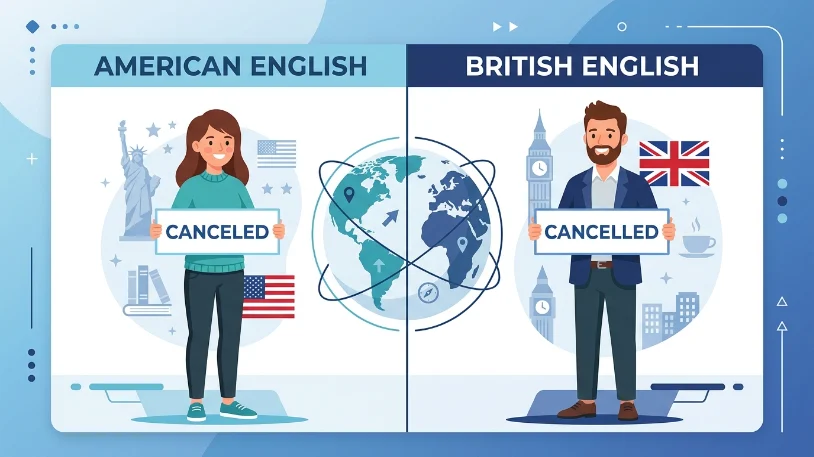
The difference between “canceled” and “cancelled” is purely regional. “Canceled” with one “l” is the standard spelling in American English, while “cancelled” with two “l’s” is preferred in British English and other Commonwealth countries. Both spellings are correct and have the same meaning.
Have you ever typed out an email, only to pause and wonder whether you should write “canceled” or “cancelled”? You are certainly not alone in this confusion. This single letter often trips up even the most experienced writers and professionals. The good news is that both spellings are actually correct, and the choice depends on where your audience lives.
Understanding this difference is important for clear and professional communication. Using the wrong regional spelling in a business document or academic paper can make your work seem less polished. It can distract your reader from your message. For example, an American company might view the double “l” spelling as an error, even though it is perfectly correct in British English . This small detail can affect your credibility.
This article will clear up the confusion once and for all. We will explore the historical reasons for this spelling difference. We will provide clear rules and examples to guide you. By the end, you will confidently know which spelling to use for any audience. You will also learn about the one exception where everyone spells it the same way. Let us dive in and settle the debate between “canceled” and “cancelled.”
Key Takeaway and Summary
The core rule for using “canceled” or “cancelled” is straightforward. In essence, it depends on whether you are writing for an American or a British audience .
This variation follows a broader pattern in English. The language has many words with different spellings in the US and the UK. The table below summarizes the main points for quick reference:
| Feature | American English | British English |
| Past Tense Spelling | Canceled (one “l”) | Cancelled (two “l’s”) |
| Present Participle Spelling | Canceling (one “l”) | Cancelling (two “l’s”) |
| Noun Form (Exception) | Cancellation (two “l’s”) | Cancellation (two “l’s”) |
The key takeaway is that while the single “l” and double “l” forms are both acceptable, consistency within your document is vital. You should not mix both spellings in the same piece of writing. As one source notes, “Both spellings are correct; it just depends on who you’re writing for” . Choosing the correct form shows attention to detail, which is a sign of a skilled writer.
Definition and Explanation
The word “cancel” is a verb that means to decide or announce that a planned event will not take place, or to annul or invalidate something . For example, a company might cancel a meeting, or an individual could cancel a subscription. The words “canceled” and “cancelled” are simply the past tense and past participle forms of this verb.
Why are there two spellings? The answer lies in history and the efforts of one man. Noah Webster, an American lexicographer, published his dictionary in 1828. He was a strong advocate for simplifying American English spellings . He believed that many words had unnecessary letters. For example, he changed “colour” to “color” and “labour” to “labor.” He applied this same logic to the word “cancel,” dropping the second “l” to create “canceled” .
In contrast, British English retained the original double “l” spelling. British dictionaries, like Samuel Johnson’s from 1755, influenced this standard . This rule generally holds true for other words, such as “traveled/travelled” and “labeled/labelled.” The pattern of simplifying the spelling is a defining characteristic of American English.
Advantages and Disadvantages of Each Spelling
It is not helpful to think of one spelling as better than the other. Both have their place depending on the context.
Advantages:
- American English (Canceled): Using this spelling is advantageous when writing for a US audience. It aligns with widely accepted style guides like the AP Stylebook . It signals that the writer is familiar with local conventions.
- British English (Cancelled): This is the preferred and more traditional spelling. It is the standard in the UK, Canada, Australia, and other Commonwealth nations . It demonstrates respect for the reader’s linguistic norms.
Disadvantages:
- Potential for Distraction: Using the “wrong” spelling for your audience can be distracting. A reader might perceive it as a simple error . This is less of an issue in our globalized world, but it can still happen.
- Spellcheck Issues: Your word processor’s spellchecker might flag one version as incorrect if it is set to the wrong dialect of English. This can be an annoyance, but it is easy to fix by changing the language settings.
Real-World Examples
Seeing both forms in action helps to clarify their usage. Here are some examples from reputable news sources that illustrate the regional preference.
American English Examples
In the United States, “canceled” is the standard. Major newspapers and news agencies all use this spelling.
- “Met Opera Cancels Premiere; Broadway Shows Canceled” – The New York Times .
- “St. Patrick’s Day Parade Canceled Again” – The Boston Globe .
- “Hundreds of Southwest flights canceled after two disruptions in 24 hours.” – CBS News .
British English Examples
Across the Atlantic, “cancelled” is the accepted form. British publications consistently use the double “l” spelling.
- “Organisers blame government as Womad festival cancelled again.” – The Guardian .
- “Watchdog wants independent review into cancelled 999 calls.” – The Times .
- “Tories accuse Jeremy Corbyn of cancelling Christmas.” – The Independent .
Canadian and Australian Usage
It is a common misconception that all of North America uses American spelling. However, countries like Canada and Australia are part of the British Commonwealth. Therefore, they typically follow the British English convention. In these countries, “cancelled” with two “l’s” is the preferred form .
Common Mistakes
Even though the rule is simple, people still make mistakes. Here are some common pitfalls to watch out for.
Mistake 1: Inconsistency
Writers sometimes accidentally use both spellings within the same document. This can make the text look unprofessional.
- Incorrect: The flight was canceled, and the hotel room was cancelled.
- Correct: The flight was canceled, and the hotel room was canceled. (American English)
- Correct: The flight was cancelled, and the hotel room was cancelled. (British English)
Mistake 2: The Noun Exception
Many people apply the past-tense rule to the noun form. This leads to an error. The word “cancellation” is almost always spelled with two “l’s,” even in American English .
- Incorrect: The cancelation of the event was frustrating. (While technically not impossible, this is very rare.)
- Correct: The cancellation of the event was frustrating. (This is the standard form in both US and UK English.)
Mistake 3: Forgetting the Reader’s Location
Not considering the audience is a common mistake. You should choose the spelling that your intended reader expects.
Mistake 4: Misapplying the Rule
The rule for doubling the “l” is not universal. It often depends on where the stress falls in the word. For “cancel,” the stress is on the first syllable. American English does not double the “l” in this case, while British English does .
Exercises with Answers
Test your understanding of the “canceled” vs. “cancelled” rule with these practice questions.
Exercise 1: Fill in the Blank
Choose the correct spelling for an American English context.
- The school board has ______ all after-school activities for the week.
- Due to a lack of interest, the committee ______ the annual fundraiser.
- The tennis match was ______ because of the thunderstorm.
Exercise 2: Fill in the Blank
Choose the correct spelling for a British English context.
- The train service was ______ due to a signal failure.
- The Prime Minister has ______ his visit to the factory.
- The theatre company is ______ all performances tonight.
Exercise 3: Identify the Error
Find and correct the spelling mistakes in the following sentences.
- The concert was cancelled, so we are requesting a full refund for our tickets. (Written for a US audience)
- The airline reported that the cancelation of the flight was due to bad weather.
- The marketing team has been canceling meetings all week because the project is on hold. (Written for a UK audience)
Answers
Exercise 1 (American English):
- canceled
- canceled
- canceled
Exercise 2 (British English):
- cancelled
- cancelled
- cancelling
Exercise 3:
- Correction: The concert was canceled… (American English uses one “l”).
- Correction: …the cancellation… (The noun always has two “l’s”).
- Correction: …cancelling meetings… (British English uses two “l’s” for the verb form).
Related Concepts and Comparisons
The “canceled/cancelled” debate is just one example of a wider phenomenon. The English language is full of spelling variations between American and British English. Understanding these broader patterns can help you navigate many similar issues.
Other Words with the Same Pattern
Many verbs that end in an “l” follow the same rule. Here are a few examples:
| Base Verb | American English | British English |
| Travel | Traveled, Traveling | Travelled, Travelling |
| Label | Labeled, Labeling | Labelled, Labelling |
| Level | Leveled, Leveling | Levelled, Levelling |
| Rival | Rivaled, Rivaling | Rivalled, Rivalling |
Other Common Spelling Differences
Beyond the “l” rule, there are many other spelling variations between US and UK English. Recognizing these is key to mastering the language.
- -or vs. -our: Color (US) vs. Colour (UK) .
- -ize vs. -ise: Organize (US) vs. Organise (UK).
- -er vs. -re: Center (US) vs. Centre (UK) .
FAQs
Is “canceled” or “cancelled” the correct spelling?
Both spellings are correct. The past tense of “cancel” can be spelled with one “l” or two “l’s.” The choice depends on the version of English you are using. For an American audience, use “canceled.” For a British audience, use “cancelled.” You can use either spelling, but you should be consistent in your choice .
What is the difference between canceled and cancelled?
There is no difference in meaning between these two words. They mean exactly the same thing. The sole difference is in their spelling, which is based on regional preferences. American English uses the shorter form, “canceled,” while British English uses the longer form, “cancelled” .
Why is it “canceled” in American English and “cancelled” in British English?
This difference is largely thanks to Noah Webster. He created his American dictionary in 1828 and advocated for simpler spellings. He removed what he saw as unnecessary letters. In British English, the traditional spelling with a double “l” was retained .
When should I use “canceled” in my writing?
You should use “canceled” when you are writing for an American audience or in American English. This is the preferred spelling in the United States. Style guides like the AP Stylebook recommend this spelling. It is best for business, academic, or professional communication directed at US readers .
When should I use “cancelled” in my writing?
You should use “cancelled” when you are writing for a British audience or in British English. This is the standard spelling in the UK, Canada, Australia, and other Commonwealth countries. If your document uses British spellings like “colour” or “centre,” then you should also use “cancelled” .
How do Canadians spell “cancelled”?
Canadians spell it as “cancelled” with two “l’s.” Although Canada is geographically close to the United States, it is a member of the British Commonwealth. Therefore, Canadians typically follow British English spelling conventions for words like this .
What about “canceling” and “cancelling”?
The same regional rule applies. “Canceling” with one “l” is the American English spelling. “Cancelling” with two “l’s” is the British English spelling. The word “cancellation,” however, is a special case where the double “l” form is always preferred .
Why does “cancellation” always have two “l’s”?
The noun “cancellation” is an exception to the rule. It is always spelled with two “l’s,” even in American English. The spelling “cancelation” is very rarely used and generally considered incorrect. This is the standard form recognized by all major style guides .
Is it “canceled” or “cancelled” in the UK?
In the UK, the correct spelling is definitely “cancelled” with two “l’s.” This is the overwhelmingly dominant form in British publications and everyday writing. Using “canceled” in the UK would be seen as an Americanism .
Which spelling should I use in a formal document?
You should choose the spelling that matches your audience and the version of English you are using. For a formal document for a US company, use “canceled.” For a UK company, use “cancelled.” Consistency is the most important rule. Do not mix the two spellings in the same document.
Conclusion
The choice between “canceled” and “cancelled” is a classic example of how English varies across the globe. Both spellings are technically correct and carry the same meaning. The primary factor in your decision should be your target audience. If you are writing for Americans, “canceled” is the clear choice. If your readership is primarily British, Canadian, Australian, or from another Commonwealth nation, then “cancelled” is the standard.
Remember the key exceptions and rules. The noun form “cancellation” always takes two “l’s.” Furthermore, the present participles follow the same pattern: “canceling” for the US and “cancelling” for the UK. These small details are important for maintaining professionalism and credibility in your writing.
Ultimately, the most important takeaway is consistency. Choose one spelling convention and stick with it throughout your entire document. This attention to detail will ensure your message is clear and your writing appears polished and well-edited. Now that you understand the rule, you can write with confidence and never second-guess yourself on this point again.