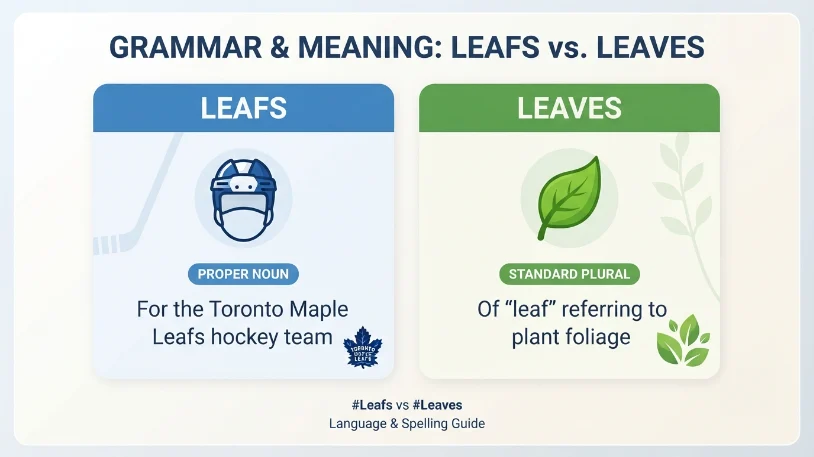
“Leaves” is the standard and correct plural form of “leaf” when referring to the foliage of plants and trees. “Leafs” is only used as a proper noun, most notably for the Toronto Maple Leafs hockey team, or as a third-person singular verb form.
Have you ever paused while writing about autumn foliage, wondering whether to type “leafs” or “leaves”? You are certainly not alone in this confusion. This small spelling difference trips up many writers, from students to seasoned professionals. The English language contains several tricky pluralization rules, and words ending in “f” often cause the most uncertainty. The root of the confusion lies in the fact that both versions appear in print, making it difficult to know which one is correct in a given context. However, the distinction between these two forms is actually quite straightforward. The choice depends entirely on whether you are referring to the green parts of a plant, a specific sports team, or an action. This comprehensive guide will clarify the difference between leafs and leaves once and for all. By using simple explanations, real-world examples, and helpful memory tricks, you will learn to choose the right form with confidence every single time.
Key Takeaway
The most crucial point to remember from this entire discussion is simple. If you are writing about the foliage on trees, bushes, or any plant, the word you need is “leaves.” This is the standard plural form of the noun “leaf.” On the other hand, “leafs” is almost never the correct choice in standard English for botanical contexts. There is one notable exception: the Toronto Maple Leafs, a professional ice hockey team. Additionally, “leafs” serves as the third-person singular verb form meaning “to turn pages” or “to produce leaves.” Therefore, if you are unsure which to use about plants, the safest and most likely correct choice is “leaves.
Definition and Explanation
To use these words correctly, it helps to understand their definitions and grammatical rules thoroughly.
Leaves
“Leaves” is the plural form of the noun “leaf.” A leaf is the flat, typically green, organ that grows from the stem of a plant and is responsible for photosynthesis. When referring to more than one of these botanical structures, you must use “leaves.” For example, “The leaves on the oak tree turned a brilliant orange in autumn.” The pronunciation uses a “v” sound, like “leevz.” This spelling follows a standard English pluralization rule: many nouns that end in “f” or “fe” change the “f” to “v” and add “es.” Other examples include:
- Wife → wives
- Knife → knives
- Calf → calves
- Shelf → shelves
Leafs
“Leafs” is generally not a standard plural form of the noun “leaf.” It is incorrect in botanical or everyday contexts. However, “Leafs” does exist as a proper noun in a very specific situation. It is the official name of the Toronto Maple Leafs, a team in the National Hockey League. When referring to this hockey team, “Leafs” is the correct spelling. For example, “The Leafs secured a decisive victory in overtime.”
Verb Form: Leafs
There is another context where “leafs” can appear: as a verb. Leaf” can function as a verb meaning “to turn the pages of a book or magazine quickly” or “to produce new leaves.” When used in the third-person singular present tense, it becomes “leafs.” For instance, “She leafs through the magazine while waiting for her appointment.” However, this usage is distinct from the noun plural and is much less common.
Side-by-Side Comparison
To visualize the difference between leafs and leaves, review this comparison table.
| Aspect | Leafs | Leaves |
| Definition | Proper noun for Toronto Maple Leafs hockey team; or third-person singular verb form of “leaf” | Standard plural noun form of “leaf” referring to plant foliage |
| Common Usage | “The Maple Leafs have a game tonight.” | “The tree’s leaves turned red in autumn.” |
| Key Difference | Limited to proper noun or verb usage | General term for multiple leaf units |
| Context | Sports, team names, or page-turning action | Nature, botany, seasonal changes |
Real-World Examples
Seeing the difference between leafs and leaves in common contexts makes the distinction easier to grasp.
Leaves in Action
- Nature and Seasons: “The autumn leaves created a beautiful carpet of red and gold on the forest floor.”
- Household Chores: “Raking the fallen leaves from the lawn is a tedious but necessary task.”
- Botany: “The tropical plant’s large leaves provide excellent shade for smaller flowers growing beneath them.”
- Cooking: “She used fresh lettuce leaves to create a crisp and healthy salad.”
- Literary Context: “The ancient book’s leaves were brittle and yellowed with age.”
Leafs in Action
These examples show how “leafs” is used in its rare, correct form.
- Proper Noun (Hockey Team): “The Toronto Maple Leafs are one of the original six teams in the NHL.”
- Verb (Page-Turning): “He leafs through the pages of the report, looking for the relevant statistics.”
- Verb (Plant Growth): “The new sapling leafs out in early spring, producing tiny green shoots.”
Advantages and Disadvantages
While it might seem unusual to consider “advantages” and “disadvantages” for a grammar rule, understanding these can help reinforce the lesson.
Correct Usage (Leaves)
The primary advantage of using “leaves” correctly is clarity. When you write “leaves,” your reader immediately understands that you are talking about the foliage of a plant or the pages of a book. The word is universally understood in this context. A disadvantage arises when “leaves” is misspelled as “leafs,” as this can confuse the reader. They might pause, misinterpret your intended meaning, or judge your writing as careless.
Correct Usage (Leafs)
The advantage of knowing “leafs” is that it allows for precise meaning in very specific situations, such as discussing the Toronto Maple Leafs or describing an action. It also demonstrates a strong command of the English language. However, the disadvantage is the high risk of misuse. Because it is so rare, most people will assume it is a typo for “leaves.” As a result, using it may cause more confusion than clarity in modern writing.
Regional and Global Usage
Understanding how different English-speaking regions treat these forms can provide additional clarity.
North American Usage
In North America, the distinction between leafs and leaves is generally consistent with standard English rules. The Toronto Maple Leafs have popularized the “leafs” spelling, but only in the context of the hockey team. Americans and Canadians alike use “leaves” when referring to plant foliage. The team’s name originated in 1927, and the unusual spelling has become a distinctive trademark.
British and Commonwealth Usage
British English follows the same rules as American English. “Leaves” remains the standard plural for plant foliage. The “leafs” spelling is similarly reserved for proper nouns or verb forms. There are no notable regional variations that alter these basic rules. Both variants maintain the distinction between the standard plural and the specialized uses.
Australian and New Zealand Usage
Australian and New Zealand English also adhere to the standard rules. “Leaves” is the correct plural for botanical references. The verb form “leafs” appears in the same contexts as in other English varieties. Cricket and rugby teams sometimes use “leafs” in their names, though less famously than the Maple Leafs.
Common Mistakes and Corrections
The most frequent mistake is using “leafs” when “leaves” is the intended word. Here are the common errors and their fixes.
| Common Mistake | Correction | Explanation |
| “The tree has many beautiful leafs.” | “The tree has many beautiful leaves.” | The context is about plant foliage, not a sports team. |
| “I need to rake the leafs in the yard.” | “I need to rake the leaves in the yard.” | This is about fallen foliage, requiring the standard plural. |
| “The leafs are changing color.” | “The leaves are changing color.” | This refers to a natural process, not a proper noun. |
| “She collected the leafs for her art project.” | “She collected the leaves for her art project.” | This describes a collection of plant parts. |
| “The salad had crispy green leafs.” | “The salad had crispy green leaves.” | This refers to lettuce or similar foliage. |
Related Concepts and Comparisons
To fully understand the leafs vs leaves distinction, consider these related grammar concepts.
The “F to V” Pluralization Rule
Many English nouns ending in “f” or “fe” follow the pattern of changing to “ves” in the plural. This rule applies to:
- Leaf → leaves
- Wolf → wolves
- Thief → thieves
- Half → halves
However, not all words follow this pattern. Some simply add “s”:
- Chief → chiefs
- Roof → roofs
- Belief → beliefs
Understanding this rule helps predict the correct plural form for many words.
Proper Nouns and Brand Names
Proper nouns often break standard spelling rules. The Toronto Maple Leafs are a prime example of this phenomenon. Other brand names and team names may similarly deviate from standard spelling:
- The Los Angeles Angels (pluralizing “angel” with “s” rather than “angels” which is standard)
- The Minnesota Vikings (using the standard plural)
- Leafs (intentionally misspelled for branding)
Verb Forms and Homophones
“Leafs” as a verb can create confusion with the noun plural. Consider these examples:
- “He leafs through the book” (verb, third person singular)
- “The book’s leaves are yellowed” (noun, plural)
The context usually clarifies which meaning is intended. However, careful writers ensure their meaning is unmistakable.
Exercises with Answers
Practice makes perfect. Test your knowledge with these exercises.
Fill-in-the-Blanks
- The autumn _______ fell gently to the ground.
- The Toronto Maple _______ won the championship game.
- The plant’s _______ were large and vibrant green.
- She _______ through the pages of the old book.
- The wind scattered the _______ across the driveway.
- The gardener examined the _______ for signs of disease.
- The team’s mascot waved a flag with the _______ logo.
- He _______ through the magazine while waiting.
- The oak tree lost all its _______ during the storm.
- The Maple _______ have a passionate fan base.
Answer Key
- leaves (Foliage falling to the ground)
- Leafs (Proper noun for the hockey team)
- leaves (Botanical parts of a plant)
- leafs (Third-person singular verb for turning pages)
- leaves (Plural noun for plant foliage)
- leaves (Botanical parts being examined)
- Leafs (Team logo and branding)
- leafs (Verb form for turning pages)
- leaves (Plant foliage being lost)
- Leafs (Proper noun for the team)
Identify the Correct Word
- (Leafs/Leaves) are essential for photosynthesis.
- The (Leafs/Leaves) are preparing for the playoffs.
- He (leafs/leaves) through the magazine at the doctor’s office.
- The park was covered with fallen (leafs/leaves).
- The (Leafs/Leaves) have a passionate fan base.
- The tree’s (leafs/leaves) provided ample shade.
- The author (leafs/leaves) through research papers.
- The Maple (Leafs/Leaves) play at Scotiabank Arena.
- The autumn (leafs/leaves) created a colorful display.
- The plant (leafs/leaves) out in the spring.
Answer Key
- Leaves
- Leafs
- leafs
- leaves
- Leafs
- leaves
- leafs
- Leafs
- leaves
- leafs
Advanced Usage and Style Considerations
For those seeking a deeper understanding, consider these advanced points about leafs and leaves.
Historical Context
The “f” to “v” pluralization rule has Germanic origins. Old English used this pattern extensively. Over time, many words shifted to the simpler “s” plural. However, common words like “leaf” retained the older form. This historical context explains why some “f” ending words have “ves” plurals while others do not.
Style Guide Recommendations
Major style guides agree on the leafs vs leaves distinction:
- The Chicago Manual of Style recommends “leaves” for botanical contexts
- The Associated Press Stylebook notes the Maple Leafs as an exception
- The MLA Handbook follows standard pluralization rules
Writers should consult their preferred style guide for specific usage questions.
Professional Writing Considerations
In professional and academic writing, correctness matters greatly. Using “leafs” for plant foliage can undermine credibility. Editors frequently correct this error. Business documents, academic papers, and journalistic pieces should all use “leaves” for botanical references.
Creative Writing and Poetry
Writers may sometimes use “leafs” for stylistic effect. Poetic license allows deviation from standard rules. However, this choice should be intentional and meaningful. Accidental errors remain unacceptable in professional writing.
Frequently Asked Questions
What is the correct plural form of the word “leaf”?
The correct plural form of “leaf” is “leaves” when referring to more than one leaf from a tree or plant. This term applies to contexts involving nature, botany, and seasonal changes. The rule follows the standard “f” to “v” pluralization pattern.
Are “leafs” and “leaves” interchangeable in everyday language?
No, “leafs” and “leaves” are not interchangeable. “Leaves” is the plural of “leaf,” while “Leafs” is specifically used when referring to the Toronto Maple Leafs hockey team. Using them incorrectly can confuse readers and undermine your writing credibility.
How can I remember the difference between “leafs” and “leaves”?
A simple way to remember the difference is to associate “Leafs” with the hockey team and “Leaves” with multiple foliage parts. Think of the ‘e’ in “Leaves” as representing “environment” or “ecology,” which are related to nature. Alternatively, remember that “leaves” follows the same pattern as “wives” and “knives.”
What are some common mistakes to avoid when using “leafs” and “leaves”?
A frequent error is using “leafs” to refer to multiple leaves of a plant or tree. Remember, “leaves” is the correct term for referring to more than one leaf from any plant or tree. Another mistake is forgetting the verb form of “leafs” when describing page-turning.
Can “leafs” ever be correct?
Yes, “leafs” is correct in specific situations. It is used as a proper noun for the Toronto Maple Leafs hockey team. It is also the third-person singular verb form meaning “to turn pages” or “to produce leaves.” In all other contexts, “leaves” is the correct choice.
Why does “leaf” become “leaves” in the plural?
“Leaf” becomes “leaves” because of a standard English rule. When a noun ends in “f” or “fe,” we typically change the “f” to “v” and add “es” to form the plural. This rule also applies to words like “wife,” “knife,” and “calf.” The pronunciation shifts from an “f” sound to a “v” sound.
Is “leafs” used in British English?
No, “leafs” is not used as the plural of “leaf” in British English. The correct plural form is “leaves” in both British and American English. The only exception is the proper noun use for the Toronto Maple Leafs, which is recognized globally.
What is the plural possessive form of “leaf”?
The singular possessive form is “leaf’s,” as in “The leaf’s stem is long.” The plural possessive form is “leaves’,” as in “The leaves’ colors were vibrant.” These forms follow standard possessive rules. Both forms are commonly used in nature writing.
When should I use “leafs” as a verb?
Use “leafs” as the third-person singular verb form when someone turns pages or when a plant produces leaves. For example, “She leafs through the book” or “The tree leafs out in spring.” This usage is distinct from the noun plural and follows standard verb conjugation rules.
How do style guides handle “leafs” and “leaves”?
All major style guides recommend “leaves” for the botanical plural. They acknowledge “Leafs” as the proper name for the Toronto hockey team. The verb form “leafs” appears in dictionaries. Style guides generally advise using “leaves” unless referring to the team or the verb.
Conclusion
The choice between leafs and leaves is a common stumbling block in English. Yet, as this guide has shown, it is a simple distinction to master. Remember, the word “leaves” is your default choice for any situation involving plant foliage, natural settings, or the pages of a book. It is the word that applies to trees, raking, and autumn scenes. In contrast, “leafs” is a specific term reserved for the Toronto Maple Leafs hockey team or the verb form for turning pages. By understanding these distinct uses and applying the memory tricks, you can confidently avoid this error.
Professional writing demands clarity and precision. Choosing the correct spelling is a small but significant step toward maintaining a credible and polished voice. Next time you are about to type “leafs,” pause for a second and ask yourself if you mean “leaves.” Chances are, you do. Keep this guide handy for quick reference and you will never second-guess this spelling again.