The most important lesson from this entire discussion is simple: remember the ‘a’. The word for the sweet treat always has an extra ‘a’ in the middle. “Caramel” is the correct spelling for the food, the sauce, and the flavor. “Carmel” is a name for a place. It is never the correct choice for describing food. Therefore, if you are writing about anything edible or delicious, you should always choose “caramel.”
Picture this scenario. You are standing in a coffee shop, ready to order your favorite sweet drink. As you look at the menu, you suddenly hesitate. Do you want a “caramel” latte or a “carmel” latte? It is a small question that can cause a surprisingly large moment of doubt. This confusion is incredibly common, and it happens to people all the time. The truth is, both spellings exist, but they mean entirely different things. Understanding the difference between caramel and carmel is not just a matter of grammar. It is about clear communication, whether you are writing a menu, a travel blog, or a simple social media post. This guide will clear up the confusion once and for all. By the end, you will know exactly which word to use in any situation, and you will never have to second-guess yourself again.
Definition and Explanation
The core of the confusion between “caramel” and “carmel” is that they are two distinct words with separate meanings, origins, and uses. Let us break down each one clearly.
What Is Caramel?
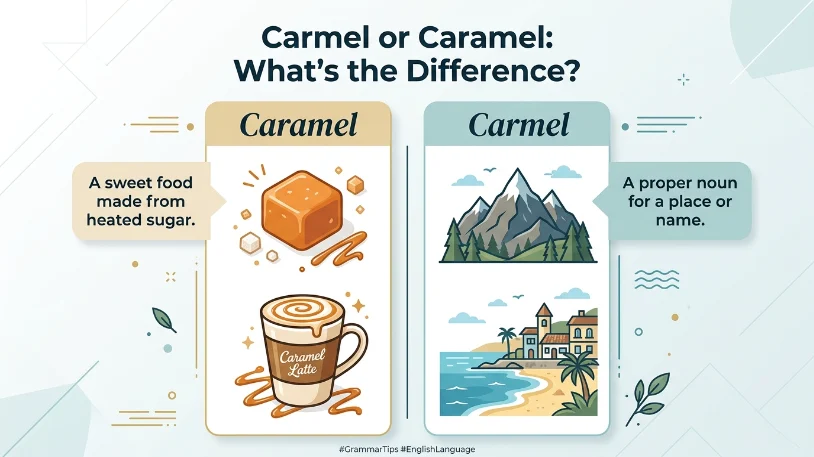
Caramel is a noun that refers to a specific food item. It is a confection made by heating various sugars until they melt and turn a dark, golden brown. This process is called caramelization. The result is a substance with a rich, sweet, and slightly nutty or buttery flavor.
Its dictionary definition includes three main aspects :
- The Substance: A golden-brown, sweet, sticky substance used for flavoring and coloring food.
- The Candy: A firm, chewy candy made with sugar, cream, and butter.
- The Color: A light brown color resembling the confection.
What Is Carmel?
Carmel is a proper noun. This means it is a specific name for a specific person, place, or thing and should always be capitalized . The word itself comes from the Hebrew word Karmel, which means “garden” or “orchard .
The most common uses of “Carmel” refer to:
- A Place in California: Carmel-by-the-Sea is a famous and picturesque coastal town in California .
- A Mountain in Israel: Mount Carmel is a significant coastal mountain range in northern Israel with great historical and religious importance .
Comparison Table: Carmel vs. Caramel
The differences between carmel and caramel are easiest to see side by side. This table provides a quick and clear comparison.
| Feature | Caramel | Carmel |
| Part of Speech | Common Noun | Proper Noun |
| Meaning | A sweet food, flavor, or color made from sugar | A name for a geographic place or a person |
| Spelling | c-a-r-a-m-e-l | C-a-r-m-e-l |
| Correct Usage | “I love caramel sauce on my ice cream.” | “We visited Carmel-by-the-Sea on our trip.” |
| Capitalization | Usually lowercase | Always capitalized |
| Origin | From French/Spanish, likely from Latin for “sugar cane” | From Hebrew, meaning “garden” or “orchard” |
Pronunciation Variations
The reason many people misspell “caramel” as “carmel” is rooted in its pronunciation. This is a key point of confusion that deserves its own explanation.
How to Pronounce Caramel
The word “caramel” has several accepted pronunciations, and this is where the trouble begins. The two most common ways to say it in the United States are :
- Three Syllables: This sounds like “CARE-uh-mel.” It is the more traditional pronunciation and is common in the UK and along the East Coast of the U.S. .
- Two Syllables: This sounds like “CAR-mull.” It drops the middle “a” sound entirely. This pronunciation is extremely common across the Midwest, West Coast, and most of the U.S. .
How to Pronounce Carmel
The pronunciation of “Carmel” is much more consistent. It is almost always pronounced with two syllables: “CAR-mull” .
The Source of the Confusion
The root of the spelling problem is clear. When someone pronounces “caramel” as “CAR-mull,” it sounds exactly the same as the standard pronunciation of the place name “Carmel.” This auditory identicality leads people to spell the word the way it sounds to them. In addition to the pronunciation, a simple typo can easily result in the omission of the middle ‘a’ .
Real-World Usage Examples
Seeing these words in real contexts helps solidify the correct usage. Here are examples that show the difference clearly.
- Caramel in the Kitchen:
- “The recipe requires a cup of caramel sauce for the topping.”
- “Her favorite candy is a soft, chewy caramel.”
- “I love the taste of salted caramel in my coffee.”
- Carmel as a Place:
- “Carmel-by-the-Sea is a beautiful tourist destination.”
- “The ancient Mount Carmel is a significant landmark in Israel.”
Common Mistakes and Corrections
The most frequent mistake is using “Carmel” when “caramel” is the intended word. This error is so common that many people do not realize it is a mistake.
| Common Mistake | Correction | Explanation |
| “I ordered a carmel latte.” | “I ordered a caramel latte.” | You are referring to the sweet flavor, not a place. |
| “The recipe calls for carmelized onions.” | “The recipe calls for caramelized onions.” | The verb for cooking sugar is “caramelize.” |
| “We visited the charming town of caramel.” | “We visited the charming town of Carmel.” | The town name is “Carmel-by-the-Sea.” |
| “The chocolate bar was filled with carmel.” | “The chocolate bar was filled with caramel.” | The filling is the sweet confection. |
Exercises with Answers
Test your understanding of the difference between carmel and caramel with these practice questions.
Fill in the Blanks
- The best part of the sundae is the gooey __________ sauce.
- We are planning a trip to __________, California, this summer.
- She has a purse that is a beautiful __________ color.
- The __________ mountains in Israel have a rich history.
- I love the flavor of __________ in my hot chocolate.
Answer Key
- caramel (It is a food item.)
- Carmel (It is a place name.)
- caramel (It refers to a color.)
- Carmel (It is a proper name for a place.)
- caramel (It is a food flavoring.)
Choose the Correct Word
- I can’t decide between the (caramel/Carmel) apple and the chocolate one.
- Have you ever been to (Caramel/Carmel)-by-the-Sea?
- The chef knows how to (caramelize/Carmelize) the sugar perfectly.
- The candy store is famous for its homemade (caramels/Carmels).
- The mountain range is called Mount (Caramel/Carmel).
Answer Key
- caramel
- Carmel
- caramelize
- caramels
- Carmel
Frequently Asked Questions
What is the main difference between caramel and carmel?
The main difference is that “caramel” is a delicious food made from sugar, while “Carmel” is the name of a place, most famously a city in California or a mountain in Israel .
Is “carmel” ever a correct spelling for the candy?
No, “carmel” is never the correct spelling when referring to the sweet treat. The only correct spelling for the food is “caramel . Using “carmel” for the candy is a common misspelling.
Why do so many people misspell “caramel” as “carmel”?
This misspelling happens primarily because of the pronunciation. When people say “caramel” with two syllables, it sounds like “CAR-mull,” which sounds exactly like the place name “Carmel.” This leads them to spell it the way it sounds .
Can “caramel” be pronounced with two syllables?
Yes, absolutely. Pronouncing “caramel” as “CAR-mull” is very common, especially in the western and midwestern United States. It is considered an accepted variant pronunciation . The three-syllable pronunciation, “CARE-uh-mel,” is more common in the East and in British English .
If I’m talking about a color, which word should I use?
You should use “caramel” to describe a light brown or tan color. The color gets its name from the sweet confection, not from the place . For example, you would say, “She wore a caramel-colored coat.”
Is “Carmel” ever used as a name for a person?
Yes, “Carmel” can be used as a given name for both men and women. It is a less common but established name, often derived from the Hebrew word for “garden” .
What is the origin of the word “caramel”?
The word “caramel” comes from the French word caramel, which was borrowed from the Spanish word caramelo. Some etymologists trace it back to the Medieval Latin word cannamella, meaning “sugar cane” .
What is the origin of the word “Carmel”?
“Carmel” has a different origin. It comes from the Hebrew word Karmel, which means “garden,” “orchard,” or “fertile field . This is fitting, as Mount Carmel in Israel is known for its lush, beautiful landscape.
How can I remember the correct spelling?
A helpful trick is to associate the extra ‘a’ in “caramel” with the word “apple.” Think about a classic fall treat: a caramel apple. This helps you remember that “caramel” has an ‘a’ and is something you eat, while “Carmel” does not .
What is the process of making caramel called?
The process of heating sugar until it melts, turns brown, and develops that rich flavor is called “caramelization.” The verb form is “to caramelize” . This word is always spelled with an ‘a’.
Conclusion
In the end, the choice between “carmel” and “caramel” is straightforward when you understand the context. The word “caramel” with an ‘a’ is the clear winner for all things sweet, flavorful, and delicious. It is the correct spelling for the sticky sauce on your dessert, the chewy candy in your hand, and the golden-brown color of your favorite boots. Remember, the extra ‘a’ stands for apple, as in a delicious caramel apple. On the other hand, “Carmel” with an ‘e’ is a proper noun reserved for places and names, like the scenic Carmel-by-the-Sea or the historic Mount Carmel.
These two words are not interchangeable, and their correct use demonstrates a strong command of the English language. Now, you can confidently order your caramel latte or discuss your travel plans to Carmel without a second thought. By mastering this simple distinction, you are taking a step toward clearer and more professional communication.