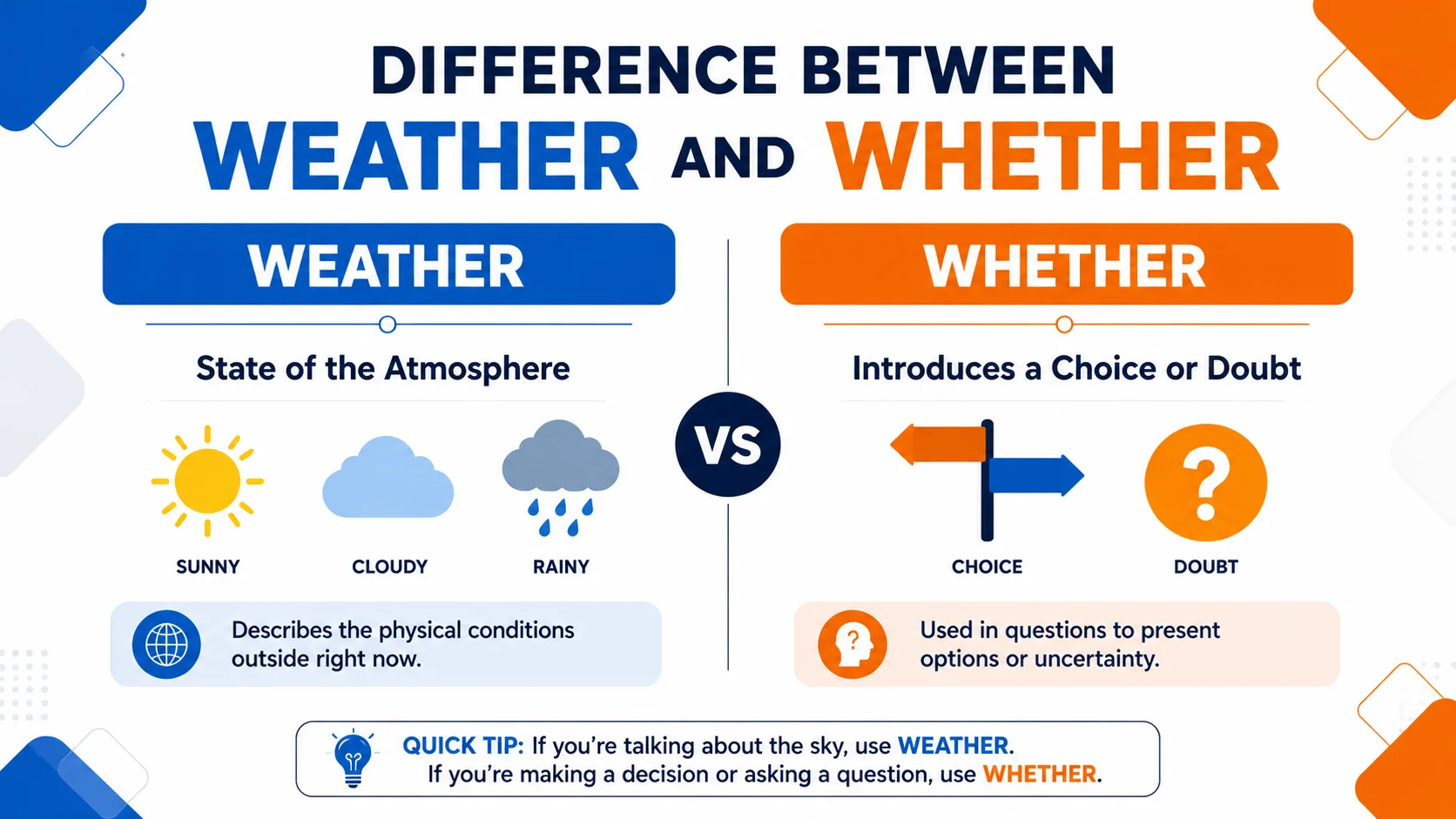
The difference between weather and whether is simple. Weather refers to atmospheric conditions like rain, sun, or temperature. Whether is a conjunction used to express doubt or choices between alternatives. If you are discussing climate, use weather. If you are presenting options or uncertainty, use whether.
Have you ever paused while typing and wondered if you should write “weather” or “whether”? This is one of the most common spelling dilemmas in the English language. The words sound identical, but they have completely different meanings. Many people make this mistake without even realizing it.
The confusion is understandable. Both words are homophones, which means they sound the same when spoken. However, the correct choice depends entirely on the context. Using the wrong word can confuse your readers and make your writing appear unprofessional. This is particularly important in business writing, academic papers, and official correspondence. In contrast, a simple mistake in a text message is usually harmless.
This article will clear up the confusion once and for all. You will learn the definitions, see real-world examples, and discover memory tricks to ensure you always choose the right word. Whether you are a student, a professional, or a casual writer, this guide will help you master this common English challenge.
Key Takeaway
The key distinction lies in their functions. Weather is a noun or verb related to the atmosphere and climate. Whether is a conjunction that introduces alternatives or expresses uncertainty. A simple memory trick is to remember that weather has an “a” for “atmosphere,” while whether has an “h” for “hypothetical choices.” Once you grasp this fundamental difference, you will never confuse them again.
Definitions and Explanations
What Does “Weather” Mean?
Weather primarily functions as a noun. It describes the state of the atmosphere at a specific time and place. This includes temperature, precipitation, wind, humidity, and other atmospheric conditions.
For example:
- “The weather is beautiful today.”
- “Rain is expected in the weather forecast.”
- “I check the weather every morning before I leave for work.”
The word also serves as a verb. As a verb, it means to withstand or endure a difficult situation. You can weather a storm in a literal sense, meaning to survive a storm. You can also weather a challenge metaphorically, like a financial crisis or a personal setback. For instance, “Our company managed to weather the economic downturn.” Another verb usage refers to the process of rocks or surfaces being worn down by exposure to the elements. For example, “The ancient statue had weathered over centuries.”
What Does “Whether” Mean?
Whether is a conjunction. Its main purpose is to introduce a choice or doubt between two or more alternatives . It signals that the speaker is considering different possibilities.
Common examples include:
- “I cannot decide whether to go or stay.”
- “We will proceed whether you agree or not.”
- “She asked whether I wanted coffee or tea.”
Notice how whether often pairs with “or” to present options. It can also express doubt or uncertainty without explicitly listing all alternatives. For example, “I wonder whether it will rain tomorrow.” This implies you are unsure about the possibility.
Importantly, whether is not the same as if. While they are often interchangeable in everyday speech, there are subtle differences. We will explore this comparison in a later section.
| Word | Part of Speech | Primary Meaning | Example |
| Weather | Noun | Atmospheric conditions | “The weather is cloudy.” |
| Weather | Verb | To withstand or endure | “We weathered the crisis.” |
| Whether | Conjunction | Expresses choice or doubt | “I don’t know whether to laugh.” |
The Etymology and Origin
Understanding the history of these words can provide a helpful memory anchor.
- Weather: This word traces back to Old English weder. It shares roots with German Wetter and Dutch weer. All these words relate to the atmosphere, wind, and storms. Its origins are ancient, with cognates in other Germanic languages. The word has always been associated with the sky and elements. The verb form of weather comes from the noun. It evolved from the idea of a ship or person surviving the weather.
- Whether: This word comes from Old English hwæther or hweder. It shares a common root with the German weder (meaning “neither”). The “wh” spelling is a clue to its Old English origin and connects it to other question words like what, where, and why. Its core meaning of “which of two” has remained stable for over a thousand years.
Advantages and Disadvantages
Understanding the advantages and disadvantages of using each word correctly can sharpen your writing skills.
The Advantage of Using “Weather” Correctly
Using weather correctly allows you to communicate about the environment precisely. It enables clear discussions about climate, forecasts, and planning. For instance, when you say, “The weather will affect our travel plans,” your meaning is perfectly clear. You are making a statement about the atmosphere and its impact.
The word’s power lies in its specificity. It is a concrete term that everyone understands. There is no ambiguity when you talk about the weather. This clarity is especially valuable in fields like aviation, agriculture, and logistics. In these industries, accurate weather communication is often critical.
The Advantage of Using “Whether” Correctly
Whether introduces nuance and possibility into your writing. It allows you to present options and express doubt. This is essential for clear reasoning and logical argumentation. When you write, “We need to decide whether to expand or consolidate,” you are presenting a clear choice to your readers.
Additionally, whether is a crucial word in formal writing. It elevates your tone and demonstrates grammatical precision. Using it correctly signals that you are a careful and educated writer. This can build trust with your audience, whether you are writing a report or an academic paper.
The Disadvantage of Confusing Them
The primary disadvantage of confusing weather and whether is that it undermines your credibility. A simple typo can distract your reader and make your work seem sloppy. This is particularly damaging in professional contexts. An email with a spelling error might be forgiven, but a formal document with such a mistake can leave a negative impression.
The confusion can also lead to genuine misunderstandings. For example, the sentence “I don’t know weather to go” is nonsensical. The reader will eventually understand what you mean, but the initial confusion creates a barrier to clear communication.
Real-World Examples
Seeing these words used in context is the best way to solidify your understanding. The following examples cover a range of situations.
Examples of “Weather” as a Noun
- “The weather report predicts heavy rain for tomorrow.” This is a standard forecast.
- “We canceled the picnic due to the bad weather.” This shows how weather affects plans.
- “Sunny weather always puts me in a good mood.” This describes a personal reaction.
- “The weather in the mountains can change very quickly.” This gives a general observation about a location.
- “Global weather patterns are becoming more unpredictable.” This discusses climate trends.
Examples of “Weather” as a Verb
- The sailors managed to weather the terrible storm.” This is a literal usage meaning to survive.
- Our small business weathered the recession successfully.” This is a metaphorical usage meaning to endure a challenge.
- “The cliff face has weathered significantly over the centuries.” This describes erosion from the elements.
- “We need to weather this difficult period in our industry.” This expresses a need for resilience.
Examples of “Whether” Expressing Choice
- “I am trying to decide whether to go to the gym or stay home.” This presents a clear choice.
- “The election depends on whether voters turn out.” This introduces a condition.
- “We will have the meeting whether the manager is here or not.” This shows that the event will proceed regardless of a specific condition.
- “Please let me know whether you prefer beef or chicken.” This asks for a preference.
- “He asked whether I wanted the blue one or the red one.” This reports a question.
| Context | Correct Word | Example Sentence |
| Climate, atmosphere | Weather | “The weather is cold and windy.” |
| Withstanding hardship | Weather (Verb) | “We will weather this crisis.” |
| Expressing a choice | Whether | “I don’t know whether to go left or right.” |
| Expressing doubt | Whether | “I wonder whether she will come.” |
Regional and Global Usage
The distinction between weather and whether exists in all English dialects. Native speakers everywhere must navigate this homophone. However, the prevalence of this error may vary slightly.
Usage in American English
In American English, the difference is strictly maintained in formal writing. Editors and teachers consistently mark a mix-up as an error. The homophone is one of the first spelling lessons taught in schools. Most Americans learn the mnemonic “weather has an ‘a’ for atmosphere” early on. Therefore, the mistake often appears more in casual writing like emails and social media posts.
Usage in British English
British English follows the same rules. Weather relates to the atmosphere, and whether introduces choices. There is a slight difference in pronunciation, though. In some British accents, the “wh” in whether is pronounced with an “hw” sound. This is an older pronunciation that is fading in many places. However, in Received Pronunciation, the distinction between the “w” sound and the “wh” sound is often maintained. This can make the difference slightly more audible for some British speakers.
Global English
For non-native speakers, this pair is a common challenge. Many learners of English struggle with homophones like weather and whether. This is because they often learn the words through listening. Without a visual reminder, they may not realize there are two distinct spellings. Global English tends to simplify things. The incorrect use of weather for whether is a frequent error in international business communication. However, proofreading tools and spell-checkers usually catch this mistake, making it increasingly rare in final documents.
Common Mistakes
Understanding why people confuse weather and whether can help you avoid the error. The primary reason is, of course, that they sound exactly the same. However, there are other contributing factors.
Mistake 1: Over-Reliance on Spell Checkers
Spell checkers are helpful, but they are not foolproof. They will accept both weather and whether as correctly spelled words. If you type the wrong one, the spell checker will not flag it as an error. This is why you cannot rely solely on technology. You must know the meaning of the words yourself. This is a classic example of a homophone error that spell checkers cannot catch.
Mistake 2: Confusing “Whether” with “If”
Many people use whether and if interchangeably. However, they are not always the same. There are certain situations where whether is the only correct choice. For example, you should use whether in formal writing when presenting alternatives. You should also use it before an infinitive. The phrase “I don’t know if to go” is incorrect. The correct phrasing is “I don’t know whether to go.” We will explore this comparison in more detail later.
Mistake 3: Forgetting the “H” in “Whether”
A common spelling error is simply forgetting the “h” in whether. In rapid typing, people often write “wether.” This is a misspelling of both words. It is a typo rather than a grammatical mistake. Wether is actually a word as well. It refers to a castrated male sheep. Therefore, if you are writing about sheep, you are correct. Otherwise, it is an error.
Mistake 4: The “A” vs. “E” Confusion
Some people mix up the vowels in the middle. They might write “wheather” or “wether” accidentally. This is usually a simple typo. The correct spellings are weather and whether. A good memory trick is to remember that weather contains the word “eat” within it. You can “eat” in the weather. Conversely, whether contains the word “he.” You ask “whether he” will come.
Exercises
Now it is time to test your knowledge. These exercises will help you master the difference. Complete the exercises without looking at the answers for the best results.
Exercise 1: Fill in the Blank
Choose the correct word (weather or whether) to complete each sentence.
- I am unsure __________ I should accept the job offer.
- The __________ forecast is calling for snow tomorrow morning.
- Can you tell me __________ you are coming to the party?
- The company is trying to __________ the current financial crisis.
- Please decide __________ you want coffee or tea.
- The __________ has been very unpredictable this month.
- We will go on the hike __________ it rains or not.
- The coastal house has __________ed many storms over the years.
Exercise 2: Identify the Error
Each sentence below has a mistake. Identify the incorrect word and correct it.
- “I don’t know weather to stay or to leave.”
- “The whether outside is beautiful.”
- “She asked me weather I liked the meal.”
- “We will whether the storm together.”
- “Whether you are coming with us is up to you.”
- “The weather or not we get the contract depends on our pitch.”
Answer Key
Exercise 1 Answers:
- Whether (expresses doubt/choice)
- Weather (atmospheric conditions)
- Whether (expresses a question of choice)
- Weather (verb meaning to withstand)
- Whether (expresses a choice)
- Weather (atmospheric conditions)
- Whether (expresses a condition)
- Weather (verb meaning to have endured)
Exercise 2 Corrections:
- “I don’t know whether to stay or to leave.” (Choice)
- “The weather outside is beautiful.” (Atmosphere)
- “She asked me whether I liked the meal.” (Doubt/Choice)
- “We will weather the storm together.” (Withstand)
- This sentence is actually correct! “Whether you are coming with us is up to you.” (Introduces a choice)
- “Whether or not we get the contract depends on our pitch.” (Choice)
Related Concepts and Comparisons
Understanding how weather and whether relate to other words and concepts will deepen your understanding.
Whether vs. If
This is one of the most common comparisons. Both whether and if can introduce clauses that express doubt. However, they are not always interchangeable. There are specific rules for when to use each one.
- Use whether for choices: When you present a direct choice between two or more alternatives, use whether. For example, “I do not know whether to go or stay.” The “or” is often a clue.
- Use whether before infinitives: You must use whether before a “to” infinitive verb. For example, “I cannot decide whether to proceed.” You cannot say “I cannot decide if to proceed.”
- Use if for conditions: Use if for a conditional statement. For example, “We will go if it does not rain.” This states a condition for the action.
Another common structure is “whether or not.” It is usually acceptable to use either “whether” or “whether or not.” However, “whether or not” is often redundant. You can often omit the “or not” without changing the meaning. For example, “I do not know whether (or not) it will rain.” However, there is a difference when “whether” means “regardless of whether.” In that case, you need the “or not.” For example, “We will go whether or not it rains.” This means we will go regardless.
| Context | Correct Word | Example |
| Presenting a choice | Whether | “I can’t tell whether he is sad or tired.” |
| Before an infinitive | Whether | “I don’t know whether to laugh.” |
| Conditional statement | If | “We will eat if we are hungry.” |
| Expressing uncertainty | Whether or If | “I wonder if/whether she is home.” |
Weather as a Verb: Endure vs. Erode
Weather has two distinct verb meanings. Understanding both can help you use it correctly. One meaning is to withstand or endure. The other is to be worn down by exposure to the elements.
- To withstand: “The company weathered the financial storm.”
- To erode: “The rocks weathered over the centuries.”
The meaning of the sentence usually makes the intended usage clear. When the subject is a living thing or an organization, it means to endure. When the subject is a surface or object, it often means to erode.
“Wether” as a Third Option
There is actually a third word that sounds the same. Wether refers to a castrated male sheep. It is a technical term used in agriculture. Unless you are a farmer or a shepherd, you will almost certainly never need this word. However, it is useful to know it exists. This explains why spell checkers do not flag it as a mistake. The correct spelling of the atmospheric word is weather.
FAQs
What is the difference between weather and whether?
Weather refers to atmospheric conditions like rain or sun. Whether is a conjunction used to introduce choices or express doubt. They are homophones, so they sound the same but have different meanings.
How do I remember the difference between weather and whether?
A simple trick is to remember that weather has an “a” for “atmosphere.” Meanwhile, whether has an “h” for “hypothetical choices” or “he.” This association helps many people remember which spelling to use.
Is it “weather or not” or “whether or not”?
The correct phrase is “whether or not.” You should never use “weather” in this context. The phrase introduces a choice or condition. For example, “We will proceed whether or not the boss approves.”
Can I use “if” instead of “whether”?
Sometimes, but not always. You can use “if” to express a condition. For example, “I will go if it does not rain.” However, you must use whether before an infinitive or to present a clear choice. For instance, “I cannot decide whether to go” is the only correct phrasing.
What does “whether” mean in a sentence?
Whether means “which of two” or “introduces a choice.” It shows that there is a doubt or a decision to be made. It is often, but not always, paired with “or.” For example, “I am unsure whether she is happy.”
What does “weather” mean as a verb?
As a verb, weather has two main meanings. It can mean to withstand or endure a difficult situation, like a storm. It can also mean to be worn down or changed by exposure to the atmosphere, like rocks.
Is “wether” a word?
Yes, “wether” is a word. However, it is a technical term for a castrated male sheep. It is pronounced the same as weather and whether. Unless you are discussing livestock, it is almost certainly the wrong word to use.
Why do people confuse weather and whether?
People confuse them because they are perfect homophones. This means they sound exactly the same when spoken. Without a visual cue, many people learn them by listening and do not realize there are two spellings.
How can I practice using weather and whether correctly?
You can practice by writing sentences with both words. Try to create a sentence that uses both. For example, “The weather will determine whether we have the picnic.” You can also do exercises like the ones in this article.
Is “weather” ever used to talk about choices?
No, weather is never used to talk about choices. It is strictly for atmospheric conditions or enduring hardship. If you are presenting options, you must use whether. This is the core distinction.
Conclusion
The distinction between weather and whether is a classic example of a homophone challenge. Weather is for the atmosphere, climate, and endurance. Whether is for choices, uncertainty, and alternatives. These definitions are fixed and do not overlap.
The key takeaway is that context always reveals the correct choice. If you are discussing rain, sunshine, or storms, your word is weather. If you are discussing a choice or a doubt, your word is whether. This simple rule will solve 100% of your problems with these words.
For practical advice, always proofread your work carefully. Read your sentences aloud. If you have used the word to mean “atmosphere,” check the spelling. If you have used it to mean “choice,” check the spelling again. Use the memory trick: “A” is for atmosphere, and “H” is for hypothetical. With a little practice, choosing the right word will become second nature. You will write with greater clarity and confidence.