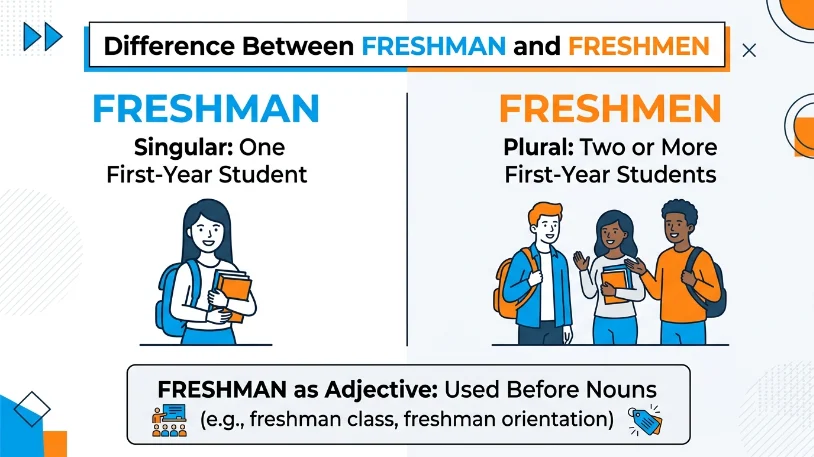
The difference between freshman and freshmen is simple. Freshman is singular, referring to one first-year student. Freshmen is plural, referring to two or more first-year students. Use freshman as an adjective too, like “freshman orientation” even when talking about a group.
Have you ever written a sentence and paused, wondering if you should type “freshman” or “freshmen”? This small difference trips up writers of all levels. The distinction seems minor, but using the wrong form can make your writing look careless.
This confusion matters more than you might think. Academic writing, school publications, and everyday communication all require correct usage. Using the wrong word can distract your readers and weaken your message. Whether you are writing an essay, an email to a professor, or a social media post, accuracy builds trust with your audience.
The rule is straightforward once you understand it. This article clears up the confusion between freshman and freshmen once and for all. You will learn the definitions, see real examples, and discover easy tricks to remember which word fits your sentence. Good writing relies on these small but important distinctions, and now you can master this one.
Key Takeaway
The key takeaway is that freshman is singular while freshmen is plural. When you refer to one student in their first year, you use freshman. When you refer to multiple first-year students, you use freshmen. Additionally, freshman serves as an adjective, even when describing a group. For example, you say “freshman class” and “freshman orientation,” not “freshmen class” or “freshmen orientation.” This rule applies consistently across all types of English writing.
Definitions and Explanations
What Does “Freshman” Mean?
Freshman is a noun that refers to a first-year student in high school, college, or university. It describes a person who is in their first year of study. This word comes from the combination of “fresh” and “man.” Historically, it meant someone who was fresh or new to a school.
The word functions as both a noun and an adjective. As a noun, it names the student. For example, “She is a freshman at Harvard.” As an adjective, it modifies a noun. For example, “He attended the freshman orientation.” When you use it as an adjective, it does not change form, even when it describes a group.
Common contexts where freshman appears include:
- Academic records and transcripts
- School orientation programs
- Housing assignments for first-year students
- Sports team descriptions
- Course registration materials
The singular form appears in phrases like “the freshman class,” “freshman year,” and “freshman orientation.”
What Does “Freshmen” Mean?
Freshmen is the plural form of freshman. It refers to two or more first-year students. This word simply adds an “n” to the end of freshman. The spelling change from “man” to “men” follows the standard English pattern for irregular plurals. Just as man becomes men, freshman becomes freshmen.
You use freshmen when you discuss a group of first-year students. For example, “The freshmen are attending orientation today.” This sentence refers to multiple students, so the plural form is correct.
Important contexts for freshmen include:
- Describing a group of first-year students
- Discussing class statistics
- Referring to multiple dorm assignments
- Mentioning a team consisting of first-year players
Remember that freshmen is only a noun. It never functions as an adjective. You would never say “freshmen orientation” because that would use the plural form incorrectly as an adjective.
| Form | Part of Speech | Meaning | Example |
| Freshman | Noun (Singular) | One first-year student | “The freshman is studying.” |
| Freshman | Adjective | Describes first-year things | “The freshman class is large.” |
| Freshmen | Noun (Plural) | Multiple first-year students | “The freshmen are studying.” |
The Etymology and Origin
Understanding where these words come from helps you remember the rule. Freshman originated in the 16th century. It combines the word “fresh” with “man.” The “fresh” part meant new or recent. A freshman was literally a new person at a school.
The plural freshmen follows the same pattern as men. The word man becomes men in the plural. Therefore, freshman becomes freshmen. This pattern is consistent and logical. Many other compound nouns with man follow this same rule. For example, businessman becomes businessmen, and policeman becomes policemen.
Interestingly, some institutions now use first-year student instead of freshman. They do this to be more gender-neutral. However, freshman and freshmen remain standard English words in most contexts.
Advantages and Disadvantages
Each form has its appropriate use. Understanding these uses prevents errors.
When to Use “Freshman”
Using freshman correctly shows attention to detail in your writing. The main advantage of this form is its precision. When you use freshman, you clearly indicate that you are talking about one person. This clarity helps your reader understand your meaning without ambiguity.
Another advantage is its flexibility. Freshman works as both a noun and an adjective. This versatility makes it a valuable word in academic writing. For instance, you can write “the freshman” and “freshman year” without changing the form.
The only disadvantage of freshman is that using it as an adjective can confuse some writers. People sometimes mistakenly think that freshmen works as an adjective. However, this is incorrect, and using freshmen as an adjective is a common error.
| Context | Correct Form | Example |
| Singular student | Freshman | “The freshman is lost.” |
| Adjective before a noun | Freshman | “This is the freshman dorm.” |
| A single person’s status | Freshman | “She is a freshman.” |
When to Use “Freshmen”
Using freshmen correctly indicates that you are discussing more than one student. The advantage of this form is that it clearly shows plurality. Your reader will immediately know that you are referring to a group, not an individual.
Freshmen is essential when you discuss statistics, group activities, or general statements about first-year students. For example, “The freshmen are excited about the game” clearly refers to multiple students.
The only disadvantage of freshmen is that it cannot function as an adjective. Some writers incorrectly use it in adjective positions. For instance, writing “freshmen orientation” is wrong. You must use freshman orientation instead.
| Context | Correct Form | Example |
| Multiple students | Freshmen | “The freshmen are studying.” |
| Group of first-years | Freshmen | “All freshmen must attend.” |
| Referring to a class cohort | Freshmen | “The freshmen of 2024.” |
Real-World Examples
Seeing these words used correctly in real-world contexts helps solidify the difference.
Examples of “Freshman” in Action
- “The freshman is walking to her first class.” This refers to one specific student.
- “My freshman year was challenging but rewarding.” Here, freshman acts as an adjective before the noun year.
- “The university offers a special freshman orientation program.” Freshman modifies orientation, even though many students attend.
- “He is a freshman on the basketball team.” This refers to one player’s status.
- “The freshman class has 500 students.” Freshman acts as an adjective, even though the class has many students.
Examples of “Freshmen” in Action
- “All freshmen must attend the safety workshop.” This refers to all first-year students.
- “The freshmen are organizing a study group.” Here, freshmen is a plural noun acting as the subject.
- “Many freshmen live in the dorms.” Freshmen refers to multiple students.
- “The freshmen received their course schedules yesterday.” This discusses a group receiving something.
- “These freshmen are very motivated.” Freshmen is the plural noun.
Real-World Scenarios
Scenario 1: A Parent’s Question
A parent calls the school office and asks, “Is my freshman enrolled in the right classes?” The parent refers to one child, so freshman is correct.
Scenario 2: A Professor’s Announcement
A professor announces, “All freshmen must submit their forms by Friday.” The professor addresses the entire group of first-years, so freshmen is correct.
Scenario 3: A Newspaper Headline
A student newspaper runs the headline, “Freshman Year: A Survival Guide.” The headline uses freshman as an adjective, and this is correct even though it describes experiences many students share.
Scenario 4: A Student’s Conversation
A student says, “I am a freshman majoring in biology.” This refers to one person, so freshman is correct.
Regional and Global Usage
The distinction between freshman and freshmen exists in all varieties of English. However, there are some regional variations in how the words are used.
United States
In the United States, freshman and freshmen are standard terms in high schools and colleges. Universities like Harvard, Stanford, and the University of Michigan use these terms officially. Some institutions have moved toward using first-year student to be more inclusive. However, freshman remains common in everyday speech and writing.
United Kingdom and Australia
In the United Kingdom and Australia, freshman is less common. British universities often use “fresher” to refer to a first-year student. The plural is “freshers.” You might see “freshers’ week” instead of “freshman orientation.” However, freshman and freshmen are still understood and used in some contexts.
Canada
Canadian universities use both freshman and first-year student. The usage is similar to that of the United States. Some Canadian institutions prefer gender-neutral language, so first-year student appears more often in official documents.
Global Education
International schools and programs may use freshman as a universal term. Students studying abroad often encounter the word in American-influenced contexts. Online education platforms also use freshman and freshmen to describe first-year students.
| Region | Common Usage | Example |
| United States | Freshman/Freshmen | “Freshman year is exciting.” |
| United Kingdom | Fresher/Freshers | “Freshers’ week begins Monday.” |
| Australia | Fresher/Freshers | “The freshers are settling in.” |
| Canada | Freshman/First-Year | “Freshman orientation is today.” |
| International | Freshman/Freshmen | “Freshmen enroll in September.” |
Common Mistakes
Even experienced writers sometimes make errors with freshman and freshmen. Understanding these common mistakes helps you avoid them.
Mistake 1: Using “Freshmen” as an Adjective
This is the most common error. People write “freshmen class” or “freshmen orientation” when they should use freshman. Remember that the adjective form is always freshman, even when you describe a group. Think of it as being similar to “woman” and “women.” You say “woman doctor” for one, but you also say “woman doctor” for a group? No, you would say “women doctors” for a group, but here’s the trick: with freshman as an adjective, the rule is different. The single word “freshman” serves as the adjective in all cases.
Incorrect: “The freshmen class is large.”
Correct: “The freshman class is large.”
Incorrect: “They attended the freshmen orientation.”
Correct: “They attended the freshman orientation.”
Mistake 2: Using “Freshman” for Plural Students
Some writers use freshman when they should use freshmen. This mistake occurs when people forget that freshman is singular. If you refer to two or more students, you need the plural form. For instance, “The freshman are coming” is wrong if you mean multiple students. You would say “The freshmen are coming” instead.
Incorrect: “All freshman are required to attend.”
Correct: “All freshmen are required to attend.”
Incorrect: “The freshman have a meeting.”
Correct: “The freshmen have a meeting.”
Mistake 3: Confusing “Freshman” and “Fresher”
In British English, fresher means a first-year student. Some writers confuse these terms when writing for a British audience. If you are writing for an American audience, use freshman. If you are writing for a British or Australian audience, fresher may be more appropriate.
Mistake 4: Incorrect Spelling
Another common mistake is misspelling freshmen. Some writers incorrectly write “freshmans” as the plural. This is never correct. The plural of freshman is always freshmen, following the man to men pattern.
Incorrect: “The freshmans are here.”
Correct: “The freshmen are here.”
Exercises
Test your knowledge with these exercises.
Exercise 1: Fill in the Blank
Choose the correct word (freshman or freshmen) to complete each sentence.
- The _________ is nervous about his first exam.
- All _________ must submit their housing forms.
- The _________ orientation will be held in the gym.
- I remember my _________ year fondly.
- Many _________ are undecided about their majors.
- She is a _________ at State University.
- The _________ class of 2028 is very diverse.
- These _________ have a lot of potential.
Exercise 2: Identify and Correct the Error
Each sentence below has a mistake. Identify the incorrect word and correct it.
- “The freshmen class is planning a trip.”
- “I met several freshman at the orientation.”
- “The freshmen orientation was very helpful.”
- “All freshman are invited to the party.”
Exercise 3: Choose the Correct Form
Select the correct form for each context.
- When referring to one first-year student, use:
a) Freshman
b) Freshmen - When referring to a group of first-year students, use:
a) Freshman
b) Freshmen - When describing a program for first-year students, use:
a) Freshman
b) Freshmen
Answer Key
Exercise 1 Answers:
- Freshman (one student)
- Freshmen (all students, plural)
- Freshman (adjective form)
- Freshman (adjective before year)
- Freshmen (many students, plural)
- Freshman (one person)
- Freshman (adjective before class)
- Freshmen (these students, plural)
Exercise 2 Corrections:
- “The freshman class is planning a trip.” (Adjective form needed)
- “I met several freshmen at the orientation.” (Plural needed for several)
- “The freshman orientation was very helpful.” (Adjective form needed)
- “All freshmen are invited to the party.” (Plural needed for all)
Exercise 3 Answers:
- a) Freshman (singular)
- b) Freshmen (plural)
- a) Freshman (adjective)
Related Concepts and Comparisons
Understanding how freshman relates to other academic year terms helps you use them correctly.
First-Year Student
First-year student is a gender-neutral alternative to freshman. Many institutions now prefer this term because it is more inclusive. It also avoids the historical connection to “man” as a default. However, first-year student is more formal and less common in everyday speech.
Sophomore, Junior, Senior
The academic year terms follow a pattern. Each has a singular and plural form. The pattern is consistent: add an “s” for plurals, except for freshman which changes to freshmen.
| Year | Singular | Plural |
| First | Freshman | Freshmen |
| Second | Sophomore | Sophomores |
| Third | Junior | Juniors |
| Fourth | Senior | Seniors |
Underclassman and Upperclassman
Underclassman refers to first-year and second-year students. The plural is underclassmen. Upperclassman refers to third-year and fourth-year students. The plural is upperclassmen. These terms follow the same man to men pattern as freshman.
Academic Year Terms
Here is a comparison of terms for different academic stages.
| Term | Singular | Plural | Meaning |
| Freshman | Freshman | Freshmen | First-year student |
| Sophomore | Sophomore | Sophomores | Second-year student |
| Junior | Junior | Juniors | Third-year student |
| Senior | Senior | Seniors | Fourth-year student |
| Underclassman | Underclassman | Underclassmen | First or second-year |
| Upperclassman | Upperclassman | Upperclassmen | Third or fourth-year |
Freshman vs. Fresher
This table compares freshman and fresher.
| Term | Singular | Plural | Region | Formality |
| Freshman | Freshman | Freshmen | US, Canada | Standard |
| Fresher | Fresher | Freshers | UK, Australia | Informal |
| First-year | First-year student | First-year students | Global | Formal, neutral |
FAQs
What is the difference between freshman and freshmen?
The difference is simple. Freshman is singular, meaning one first-year student. Freshmen is plural, meaning two or more first-year students. Use freshman as an adjective too.
Is it freshman or freshmen orientation?
It is freshman orientation. The word freshman acts as an adjective, so it does not change to plural. Even though many freshmen attend orientation, you still use the singular form as the adjective.
Is it freshman or freshmen class?
It is freshman class. Again, freshman serves as an adjective. You would say “freshman class” even though the class contains many students. The adjective form does not change to plural.
Is it freshman or freshmen year?
It is freshman year. The word year is singular, and freshman is the adjective. You refer to “my freshman year” or “her freshman year.” You never say “freshmen year.”
Are freshman and freshmen both correct?
Yes, both are correct but in different contexts. Freshman is correct for one student or as an adjective. Freshmen is correct for multiple students. Choose the form that matches your meaning.
What is the plural of freshman?
The plural of freshman is freshmen. This follows the man to men pattern. You do not add an “s” to make freshmans. That is always wrong.
What do you call a first-year student in the UK?
In the UK, people often call a first-year student a fresher. The plural is freshers. You might see freshers’ week at many British universities.
What is a gender-neutral term for freshman?
First-year student is the most common gender-neutral term. Many colleges and universities now use this term in official communications. Some use first-year as an adjective.
How do you remember the difference between freshman and freshmen?
Use this simple trick: Freshman has an “a” like “one” (one student). Freshmen has an “e” like “everyone” (many students). Another trick: Freshman works as an adjective, and adjectives are singular.
Is a freshman a first-year student?
Yes, a freshman is a first-year student in high school, college, or university. This term applies to the first academic year. Some institutions use first-year instead of freshman.
What does freshman stand for?
The term freshman means a new or recent member of a school. The “fresh” part means new, and “man” means person. The term has existed since the 16th century.
Do Americans use freshman or freshmen?
Americans use both. They use freshman for one student and freshmen for multiple students. They also use freshman as an adjective. The rules are the same across the United States.
What do Canadians call freshmen?
Canadians often use the same terms as Americans. They say freshman for one and freshmen for multiple. Some Canadian universities prefer first-year student for official documents.
Can you use freshmen as an adjective?
No, freshmen never works as an adjective. You must use freshman when you need an adjective. For example, “freshman orientation” is correct. “Freshmen orientation” is wrong.
What is the difference between a freshman and a sophomore?
A freshman is a first-year student. A sophomore is a second-year student. Freshman comes before sophomore in the academic sequence. Both terms have singular and plural forms.
Conclusion
This guide has clarified the difference between freshman and freshmen. The rule is straightforward: freshman is singular and freshmen is plural. Freshman also works as an adjective and never changes to freshmen in that role. Understanding this distinction shows attention to detail and improves your writing clarity.
The best practical advice is to think about how many students you are discussing. If you refer to one student, choose freshman. If you refer to more than one, choose freshmen. If you are describing a program, event, or class for first-year students, choose freshman. This simple guideline covers almost every situation.
Avoid the common mistakes of using freshmen as an adjective or using freshman for plural students. These errors are easy to spot and correct. With practice, choosing the right form becomes automatic. Your writing will be clearer, more professional, and more accurate. Good writing depends on these small but important details, and now you have mastered this one.