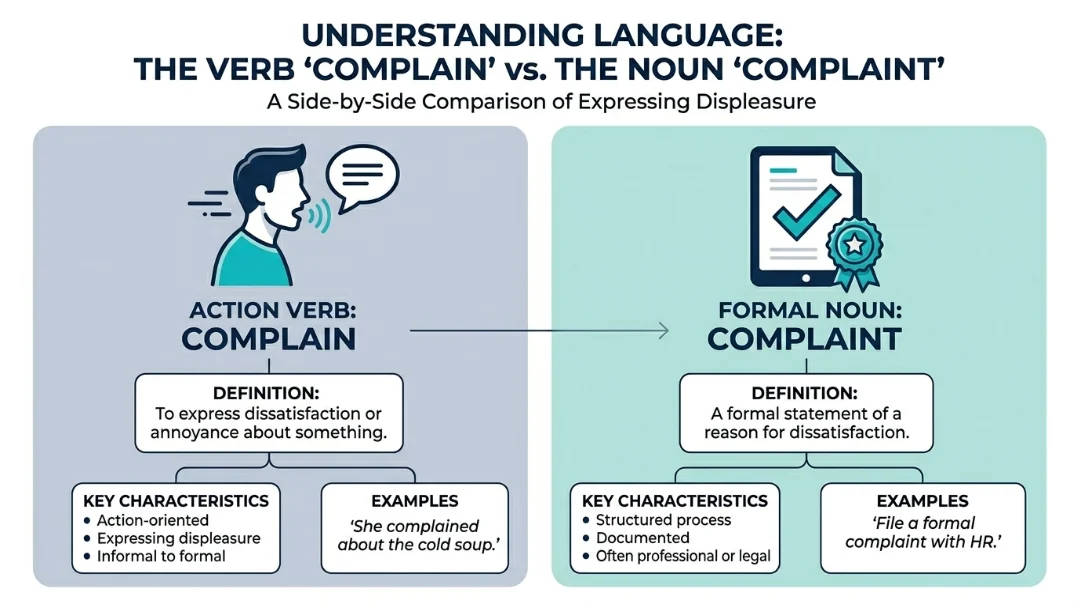
The word complain is a verb that describes the action of expressing dissatisfaction or unhappiness about a situation. In contrast, the word complaint is a noun that represents the actual statement, document, or expression of that dissatisfaction. Understanding whether to use complain or complaint depends entirely on whether your sentence requires an action word or a naming word.
Choosing between complain or complaint stands as one of the most common hurdles in daily business and academic writing. While these two words look nearly identical and share the same core meaning, they belong to entirely different parts of speech. Mixing them up can instantly make an email, a customer service ticket, or a legal document look unprofessional. Therefore, mastering their usage is essential for clear communication.
Many professionals frequently stumble when deciding whether to use the action-oriented form or the object-oriented form. This confusion usually happens because both terms deal with the act of expressing dissatisfaction. However, using the wrong word disrupts the grammatical structure of your sentence and confuses the reader.
Fortunately, the underlying rules governing these terms are straightforward and easy to memorize. By learning a few simple structural patterns, you can permanently eliminate this grammatical error from your writing. This comprehensive guide will walk you through definitions, comparative examples, regional variations, and practical exercises to ensure you always choose the correct term with complete confidence.
Key Takeaway & Summary
The fundamental difference between these two terms rests on their grammatical functions within a sentence structure. Specifically, you must use complain when you need a verb to describe an action that someone is performing. Conversely, you must choose complaint when you need a noun to identify the specific grievance, object, or document itself.
To simplify your writing process, remember that an individual can complain about a bad experience, and their action results in a formal complaint. If you can place the words “a,” “an,” or “the” directly before the term, the noun form is almost certainly the correct choice for that specific sentence.
Definition and Grammatical Explanation
To build a solid foundation, let us look closely at the linguistic definitions and structural roles of both words.
Understanding the Verb Complain
The word complain functions exclusively as a verb. It originates from Old French and Latin roots that mean to lament or beat the breast in grief. In modern English, it means to express discontent, displeasure, resentment, or regret. Because it is a verb, it changes form based on the tense of the sentence and the subject performing the action.
- Present Tense: I complain about the noise. / He complains about the service.
- Past Tense: Yesterday, they complained to the manager.
- Continuous Tense: She is complaining about her current workload.
When you use this verb, it often requires a preposition to connect it to the object of dissatisfaction. The most common prepositions that follow this verb are about, of, and to. For example, you complain to a person about a specific problem.
Understanding the Noun Complaint
The word complaint functions exclusively as a noun. It refers to the actual expression of grief, pain, or dissatisfaction. It can also represent a formal legal document that sets forth the facts and remedies sought in a lawsuit. Because it is a noun, it can be singular or plural, and it can act as the subject or the object of a sentence.
- Singular: The customer filed a formal complaint.
- Plural: The human resources department received multiple complaints this week.
Unlike the verb form, this noun frequently couples with possessive adjectives like my, your, his, or their. It also pairs naturally with verbs of action, such as file, submit, receive, or address.
Advantages and Disadvantages of Expressions
In professional communication, expressing dissatisfaction carries both benefits and risks depending on how you frame your words. Understanding when and how to articulate these points can drastically alter workplace outcomes.
Advantages of Addressing Issues Correctly
When an individual or organization handles a grievance properly, it drives constructive change. In business, a formal submission highlights systemic flaws that management needs to fix immediately. Consequently, this process leads to better products, safer environments, and stronger relationships.
For employees, speaking up about poor conditions prevents burnout and ensures that leadership remains aware of operational challenges. Furthermore, clear documentation protects an individual’s legal rights if a dispute escalates.
Disadvantages of Poorly Framed Objections
Constant verbal venting without a clear goal can quickly destroy team morale and damage your professional reputation. If an employee habitually voices discontent without offering solutions, colleagues may view them as toxic or uncooperative.
Moreover, submitting a poorly written document that confuses the verb and noun forms reduces the credibility of the message. In legal scenarios, failing to structure a grievance correctly can result in the immediate dismissal of a case.
| Grammatical Part | Verb | Noun |
| Core Function | Denotes the active process of voicing a grievance. | Represents the tangible item, statement, or record. |
| Sentence Role | Serves as the action or predicate of the subject. | Serves as the subject, direct object, or object of preposition. |
| Common Placements | Placed directly after pronouns or nouns ($I$, $we$, $they$). | Placed after articles ($a$, $the$) or adjectives ($formal$). |
| Tense Modifications | Changes to complained, complains, or complaining. | Changes only for plurality (complaint to complaints). |
| Typical Context | Used in casual speech and descriptions of active dialogue. | Used in official documentation, customer service, and law. |
Real-World Examples
To solidify your understanding, let us analyze how these words function across various industries. The following scenarios demonstrate proper structural application.
Corporate and Human Resources Context
In a corporate office environment, clear communication prevents misunderstandings among staff members.
Correct Verb Usage: Employees frequently complain about the lack of natural light in the new office space.
Correct Noun Usage: The human resources director reviewed the written complaint regarding workplace safety.
Notice how the verb form describes the active behavior of the employees. On the other hand, the noun form identifies the physical or digital document that the director is reviewing.
Customer Service and Retail Scenarios
Customer support teams handle dozens of customer interactions every single day, making precise language vital.
Correct Verb Usage: Customers will complain if the shipping delays exceed five business days.
Correct Noun Usage: Our support team logged a complaint every time the software crashed during checkout.
If a support agent writes, “The customer wanted to file a complain,” the sentence becomes grammatically broken. The agent must use the noun form because the word follows the verb phrase “to file.”
Legal and Medical Fields
Both the legal system and the healthcare industry rely on highly specific definitions for these terms.
Correct Verb Usage: Patients often complain of lower back pain after sitting for extended periods.
Correct Noun Usage: The plaintiff served the formal complaint to the defendant’s legal representative on Tuesday.
In medicine, the phrase “chief complaint” stands as a standard term for the primary symptom that brings a patient to the doctor. In law, the document that initiates a lawsuit is always called a civil or criminal action document.
Regional and Global Usage
While the underlying grammar rules for these words remain constant around the world, subtle cultural differences shape how people use them.
North American Corporate Culture
In the United States and Canada, business cultures place a heavy emphasis on directness and documented evidence. Consequently, companies encourage consumers and workers to submit a formal complaint whenever a service standard drops. The word is viewed as a standard tool for quality assurance rather than a purely negative attack.
However, actively choosing to complain verbally in a public meeting is often discouraged. North American managers prefer that employees channel their dissatisfaction into structured, written formats.
British and Commonwealth Variations
In the United Kingdom, Australia, and New Zealand, traditional communication styles lean toward understatement and politeness. People in these regions might hesitate to say they want to complain because it sounds overly confrontational. Instead, they might use softer phrases like “raising a concern” or “making an inquiry.”
Despite this polite hesitation, the actual term used for official procedures remains identical to North American English. An official grievance sent to a British utility company or government office is always processed as a formal structure.
Common Mistakes and How to Avoid Them
Even native speakers occasionally make errors when rushing through their writing. Reviewing these common pitfalls will help you keep your prose flawless.
Confusing the Tenses and Endings
The most frequent error involves adding an accidental “$t$” to the end of the verb form when describing a past action.
- Incorrect: He complaint about the cold food to the waiter.
- Correct: He complained about the cold food to the waiter.
Because the sentence describes a past action, you must use the past tense of the verb. Adding a “$t$” to create the noun form and trying to use it as an action word violates basic syntax.
Using the Verb Form Instead of the Noun
Another common mistake occurs when a writer uses the action word immediately after an article or a possessive pronoun.
- Incorrect: We need to address this complain immediately.
- Correct: We need to address this complaint immediately.
The word “this” functions as a demonstrative adjective pointing toward an object. Therefore, it must modify a noun rather than a verb.
The Memory Trick for Perfect Accuracy
To ensure you never mix up these words again, look closely at the spelling of the noun form. The word complaint ends with the letter T. You can think of this T as standing for the word Thing.
Since a noun represents a person, place, or thing, the word with the T at the end is always the noun. If you are describing an action, leave the T off and use the base verb form.
Exercises with Answers
Practicing with real sentences is an excellent way to reinforce your grammatical skills. Complete the following exercises by choosing the correct word.
Part 1: Fill in the Blanks
Select the correct form for each sentence below.
- The tenant decided to __________ to the landlord about the broken heater.
- Management received a written __________ from the marketing department.
- Why do you always __________ about the weekly meetings?
- The customer service representative resolved the __________ in less than ten minutes.
- She has been __________ of severe headaches all morning.
Part 2: Answer Key and Explanations
Review the explanations below to see how well you performed.
- complain — Explanation: The phrase “decided to” requires a base verb to complete the infinitive structure.
- complaint — Explanation: The word follows the indefinite article “a” and the adjective “written,” which means it must be a noun.
- complain — Explanation: The sentence uses the helper verb “do” and describes an action performed by the subject “you.”
- complaint — Explanation: The definite article “the” precedes the word, indicating that it functions as the direct object noun of the verb “resolved.”
- complaining — Explanation: The sentence uses the present perfect continuous tense (“has been”), which requires the participle form of the verb.
Related Concepts and Comparisons
To deepen your understanding of these terms, it helps to compare them with related words in the English language. This contextual look prevents similar errors with other word pairs.
Complain vs. Whine
While both words mean to express dissatisfaction, their tones and professional connotations differ dramatically. To complain often implies that you have a legitimate, objective reason for your displeasure, such as a broken product or an unsafe workspace.
In contrast, to whine implies that a person is venting in a childish, repetitive, or trivial manner without a valid cause. In a professional setting, you should always frame your objections as objective points to avoid sounding like you are whining.
Complaint vs. Critique
Understanding the difference between an objection and a critique is vital for career development. A complaint typically focuses purely on the negative aspects of a situation or the discomfort it causes.
Conversely, a critique offers a balanced, structured, and analytical evaluation of a piece of work or a process. Critiques usually include constructive feedback aimed at helping the recipient improve, whereas an objection simply demands a correction.
Similar Noun-Verb Pairs in English
The structural pattern seen in this keyword pair appears across several other common English words. Recognizing this pattern can improve your overall grammatical accuracy.
- Fly (Verb) vs. Flight (Noun): The birds fly south, completing a long flight.
- Weigh (Verb) vs. Weight (Noun): You must weigh the package to find its total weight.
- Grieve (Verb) vs. Grief (Noun): Families grieve when they experience profound grief.
By noticing how the addition of letters like “t” or “th” transforms verbs into nouns, you can navigate the language more intuitively.
FAQs
Here are clear, actionable answers to the most frequently asked questions regarding these terms.
What is the main difference between complain or complaint?
The primary difference is that complain functions as a verb representing an action, while complaint operates as a noun representing a thing or document. You perform the action to create the object.
Can you use complain as a noun in a professional email?
No, you cannot use it as a noun under any circumstances. If you are referring to a specific issue or document, you must use the noun form with a “t” at the end.
How do you spell the past tense of the verb form?
The correct past tense spelling is complained. Do not add a “t” before the “ed” ending, as that is a frequent spelling error.
What does chief complaint mean when visiting a hospital?
The phrase refers to the primary medical symptom or reason that caused a patient to seek professional medical care in the first place.
What words commonly pair with the noun form in business writing?
Common pairings include verbs like file, submit, lodge, investigate, resolve, and withdraw. It also pairs with adjectives like formal and written.
Is it grammatically correct to say someone is full of complains?
No, that expression is incorrect because you must use the plural noun form. The grammatically correct phrasing is “full of complaints.”
What prepositions should I use after the action verb?
You should use to when identifying the listener, and use about or of when identifying the specific problem or symptom.
Can a corporate complaint be a positive element for a business?
Yes, a documented issue acts as valuable feedback that allows a company to identify operational defects and improve customer satisfaction.
What is a formal civil complaint in a court of law?
It is the initial legal document filed by a plaintiff that explains the legal reasons for a lawsuit and outlines the requested damages.
How can I quickly check if I used the correct word in a sentence?
Try replacing the word with “protest” (verb) or “protestation” (noun). If the sentence requires the action word, use the version without a “t.”
Conclusion
Mastering the distinction between complain or complaint is a simple yet powerful way to elevate the professionalism of your writing. By remembering that the former is an action verb and the latter is a concrete noun, you can easily avoid formatting errors that undermine your credibility.
Whenever you write, pay close attention to the words surrounding your choice. Look for articles, possessive pronouns, and helper verbs to guide your structural decisions. Taking a brief moment to review your sentences ensures your message remains clear, authoritative, and grammatically flawless.