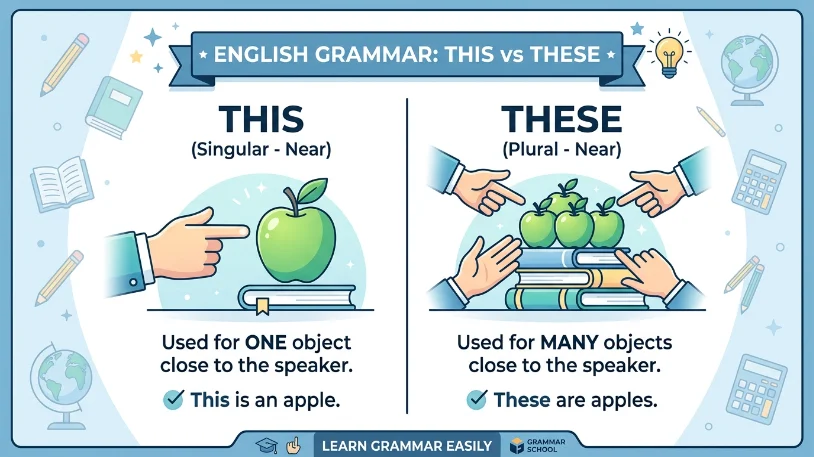
“This” and “these” are demonstrative pronouns and determiners used to point to people, objects, or ideas. Use this when referring to one thing and these when referring to more than one thing. Understanding the difference helps improve grammar, writing clarity, and everyday communication.
English learners often struggle with small words that seem simple but can completely change the meaning of a sentence. One of the most common examples is this or these.
At first glance, the difference looks easy. Many people learn that this is singular and these is plural. While that rule is correct, there is more to understand if you want to speak and write naturally.
Whether you are writing emails, completing school assignments, preparing for exams, or improving your spoken English, knowing when to use this and these is essential.
The good news is that the rule is straightforward. Once you understand how each word works and see enough examples, using them correctly becomes automatic.
This guide explains everything you need to know about this or these, including meanings, grammar rules, examples, common mistakes, exercises, and frequently asked questions.
What Does “This” Mean?
Definition of This
The word this is used to refer to a single person, object, idea, or situation that is near the speaker or writer.
It can function as:
- A demonstrative pronoun
- A demonstrative determiner
Examples of This
- This is my laptop.
- This book belongs to me.
- I like this movie.
- This chair is comfortable.
In each example, only one item is being discussed.
When to Use This
Use this when:
- Referring to one thing
- Talking about something nearby
- Introducing a singular noun
- Referring to a current situation
Examples:
- This apple looks fresh.
- This idea could help our business.
- This is exactly what I needed.
What Does “These” Mean?
Definition of These
The word these is the plural form of this.
It refers to multiple people, objects, ideas, or situations that are near the speaker.
Examples of These
- These are my shoes.
- These books are interesting.
- I bought these flowers today.
- These students passed the exam.
Each sentence refers to more than one thing.
When to Use These
Use these when:
- Referring to multiple items
- Talking about nearby objects
- Introducing plural nouns
- Referring to several ideas or events
Examples:
- These cookies are delicious.
- These documents need approval.
- These lessons are important.
This or These: Quick Comparison
| Feature | This | These |
|---|---|---|
| Number | Singular | Plural |
| Refers To | One thing | More than one thing |
| Demonstrative Type | Pronoun/Determiner | Pronoun/Determiner |
| Example | This car is new. | These cars are new. |
Easy Memory Trick
Think about the letter S.
- ThiS = Singular
- TheSe = Several
This simple trick helps many learners remember the difference.
How This and These Work in Grammar
As Demonstrative Determiners
When placed before nouns:
This
- This phone
- This computer
- This shirt
These
- These phones
- These computers
- These shirts
As Demonstrative Pronouns
When replacing nouns:
This
- This is amazing.
- This belongs to me.
These
- These are expensive.
- These look great.
Real World Examples of This or These
At a Store
Singular item:
- This jacket looks good.
Multiple items:
- These jackets look good.
In a Classroom
Singular object:
- This pen is mine.
Plural objects:
- These pens are mine.
In Business Communication
Singular document:
- Please review this report.
Plural documents:
- Please review these reports.
In Everyday Conversation
- This restaurant is excellent.
- These restaurants are excellent.
This or These in Questions
Using This in Questions
Examples:
- What is this?
- Is this your phone?
- Who gave you this?
Using These in Questions
Examples:
- What are these?
- Are these your keys?
- Who owns these books?
Notice that the verb changes:
- This is
- These are
This or These with Uncountable Nouns
Using This
Uncountable nouns are generally singular.
Examples:
- This water is cold.
- This information is helpful.
- This advice is useful.
Why These Usually Doesn’t Work
Incorrect:
- These information are useful.
Correct:
- This information is useful.
Information is uncountable, so it remains singular.
Common Mistakes with This or These
Using This with Plural Nouns
Incorrect:
- This books are interesting.
Correct:
- These books are interesting.
Using These with Singular Nouns
Incorrect:
- These car is expensive.
Correct:
- This car is expensive.
Forgetting Subject Verb Agreement
Incorrect:
- These is my shoes.
Correct:
- These are my shoes.
Using These with Uncountable Nouns
Incorrect:
- These advice helped me.
Correct:
- This advice helped me.
This vs These vs That vs Those
Understanding the Full Demonstrative Family
| Word | Singular/Plural | Near/Far |
|---|---|---|
| This | Singular | Near |
| These | Plural | Near |
| That | Singular | Far |
| Those | Plural | Far |
Examples:
- This book is mine.
- These books are mine.
- That book is yours.
- Those books are yours.
Distance Matters
Near:
- This chair
- These chairs
Far:
- That chair
- Those chairs
Why Learning This or These Matters
Better Writing
Correct grammar makes writing easier to understand.
Better Speaking
Using the right word helps you sound more natural.
Better Exam Scores
Grammar questions involving demonstratives frequently appear in:
- IELTS
- TOEFL
- School exams
- English proficiency tests
Better Professional Communication
Correct grammar creates a more professional impression in emails, reports, and presentations.
Practice Exercises
Exercise 1
___ laptop belongs to Sarah.
Answer: This
Exercise 2
___ laptops belong to Sarah.
Answer: These
Exercise 3
___ flowers smell wonderful.
Answer: These
Exercise 4
Choose the correct word.
___ flower smells wonderful.
Answer: This
Exercise 5
Correct the sentence.
These car is new.
Answer:
This car is new.
Exercise 6
Correct the sentence.
This books are expensive.
Answer:
These books are expensive.
Advanced Usage of This and These
Referring to Ideas
This and these can refer to concepts rather than physical objects.
Examples:
- This is an important point.
- These are common challenges.
Referring to Previous Statements
Example:
The company increased sales by 30%. This was unexpected.
Here, this refers to the entire previous statement.
Referring to Multiple Previous Points
Example:
Higher costs, slower production, and staffing issues occurred. These affected profits.
Here, these refers to multiple issues.
Frequently Asked Questions
What is the difference between this and these?
This refers to one thing, while these refers to more than one thing.
Can I use this for plural nouns?
No. Use these for plural nouns.
Can I use these for singular nouns?
No. Use this for singular nouns.
Is these the plural of this?
Yes. These is the plural form of this.
How do I remember this or these?
Remember: This = one item. These = many items.
Can this and these be pronouns?
Yes. They can replace nouns in a sentence.
Can this and these be determiners?
Yes. They can appear before nouns.
Why is ‘these information’ incorrect?
Information is uncountable and singular, so use this information.
Which is correct: these is or these are?
These are is correct because these is plural.
How can I improve using this or these?
Practice reading, writing, and speaking with singular and plural nouns daily.
Conclusion
Understanding this or these is one of the simplest but most important grammar skills in English. The rule is straightforward: use this for one person, thing, idea, or object, and use these for more than one.
While the concept appears basic, many learners still make mistakes when matching singular and plural nouns or choosing the correct verb. By learning the core rule, practicing with examples, and avoiding common errors, you can improve both your writing and speaking quickly.
Whenever you are unsure, ask yourself one question: Am I talking about one thing or several things? If the answer is one, use this. If the answer is more than one, use these.
Mastering this small grammar point will make your communication clearer, more natural, and more professional.