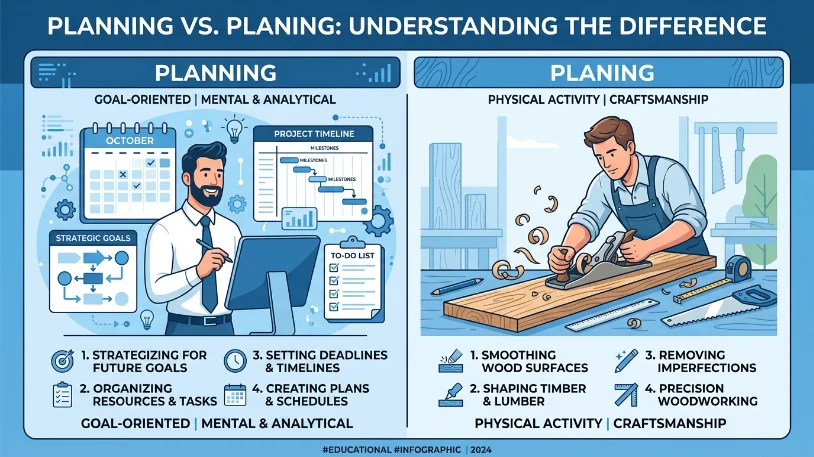
Planning is the correct spelling in almost all everyday and professional situations. It refers to the process of organizing, preparing, or making arrangements for future actions. Planing, on the other hand, is a specialized woodworking term that means smoothing or shaping a surface with a plane. If you’re writing about business planning, project planning, financial planning, event planning, or personal planning, the correct word is planning.
Many English learners and even native speakers get confused between planing or planning. At first glance, the two words look almost identical. The only difference is one extra letter, yet that small difference completely changes the meaning.
This spelling confusion often appears when writing emails, reports, blog posts, assignments, and business documents. Someone may write “project planing” or “business planing” without realizing that the word is actually incorrect in that context.
Understanding the difference between planing or planning is important because using the wrong spelling can affect professionalism and clarity. In academic writing, business communication, and SEO content, spelling accuracy matters.
In this guide, you’ll learn the meaning of both words, why the confusion happens, where each term is used, and how to remember the correct spelling easily. By the end, you’ll never wonder whether to write planing or planning again.
Planing or Planning?
Which One Is Correct?
In most situations, planning is correct.
Examples:
✔ Planning a vacation
✔ Planning a business strategy
✔ Planning a wedding
✔ Planning for retirement
✔ Project planning
The word planing is correct only in specific technical fields, especially woodworking and manufacturing.
Examples:
✔ Planing a wooden board
✔ Surface planing in construction
✔ Metal planing in machining
For everyday writing, you almost always need planning.
What Does Planning Mean?
Definition of Planning
Planning is the process of deciding in advance what actions need to be taken to achieve a goal.
It involves:
- Setting objectives
- Organizing resources
- Creating timelines
- Preparing for future events
- Managing risks
Planning helps people and organizations move from an idea to successful execution.
Examples of Planning
- Planning a new business
- Planning a family trip
- Planning a marketing campaign
- Planning a construction project
- Planning monthly expenses
In each example, planning means preparing for future actions.
What Does Planing Mean?
Definition of Planing
Planing is a technical term that refers to smoothing, shaping, or leveling a surface using a tool called a plane.
It is commonly used in:
- Woodworking
- Carpentry
- Manufacturing
- Engineering
- Metalworking
Examples of Planing
- The carpenter is planing the wood.
- Planing creates a smooth wooden surface.
- The technician completed the metal planing process.
In these cases, planing has nothing to do with preparation or organization.
Why People Confuse Planing and Planning
Similar Appearance
The words differ by only one letter.
- Planing
- Planning
Because they look nearly identical, many writers accidentally choose the wrong version.
Pronunciation Similarity
When spoken quickly, the words sound very similar.
This causes people to rely on memory instead of understanding the actual meaning.
Spell Check Limitations
Many spelling tools won’t catch the mistake because both words are legitimate English words.
For example:
❌ Project planing is important.
The spelling checker may not flag “planing” because it exists as a real word.
Grammar Rule Behind Planning
Why Does Planning Have Double “N”?
The base word is:
Plan
When adding “-ing” to a short verb ending in a consonant, English often doubles the final consonant.
Examples:
| Base Word | Correct Form |
|---|---|
| Run | Running |
| Sit | Sitting |
| Stop | Stopping |
| Plan | Planning |
Therefore:
Plan + ing = Planning
Not Planing
Common Uses of Planning
Business Planning
Business planning helps companies define goals, strategies, and growth opportunities.
Examples:
- Startup planning
- Strategic planning
- Financial planning
- Operational planning
Good planning reduces uncertainty and improves decision-making.
Project Planning
Project planning involves organizing tasks, timelines, budgets, and resources before work begins.
Key components include:
- Scope definition
- Budget estimates
- Team allocation
- Risk management
Without proper planning, projects often experience delays and cost overruns.
Financial Planning
Financial planning helps individuals and organizations manage money effectively.
Areas include:
- Savings plans
- Retirement plans
- Investment strategies
- Tax preparation
Effective planning supports long-term financial stability.
Event Planning
Event planning covers the organization of:
- Weddings
- Conferences
- Corporate events
- Birthday celebrations
Successful events depend heavily on detailed planning.
Where Is Planing Commonly Used?
Woodworking
The most common use of planing is in woodworking.
A carpenter uses a plane to:
- Remove rough surfaces
- Flatten wood
- Create smooth finishes
Manufacturing
In industrial settings, planing is used to shape materials precisely.
Examples include:
- Metal planing
- Surface planing
- Mechanical planing
Construction
Builders may use planing techniques to prepare materials before installation.
Planning vs Planing Comparison Table
| Feature | Planning | Planing |
|---|---|---|
| Meaning | Organizing future actions | Smoothing a surface |
| Common Usage | Everyday English | Technical fields |
| Business Use | Yes | No |
| Education Use | Yes | Rare |
| Project Management | Yes | No |
| Woodworking | No | Yes |
| SEO Keyword Usage | High | Low |
| Common Spelling Error | Often confused with planing | Often mistaken for planning |
Advantages of Good Planning
Better Time Management
Planning helps prioritize tasks and reduce wasted time.
Improved Decision Making
A clear plan provides direction when making choices.
Reduced Stress
People feel more confident when they know what comes next.
Increased Productivity
Planning allows resources to be used more efficiently.
Better Goal Achievement
Goals become easier to achieve when broken into planned steps.
Disadvantages of Poor Planning
Missed Deadlines
Lack of planning often results in delays.
Budget Problems
Unexpected expenses become more likely.
Confusion Among Teams
Without planning, responsibilities become unclear.
Increased Risk
Poor planning can lead to avoidable mistakes and losses.
Real World Examples
Example One: Business Startup
A new entrepreneur wants to launch an online store.
Good planning includes:
- Market research
- Budget creation
- Product sourcing
- Marketing strategy
Without planning, the business may struggle from the beginning.
Example Two: Home Renovation
Before remodeling a house, homeowners often create a detailed planning checklist.
This includes:
- Budget estimates
- Material selection
- Contractor scheduling
- Timeline management
Example Three: Woodworking Project
A carpenter is building a dining table.
Before assembly, the wood requires planing to create smooth and level surfaces.
This is a perfect example of the correct use of “planing.”
Regional and Global Usage
Planning Around the World
The term planning is universally used in:
- Business
- Government
- Education
- Healthcare
- Construction
Countries across the world use planning in the same way.
Planing in Specialized Industries
Planing remains a technical term used primarily by:
- Carpenters
- Engineers
- Machinists
- Manufacturing professionals
Most people will rarely use the word planing in daily conversation.
Common Mistakes and Corrections
Mistake One
❌ Business planing is essential.
✔ Business planning is essential.
Mistake Two
❌ Project planing helps teams stay organized.
✔ Project planning helps teams stay organized.
Mistake Three
❌ Financial planing reduces risks.
✔ Financial planning reduces risks.
Mistake Four
❌ The carpenter was planning the wood.
✔ The carpenter was planing the wood.
Exercises with Answers
Exercise 1
The company is ______ its annual budget.
Answer: Planning
Exercise 2
The carpenter is ______ the wooden board.
Answer: Planing
Exercise 3
Choose the correct word:
Good ______ improves project success.
Answer: Planning
Exercise 4
Choose the correct word:
The worker completed the metal ______ process.
Answer: Planing
Exercise 5
Which word is used in business management?
Answer: Planning
Related Concepts and Comparisons
Planning vs Strategy
Planning focuses on how goals will be achieved.
Strategy focuses on why and where resources should be directed.
Planning vs Scheduling
Planning determines what should happen.
Scheduling determines when it should happen.
Planning vs Forecasting
Planning creates actions.
Forecasting predicts future outcomes.
Planning vs Goal Setting
Goal setting defines the destination.
Planning creates the roadmap.
FAQs
Is planning or planing the correct spelling?
Planning is correct for almost all everyday situations involving preparation, organization, and future actions.
Why is planning spelled with two N’s?
The final consonant in “plan” is doubled before adding “-ing,” creating the correct form: planning.
What does planing mean?
Planing refers to smoothing or shaping a surface, usually wood or metal, using a plane.
Can I use planing for project management?
No. Project planning is the correct term.
Is business planing correct?
No. The correct phrase is business planning.
What is strategic planning?
Strategic planning is the process of setting long-term goals and determining how to achieve them.
Why do people confuse planing and planning?
The words look similar and sound alike, making spelling mistakes common.
Is planing a real word?
Yes. It is a legitimate English word used in woodworking and manufacturing.
Which spelling should students use?
Students should use planning unless discussing woodworking or engineering processes.
How can I remember the difference?
If you’re talking about goals, projects, events, or business, use planning. If you’re smoothing wood or metal, use planing.
Conclusion
The debate between planing or planning is actually simple once you understand the meanings. Planning refers to preparing, organizing, and managing future actions. It is the correct choice for business, education, projects, finance, events, and everyday communication.
Planing, however, is a specialized technical term used mainly in woodworking, carpentry, engineering, and manufacturing. It describes the process of smoothing or shaping surfaces using a plane.
For most writers, students, professionals, and website owners, the word you need is almost always planning. Remember the simple rule: if you’re organizing something for the future, use planning. If you’re shaping wood or metal, use planing.
Using the correct spelling improves professionalism, avoids confusion, and helps ensure your content is accurate and trustworthy. When in doubt, think about the context, and the right choice becomes obvious.