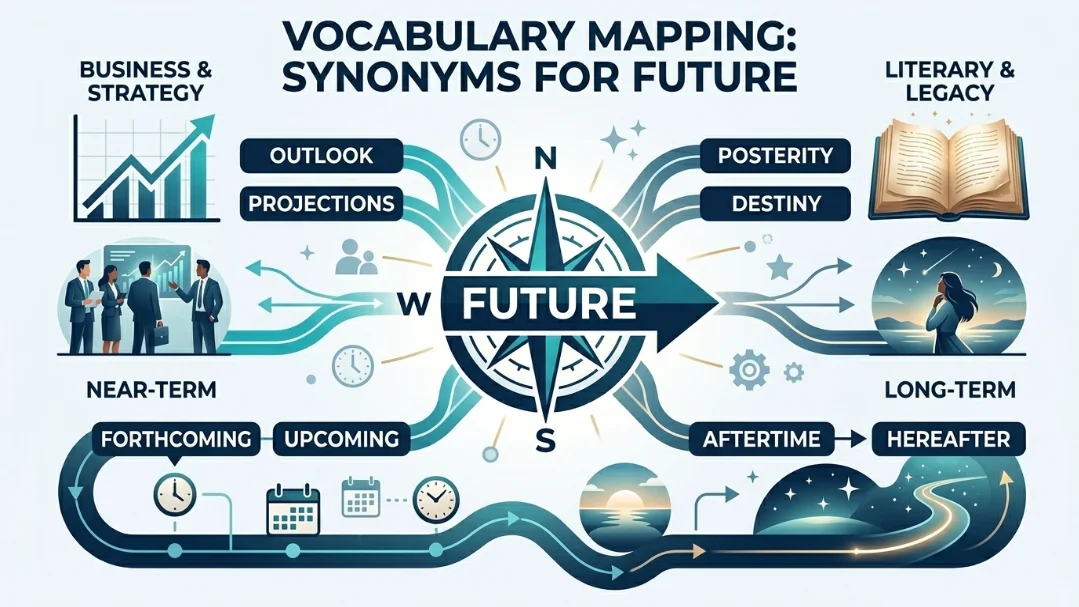
Whether you are mapping out a corporate roadmap, writing a science fiction short story, or drafting an academic essay on economic trends, repeating the word “future” can quickly make your prose feel repetitive.
Fortunately, English offers a vast landscape of alternatives. Finding the right synonyms for future can spark more imagination or inject clinical professionalism into your work. The ideal choice always hinges on your specific timeline, tone, context, and intent.
Choosing the precise word ensures your audience visualizes exactly the horizon you intend to show them.
Best Synonyms for Future
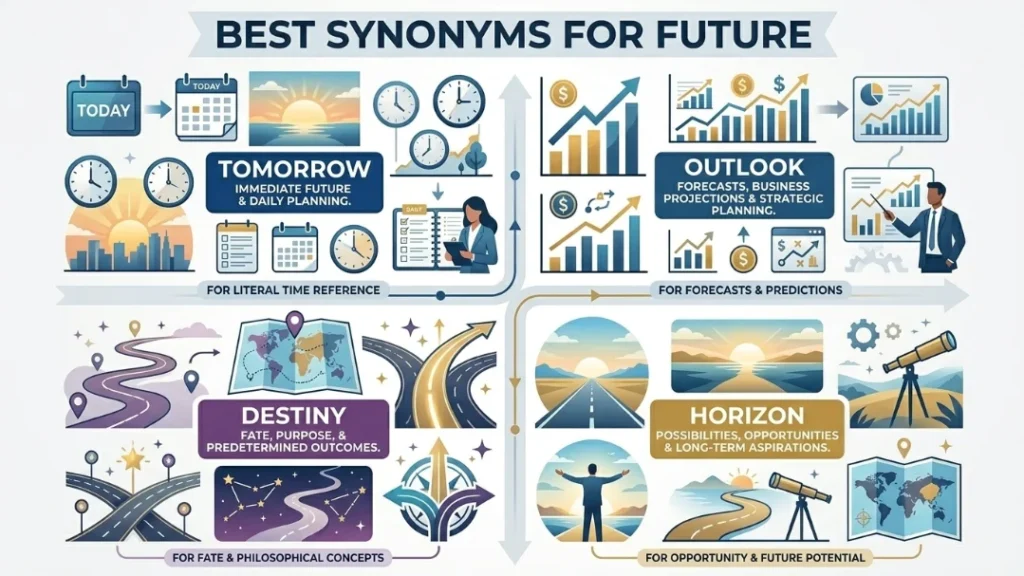
The best synonyms for future are tomorrow, outlook, destiny, and horizon. The ultimate choice depends heavily on whether you are talking about literal time, a financial forecast, or a poetic fate.
What Does Future Mean?
The word future can function as both a noun and an adjective. As a noun, it refers to time that is still to come, or a prospect of success or advancement. As an adjective, it describes something existing or happening in the time to come.
- Core Idea: The unwritten timeline occurring after the present moment.
- Part of Speech: Noun (singular) or Adjective.
- Common Usage: Universally applied in grammar (future tense), financial planning (futures market), tech development, and everyday conversations about life goals.
Example Sentence 1 (Noun): We need to preserve our planet’s resources for the sake of the future.
Example Sentence 2 (Adjective): The contract outlines responsibilities for all future business partners.
Core Meaning of Future
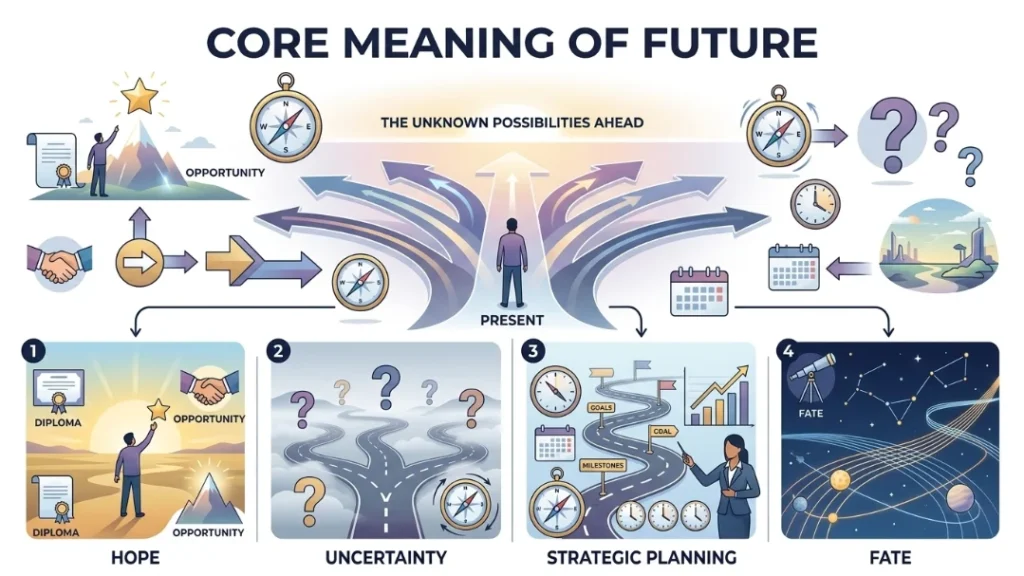
At its core, future represents potentiality and anticipation. It is the blank slate of time. Depending on how it is framed, it can evoke feelings of hope, uncertainty, strategic planning, or fate. It is the destination toward which all current actions drift.
Grammar and Usage Notes
Because future functions fluidly as two different parts of speech, its sentence mechanics matter:
- Common Sentence Patterns: “In the near future,” “planning for the future,” or “shaping a brighter future.”
- Common Phrases: “Future-proof” (designing something so it won’t become obsolete) or “foreseeable future” (the time period that can be reasonably predicted).
- When it sounds natural: It sounds perfectly organic when used broadly to indicate any point after “now.”
- When a synonym works better: In executive summaries, using future can sometimes sound vague. Swapping it out for outlook or subsequent quarters adds a sharp edge of professional data precision.
Best Synonyms for Future
The table below breaks down the top alternatives to help you choose the right word instantly.
| Synonym | Meaning | Tone | Best Use Case | Example Sentence |
| Tomorrow | The literal next day, or a general term for the coming era. | Warm / Accessible | Inspiring copy, standard speech | We are building a cleaner tomorrow through solar innovation. |
| Outlook | The mathematical or circumstantial prediction of what lies ahead. | Professional | Financial and business reporting | The economic outlook remains highly favorable for small tech firms. |
| Horizon | The limit of what can be seen or predicted; the coming future. | Visionary / Visual | Strategic planning, creative writing | Artificial intelligence opens up a brand new horizon for art. |
| Destiny | The events that will necessarily happen to a person or thing. | Dramatic / Poetic | Storytelling, speeches | The young prince was ready to fulfill his historic destiny. |
| Aftertime | A later or subsequent time period. | Literary / Formal | Historical or reflective essays | Their radical ideas would only be fully understood in the aftertime. |
Common Synonyms for Future
These are everyday words you can use in normal writing and conversation to keep your language fresh.
Tomorrow
While it literally means the day after today, it is frequently used as a metaphor for the broader time ahead.
- Best Context: Motivational speeches, community organizing, or general conversation.
- Example: “The choices we make today will directly shape the world of tomorrow.”
The Road Ahead
A idiomatic phrase that frames the coming days as a physical path or journey.
- Best Context: Casual business updates, team check-ins, or personal letters.
- Example: “There might be a few twists on the road ahead, but we are fully prepared.”
Days to Come
A soft, chronological phrase indicating any time period ahead.
- Best Context: Narrative prose, casual farewells, or personal reflections.
- Example: “We will closely monitor his medical progress over the days to come.”
Formal Synonyms for Future
When writing an essay, a corporate brief, or a legal document, you want words that sound polished, analytical, and objective.
Posterity
This noun refers specifically to all future generations of people.
- Best Context: Legal documentation, environmental policy, or historical non-fiction.
- Example: “The ancient monuments were carefully preserved for posterity.”
Subsequent
An adjective used to describe something coming after something else in time.
- Best Context: Scientific papers, legal arguments, or timeline descriptions.
- Example: “The initial experiment failed, but subsequent trials yielded excellent data.”
Forthcoming
An adjective that means happening or appearing soon.
- Best Context: Publishing announcements, academic schedules, or business calendars.
- Example: “Details regarding the merger will be highlighted in the forthcoming report.”
Informal Synonyms for Future
If you are writing a casual blog post, dialogue for a screenplay, or messaging a peer, lean into these conversational variants.
Down the Line
A relaxed phrase that points to an unspecified point down the road.
- Best Context: Casual work meetings, brainstorming sessions, or friendly chats.
- Example: “We don’t need to worry about that feature now; we can add it down the line.”
Later On
A simple, highly conversational time marker.
- Best Context: Everyday speech and texting.
- Example: “I’m busy right now, but I will give you a call later on.”
The Next Chapter
A narrative idiom framing the future as a fresh section of a book.
- Best Context: Retirement cards, graduation speeches, or lifestyle blogging.
- Example: “Moving to New York marks the exciting next chapter of her life.”
Strong Synonyms for Future
Use these heavy-hitting, epic, or cinematic words when the future you are describing carries immense weight or scope.
Destiny
This implies a fixed, unalterable future that has been preordained by fate.
- Best Context: Drama, historical biographies, or high-stakes speeches.
- Example: “She felt it was her true destiny to lead the research institute.”
The Abyss of Time
A poetic, slightly dark phrase that emphasizes the massive, unknowable expanse of deep time.
- Best Context: Creative writing, high fantasy, or philosophical texts.
- Example: “Ancient civilizations crumbled, lost forever down the abyss of time.”
Horizon
When used with strong adjectives, it evokes an expansive, limitless landscape of upcoming time.
- Best Context: Tech keynotes, product launches, or visionary thought-leadership.
- Example: “Quantum computing represents a massive, paradigm-shifting horizon.”
Mild Synonyms for Future
If you want to describe the future in a grounded, measured, or low-stakes manner, use these terms.
Proximity
While it means closeness in space or time, “in close proximity” can softly signify a very near future.
- Best Context: Formal announcements or project tracking.
- Example: “The project completion date is moving into comfortable proximity.”
Anticipated Timeline
A clinical phrase that strips away the mystique of the future and treats it like an expected calendar.
- Best Context: Project management or corporate roadmaps.
- Example: “According to our anticipated timeline, development wraps up in August.”
Prospective
An adjective that means expected or expecting to be something in the future. It is mild and practical.
- Best Context: B2B marketing or university admissions.
- Example: “The university hosted an open house orientation for prospective students.”
Synonyms for Future by Context
Using the right word depends entirely on the sandbox you are playing in. Here is how to map your choices across different writing fields.
Professional & Corporate Writing
In business, “the future” can sound like a pipe dream. Executives prefer words that imply calculated forecasting.
- Best Choices: Outlook, fiscal pipeline, projections, subsequent quarters.
- Why: These terms signal that your view of the future is backed by data, research, and concrete planning rather than wishful thinking.
Creative Writing & Sci-Fi
Fiction writers need texture and worldbuilding. They avoid clinical terms.
- Best Choices: The hereafter, days to come, destiny, offing.
- Why: These words evoke an atmosphere of mystery, adventure, or inevitability that grounds the setting.
Environmental & Political Advocacy
When rallying people around a cause, you need words that evoke responsibility, legacy, and inheritance.
- Best Choices: Posterity, tomorrow, the horizon, future generations.
- Why: These terms remind the reader that the future is populated by real people who will inherit the consequences of today’s actions.
Another Word for Future in a Sentence
Here is a list of practical example sentences showing how you can seamlessly swap out the word future depending on what you want to emphasize.
- Using Tomorrow: “We must invest heavily in green energy to protect the world of tomorrow.”
- Using Outlook: “Due to supply chain issues, the near-term financial outlook is uncertain.”
- Using Horizon: “New space exploration missions are appearing on the scientific horizon.”
- Using Posterity: “The historical letters were carefully digitized and saved for posterity.”
- Using Subsequent: “Her first book was popular, but subsequent releases broke sales records.”
- Using Forthcoming: “A full list of speakers will be published in the forthcoming newsletter.”
- Using Down the Line: “Investing in durable machinery now will save us thousands of dollars down the line.”
- Using Destiny: “He believed it was his destiny to inherit the family vineyard.”
- Using Prospective: “The real estate agent showed the modern apartment to three prospective buyers.”
- Using In Store: “No one truly knows what surprises fate has in store for us.”
- Using Offing: “Major changes to our company healthcare package are currently in the offing.”
- Using Later On: “We can handle the basic installation now and worry about aesthetics later on.”
Future Synonyms Compared
Sometimes words look identical on paper but carry completely different weight. Let’s compare a few close relatives.
Future vs. Outlook
The future is the raw time that has yet to happen. An outlook is a specific, calculation-based interpretation or prediction of how that time will look based on current trends.
Destiny vs. Fate
While both imply a fixed future, destiny usually carries a positive, triumphant connotation (e.g., fulfilling your destiny). Fate often carries a passive or negative connotation (e.g., accepting a grim fate).
Posterity vs. Descendants
Descendants refers strictly to your direct bloodline (children, grandchildren). Posterity is a much larger, formal umbrella term for all future people who will occupy the planet after you are gone.
Words Similar to Future
These words are closely related to the concept of the future, but they aren’t exact substitutes. Use them when you need to specify a exact type of upcoming event.
- Projections: An estimate or forecast of a future situation based on a study of present trends. (Use this for business charts).
- Precursors: A person or thing that comes before another of the same kind; a forerunner. (Use this to describe present events that hint at what the future holds).
- Imminent: About to happen at any second. (Unlike “future,” which can be thousands of years away, imminent means it is happening almost immediately).
Antonyms of Future
If you want to describe time that has already ticked away, use these past-focused terms.
- Past: The time or a period of time before the moment of speaking or writing.
- Example: “We can learn invaluable lessons from studying the mistakes of the past.”
- History: The whole series of past events connected with someone or something.
- Example: “The old theater is packed with a rich history of artistic performance.”
- Antiquity: The ancient past, especially the period before the Middle Ages.
- Example: “The museum is filled with beautiful artifacts recovered from classical antiquity.”
How to Choose the Right Synonym for Future
To keep your writing smooth and natural, follow this simple checklist before choosing an alternative:
- Measure the Distance: Are you talking about next week (forthcoming), next year (down the line), or a century from now (posterity)?
- Identify the Vibe: Is your writing scientific (subsequent), business-oriented (outlook), or deeply emotional (tomorrow)?
- Check the Part of Speech: Make sure you aren’t accidentally trying to plug an adjective into a noun slot. (e.g., “The prospective looks bright” does not work; “The outlook looks bright” does).
Common Mistakes When Using Synonyms for Future
- Using “Destiny” for Mundane Items: Saying “It is the destiny of this code patch to fix the bug” sounds overly dramatic. Use intended purpose or goal instead.
- Confusing “Subsequent” with “Consequent”: Subsequent means happening after. Consequent means happening as a direct result of something.
- Overusing “In the Offing”: This is an old nautical term meaning “visible from the shore.” While cool, overusing it in modern tech settings can make your phrasing sound dated.
Quick Synonym List for Future
Keep this clean, grouped list handy for your next writing project:
- Common: Tomorrow, Horizon, Days to come, The road ahead, Later on.
- Formal: Posterity, Subsequent, Forthcoming, Expected timeline, Aftertime.
- Informal: Down the line, Next chapter, In store, In the cards.
- Strong: Destiny, Fate, The hereafter, Uncharted waters.
- Mild: Outlook, Prospective, Approaching, Near-term.
FAQs
What is the best synonym for future?
The most reliable, adaptable synonym for future is tomorrow for inspirational writing, and outlook or horizon for professional environments.
What is another word for future generations?
The most accurate formal word for future generations is posterity.
What is a formal adjective for future?
Excellent formal adjectives include subsequent (happening after) and prospective (likely to happen or become).
Can I use “down the line” in a formal business presentation?
It is acceptable in spoken presentations with colleagues, but should be replaced by “in future quarters” or “long-term strategy” in formal written reports to clients.
What is the difference between future and horizon?
“Future” is the literal time period ahead. “Horizon” is a figurative term for the boundary of what we can currently anticipate or see coming down the line.
What is the opposite of future?
The direct antonyms of future are past, history, and yesterday.
Conclusion
Refreshing your vocabulary keeps your content dynamic and highly readable. While the word “future” is an excellent anchor term, sprinkling in nuanced alternatives like outlook, posterity, or horizon gives your prose an immediate upgrade. Always align your synonym selection with your specific timeline and target audience, and your writing will maintain a polished, engaging, and thoroughly human flow.