The word “you” is one of the most heavily used words in the English language. As the standard second-person pronoun, it handles an incredible amount of linguistic heavy lifting. We use it to text our friends, address an audience, or talk directly to a coworker.
However, because English lacks a built-in distinction between a singular “you” and a plural “you,” and because formal or academic writing often strictly forbids addressing the reader directly, finding synonyms for you can be a unique challenge. The best alternative depends entirely on who you are talking to, how many people are in the room, and how formal your text needs to be.
Best Synonyms for You
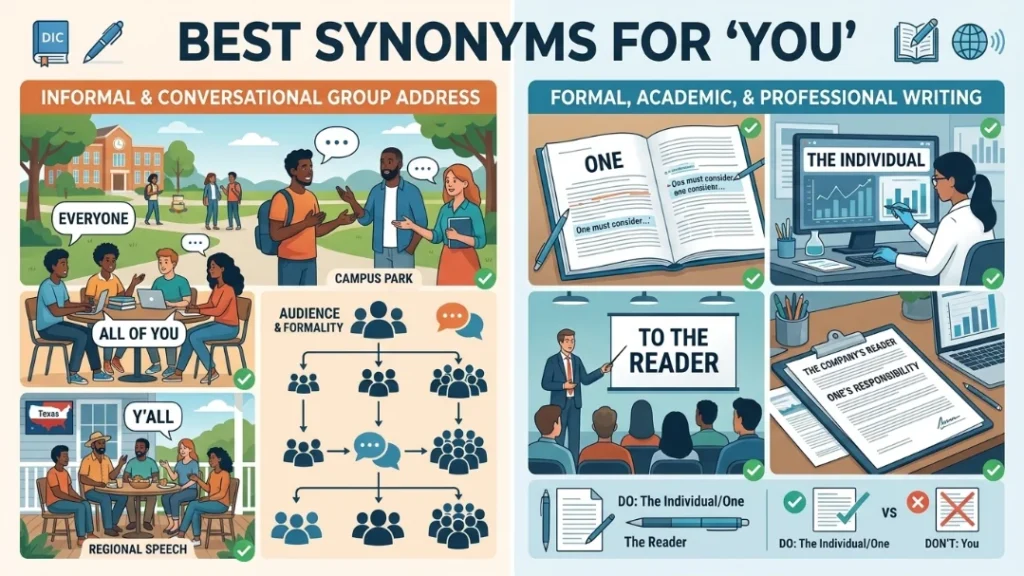
The best synonyms for “you” depend heavily on context. For addressing groups, use everyone, all of you, or y’all. In formal or academic writing where direct address is restricted, “you” is typically replaced by one, the reader, or the individual.
What Does “You” Mean?
In English grammar, “you” is the second-person pronoun used to represent the person or people being directly addressed by a speaker or writer.
- Core Idea: A direct linguistic pointer to the listener or audience.
- Part of Speech: Personal Pronoun (both singular and plural, nominative and objective case).
- Common Usage: Used seamlessly in daily conversation, instructional writing, marketing, and direct dialogue.
Example: If you want to master a new language, you must practice every single day.
Core Meaning of “You”

The core purpose of “you” is to create an immediate path of communication between the creator of a message and its recipient. It personalizes a sentence, pulling the reader or listener directly into the context of the statement.
Grammar and Usage Notes
Unlike many other modern languages (such as Spanish with tú and usted, or French with tu and vous), modern English uses “you” for both a single person and a massive crowd.
- The Essay Rule: In formal academic or scientific essays, using “you” is generally considered too informal or conversational. Writers must swap “you” for third-person constructions.
- Verb Agreement: Even when “you” refers to a single person, it always takes a plural verb form (e.g., you are, never you is).
Best Synonyms for “You”
The table below categorizes the most effective ways to replace or shift the pronoun “you” depending on your target audience.
| Synonym / Alternative | Grammatical Category | Tone | Best Use Case | Example Sentence |
| One | Indefinite Pronoun | Formal / Academic | Stating general truths or rules without addressing the reader directly. | One must carefully weigh the evidence before drawing a conclusion. |
| Everyone | Indefinite Pronoun | Neutral | Addressing a whole room or collective group clearly. | I want to thank everyone for attending today’s workshop. |
| The reader | Noun Phrase | Academic / Literary | Analyzing text or media without breaking the third-person barrier. | This tragic twist leaves the reader feeling deeply unsettled. |
| Yourself | Reflexive Pronoun | Neutral | Used when the subject of the sentence and the object are both “you.” | You need to give yourself some credit for this massive achievement. |
| Y’all | Contraction (Regional) | Informal | Casual, warm address to a group of two or more people. | What are y’all planning to do over the summer weekend? |
Common Synonyms for “You” (Group Address)
Because English does not have a distinct standard word for a plural “you,” native speakers have invented several everyday alternatives to address crowds.
All of you
- Meaning: The entire group being addressed, without exception.
- Best Context: Work meetings, classrooms, or family gatherings.
- Example: I need all of you to turn in your reports by Friday afternoon.
Everyone / Everybody
- Meaning: Every single person currently listening or reading.
- Best Context: Speeches, emails to a team, or public announcements.
- Example: I hope everyone has a safe and happy holiday season.
You guys
- Meaning: A gender-neutral, conversational plural form of address used widely across North America.
- Best Context: Casual conversations among friends, peers, or familiar coworkers.
- Example: Hey, what time are you guys heading over to the restaurant?
Formal Synonyms for “You” (Academic Workarounds)
If a professor or editor marks your essay with “Avoid second person” or “Do not use ‘you’,” you cannot simply drop in a flat synonym. You must reframe the sentence using third-person nouns.
One
- Meaning: Any typical person or hypothetical individual.
- Best Context: Formal philosophy, academic papers, and traditional formal essays.
- Example: By studying historical economic cycles, one can better understand modern inflation.
The individual
- Meaning: A single human being, viewed separately from a group.
- Best Context: Psychology papers, legal briefs, or sociology reports.
- Example: The tax structure dictates how much a citizen owes based on what the individual earns.
The user
- Meaning: The person actively interacting with a system, piece of software, or machine.
- Best Context: Technical writing, software manuals, and UI/UX design documentation.
- Example: Once the app launches, the user is prompted to create a secure password.
Informal Synonyms for “You”
These are highly casual, regional, or slang variations used to address people in informal, spoken English.
You lot
- Meaning: A collective group of people (predominantly British, Australian, and Irish slang).
- Best Context: Casual, sometimes slightly playful or exasperated speech among familiar parties.
- Example: What are you lot whispering about over in the corner?
Yous / Youse
- Meaning: A regional phonetic plural of “you” found in parts of the UK, Australia, New Zealand, and certain US cities like Boston and Philadelphia.
- Best Context: Deeply informal, localized street conversation.
- Example: Are yous coming down to the game tonight or staying home?
Folks
- Meaning: A friendly, inclusive way to address a group of people.
- Best Context: Southern US speech, casual business greetings, or warm community introductions.
- Example: Well, folks, that brings us to the end of tonight’s presentation.
Strong & Mild Synonyms for “You”
Because “you” is a neutral structural pronoun, it doesn’t have variations in “emotional intensity” the way a verb or adjective does. Instead, its intensity changes based on how specific or broad your substitute word is.
Specific / Direct (Stronger)
When you want to pinpoint a specific person’s role or identity rather than a vague “you.”
- The Candidate: Used in hiring contexts. (We will evaluate what the candidate brings to the firm.)
- The Patient: Used in medical analysis. (The treatment options depend entirely on what the patient prefers.)
Broad / Generic (Milder)
When you want to dilute a statement so it applies to humanity as a whole rather than a specific listener.
- People: (When people face adversity, they tend to adapt.)
- Society: (Modern life forces society to process data at an exhausting rate.)
Another Word for “You” in a Sentence
Here are realistic examples showing how to replace “you” across various writing settings:
- In this chapter, the reader discovers the dark secret behind the family’s wealth.
- When navigating deep grief, one often finds comfort in community support.
- We invite all attendees to join us in the main lobby for refreshments.
- The instructions explain how the operator should clear a paper jam.
- If a consumer is unhappy with a purchase, they can request a full refund within thirty days.
- Good morning, team, let’s review our sales targets for the quarter.
- The law protects what the accused says prior to speaking with legal counsel.
- How are y’all doing over here? Can I get you some more water?
- An applicant must submit three reference letters along with the resume.
- This contract outlines what the tenant is responsible for repairing.
“You” Synonyms Compared
Choosing the right alternative means balancing the number of people you are addressing with the professional level of the setting.
| Word / Phrase | Number Addressed | Formality Level | Best Used In… |
| One | Singular (Generic) | High | Traditional academic essays and academic prose. |
| The individual | Singular (Specific) | High | Legal, medical, or psychological scientific writing. |
| Y’all | Plural | Low | Friendly, informal speech or regional creative writing. |
| Everyone | Plural | Medium-High | Professional emails, public speaking, and team notes. |
Words Similar to “You”
These words belong to the historical or grammatical family of second-person address but carry archaic baggage or distinct technical rules.
- Thou / Thee: The historical singular form of “you” used in Early Modern English (like Shakespeare or the King James Bible). Thou was the subject form (thou art), and thee was the object form (I love thee). Today, they are purely literary or religious.
- Ye: Historically, the formal or plural version of “you.” Today, it survives primarily in old signs (like “Ye Olde Coffee Shoppe,” though the “Y” there is actually an old letter called a thorn, pronounced like a “Th”) or in certain Irish dialects.
Antonyms of “You”
Because pronouns represent points of view, the true opposites of the second-person perspective (“you”) are the first-person perspective (“I” or “we”) and the third-person perspective (“he,” “she,” “it,” or “they”).
I / We
- Meaning: The person or group currently doing the talking, rather than the person listening.
- Example: While you prefer traveling by train, I prefer taking a direct flight.
They / Them
- Meaning: Outside individuals who are neither speaking nor being directly spoken to.
- Example: Don’t worry about what they think; focus on what matters to you.
How to Choose the Right Synonym for “You”
- Check your essay guidelines: If a formal prompt bans the second person, replace “you” by shifting to the plural third person (change “when you vote” to “when citizens vote”).
- Count your crowd: Ensure your conversational plural fits your geographic setting (“y’all” works beautifully in Texas; “you guys” or “everyone” is safer for a global corporate Zoom call).
- Keep it natural: Do not use “one” in a casual conversation or blog post, as it sounds incredibly stiff and robotic.
Common Mistakes When Using Synonyms for “You”
- Mixing pronouns mid-sentence: A classic error is switching between “one” and “you” in the same thought.
- Wrong: “If one wants to succeed, you must work hard.”
- Right: “If one wants to succeed, one must work hard.”
- Using exclusive terms for diverse groups: Using “you guys” in professional settings can occasionally alienate team members who prefer gender-neutral collective nouns like “team,” “everyone,” or “colleagues.”
Quick Synonym List for “You”
A fast reference guide for your next conversation or writing project:
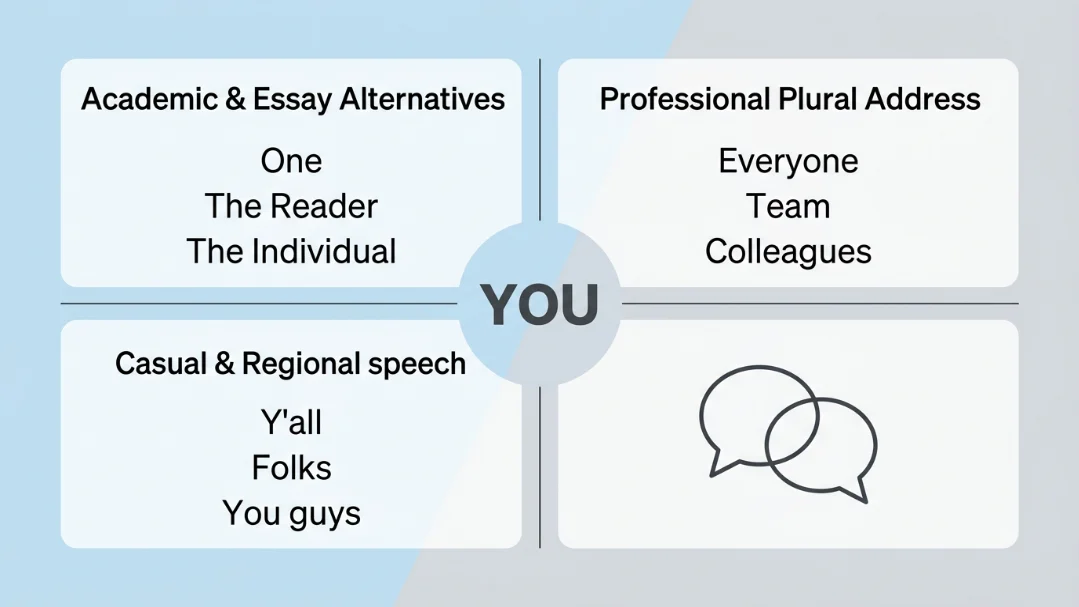
- Academic/Formal Workarounds: One, The reader, The individual, The consumer, The user, The citizen.
- Collective/Plural (Professional): Everyone, Everybody, Team, Colleagues, Attendees, Participants.
- Collective/Plural (Casual): You guys, Y’all, Folks, You lot, Youse.
- Archaic/Literary: Thou, Thee, Ye.
FAQs
What is a formal synonym for “you” in an essay?
The most accepted formal substitute for a general “you” is the indefinite pronoun one. Alternatively, you can name the specific group you are analyzing, such as the researcher, the citizen, or the reader.
Is “you guys” grammatically correct?
While widely accepted in casual spoken English across North America as a plural form of “you,” it is considered an informal colloquialism. It should be avoided in formal, academic, or professional technical writing.
Why does English use the same word for singular and plural “you”?
Historically, English had separate words (thou for singular, ye for plural). Over centuries, the plural form you gradually became used as a polite, formal singular form (similar to how French uses vous). Eventually, thou died out entirely, leaving “you” to handle both jobs.
Conclusion
Finding a synonym for “you” isn’t about replacing a simple word with a fancy one—it is about managing your relationship with your audience. Whether you are stripping “you” out of a college essay to maintain third-person objectivity, or selecting a warm collective term like “folks” or “team” to unify a work group, choosing the right substitute keeps your communication clear, appropriate, and perfectly tuned to the room.