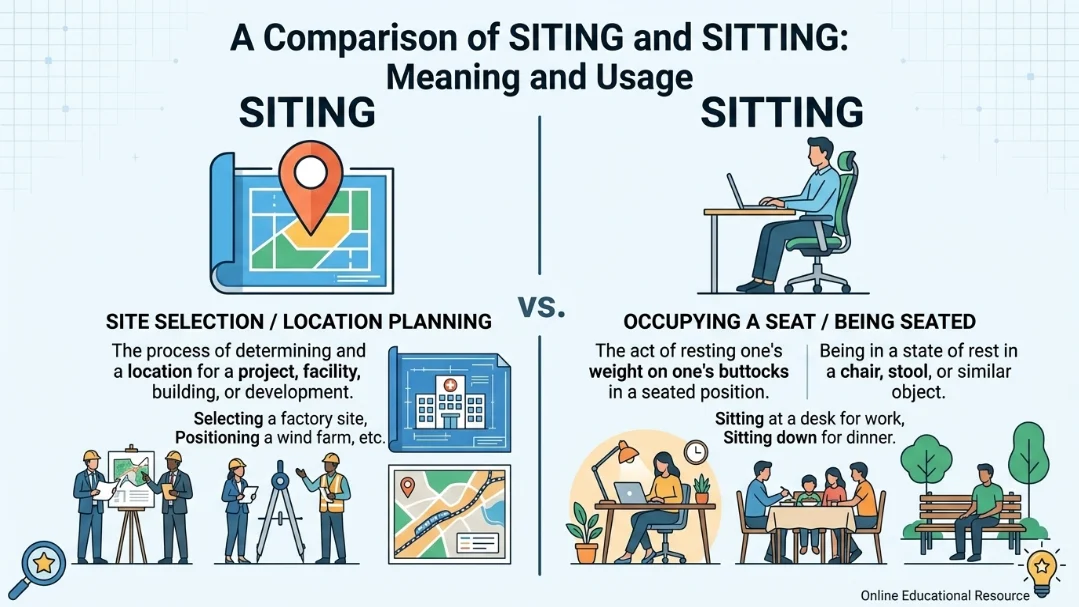
The difference between siting or sitting comes down to spatial placement versus physical posture. “Siting” (from the verb site) means placing, locating, or positioning a structure or object in a specific location. “Sitting” (from the verb sit) refers to resting on your buttocks, being seated, or resting on a surface.
Have you ever paused while writing “I am sitting” and wondered if it should actually be “I am siting”? You’re not alone. Because these two words sound almost identical, they’re among the most commonly confused terms in English. Even experienced writers occasionally mix them up, especially when relying on spell-check, which won’t flag the mistake since both are valid English words.
If you’ve searched for siting, siting meaning, siting or sitting, sitting or siting, or even I am sitting or siting, this guide will give you a clear, authoritative answer. The confusion usually comes from pronunciation, but the meanings are completely different. Sitting refers to being seated, while siting means choosing or placing the location of something, such as a building, road, or facility.
Our explanations are based on standard English grammar, trusted dictionary definitions, and real-world usage to help you understand not just the definitions but also the contexts where each word is appropriate. We’ll also clarify related searches such as siting definition, I am sitting or siting meaning, site sitting, and sitting place meaning, so you can confidently choose the correct term in any sentence.
By the end of this guide, you’ll understand the grammatical differences, see practical examples, avoid common mistakes, and never hesitate again when deciding whether siting or sitting is the right word.
Before diving deep into definitions, let us review the fundamental differences. Remembering a simple association can save you from making embarrassing spelling mistakes in your writing.
| Feature | Siting | Sitting |
| Base Verb | Site | Sit |
| Primary Meaning | Locating, positioning, or placing something on a plot of land | Resting the body in a seated position |
| Typical Subject | Buildings, power plants, parks, structures, furniture arrangements | People, animals, objects resting on surfaces |
| Grammatical Function | Present participle / Gerund | Present participle / Gerund |
| Memory Trick | Siting connects to Site (Location) | Sitting connects to Seat (Posture) |
Definition and Explanation of Siting
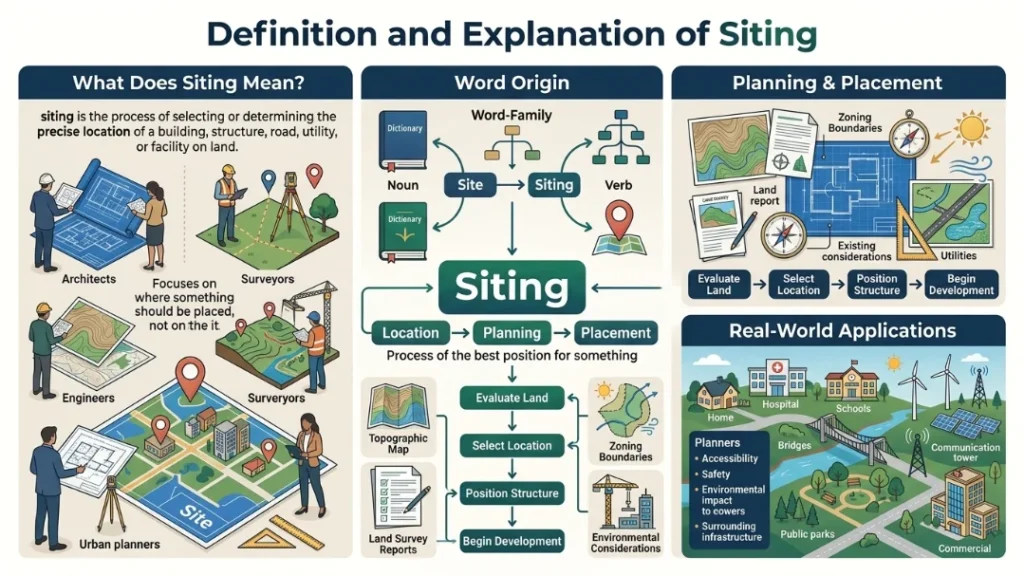
The word siting comes directly from the noun and verb site. Therefore, when you engage in siting, you are determining the position or location of something on a piece of land or within an architectural blueprint.
Siting in Architecture and Urban Planning
In urban development, siting involves choosing the best plot of land for a new facility. Engineers evaluate soil quality, environmental impacts, and access to roads during the siting process. Consequently, proper siting ensures that modern infrastructure remains safe, accessible, and environmentally sustainable for generations.
Siting in Industrial and Technical Contexts
Engineers often discuss the siting of renewable energy projects. For example, wind farm siting requires detailed studies of wind patterns and local wildlife habitats. Similarly, nuclear power plant siting demands strict compliance with federal safety zones and geological stability guidelines.
Visual Mapping for Siting:
[ Project Idea ] ──> [ Land Survey ] ──> [ Siting Phase ] ──> [ Construction ]
                                               │
                                       (Choosing Location)
Definition and Explanation of Sitting
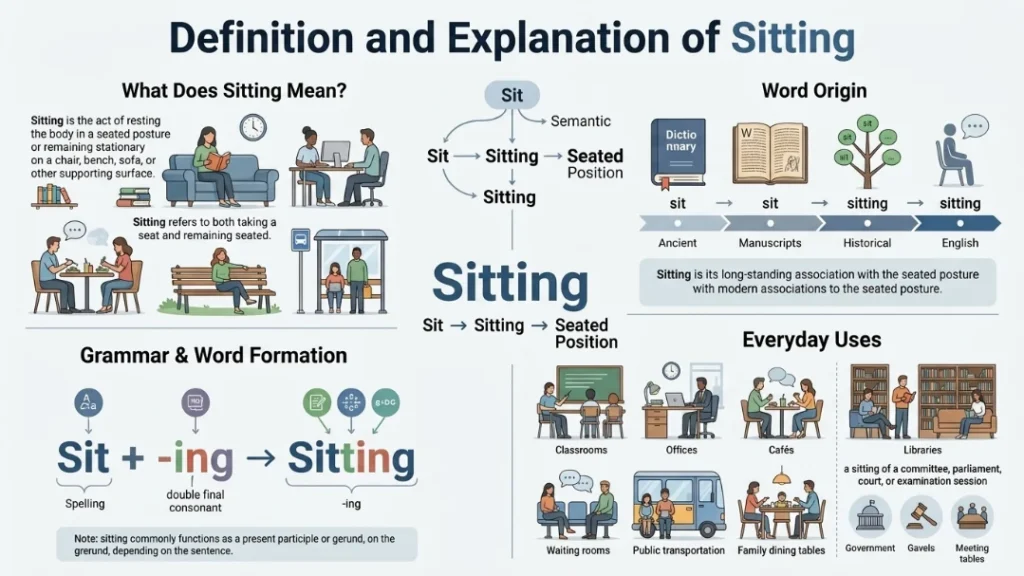
The word sitting comes from the ancient Germanic verb sit. In modern English usage, sitting refers primarily to resting the body in a seated posture. Furthermore, it describes the act of taking a seat or remaining stationary on a supporting surface.
Physical Posture and Daily Actions
Most people spend a significant portion of their workday sitting at a desk. When you rest your body on a chair, stool, couch, or bench, you are sitting. Therefore, the word emphasizes physical posture rather than physical location on a geographic map.
Secondary Uses of Sitting
Beyond human posture, sitting carries several established meanings in English grammar. Specifically, it can describe temporary duty, such as baby-sitting or house-sitting. Additionally, legal bodies hold formal gatherings known as legislative or court sittings.
Visual Mapping for Sitting:
[ Person / Object ] ──> [ Chair / Surface ] ──> [ Sitting Posture ]
Advantages and Disadvantages of Word Clarity
Using precision when selecting siting or sitting directly impacts the professionalism of your written communication. Misusing these terms creates ambiguity that confuses clients, professors, and professional colleagues.
Advantages of Correct Word Choice
- Professional Credibility: Accurate language demonstrates attention to detail and high literacy.
- Legal Precision: Using siting correctly in contracts prevents costly misunderstandings regarding land development.
- Readability: Clear word choices help readers process your technical information without hesitation.
Disadvantages of Misusing the Terms
- Reader Confusion: A sentence like “We are sitting the new factory” confuses readers about physical actions versus geographic locations.
- Reduced Authority: Spelling errors weaken your professional authority during business proposals.
- Search Engine Misinterpretation: Search engines prioritize clear, semantically accurate context in online articles.
Real-World Examples in Professional Contexts
Examining real-world examples clarifies how these terms function across various professional disciplines. Observe how sentence meaning changes depending on which word you select.
Examples in Urban Planning and Real Estate
- Correct: “The city council approved the siting of the new public park near the riverbank.”
- Incorrect: “The city council approved the sitting of the new public park near the riverbank.”
- Context: Because the sentence discusses geographic placement, siting is the only accurate choice.
Examples in Everyday Workplace Communication
- Correct: “Our team spent the entire afternoon sitting in a long strategic planning session.
- Incorrect: “Our team spent the entire afternoon siting in a long strategic planning session.”
- Context: The sentence describes physical presence inside a meeting room, making sitting the proper verb.
Quick Context Check:
• Building a school? ──> Siting (Location)
• Resting in a chair? ──> Sitting (Posture)
• Watching a pet?     ──> Sitting (Pet-sitting)
• Placing a solar panel? ──> Siting (Positioning)
Regional and Global Usage Patterns
Both American English and British English maintain identical definitions for siting or sitting. However, regional variations appear frequently in legal terms and colloquial phrasing.
North American English Patterns
In the United States and Canada, siting appears constantly in legal statutes, environmental impact reports, and zoning laws. Meanwhile, sitting dominates daily conversation regarding work habits, ergonomic furniture marketing, and pet care services.
British and Commonwealth English Patterns
British English frequently uses the word sitting to describe formal parliamentary sessions. For instance, news outlets often report that “Parliament is currently sitting.” Conversely, urban planners across the United Kingdom use siting when discussing historical conservation zones and infrastructure placement.
Common Mistakes and How to Avoid Them
Writers frequently make mistakes with siting or sitting due to phonetic similarity and keyboard typing errors. Examining these common pitfalls helps you recognize and eliminate errors quickly.
1: Double Consonant Errors
- Wrong: “The company is siting at the desk.”
- Right: “The company is sitting at the desk.”
- Rule: Remember that sitting requires two ‘t’s because it forms from the short vowel verb sit.
2: Dropping the Silent E Improperly
- Wrong: “The engineers are siteing the project.”
- Right: “The engineers are siting the project.”
- Rule: Drop the silent ‘e’ from site when adding the -ing suffix.
3: Confusing Physical Placement with Human Action
- Wrong: “We are sitting the solar array on the south ridge.”
- Right: “We are siting the solar array on the south ridge.”
- Rule: If you can substitute the word locating, use siting.
Exercises with Answers
Test your mastery of siting or sitting with the following practice sentences. Complete all ten questions before checking your answers in the key below.
Exercise Questions
- The architectural firm is currently __________ the new library on Main Street.
- After __________ at her computer for eight hours, Sarah felt a sharp pain in her lower back.
- Proper __________ of wind turbines requires analyzing local air currents and terrain.
- Why are you __________ in the dark without any lights turned on?
- Environmental regulators published new guidelines for the __________ of chemical processing plants.
- The judge remained __________ quietly while the defense attorney presented the final evidence.
- Good ergonomic chairs support healthy posture while you are __________ at work.
- County officials met yesterday to discuss the __________ of a regional waste management facility.
- She offered to watch the house, effectively house-__________ for her neighbors while they were away.
- Careful __________ of the garden shed ensures it receives plenty of sunlight throughout the day.
Answer Key and Explanations
- siting – Refers to placing a building in a specific physical location.
- sitting – Describes the physical posture of resting on a seat.
- siting – Means determining the optimal geographical position for wind turbines.
- sitting – Refers to a person resting in a seated position.
- siting – Relates to legal decisions regarding factory location placement.
- sitting – Describes the judge remaining seated in the courtroom.
- sitting – Refers to sitting at a office desk or workspace.
- siting – Focuses on selecting land for a public facility.
- sitting – Part of the compound phrase house-sitting.
- siting – Describes positioning a structure within a backyard space.
Related Concepts and Comparisons
To strengthen your understanding of siting or sitting, examine these related English word pairs. Understanding these broader connections prevents similar spelling mistakes across your vocabulary.
Site vs. Sight vs. Cite
- Site: A physical place or location (e.g., “construction site”).
- Sight: The ability to see or something that is seen (e.g., “a beautiful sight”).
- Cite: To quote an author or reference evidence (e.g., “cite your sources”).
Sit vs. Set
- Sit: To rest the body in a seated position (intransitive verb).
- Set: To place an object down on a surface (transitive verb).
| Root Word | Present Participle | Core Focus |
| Site | Siting | Geographic positioning |
| Sit | Sitting | Body posture |
| Sight | Sighting | Visual observation |
| Cite | Citing | Academic quotation |
FAQs
What is the primary difference between siting or sitting?
Siting refers to placing or locating a building or structure on land. Conversely, sitting describes resting your body in a chair or remaining seated.
How do you spell siting correctly?
You spell siting with one ‘t’ and no ‘e. Because it derives from site, you drop the trailing ‘e’ before adding the -ing ending.
Is sitting written with one ‘t’ or two ‘t’s?
Sitting always uses two ‘t’s. The base verb sit features a single short vowel, which requires doubling the final consonant when adding -ing.
Can siting apply to furniture inside a home?
Yes, designers occasionally speak of siting large furniture pieces, though positioning or placing sounds more natural in residential contexts.
What does siting mean in environmental law?
In legal statutes, siting describes the formal process of surveying, selecting, and approving property for industrial, municipal, or commercial development projects.
Is house-siting spelled with one ‘t’?
No, house-sitting uses two ‘t’s because it stems from the verb sit. You are taking care of a seat or home while owners travel.
Why does spellcheck allow both siting or sitting?
Both terms represent valid, correctly spelled words in standard English dictionaries. Therefore, automated spellcheck tools cannot detect when you use the wrong word in context.
What is a sitting duck?
A sitting duck is an idiomatic expression that describes an easy target or a person in a vulnerable situation.
Can sitting refer to a formal meeting?
Yes, a sitting refers to a formal session of a legislature, parliament, or court of law during which official business takes place.
How can I easily remember the difference between siting or sitting?
Associate siting with the noun site (a place). Alternatively, link sitting with the noun seat (a chair).
Conclusion
Mastering the difference between siting or sitting remains essential for clear, professional English communication. Although both words sound almost identical when spoken aloud, their written forms serve completely different functions across urban planning, legal agreements, and everyday speech.
To recap, use siting whenever you write about placing structures, selecting land, or positioning infrastructure projects. Choose sitting whenever you describe bodily posture, temporary caretaking, or formal legislative meetings.
By applying these simple rules, reviewing real-world examples, and utilizing memory tricks, you will eliminate confusion permanently. Maintaining precise word choices elevates your writing, sharpens your message, and ensures that your readers understand your exact intent every time.