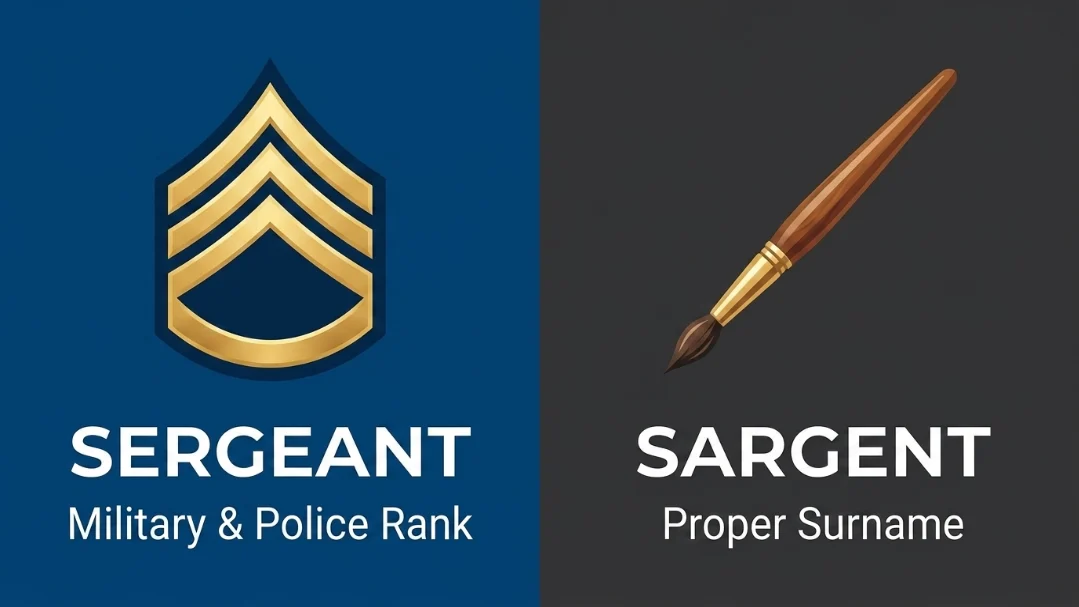
The primary difference between sargent or sergeant is that “sergeant” is the correct spelling for a military or law enforcement rank, whereas “sargent” is a proper surname. Because these two words sound exactly the same when spoken aloud, writers frequently confuse them in written English. Consequently, using the incorrect spelling can undermine the professionalism of your writing, especially in formal or institutional documents.
Sargent or Sergeant
The word sergeant refers exclusively to a non-commissioned officer in the military, police force, or other uniformed organizations. In contrast, sargent is an altered spelling that functions almost entirely as a family last name or a geographic place name. Therefore, unless you are addressing a specific person whose last name is spelled Sargent, you should always use the spelling with an “e” after the “s” to describe an official title.
English orthography contains numerous traps, and homophones rank among the most difficult challenges for writers. Specifically, the confusion between sargent or sergeant creates frequent errors in essays, news articles, and business communications. Because both words share an identical pronunciation, the human ear cannot distinguish between them during speech. Consequently, the burden falls entirely on the writer to select the accurate visual form based on the underlying meaning.
Understanding this distinction matters immensely because titles carry structural weight within official institutions. Misspelling a military or police rank reflects poorly on a writer’s attention to detail, whereas misspelling an individual’s family name can cause personal offense. By mastering the distinct rules governing these two words, you will improve your communication clarity and ensure your prose remains professional. This guide will explore their origins, break down their proper usage, and provide memorable tricks to eliminate spelling errors forever.
To ensure you never mix up these terms again, remember that context dictates the spelling completely. The term “sergeant” serves as a functional title within structured hierarchies all around the world. On the other hand, “Sargent” is a proper noun that requires capitalization when it refers to a specific individual or family line.
| Word | Primary Part of Speech | Core Definition | Capitalization Rule |
| Sergeant | Common Noun / Official Title | A non-commissioned officer rank in military or police units. | Only capitalized before a person’s name or as a direct title. |
| Sargent | Proper Noun / Surname | A traditional family last name or specific geographical location. | Always capitalized because it is a proper noun. |
Definition and Explanation of Sergeant
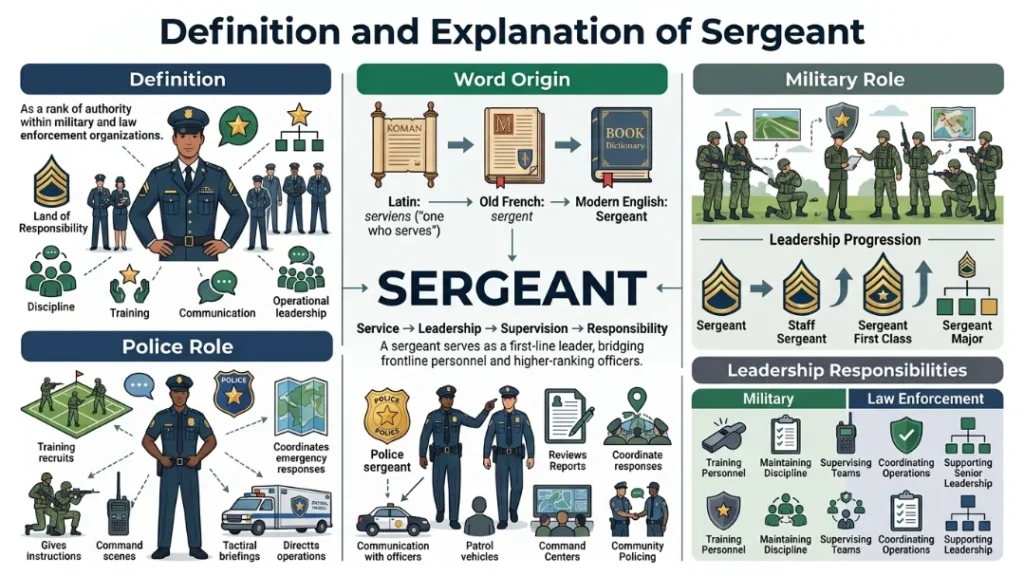
The noun sergeant represents a specific tier of authority within modern uniformed services. Historically, this term traces its roots back to the Latin word serviens, which translates directly to “servant” or “one who serves.” As centuries passed, the Old French language adapted the term into sergent, transforming its meaning into a specialized military servant or warrior.
Eventually, the English language adopted the word to signify a reliable leader who bridges the gap between raw recruits and commissioned officers. Today, a sergeant holds significant responsibility for training, discipline, and daily tactical execution.
The Role of a Sergeant in the Military
Within military branches like the Army, Marine Corps, and Air Force, a sergeant functions as a non-commissioned officer. These individuals manage small teams, oversee equipment readiness, and enforce operational standards during missions. Because they work closely with lower-enlisted personnel, they maintain organizational morale on a daily basis.
Furthermore, the military splits this title into several distinct sub-ranks to indicate increasing levels of seniority. For example, a soldier might advance from a basic sergeant to a Staff Sergeant, a Sergeant First Class, or eventually a Sergeant Major. Each step up the ladder brings greater administrative duties and wider operational leadership.
The Role of a Sergeant in Law Enforcement
In police departments, a sergeant occupies a crucial first-line supervisory position. Officers in this role supervise shifts of patrol deputies, respond to major field incidents, and review official police reports for accuracy. Because they evaluate the performance of frontline officers, they act as a vital link between street-level policing and department command staff.
Additionally, achieving this rank requires passing rigorous civil service examinations and demonstrating field competence over many years. Consequently, community members and legal professionals view the title with a high degree of respect and authority.
Definition and Explanation of Sargent
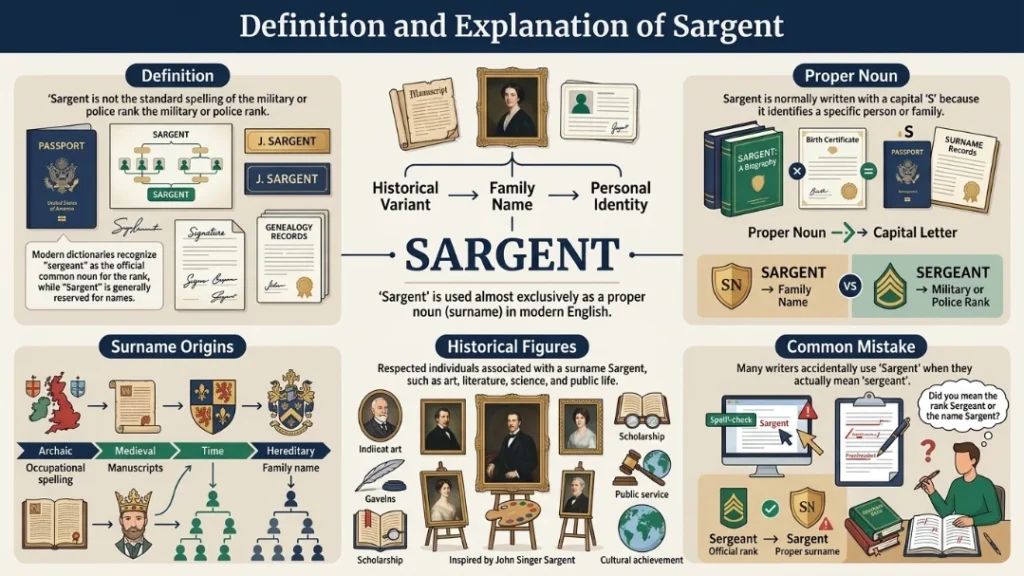
The term Sargent serves almost exclusively as a proper noun in modern English usage. While it originated centuries ago as an archaic variant spelling of the military title, it evolved to become a distinct family surname. Consequently, dictionary publishers do not recognize it as a valid common noun for an official rank.
If you encounter this spelling today, it will almost certainly feature a capital letter “S” because it designates a specific identity. Using this spelling without a capital letter generally indicates an uncorrected typo rather than a deliberate choice.
Sargent as a Surname
As a family name, Sargent has deep roots in English-speaking countries, particularly within the United Kingdom and the United States. Genealogists note that the name initially developed as an occupational surname given to individuals who worked as magistrates or official enforcement servants.
Over time, families stabilized the spelling with an “a” to differentiate their lineage from the functional job title itself. Therefore, the spelling has transformed from a description of employment into a symbol of familial heritage.
Historical Figures with the Name Sargent
Several prominent historical figures have carried this surname, cementing its place in global culture and art history. Most notably, John Singer Sargent achieved international fame as a leading American portrait painter during the late nineteenth and early twentieth centuries. His masterpiece paintings continue to hang in prestigious museums worldwide.
In addition to the arts, individuals named Sargent have made significant contributions to science, politics, and literature. Recognizing these figures helps reinforce why the capitalized, “a” variant must remain reserved for individuals rather than institutional offices.
Advantages and Disadvantages of Distinct Spellings
Maintaining two separate spellings for identical-sounding words offers distinct benefits for written clarity, though it introduces minor challenges for language learners. Examining these aspects reveals why modern English preserves both forms rather than merging them into a single word.
Advantages of Visual Differentiation
The primary benefit of keeping “sergeant” and “Sargent” distinct is the instant clarity it provides to the reader. When you see the word on a page, your brain immediately categorizes the subject without needing secondary contextual clues. Specifically, the unique spelling prevents readers from confusing an individual’s identity with an official institutional position.
Furthermore, this separation preserves the rich etymological history of both terms. It allows legal documents, military orders, and historical texts to remain precise, eliminating any ambiguity regarding whether a passage refers to a specific family member or an active duty officer.
Disadvantages of Homophonic Variation
Conversely, the main drawback of this linguistic split is the high likelihood of spelling mistakes. Because auditory learners rely heavily on phonetic sounds, they often struggle to remember which vowel belongs to which concept. This confusion leads to frequent red underlines in word processors and requires extra editing time during document preparation.
Additionally, non-native English speakers often find these variations frustrating to memorize. Since the pronunciation offers no clues regarding the correct vowels, learners must rely entirely on rote memorization to master the spelling patterns.
Real World Examples of Both Terms
Examining how these words function in professional writing provides a clear blueprint for your own work. Pay close attention to how capitalization and sentence structure change depending on which concept the author intends to express.
Sentences Using Sergeant Correctly
- The sergeant ordered the platoon to assemble near the command tent before sunrise.
- After reviewing the evidence, Police Sergeant Miller signed the arrest warrant.
- She hoped to earn a promotion to staff sergeant before her enlistment contract ended.
- During the ceremony, the commander praised the sergeant for exceptional bravery under pressure.
Sentences Using Sargent Correctly
- We spent the afternoon admiring a rare portrait painted by John Singer Sargent.
- Professor Sargent scheduled her office hours for Tuesday afternoons in the main hall.
- The local community theater group named their new stage after Thomas Sargent.
- According to the public records, the Sargent family purchased this plot of land in 1922.
Regional and Global Usage Patterns
While the core definitions remain steady worldwide, different countries display slight preferences regarding how they handle titles and names. Understanding these subtle global patterns ensures your writing aligns with international expectations.
In the United States and Canada, the distinction between the two words remains exceptionally rigid. Military branches and local police departments strictly enforce the “sergeant” spelling in all official communications, press releases, and uniform badges. Similarly, media outlets follow style guides that mandate the standard rank spelling without exception.
In contrast, certain historical British texts from the eighteenth and nineteenth centuries occasionally utilized “sargent” as an acceptable variant for the rank. However, modern British English has entirely aligned with global standards, classifying that older usage as completely obsolete. Today, the United Kingdom, Australia, and New Zealand use “sergeant” for all official capacities, keeping “Sargent” solely as a proper noun.
Common Mistakes and How to Avoid Them
The most frequent error involves using “sargent” when writing about a police officer or military member. This mistake often occurs because the “sar” sound matches the phonetic pronunciation more closely than the traditional “ser” spelling. To avoid this blunder, you must train your eye to spot the error during the proofreading stage of your writing process.
Another error occurs when writers fail to capitalize “Sargent” when using it as a last name. Because all proper surnames require capitalization under standard English grammar rules, leaving it lowercase creates an unprofessional impression.
The Memory Trick for Spelling Sergeant
Fortunately, a simple and highly effective mnemonic device can permanently fix the correct spelling of the rank in your mind. Take a close look at the first few letters of the military title: S-E-R-G-E-A-N-T.
Notice that the word contains the smaller hidden word “ERGE” right in the middle, which can remind you of the phrase “Every Rank Generates Effort.” Alternatively, you can remember that a sergeant works with serious responsibility, which both begin with the letters S-E-R. If your target sentence describes a person performing a serious job in uniform, always start the word with an e.
Exercises with Answers
Practicing with real sentences helps solidify your knowledge and builds long-term muscle memory. Read through the following sentences and determine which spelling fits the context correctly.
Practice Quiz
- The desk [sargent / sergeant] instructed the visitors to sign the security log.
- Many art critics consider [Sargent / Sergeant] to be one of the finest painters of his era.
- He was promoted to the rank of drill [sargent / sergeant] due to his excellent leadership skills.
- We are planning to interview Dr. Alice [Sargent / Sergeant] regarding her new space research project.
- The infantry [sargent / sergeant] led the nighttime navigation exercise through the forest.
Answer Key and Explanations
- sergeant | Explanation: This sentence describes a specific job position within a security or police framework, requiring the common noun title.
- Sargent | Explanation: The context mentions art critics and painters, clearly pointing to the famous historical individual named John Singer Sargent.
- sergeant | Explanation: A drill instructor in the military holds an official institutional rank, which demands the standard title spelling.
- Sargent | Explanation: The presence of the title “Dr.” followed by a specific first name indicates that this word functions as a family surname.
- sergeant | Explanation: Infantry units are military structures led by non-commissioned officers, making the official rank spelling necessary.
Related Concepts and Linguistic Comparisons
To fully appreciate the spelling of sergeant, it helps to examine other words that share similar linguistic anomalies. English contains several military and organizational titles where the spelling does not match the modern pronunciation, causing widespread confusion.
For instance, consider the word colonel. Modern English speakers pronounce this rank exactly like the word “kernel,” yet the spelling retains its historical French and Italian roots. Similarly, the title lieutenant is pronounced with a sharp “f” sound in British English, despite containing no such letter in its written form. These examples demonstrate that administrative titles often preserve historical spellings long after pronunciation habits have evolved.
To help you navigate these related terminology challenges, review this table of common rank spellings and their correct applications:
| Rank / Title | Common Misspelling | Correct General Meaning |
| Sergeant | Sargent / Sarjant | A non-commissioned officer supervising personnel. |
| Colonel | Kernel / Colnel | A senior military officer commanding a regiment. |
| Lieutenant | Leftenant / Lutenant | A junior commissioned officer acting as a deputy. |
| Marshal | Marshall | A high-ranking officer or official master of ceremonies. |
FAQs
What is the correct spelling for a police rank?
The correct spelling for a police rank is always sergeant. You should never use the variant spelling with an “a” when describing a law enforcement title.
Is sargent ever an acceptable spelling for a military officer?
No, sargent is not an acceptable spelling for a military officer in modern English. Official military protocols and standard dictionaries classify this as a spelling error.
Why is sergeant spelled with an e instead of an a?
The word is spelled with an “e” because it evolved from the Old French word sergent, which originally came from the Latin root serviens.
Can sargent be used as a first name?
Yes, sargent can occasionally serve as a first name, though it usually functions as a traditional family last name or surname.
What is another word for sergeant?
Depending on the context, another word for sergeant is non-commissioned officer, squad leader, supervisor, or line officer.
What are the best formal synonyms for sergeant?
The best formal synonyms include disciplinary officer, ranker, or commanding NCO, which accurately describe the professional duties of the position.
What is the opposite of sergeant?
While ranks do not have exact antonyms, the practical opposite of a sergeant would be a subordinate, private, or recruit who receives orders rather than giving them.
Are there any words similar to sergeant in law enforcement?
Yes, words similar to sergeant in law enforcement include corporal, lieutenant, captain, and inspector, which represent neighboring tiers of the command hierarchy.
Should I capitalize sergeant when writing it in a sentence?
You should capitalize sergeant only when it immediately precedes a person’s name as an official title, such as Sergeant Jones. If you are using it generally, keep it lowercase.
How can I remember the difference between sargent or sergeant quickly?
Remember that a sergeant performs a serious job in uniform. If the person has a military or police rank, start the word with the letters S-E-R.
Conclusion
Mastering the difference between sargent or sergeant is a vital step toward ensuring your writing remains accurate, professional, and authoritative. By keeping the functional rank of “sergeant” separate from the personal surname of “Sargent,” you preserve semantic clarity and show respect for official institutional structures.
Always utilize the standard “sergeant” spelling whenever you are describing military operations, police hierarchies, or disciplinary roles. Conversely, save the capitalized “Sargent” exclusively for family heritages, historic artists, or specific individuals. Employing simple mnemonic devices, such as linking serious duties to the “ser” spelling, will allow you to avoid common typos effortlessly.
When you write with typographic precision, your readers can focus entirely on your ideas rather than being distracted by easily avoidable mechanical mistakes.