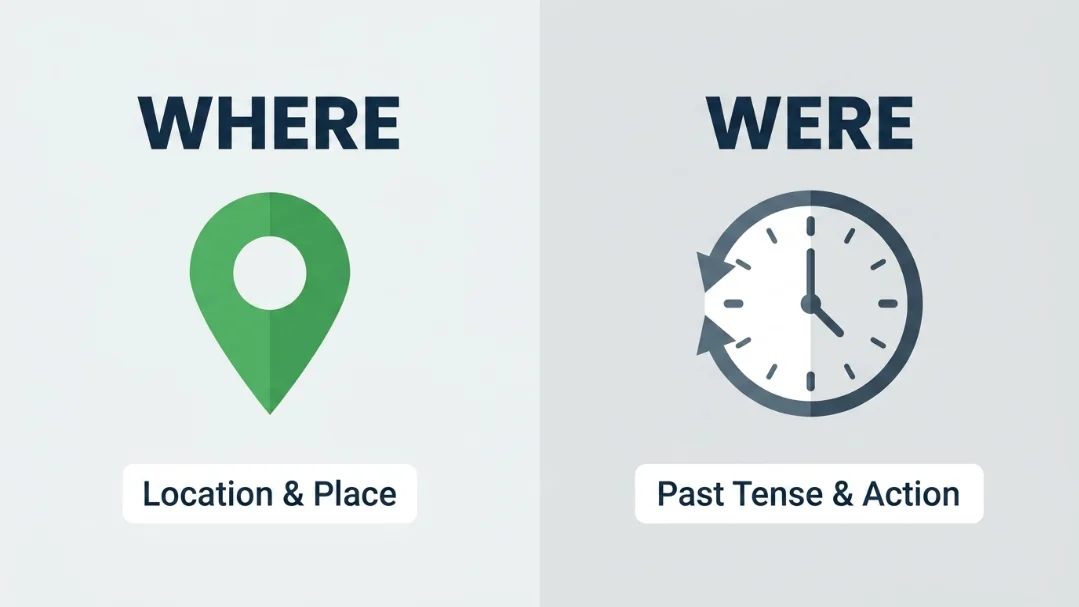
The primary difference between where or were lies in their grammatical functions, as “where” refers to a location or place while “were” is a past-tense form of the verb “to be.” Specifically, “where” acts as an adverb or conjunction to indicate position, whereas “were” functions as a plural past-tense verb or a helper verb for hypothetical situations. Remembering this simple distinction ensures that your writing remains grammatically accurate and professional in any context.
English grammar presents many challenges, especially when words sound similar but have completely different meanings and spellings. Among the most frequent traps for writers of all skill levels is the confusion between where or were. Because these two terms appear constantly in daily conversation and written text, misusing them can instantly disrupt the clarity of your message.
Whether you are drafting a professional email, working on a school essay, or writing a creative story, understanding how to deploy each word correctly is essential. A single misplaced letter changes an entire sentence from a question about location into a statement about past events. Consequently, learning the distinct boundaries of these words boosts your reading comprehension and polishes your communication skills.
This comprehensive guide breaks down the core rules governing both terms. By exploring their definitions, studying real-world examples, and analyzing comparative tables, you will master the mechanics of these essential parts of speech. Let us dive into the unique roles these words play in the English language.
If you need a quick memory trick to keep these words straight, focus on the spelling of each term. The word where contains the hidden word “here,” which directly relates to places and locations. Conversely, the word were contains the word “er,” which can remind you of “past errors” or things that occurred previously in time.
| Feature | Where | Were |
| Part of Speech | Adverb, Conjunction, Pronoun | Verb (Past Tense of “To Be”) |
| Core Function | Indicates or asks about a place, position, or situation. | Indicates past actions for plural subjects or hypothetical states. |
| Memory Trick | Contains here (points to a location). | Contains er (relates to past events). |
Definition and Explanation of Where
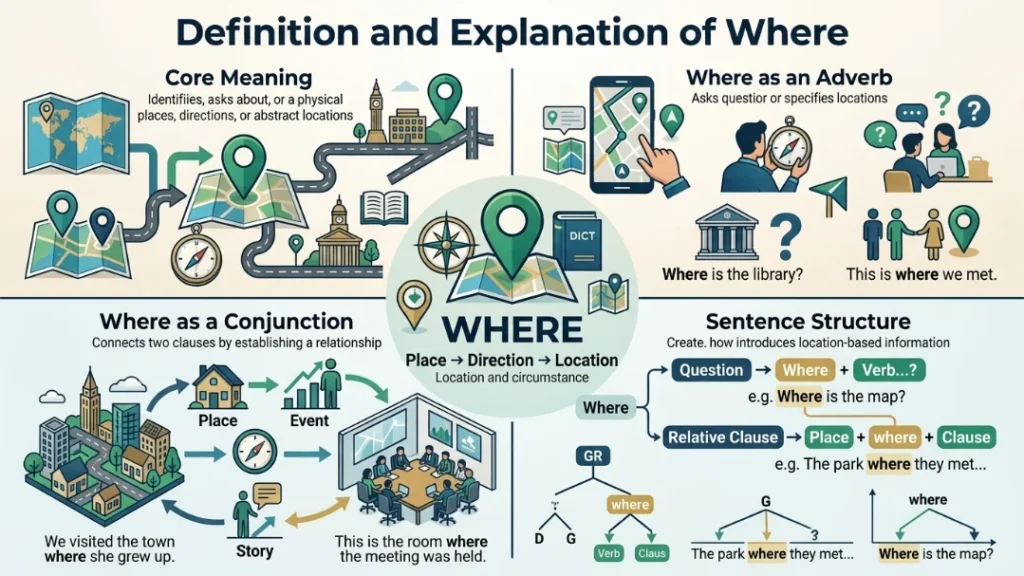
To master the phrase where or were, you must look closely at each word individually. The term where serves primarily as a word of place, direction, and circumstance.
Where as an Adverb
When used as an adverb, this word asks about or specifies a physical or abstract location. For instance, in interrogative sentences, it seeks information about destination or position. Similarly, it can introduce relative clauses that describe a specific venue or environment.
Where as a Conjunction
In complex sentence structures, this word joins clauses by establishing a geographical or situational link. It shows the reader exactly where an action takes place in relation to another event. Consequently, it creates a visual map within the text, guiding the audience through the narrative landscape.
Definition and Explanation of Were
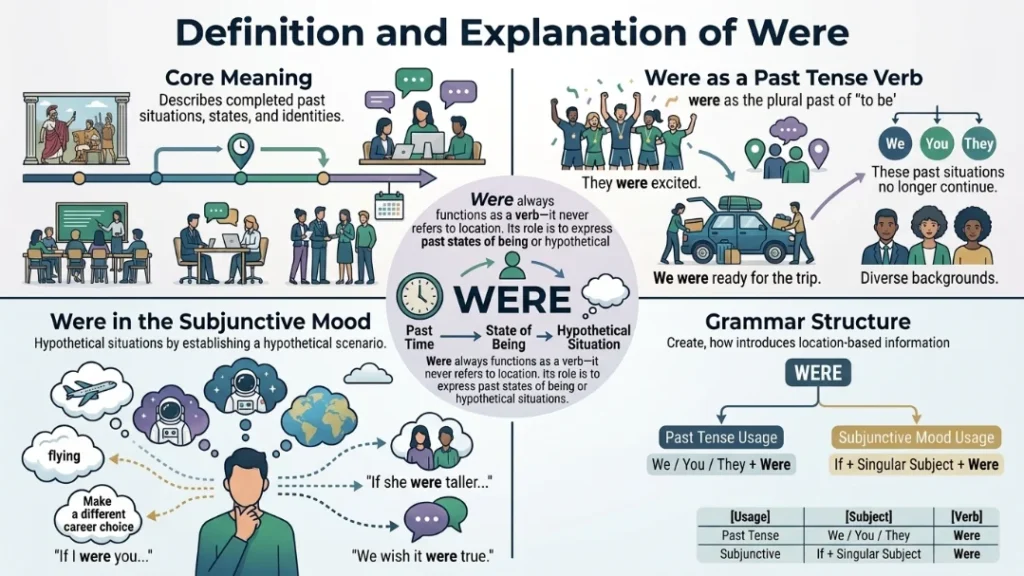
The word were belongs entirely to the verb family and has no connection to physical locations. Instead, it functions as a critical building block for expressing time, states of being, and conditional realities.
Were as a Past Tense Verb
As the plural past tense of the linking verb “to be,” this word matches with subjects like “we,” “you,” and “they.” It describes states that existed in the past but are no longer happening. For example, it tells us what a group of people or objects did yesterday, last year, or centuries ago.
Were in the Subjunctive Mood
In addition to standard past tense usage, this word plays a vital role in conditional or hypothetical sentences. This grammatical structure, known as the subjunctive mood, uses were for singular subjects to express wishes, dreams, or unreal situations. Therefore, you say “if I were” instead of “if I was” when imagining something that is currently untrue.
Advantages and Disadvantages of Mastering Usage
Polishing your understanding of where or were offers distinct advantages for personal and professional growth. Conversely, ignoring these differences creates noticeable disadvantages in your communication path.
Advantages of Clear Mastery
- Enhanced Professional Credibility: Writing clean, error-free documents establishes you as a detail-oriented and competent communicator.
- Improved Standardized Test Scores: Exams like the SAT, ACT, and TOEFL frequently test students on these exact grammatical distinctions.
- Flawless Clear Communication: Eliminating confusing typos ensures that your readers focus entirely on your core message rather than your mistakes.
Disadvantages of Ignoring the Rules
- Reader Distraction: Grammatical errors break the natural flow of reading, forcing your audience to slow down and decode your sentences.
- Reduced Trust: Employers, clients, and professors may view repetitive grammar mistakes as a sign of carelessness or poor training.
- Automated Filtering Failures: Modern applicant tracking systems and grading algorithms sometimes penalize documents that contain basic spelling confusions.
Real-World Examples
Analyzing practical scenarios clarifies how these words function in everyday language. By looking at correct sentences, you can train your eyes to spot natural language patterns.
Examples Using Where
- Location Query: Where did you leave the keys to the storage room?
- Relative Clause: This is the exact restaurant where we celebrated your promotion last year.
- Abstract Situation: We have reached a point where we must make a final decision.
Examples Using Were
- Plural Past Tense: They were driving to the theater when the storm suddenly started.
- Second Person Past Tense: You were the best candidate for the project management position.
- Hypothetical Subjunctive: If I were a millionaire, I would donate half of my wealth to medical research.
Contextual Comparison of Where or Were
Sometimes, both words appear in the very same sentence, which highlights their contrasting roles perfectly. Study the examples below to see how they interact side by side.
Mixed Sentence Scenarios
- Scenario A: The keys were exactly where you said they would be.
- Scenario B: We were unsure where the hiking trail ended.
- Scenario C: If they were going to the store, that is where they bought the milk.
In these examples, notice how were always handles the action or state of being, while where pinpoints the physical location or destination.
Regional and Global Usage Variations
While the core grammar rules for where or were remain identical across the globe, pronunciation and colloquial habits vary significantly between regions.
Accent and Pronunciation Differences
In standard American English, speakers pronounce the “h” in “where” subtly, creating a slight breath sound at the start. However, in many British and Australian dialects, “where” sounds identical to “wear” or “ware.” This phonetic overlap can confuse auditory learners, making written practice even more crucial.
Colloquial Subjunctive Trends
In casual spoken language across the United States and the United Kingdom, many people substitute “was” for “were” in hypothetical statements. For example, you might hear someone say, “If I was you, I would leave.” Despite its popularity in informal speech, professional and academic standards strictly require were for these conditional structures.
Common Mistakes and Corrections
Writers frequently mix up these words due to fast typing, autocorrect errors, or phonetic confusion. Review this table of common mistakes to protect your own writing from these slip-ups.
| Incorrect Sentence | Correct Sentence | Explanation for the Correction |
| We where planning a huge surprise party. | We were planning a huge surprise party. | Use the past tense verb, not a location word. |
| This is the house were I grew up. | This is the house where I grew up. | Use the location word to describe a physical place. |
| If he was faster, he would win the race. | If he were faster, he would win the race. | Use the subjunctive mood for hypothetical scenarios. |
| Were is my backpack hidden? | Where is my backpack hidden? | Use the question word to ask about a physical location. |
Deep Dive into the Subjunctive Mood
Understanding when to use were with singular subjects like “I,” “he,” “she,” and “it” requires a closer look at the subjunctive mood. This specific area of grammar causes tremendous confusion because it defies the standard rules of subject-verb agreement.
Real vs. Unreal Conditions
When you discuss a past event that actually happened, you use the standard indicative past tense, which means using “was” for singular subjects. For example, “I was responsible for the budget last year” is a factual statement. However, when you imagine an impossible or hypothetical scenario, you switch to the subjunctive mood, transforming the verb into were.
The Formula for Hypothesicals
Most subjunctive sentences start with introductory words like “if,” “as though,” or “I wish.” Consider the sentence, “She acts as though she were the owner of the company.” Because she is not actually the owner, the word were indicates that the statement describes an imagined reality rather than a factual truth.
Related Concepts and Comparisons
To fully solidify your grasp of where or were, it helps to compare them to other words that belong to the same phonetic or structural families. This wider perspective prevents cascading confusion with other English homophones.
Where vs. Wear vs. Ware
The word where shares its sound with “wear” and “ware,” creating a triple threat for spellers. While where handles places, “wear” relates to clothing or deterioration, and “ware” refers to manufactured goods or pottery.
Were vs. We’re
Another massive source of confusion is the contraction “we’re,” which sounds almost identical to were in casual conversation. However, “we’re” is a short combination of the words “we are,” meaning it belongs entirely in the present tense. If you can substitute “we are” into your sentence and it still makes sense, then “we’re” is the correct choice instead of were.
Exercises with Answers
Practicing with real sentences is the most effective way to lock this knowledge into your long-term memory. Complete the following sentences by choosing the correct word, then check your work using the answer key below.
Fill-in-the-Blank Questions
- Do you know ____________ the new community center is located?
- The children ____________ playing outside until the sun went down.
- If I ____________ in your position, I would double-check the financial figures.
- They settled in a quiet valley ____________ the weather stayed mild all year.
- We ____________ surprised to see how much the landscape had changed.
- ____________ did you buy those beautiful leather boots?
- Last summer, you ____________ always eager to help us tend the garden.
- This is a critical turning point ____________ we must evaluate our core values.
- If it ____________ not for your timely assistance, we would have lost the match.
- The researchers ____________ working around the clock to find a viable solution.
Answer Key and Explanations
- where (Refers to the physical location of the community center.)
- were (Acts as the plural past tense verb for the subject “children.”)
- were (Uses the subjunctive mood to express a hypothetical situation.)
- where (Functions as a conjunction introducing a geographical location.)
- were (Serves as the past tense linking verb for the plural subject “we.”)
- where (Asks an interrogative question about a place of purchase.)
- were (Functions as the past tense verb matching the pronoun “you.”)
- where (Describes an abstract situation or conceptual point in time.)
- were (Expresses a conditional, hypothetical past scenario.)
- were (Serves as the plural helper verb for the ongoing action of researching.)
Advanced Writing Application
As you transition from basic mastery to advanced writing, the interaction between where or were becomes a tool for stylistic precision. Authors and professional speechwriters leverage these structural differences to establish specific rhythms and tones in their texts.
Rhetorical Use of Location Clauses
Using where effectively allows writers to build immersive worlds by chaining descriptive clauses together cleanly. Instead of writing choppy sentences, an expert author weaves spatial relationships directly into the narrative action. This approach allows the reader to visualize environments effortlessly without losing the thread of the plot.
Subjunctive Elegance in Formal Prose
Deploying were in complex conditional statements adds an unmistakable layer of sophistication to legal briefs, academic arguments, and corporate manifestos. It signals to the reader that the writer possesses a refined command of English syntax. Consequently, this linguistic discipline lends authority to persuasive arguments and elevated policy discussions.
FAQs
What is the simplest way to remember the difference between where or were?
The simplest method is to look for the word “here” inside where, which instantly tells you that the term deals with location. Because were lacks this letter combination, it remains reserved exclusively for actions, past events, and hypothetical situations.
Can I use was instead of were in conditional sentences?
While you will hear “was” frequently in casual conversations, formal writing strictly requires were for conditional and hypothetical expressions. Stick to were in professional environments to ensure your prose meets standard grammatical expectations.
Is where considered a preposition or an adverb?
The word where functions primarily as an adverb or a conjunction rather than a preposition. It modifies actions by indicating location or hooks clauses together by establishing geographic relationships within a sentence.
Why do where and were sound so similar if they mean different things?
These words sound similar because they evolved from ancient Germanic languages that shared similar phonetic roots for past actions and physical spaces. Over centuries, their spellings diverged to create distinct definitions while their pronunciations remained closely aligned.
How do I know if I should use we’re or were?
Test your sentence by reading it aloud using the phrase “we are” in place of the disputed word. If the sentence retains its correct meaning, use the contraction “we’re”; if it sounds broken, you need the past tense verb were.
Can where refer to abstract situations instead of physical places?
Yes, where regularly refers to non-physical spaces, stages of development, or abstract situations. For example, in the phrase “a situation where everyone wins,” the word denotes a conceptual state rather than a geographical spot.
Is were always plural when used in the past tense?
The word were serves as the past tense for plural subjects like “we” and “they,” but it also pairs with the singular pronoun “you.” Additionally, it joins other singular subjects whenever a sentence enters the hypothetical subjunctive mood.
What part of speech is were in standard English?
The word were is classified as a verb, specifically functioning as a past tense form of the fundamental linking verb “to be.” It can serve as the main action driver or act as an auxiliary helper alongside other verbs.
How does autocorrect confuse these two specific words?
Because both terms are spelled correctly in standard dictionaries, digital autocorrect programs often fail to flag them when you type the wrong one. The software looks at spelling rather than contextual meaning, allowing contextual typos to slip through unnoticed.
Why is subject-verb agreement vital when choosing were?
Failing to align were with its proper plural subject creates jarring grammatical mismatches that disrupt reading comprehension. Proper agreement ensures that your sentences sound balanced, logical, and structurally harmonious to native ears.
Conclusion
Mastering the use of where or were represents a foundational milestone in your journey toward exceptional English writing. While their similar spellings and overlapping sounds can cause initial confusion, their underlying rules are entirely distinct and easy to manage. By keeping the “here” location trick in mind, you can effortlessly separate spatial descriptions from past-tense actions and hypothetical dreams.
Investing the time to review your work for these common traps pays massive dividends across your entire writing portfolio. It transforms casual notes into sharp business communications and elevates student essays into polished academic submissions. Remember that clear writing reflects a clear mind, and attention to detail signals deep respect for your reading audience.
As you move forward, apply these principles actively by proofreading your drafts with an eagle eye for homophone slips. Utilize the charts, comparative examples, and exercise frameworks provided in this guide to solidify your daily habits. With consistent practice, choosing between these essential terms will become an automatic, seamless reflex that refines your voice and amplifies your professional impact.