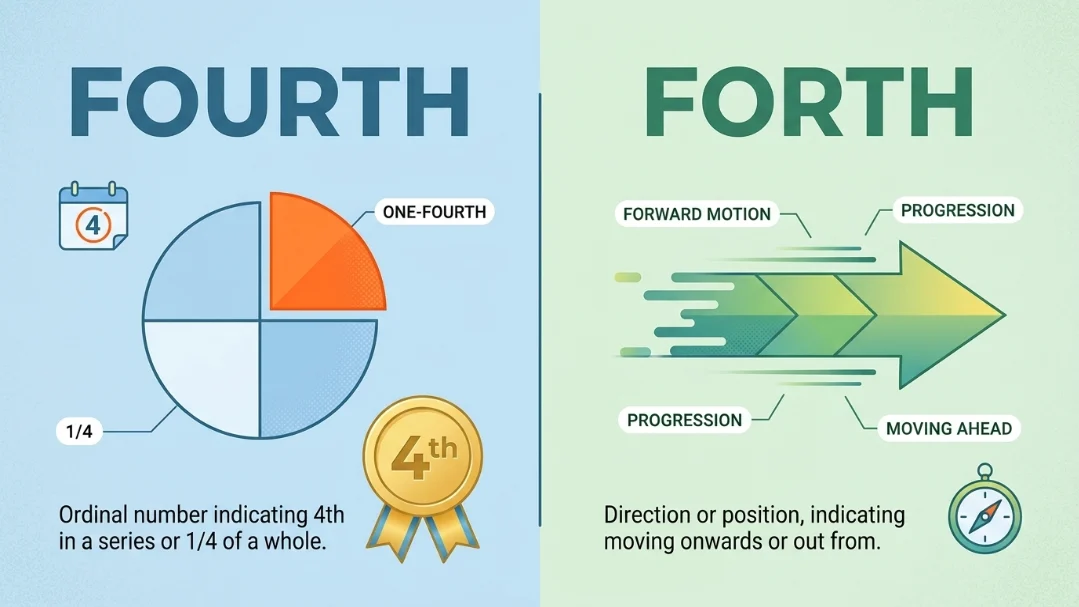
The main difference between fourth or forth lies in their spelling and grammatical functions. Fourth is a number that represents the ordinal position after third, while forth is an adverb that means forward, onward, or out into view. You should use fourth when discussing sequences or fractions and forth when describing movement or progression.
Homophones frequently cause confusion for writers of all skill levels because they sound identical but carry completely different meanings. Among the most common culprits in the English language is the mix-up between fourth or forth. While a single omitted letter might seem insignificant, using the incorrect term can instantly disrupt the professionalism of your writing.
This comprehensive guide will unpack everything you need to know about these two words. We will explore their definitions, structural differences, historical origins, and real-world applications. By understanding these concepts, you can eliminate grammatical errors and communicate with absolute confidence.
Many people struggle with these terms because they look so similar on the page. However, learning the distinction is highly straightforward once you connect them to their core grammatical purposes. Whether you are drafting a business report, writing an academic essay, or polishing creative fiction, mastering this word pair is essential for clear communication. Let us dive deep into the mechanics of both words so you never have to second-guess your choice again.
If you are looking for a quick way to remember the difference, focus on the spelling of each word. The word fourth contains the number four, which directly signals its relationship to numerical sequences. Conversely, the word forth lacks the letter u and always relates to forward motion, direction, or time.
The table below provides a quick snapshot of how these two terms diverge in daily English usage.
| Feature | Fourth | Forth |
| Part of Speech | Ordinal Number, Noun, Adjective | Adverb, Preposition |
| Core Meaning | Number four in a sequence; one of four equal parts | Forward in time or place; onward; out into view |
| Memory Trick | Contains the word four | Rhymes with north (a direction) |
| Common Collocations | Fourth of July, fourth place, one-fourth | Back and forth, bring forth, set forth, so forth |
Definition and Explanation of Fourth
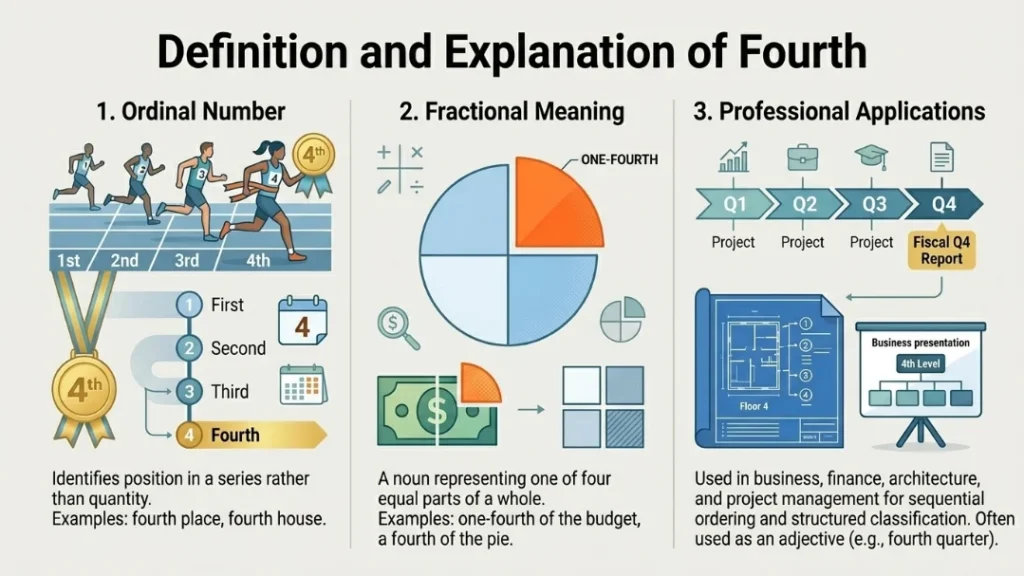
To understand fourth, you must look at its mathematical and sequential roots. It functions primarily as an ordinal number, which means it tells you the specific position of something within a series. Consequently, whenever you count items past three, the next item occupies the fourth position.
Beyond serving as a sequential marker, this term also operates as a noun to describe fractions. When you divide a whole object into four equal components, each individual segment is a fourth. For instance, a quarter of a dollar represents one-fourth of that dollar.
Architects, financial analysts, and project managers use this word constantly to organize information. It can act as an adjective when modifying another noun, such as when a company enters the fourth quarter of the fiscal year. Because it is tied strictly to counting, it never describes physical motion or direction on its own.
Definition and Explanation of Forth
In contrast to its numerical counterpart, forth functions as an adverb that deals with movement, progression, and manifestation. It originates from Old English roots that signify a transition from an enclosed space out into the open. Therefore, when an object moves forth, it travels onward or forward.
This word also carries a temporal meaning, which relates to moving forward through time. When historical documents state “from that day forth,” they mean from that specific day onward into the future. It indicates continuation and ongoing progression rather than a static point.
Additionally, writers employ this term to describe something coming into public view or being produced. To bring forth an idea means to introduce it to a group or reveal it to the world. It requires an action and almost always accompanies a verb of motion or creation.
Advantages of Using the Correct Term
Using the proper spelling elevates the clarity of your professional documentation. When clients or managers read polished text, they immediately perceive the author as competent, thorough, and highly educated. Precision in language removes ambiguity, ensuring that your audience focuses entirely on your core message.
Furthermore, correct usage improves your search engine optimization efforts if you publish content online. Search algorithms prioritize content that demonstrates high linguistic authority and accurate keyword placement. By avoiding basic homophone errors, your web pages can earn better rankings and maintain higher reader engagement rates.
Disadvantages of Misusing These Words
Mistaking these two terms can create immediate confusion for your audience. For example, telling a team to “go fourth” sounds exactly like a numerical instruction rather than a command to move forward. This minor error can stall communication and force readers to reread your sentences to deduce your intent.
Moreover, frequent grammatical slips can damage your professional credibility over time. Editors, recruiters, and clients often view homophone mistakes as a sign of carelessness or poor editing. In highly competitive fields, a simple typo like writing “back and fourth” instead of “back and forth” can undermine your authority.
Real-World Examples of Fourth
Examining concrete examples can reinforce your understanding of how to use fourth correctly in your everyday writing. Here are several sentences that demonstrate its various roles as a noun, adjective, and ordinal number:
- The corporate legal team is currently preparing the financial results for the fourth quarter.
- Maya celebrated enthusiastically after her horse crossed the finish line in fourth place.
- We need to cut the birthday cake carefully so that every child receives exactly one-fourth of it.
- October is the fourth month of the standard academic calendar at our local university.
- My office is located on the fourth floor of the downtown medical building.
Notice how every single example revolves around numbers, sequences, or fractions. If you can replace the word with a digit like 4th, then you know with absolute certainty that this spelling is correct.
Real-World Examples of Forth
To master the adverbial use of forth, observe how it interacts with verbs to show movement or progression. The following examples highlight its traditional and modern applications in English prose:
- The ocean waves rolled forth against the rocky shoreline all through the stormy night.
- Our department head set forth a brilliant strategy for minimizing operational expenses next year.
- The witnesses came forth to share their critical testimonies with the grand jury.
- He paced back and forth across the waiting room while anxiously anticipating the medical news.
- From this moment forth, all employees must log their hours using the new digital platform.
In these instances, the word always modifies an action like rolling, setting, coming, pacing, or moving. It never represents a count, but rather adds geographical or temporal direction to the sentence.
Regional and Global Usage Patterns
Geographical location does not alter the fundamental definitions of fourth or forth. Both American English and British English adhere strictly to the exact same rules regarding these homophones. Unlike words like color or theatre, these terms maintain uniform spelling across the globe.
However, the frequency of certain idioms can vary slightly depending on regional dialects. For example, the phrase “and so forth” remains universally popular, but British speakers might prefer “and so on” in casual conversation. Regardless of local preferences, global publishing standards demand the same strict adherence to the numerical and directional boundaries of these words.
Common Mistakes and How to Fix Them
The most frequent error involving this pair occurs in the idiomatic expression “back and forth.” Because people often think of numbers in sequences, they mistakenly write “back and fourth.” This is incorrect because the phrase describes a physical swaying motion, which demands the directional adverb.
Another common pitfall involves the phrase “so forth.” Writers sometimes include the letter u because they confuse the phrase with numerical lists. To fix these errors, you must actively proofread your work and check the words that surround the choice.
Let us review some incorrect sentences alongside their proper corrections:
- Incorrect: The company brought fourth a new line of hybrid vehicles.
- Correct: The company brought forth a new line of hybrid vehicles.
- Incorrect: This is the forth time I have tried to contact customer support today.
- Correct: This is the fourth time I have tried to contact customer support today.
- Incorrect: The children ran back and fourth across the playground during recess.
- Correct: The children ran back and forth across the playground during recess.
Memory Tricks and Mnemonics
If you still find yourself hesitating during the writing process, a few simple mnemonic devices can clear up your doubt instantly. The easiest trick is to look closely at the interior letters of the words themselves.
The Number Trick: The word fourth contains the word four. Since four is a number, use fourth for all things related to numbers, dates, fractions, and positions.
If your sentence does not involve a number, look at the directional alternative.
The Direction Trick: The word forth ends with the letters o-r-t-h. These same letters appear at the end of the word north. Because north is a direction, use forth when you mean movement or direction.
Related Concepts and Advanced Comparisons
Understanding how fourth or forth fit into the broader landscape of English grammar can deepen your writing expertise. These words belong to a large family of homophones that confuse writers due to ancestral sound changes. Let us look at how they compare to other related terms.
Fourth vs. Fourthly
Some writers wonder if they should use fourthly when listing arguments in an essay. While fourthly is technically a valid adverb, modern style guides generally discourage its use. Instead, expert editors recommend using the standard word fourth as an organizational transition. For example, write “Fourth, we must analyze the budget constraints” instead of using the clunkier adverbial form.
Forth vs. Forward
People often confuse forth with forward because both words indicate a frontward trajectory. While they share similar meanings, forward typically focuses on a physical destination or a specific point in front of you. On the other hand, forth carries a more abstract connotation of emerging into view or continuing indefinitely.
Forward vs. Foreword
Another related point of confusion in professional writing is the mix-up between forward and foreword. A foreword is an introductory section at the beginning of a book, usually written by someone other than the author. Mixing these up alongside fourth or forth can quickly make a manuscript look unpolished.
Exercises with Answers
Practicing with real sentences is the most effective way to lock this knowledge into your long-term memory. Read through the following ten sentences and fill in the blanks with either fourth or forth.
Practice Questions
- The digital marketing team launched its ________ major campaign of the year last Tuesday.
- After hours of deliberation, the committee finally brought ________ a viable compromise.
- My apartment is located on the ________ floor, right next to the elevator bank.
- The pendulum swung back and ________ with perfect mathematical precision.
- We watched the beautiful flowers burst ________ in magnificent colors during early spring.
- Only one-________ of the local citizens voted in the recent municipal election.
- From this day ________, all administrative meetings will be conducted via video conference.
- This marks the ________ consecutive year that our team has won the regional championship.
- The prophet stood before the crowd to hold ________ about the future of the kingdom.
- He finished the grueling marathon in ________ place out of two thousand runners.
Answer Key and Explanations
- fourth (This refers to a numerical sequence of campaigns.)
- forth (This indicates bringing an idea out into view or producing a result.)
- fourth (This denotes the specific numerical floor of a building.)
- forth (This is part of the common idiomatic phrase “back and forth,” describing physical motion.)
- forth (This describes the flowers emerging or blooming outward.)
- fourth (This represents a mathematical fraction, equal to twenty-five percent.)
- forth (This forms the temporal phrase “from this day forth,” meaning onward through time.)
- fourth (This indicates a numerical count of consecutive years.)
- forth (The phrase “hold forth” is an idiom that means to speak at great length.)
- fourth (This denotes a specific ranking or ordinal position in a race.)
FAQs
What is the difference between fourth and forth?
The word fourth is an ordinal number that indicates a specific position in a sequence after third. The word forth is an adverb that means onward, forward, or out into public view.
How do you spell back and forth correctly?
The correct spelling is always back and forth without the letter u. This phrase describes movement from side to side or front to back, which requires the directional adverb.
Is forth an adverb or a preposition?
The word forth functions primarily as an adverb because it modifies verbs by showing direction or progression. In rare historical or literary contexts, it can operate as a preposition meaning out of, though this is uncommon in modern business writing.
Can you use fourthly in a formal essay?
You can technically use fourthly in an essay, but modern writing standards advise against it. It is much more professional and elegant to use the word fourth when organizing a list of points.
What does the phrase bring forth mean?
The phrase bring forth means to produce, create, or introduce something to the public. For example, a creative tree can bring forth new fruit, or an engineer can bring forth a fresh concept during a meeting.
What does from this day forth mean?
The expression from this day forth means from this exact moment onward into the future. Writers use this phrase to establish new rules, agreements, or habits that will continue indefinitely.
Why does fourth have a u but forty does not?
The spelling difference between fourth and forty is a historical quirk of the English language. Over centuries of linguistic evolution, the letter u was dropped from forty but retained in fourth to preserve its clear connection to the root number four.
What is an example of fourth used as a noun?
An example of fourth used as a noun is: “He ate a large fourth of the pepperoni pizza by himself.” In this context, it stands alone as a physical object representing a fraction.
What does it mean to hold forth?
To hold forth means to speak at great length or express your opinions heavily on a topic. It usually implies that the speaker is talking passionately or dominating a conversation.
Is fourth of July capitalized?
Yes, you must capitalize Fourth of July when you are referring specifically to the official American holiday. If you are simply talking about the literal date on a regular calendar, you do not need to capitalize it.
Conclusion
Distinguishing between fourth or forth is an essential skill for anyone who wishes to maintain a professional writing style. While they sound completely identical to the ear, their roles in a sentence could not be more distinct. One operates strictly within the realm of mathematics, numbers, fractions, and ordering. The other moves gracefully through spaces, directions, temporal progressions, and public revelations.
Whenever you find yourself writing, remember to slow down and check for the word four inside your spelling. If your sentence requires a numerical position or a fractional quantity, keep the u intact. If your sentence describes an action moving forward, emerging outward, or continuing through time, leave the u out entirely.
Applying these basic rules will immediately safeguard your manuscripts, emails, and reports from embarrassing errors. Consistent accuracy in these small linguistic details builds immense trust with your readers and colleagues over time. Take these tools, utilize the handy mnemonics, and step forth into your writing projects with absolute clarity and precision.