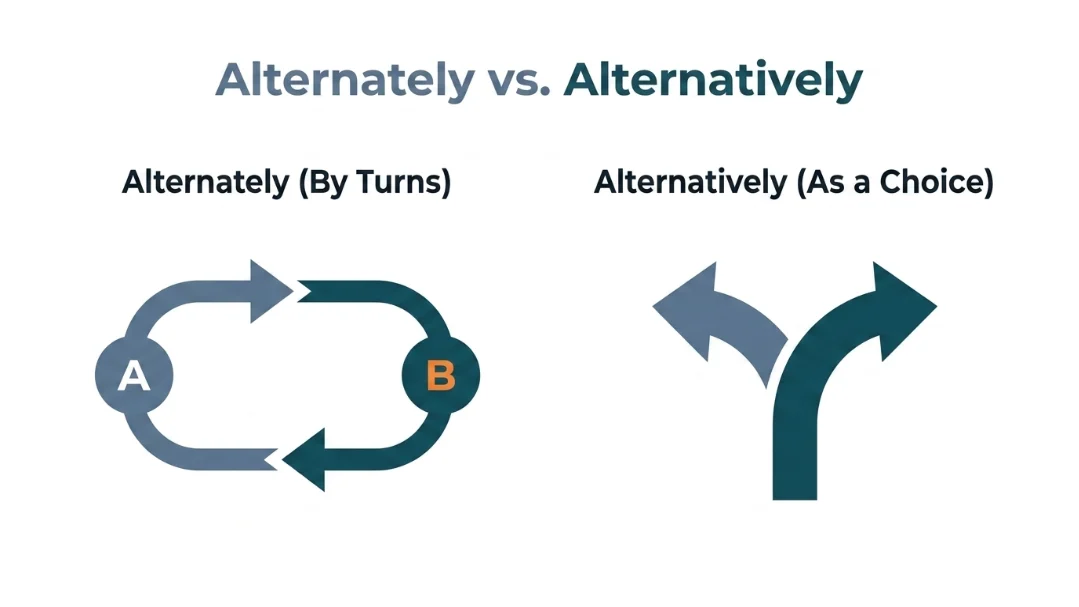
The primary difference between alternately and alternatively lies in how things switch or offer choices. Use alternately when two things succeed each other by turns in a repeating pattern. Conversely, use alternatively when you are presenting a choice between two or more mutually exclusive options.
Choosing between alternately and alternatively puzzles many writers, students, and professionals. Because these two words look and sound remarkably similar, people frequently swap them by accident. However, using the wrong term can completely change the meaning of your sentence and confuse your reader.
This common linguistic trap occurs because both words share the same Latin root, alternare, which means to do things by turns. Over time, English speakers split the words into two distinct paths of meaning. One word now tracks time and repeating patterns, while the other tracks decision-making and possibilities.
Understanding this distinction allows you to communicate with absolute precision in your emails, essays, and creative projects. Misusing these terms can make your writing appear unpolished, even if your underlying ideas are brilliant. Therefore, mastering their individual roles is a vital step toward professional communication. This comprehensive guide will break down the grammar, mechanics, and regional variations of alternately or alternatively to ensure you always pick the perfect word.
If you need a quick memory trick to keep these terms straight, focus on the core function of each adverb.
- Alternately equals “by turns.” It describes a back-and-forth action, like a light flashing on and off.
- Alternatively equals “as an option.” It introduces a backup plan, a substitute, or a different choice.
Pattern / Sequence:  [Thing A] ➔ [Thing B] ➔ [Thing A] ➔ [Thing B]  = Alternately
Fork in the Road:    [Path A]  OR  [Path B]                          = Alternatively
By keeping this structural difference in mind, you can instantly analyze your sentence to see if you are describing a moving sequence or a static list of choices.
Definition / Explanation
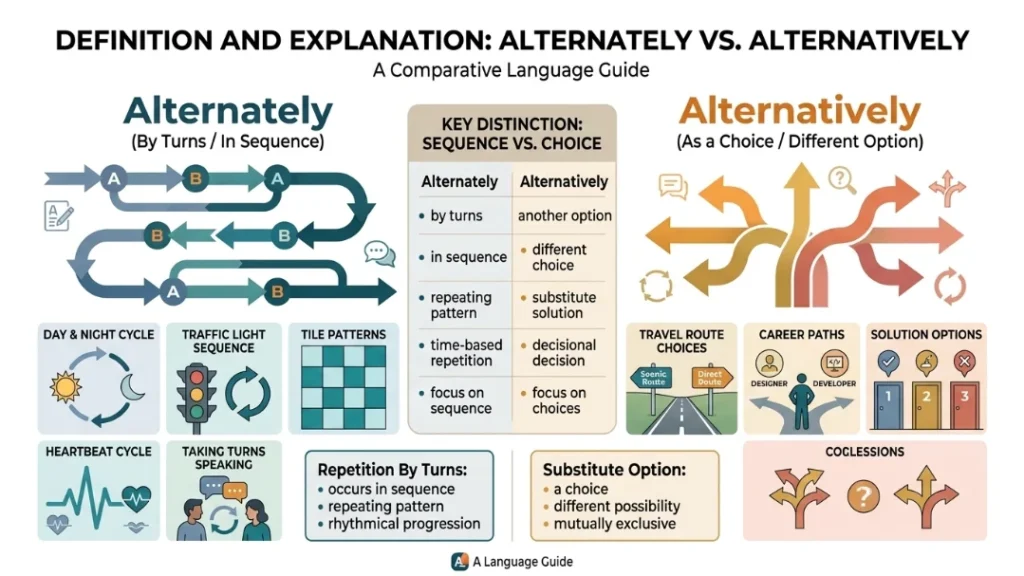
To build a strong foundation, let us look at the formal definitions and grammatical profiles of each word.
Understanding Alternately
The word alternately functions as an adverb that modifies verbs, adjectives, or other adverbs. It describes a strict chronological sequence where two or more states, actions, or things follow each other repeatedly.
When a process occurs alternately, it moves back and forth rhythmically. There is no choice involved in this word; rather, it describes an inevitable loop or chain of events. For instance, the seasons follow each other by turns, just as a heart contracts and relaxes.
Understanding Alternatively
The word alternatively functions as a conjunctive adverb or a regular adverb. It signals that a new, distinct option is being introduced as a substitute for a previous statement.
When you use alternatively, you are presenting a fork in the road for your reader or character. The options might be actions, objects, or entire philosophies. Crucially, these options are usually mutually exclusive, meaning you can choose one or the other, but rarely both at the same time.
Advantages and Disadvantages of Precise Usage
Using alternately or alternatively with high accuracy brings major benefits to your writing, though it requires conscious mental effort.
Advantages of Precision
First and foremost, semantic accuracy eliminates ambiguity in professional documentation. If a technical manual states that a machine runs alternately on electricity and gas, the technician knows the machine switches automatically.
Additionally, using these words correctly enhances your professional credibility. Editors, educators, and clients notice when a writer maintains a high standard of vocabulary usage. Consequently, your arguments carry more weight because your prose feels authoritative.
Disadvantages of Carelessness
On the flip side, mixing up these terms can cause real-world confusion. If a travel itinerary says you can alternately take a train or a bus to the hotel, it technically implies you must ride both by turns.
Furthermore, relying on repetitive explanations to avoid these words entirely can make your sentences long and clunky. Writers who feel unsafe using these adverbs often default to wordy phrases like “on the other hand as a different choice,” which slows down the reading pace.
Real-World Examples
To solidify your understanding, let us examine how these words perform in everyday sentences across various industries.
Examples of Alternately in Action
- The digital billboard displayed the current time and the local temperature alternately every five seconds.
- Throughout the tense meeting, the manager looked alternately hopeful and deeply worried.
- During the workout, the athletes ran fast for two minutes and alternately walked for one minute to recover.
In each of these scenarios, an ongoing loop or sequence takes place over a period of time.
Examples of Alternatively in Action
- We could host the annual summer company picnic at the public park; alternatively, we could rent a private boat.
- You may submit your monthly expense reports through our online portal, or alternatively, you can email them to human resources.
- The recipe calls for fresh buttermilk, but alternatively, you can use whole milk mixed with a teaspoon of lemon juice.
These sentences do not describe a repeating loop. Instead, they offer a clear alternative path to achieve a goal.
Comparative Analysis Table
This table highlights the structural, conceptual, and grammatical boundaries between the two words.
| Feature | Alternately | Alternatively |
| Primary Meaning | In a successive manner; by turns. | As another choice; as an option. |
| Core Concept | Time, pattern, and repetition. | Choice, decision, and substitution. |
| Synonyms | Reciprocally, sequentially, in turns. | Instead, on the other hand, otherwise. |
| Sentence Position | Usually middle or end of a sentence. | Often begins a sentence or clause. |
| Visual Metaphor | A swinging pendulum. | A fork in the road. |
Regional and Global Usage Variations
Language is fluid, and the rules surrounding alternately or alternatively shift depending on where you are in the world.
British and Commonwealth English Standards
In British English, Australian English, and other Commonwealth styles, the line between these two words remains very strict. Speakers and style guides in these regions fiercely protect the individual definitions.
Using alternately to mean “as a choice” is widely viewed as a clear grammatical error in the United Kingdom. Because of this cultural standard, publishing houses and universities across Europe demand total adherence to the traditional separation.
American and Canadian English Shifts
In contrast, North American English shows a higher tolerance for overlap, though formal style guides still fight against it. Some American dictionaries list alternately as a secondary definition for alternatively.
Despite this dictionary acknowledgment, professional US publications like The New York Times or academic journals still enforce the classic rule. Therefore, sticking to the precise definitions remains the safest approach for global business and academic success, regardless of your geographic location.
Common Mistakes and How to Fix Them
Reviewing frequent errors helps illuminate the mental shortcuts that lead to bad grammar. Let us look at three common blunders and their easy corrections.
Mistake One: The Wrong Choice
Incorrect: You can buy the blue sweater, or alternately, you can select the red one.
Because you are choosing between two garments, you are not switching back and forth between them in a time loop.
Correct: You can buy the blue sweater, or alternatively, you can select the red one.
Mistake Two: The Broken Loop
Incorrect: The flashing emergency lights gleamed alternatively red and blue.
The lights are not choosing between being red or blue as a lifestyle option. They are flashing in a sequential pattern over time.
Correct: The flashing emergency lights gleamed alternately red and blue.
Mistake Three: Redundant Overloading
Incorrect: Alternatively, you could also otherwise choose to walk home.
This sentence piles up three different words that all mean the same thing, creating a wall of unnecessary text.
Correct: Alternatively, you could walk home.
Exercises with Answers
Test your knowledge with these practical exercises. Fill in the blanks with either alternately or alternatively, then check your reasoning using the answer key below.
Practice Sentences
- The long-distance relationship filled her with feelings of joy and sadness __________.
- We can cook a homemade lasagna tonight; __________, we can order food from the Italian restaurant down the street.
- The museum group tour runs on Tuesdays and Thursdays; __________, you can download our audio guide and explore the exhibits alone.
- To keep the children entertained during the long rainy afternoon, the teacher read a story and __________ played a short musical game.
- If the primary software server fails to launch, the system will __________ attempt to connect to the secondary backup cloud.
- He adjusted the thermostat because he felt __________ boiling hot and freezing cold throughout the night.
Answer Key and Explanations
- Alternately. The emotions are cycling back and forth over time.
- Alternatively. This presents a distinct choice between cooking or ordering takeout.
- Alternatively. The visitor must choose between the group tour or the self-guided audio tour.
- Alternately. The teacher moved from one activity to the next in a sequential pattern.
- Alternatively. The system is looking for a backup choice because the first option failed.
- Alternately. The person’s physical state is fluctuating in a repeating loop of discomfort.
Related Concepts and Comparisons
To deepen your understanding of alternately or alternatively, it helps to compare them to other closely related vocabulary words.
Alternate versus Alternative
These two adjectives serve as the base forms for our adverbs, and they follow identical rules. An alternate route is a backup path that takes turns with the main path, or it can mean every second option in a line.
An alternative lifestyle represents a complete choice outside the mainstream norm. If you have an alternate plan, it often implies a rotation, whereas an alternative plan means a completely fresh choice.
Instead versus Alternatively
While both words introduce a substitute, their placement and tone differ significantly in professional writing. Instead often carries a slight tone of rejection toward the first option, and it usually requires the preposition “of” when linking ideas.
Alternatively acts as a smoother, more neutral bridge between two valid possibilities. It allows both options to look attractive, leaving the decision entirely up to the reader.
Deep Dive: Semantic History and Etymology
Exploring history reveals how these words wound up causing so much confusion in modern English. Both terms trace their ancestry back to the ancient Indo-European root al-, which meant “beyond” or “other.” This root evolved into the Latin word alter, meaning “the other of two.”
During the Middle Ages, Old French adopted these terms before passing them into the English language. Originally, the word alternate strictly kept the meaning of performing an action by turns, mimicking the agricultural cycle of leaving fields fallow every second year.
During the twentieth century, the demands of rapid corporate communication caused writers to look for a word that sounded grander than “or.” Consequently, people began using alternately as a fancy substitute for choices, sparking the modern grammatical debate we face today.
FAQs
Here are direct, actionable answers to the most common questions regarding these two tricky adverbs.
What is the easiest way to remember the difference between alternately and alternatively?
Think of the word alternator in a car engine, which constantly spins around to generate electricity in a repeating loop. Match that mental image of a loop to alternately, while saving alternatively for times when you need an alternative choice.
Can I start a sentence with the word alternately?
Yes, you can start a sentence with this word, provided you are describing an action that happens by turns. For example, you might write: “Alternately, the dancers stepped forward and backward to the rhythm of the music.”
Is it grammatically correct to use alternatively instead of on the other hand?
Yes, alternatively serves as an excellent, professional substitute for the phrase on the other hand. It sounds highly polished in business proposals and academic research papers when presenting secondary options.
Why do some dictionaries say these words can be used interchangeably?
Certain modern dictionaries practice descriptive lexicography, meaning they record how people actually speak, even if the usage is technically flawed. However, formal style guides still reject this interchangeability, so you should keep them separate in professional environments.
Which word should I use when offering a backup plan in a business proposal?
You must use alternatively when presenting a backup plan to a client. This tells the client that they have a clear, secondary choice to consider if the first plan does not meet their budget.
Can alternately apply to a sequence that involves three or more items?
Yes, alternately can apply to a larger sequence, as long as the items follow a strict, repeating cycle. For example, a fabric pattern can feature stripes of red, white, and blue running alternately across the material.
What happens if I misuse alternatively in a legal contract?
Misusing this word in a contract can create dangerous legal loopholes. If you accidentally write alternatively when you mean alternately, a contractor might think they can choose to skip a mandatory recurring maintenance cycle.
Is the word alternatively considered too informal for academic writing?
No, alternatively is perfectly suited for academic essays, scientific reports, and philosophical treatises. It helps researchers introduce secondary hypotheses or different interpretations of data in a structured manner.
What is a common synonym for alternatively that does not start with the letter A?
The most common and effective synonym is the word otherwise. Other strong choices include conversely, instead, or the classic phrase as a substitute.
Conclusion
Mastering the difference between alternately or alternatively is a simple yet powerful way to elevate the quality of your writing. By paying attention to whether your sentence describes a recurring time pattern or a static list of options, you can easily select the correct term every time.
Remember that alternately tracks a rhythmic, back-and-forth movement through time, while alternatively opens the door to a fresh choice or an intellectual detour. Consistently applying these rules prevents costly communication errors and ensures your voice remains authoritative, precise, and professional.
If you ever feel uncertain during a fast-paced writing session, take a brief moment to strip the sentence down to its core meaning. Substitute the phrase “by turns” into your sentence; if it makes perfect sense, use alternately. If it sounds strange, drop in the phrase “as another option,” and confidently choose alternatively to guide your reader forward.