When you are writing a story, giving instructions, or mapping out a timeline, tracking the order of events is crucial. The word “next” is one of our primary tools for keeping things moving forward. However, leaning on “next” too heavily as a transitional crutch can cause your sentences to sound repetitive, choppy, or overly simplistic.
To elevate your prose, it helps to understand that the best synonyms for next change dramatically depending on whether you are talking about physical location, an upcoming moment in time, or the logical step in a list of instructions.
Best Synonyms for Next
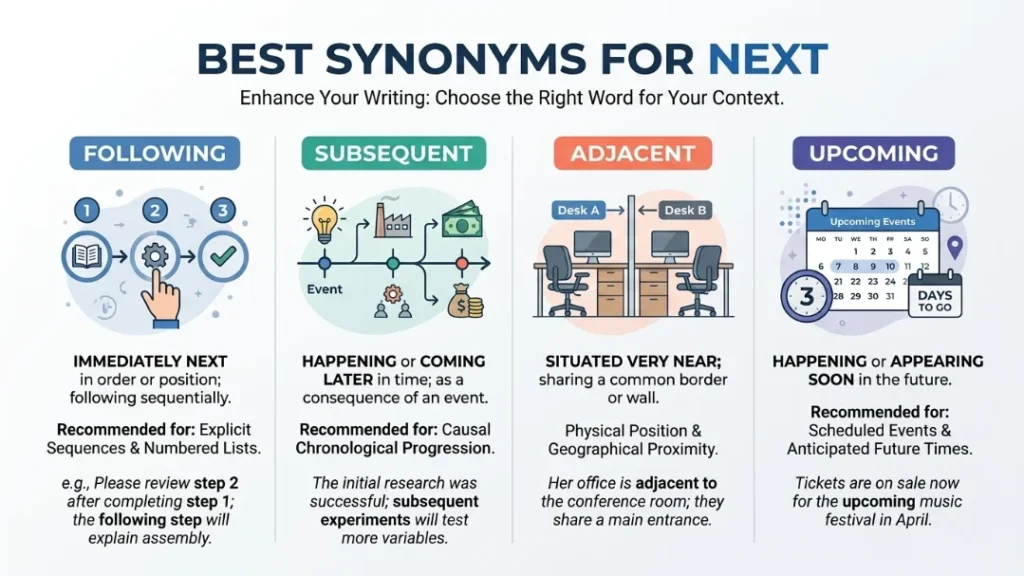
The best synonyms for next are following, subsequent, adjacent, and upcoming. The right choice depends on tone, context, and intensity.
- If you mean something that comes immediately after in a sequence, use following.
- If you mean an event occurring later in time or as a result, use subsequent.
- If you mean something located physically right beside something else, use adjacent.
- If you mean an event that is about to happen soon, use upcoming.
What Does Next Mean?
Before choosing an alternative, you must examine how the word “next” functions across different sentences. “Next” can act as an adjective, an adverb, or a noun, serving three main concepts:
- Coming immediately after the present one in time, order, or space.
- Nearest in position or location; directly adjacent.
- The very first occasion after the current moment.
Next Usage
Because of these diverse roles, “the next street” can refer to a physical location, while “the next step” refers to a procedural action.
- Example 1: We will discuss the new budget constraints during our next weekly meeting.
- Example 2: Please step into the next room so the doctor can review your medical charts.
Core Meaning of Next
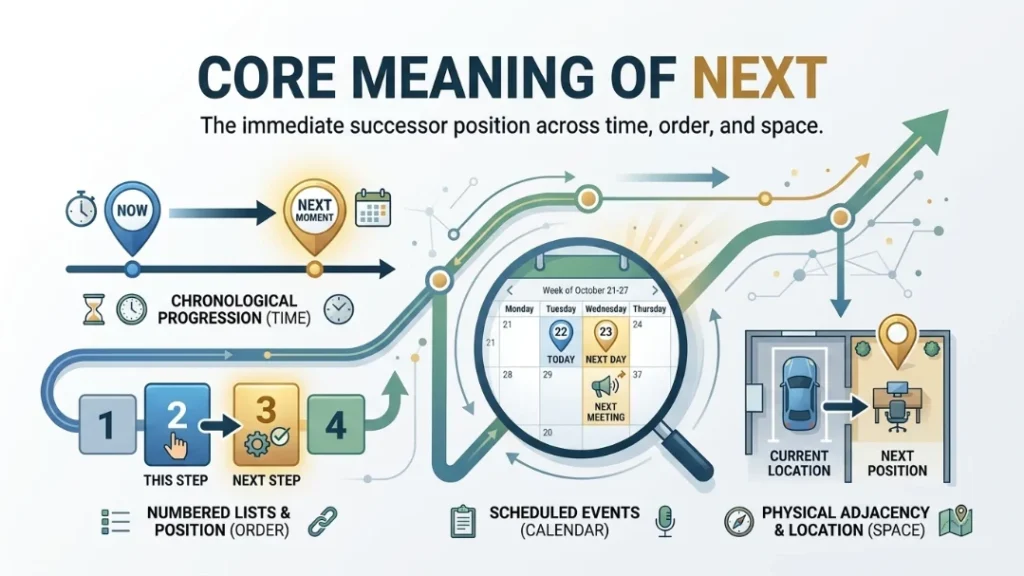
At its heart, the word “next” establishes a direct connection between two points. It acts as a bridge that eliminates gaps, pointing to the immediate successor in a line, a schedule, or a physical space. When something is next, there are no intervening elements between it and the starting point; it holds the frontline position for what happens or appears afterward.
Grammar and Usage Notes
Because “next” can pivot between an adjective, an adverb, and even a preposition, you must ensure your chosen synonym matches its exact grammatical slot.
Common Sentence Patterns
- As an Adjective (modifying a noun): The next train arrives at noon.
- As an Adverb (modifying a verb or clause): Turn left, and next add a pinch of salt.
- As a Prepositional Phrase: The parking lot is located next to the grocery store.
Common Phrases or Collocations
- Next door: The house or apartment immediately adjacent.
- Next in line: The person holding the position to receive something immediately after the current person.
- Next best thing: The top alternative choice if your first option is unavailable.
When to Replace the Word
“Next” works beautifully in rapid speech and basic step-by-step lists. However, it can lack sophistication in analytical essays or narrative fiction. Swapping “next” for a word like “subsequent” adds an analytical tone to reports, while words like “adjacent” bring greater descriptive precision to spatial layouts.
Best Synonyms for Next
The table below breaks down the top alternatives for “next,” categorized by their precise definitions and ideal applications.
| Synonym | Meaning | Tone | Best Use Case | Example Sentence |
| Following | Coming immediately after another in time, order, or logic. | Neutral | Transitional clauses, dates, or sequences. | The following morning, the storm cleared up entirely. |
| Subsequent | Coming after something else in time; following as a result. | Formal | Formal reports, history, or academic texts. | Subsequent investigations revealed serious technical glitches. |
| Adjacent | Next to or adjoining something else physically. | Neutral / Professional | Architecture, real estate, or spatial descriptions. | The lab is located in the building adjacent to the main library. |
| Upcoming | Happening or appearing soon in the near future. | Neutral | Event planning, media releases, or schedules. | The community center posted a flyer listing all upcoming events. |
| Ensuing | Happening afterward or as a direct consequence of an event. | Formal / Literary | Narrative transitions or impact statements. | In the ensuing chaos, several key files were misplaced. |
Common Synonyms for Next
These everyday options are excellent for smooth transitions, casual business emails, and standard storytelling where you want to keep your prose clear and scannable.
Following
- Meaning: Coming immediately after a specified point in time or order.
- Best Context: Describing dates, bulleted lists, or steps that come right after the current one.
- Example: If you cannot attend the Monday session, please join the following class on Wednesday.
Upcoming
- Meaning: About to happen or appear in the near future.
- Best Context: Announcements, marketing campaigns, product launches, or calendar invites.
- Example: The band announced the dates for their upcoming summer concert tour.
Succeding
- Meaning: Coming after something else, especially taking the place of a predecessor.
- Best Context: Discussing political terms, corporate leadership, generations, or structured steps.
- Example: Each succeeding generation builds upon the technological progress of the past.
Formal Synonyms for Next
When drafting an academic essay, legal brief, scientific summary, or corporate analysis, you need precise transitions that sound objective and measured.
Subsequent
- Meaning: Occurring or coming later in a sequence of time.
- Best Context: Chronicling study phases, documenting evidence, or analyzing economic trends.
- Example: The initial test failed, but subsequent trials showed excellent progress.
Adjacent
- Meaning: Sharing a common border or physically sitting right next to an object.
- Best Context: Professional property descriptions, scientific diagrams, geography, or floor plans.
- Example: The server room must be located adjacent to the main IT workspace.
Proximate
- Meaning: Closest in relationship, space, or time; immediate.
- Best Context: Legal arguments, philosophical texts, data proximity analysis, or causal chains.
- Example: The court determined that reckless driving was the proximate cause of the accident.
Consecutive
- Meaning: Following continuously and in unbroken mathematical or chronological order.
- Best Context: Tracking data over time, record-breaking streaks, or meeting schedules.
- Example: The retail company reported record-high profits for four consecutive quarters.
Informal Synonyms for Next
Casual alternatives and conversational phrasing inject life and natural rhythm into dialogue, casual blogging, and personal notes.
Down the line
- Meaning: At a future point in time; further along a sequence or path.
- Best Context: Discussing long-term plans, potential future issues, or relaxed predictions.
- Example: We don’t need to purchase a new printer now, but we will have to buy one down the line.
Up next
- Meaning: The very next item, performer, or event scheduled to appear on a program.
- Best Context: Media broadcasting, podcast transitions, sports commentary, or casual agendas.
- Example: That wraps up our weather report; up next, we have our evening sports segment.
After this
- Meaning: Directly following the completion of the current task or event.
- Best Context: Chatting about immediate daily plans, casual schedules, or texting friends.
- Example: I need to finish washing the dishes, but after this, we can watch a movie.
Strong Synonyms for Next
When you want to convey a sense of absolute certainty, relentless progression, or direct consequence, these synonyms add extra weight and narrative momentum.
Imminent
- Meaning: About to happen at any moment; overhanging dangerously or decisively.
- Best Context: Storm warnings, market shifts, critical arrivals, or high-stakes scenarios.
- Example: The dark, heavy clouds overhead indicated that a massive downpour was imminent.
Consecutive
- Meaning: Unbroken and relentless in sequential order, leaving zero gaps between steps.
- Best Context: Emphasizing long streaks of work, repetitive issues, or continuous successes.
- Example: Working twelve consecutive days without a break left the entire medical team exhausted.
Resulting
- Meaning: Occurring as an immediate logical consequence or outcome of a previous event.
- Best Context: Connecting cause and effect directly within scientific, mechanical, or tragic sequences.
- Example: The main water pipe burst, and the resulting flood damaged the entire basement floor.
Mild Synonyms for Next
If you want to keep your tone understated, casual, or flexible without forcing an absolute, immediate connection, use these softer options.
Later
- Meaning: At a time in the future after the current moment, but not necessarily immediately after.
- Best Context: Leaving schedules open, flexible planning, or low-stakes timelines.
- Example: We can tackle the formatting details later once the core text is approved.
Future
- Meaning: Characterized by happening or existing in a time that is still to come.
- Best Context: Abstract brainstorming, corporate vision statements, or general predictions.
- Example: The management team meets tomorrow to outline our future goals for the year.
Auxiliary
- Meaning: Providing supplementary or secondary help; the alternative option sitting in reserve.
- Best Context: Systems engineering, standby personnel, or backup operational steps.
- Example: If the primary engine shuts down, the auxiliary power system kicks in next.
Synonyms for Next by Context
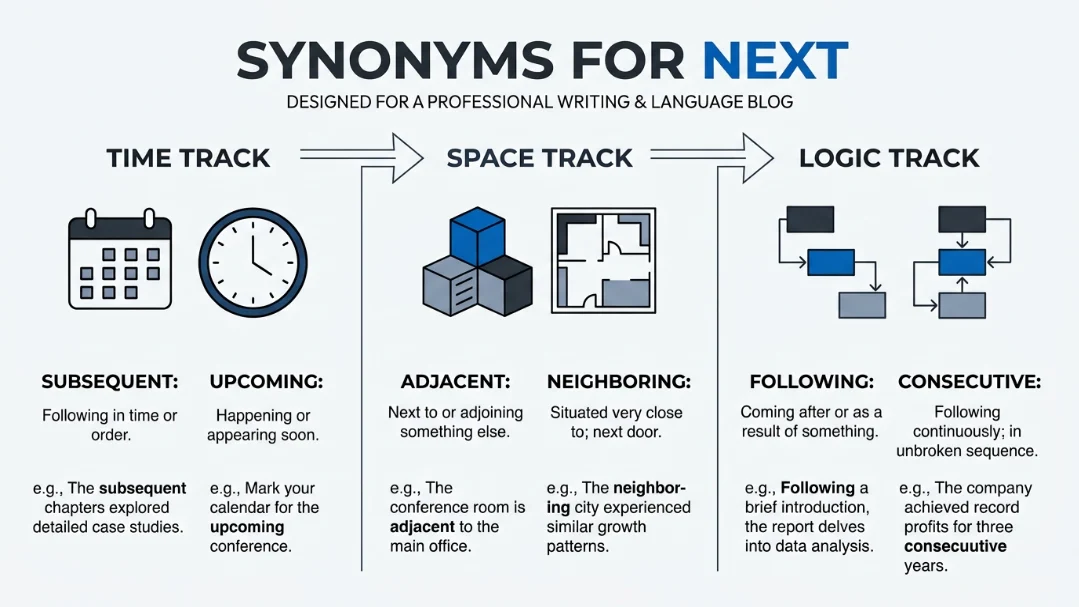
Selecting the ideal synonym requires knowing whether you are measuring physical distance, mapping out time, or linking ideas logically.
Spatial and Physical Layouts
When you are describing a room, a campus map, or a physical arrangement of items, using “next” can sound vague. You want words that clarify geometry.
- Adjacent: Use when two rooms or lots share a wall or boundary (e.g., “the adjacent courtyard”).
- Neighboring: Perfect for geography, cities, or houses on a street (e.g., “neighboring towns”).
Temporal and Time-Based Progressions
When you are moving the clock forward in a narrative, scheduling appointments, or mapping milestones, focus on the passage of time.
- Subsequent: Excellent for showing that an event happened later in a timeline (e.g., “subsequent developments”).
- Upcoming: Best for looking forward from the present moment to a scheduled event (e.g., “upcoming release”).
Logical and Procedural Steps
If you are writing a user manual, a recipe, or a coding tutorial, your words must show step-by-step logic.
- Following: Keeps the reader moving in an orderly, vertical sequence (e.g., “perform the following actions”).
- Thereupon: A classic literary or formal choice meaning “immediately after that” (e.g., “he signed the contract, and thereupon left”).
Another Word for Next in a Sentence
Observe how swapping out “next” for alternative terms sharpens the clarity and changes the style of these sentences:
- Following: The following chapter details the exact methodology used in our field research.
- Subsequent: Her first novel was a quiet success, but her subsequent books became global bestsellers.
- Adjacent: We parked our car in the lot adjacent to the crowded concert stadium gates.
- Upcoming: The manager reminded everyone to log their vacation days before the upcoming holiday weekend.
- Ensuing: A sudden power outage struck the theater, and in the ensuing dark, everyone scrambled for their phones.
- Succeeding: The retiring CEO spent months mentoring the succeeding executive director.
- Consecutive: The star athlete won the regional championship title for three consecutive years.
- Proximate: The safety inspectors discovered that a loose wire was the proximate cause of the electrical fire.
- Imminent: The base commander ordered all troops to take cover, warning that an attack was imminent.
- Resulting: The city cut funding for the park, and the resulting neglect led to overgrown pathways.
- Later: I have a meeting right now, but I will review your design drafts later this afternoon.
- Future: The urban planners designed the bridge to handle both current traffic and future expansions.
- Neighboring: Sound from the concert hall carries easily into the neighboring apartment buildings.
- Consequent: The heavy rainfall triggered mudslides and consequent highway closures across the county.
- Afterward: We enjoyed a wonderful dinner at the bistro and went for a long walk afterward.
Next Synonyms Compared
Let’s look at closely related alternatives to ensure you do not use them incorrectly.
Following vs. Subsequent
While both words indicate that something comes after, following typically implies an immediate chronological connection with zero gaps (e.g., the following day means the very next day). Subsequent is broader; it simply means occurring later in time or sequence, and it often hints at a causal relationship (e.g., subsequent changes could happen weeks after the initial event).
Adjacent vs. Neighboring
Adjacent means things are touching or sharing an exact common boundary line, wall, or vertex. Neighboring implies close proximity within a general area but does not strictly require physical contact. Two houses can be neighboring houses on the same block without being directly adjacent to one another.
Words Similar to Next
These terms are related to the concept of progression and sequence but cannot always serve as absolute drop-in replacements for “next.”
Closer
- Why it is related: It describes something that reduces the spatial or temporal distance to a target.
- Why it cannot directly replace it: “Next” means the absolute first position in line. “Closer” is a comparative adjective that indicates a shift in position but does not mean you have reached the immediate neighboring spot (e.g., moving closer vs. moving next to).
Alternative
- Why it is related: It points to the another available choice in a list or strategy.
- Why it cannot directly replace it: “Next” implies an orderly, chronological sequence. An “alternative” is a choice that can replace the primary option entirely, breaking away from the sequential order (e.g., the next choice vs. an alternative choice).
Antonyms of Next
When you need to turn the arrow around and look backward in time, space, or sequence, rely on these antonyms.
Previous
- Meaning: Existing or occurring before in time, order, or position.
- Example Sentence: Please make sure you have read the previous chapter before starting this one.
Preceding
- Meaning: Coming or happening immediately before the current item or event.
- Example Sentence: The summary on the preceding page outlines our core financial findings.
Former
- Meaning: Denoting the first of two people or things mentioned, or referring to an earlier past state.
- Example Sentence: The former strategy was highly effective, but the new market requires a different approach.
Prior
- Meaning: Existing or coming before in time, importance, or order.
- Example Sentence: The applicant had no prior experience in customer service but interviewers liked her enthusiasm.
How to Choose the Right Synonym for Next
To keep your transitions sharp, run through these quick decisions before selecting a word:
- Identify the axis: Are you talking about space (use adjacent or neighboring), time (use upcoming or subsequent), or instructions (use following or consecutive)?
- Evaluate the consequence: Did the event happen because of what came before it? If yes, terms like resulting or ensuing tell that story much better than “next.”
- Match your sentence’s grammar: If replacing “next to,” you must use a phrase like adjacent to or beside. If replacing a transitional adverb, use subsequently or following this.
- Check the urgency: If something is about to happen in seconds, use imminent. If it is simply scheduled for later on a calendar, stick to upcoming.
Common Mistakes When Using Synonyms for Next
Watch out for these vocabulary slip-ups to ensure your writing flows naturally:
- Using “subsequent” when you mean “consecutive”: Saying you visited a gym on “three subsequent days” means you went three times later on, but not necessarily in an unbroken row. Use consecutive to show an unbroken streak.
- Using spatial words for time-based items: Do not write that an event is “adjacent on the schedule.” While clear, it sounds clunky. Use next on the schedule or following on the calendar.
- Misplacing “imminent” for general plans: Do not announce an “imminent product launch” if the item is coming out in six months. Imminent means it is happening right away; use upcoming for distant calendar items.
Quick Synonym List for Next
Use this flat list for quick, scannable reference while editing your work:
- Common Synonyms: Following, upcoming, succeeding, later, after this.
- Formal Synonyms: Subsequent, adjacent, proximate, consecutive, ensuing.
- Informal Synonyms: Up next, down the line, trailing, after.
- Strong Synonyms: Imminent, consecutive, resulting, close-coupled.
- Mild Synonyms: Later, future, secondary, auxiliary.
- Related Words: Alternate, closer, subsequent, backward.
FAQs
What is the best synonym for next?
The best choice depends on context. For timelines and lists, following is the top choice. For physical spaces, adjacent works best, and for future events, use upcoming.
Is “subsequent” the same as “next”?
They are highly similar, but next usually implies the absolute immediate item in line with no gaps. Subsequent simply means occurring at a later time, whether it happens minutes or weeks afterward.
What is a formal word for “next to”?
The most accurate formal alternative for the physical preposition “next to” is adjacent to or proximate to.
Can I use “imminent” to mean next?
Only if the upcoming event is about to happen immediately or dangerously. For example, “an imminent storm” means the storm is arriving at any moment.
What is the opposite of next?
The primary antonyms for next are previous, preceding, prior, and former.
How do I avoid repeating “next” in a list of steps?
Vary your transitions by using sequential adverbs such as following this, subsequently, then, afterward, or consecutively.
Conclusion
The word “next” is incredibly handy, but using it repeatedly turns your writing into a monotonous march. By identifying whether your sequence is rooted in time, space, or cause-and-effect logic, you can easily deploy sophisticated alternatives like subsequent, adjacent, following, or ensuing.
Keep your tone consistent and verify your sentence structures. Choosing the precise synonym keeps your readers oriented, clarifies your timeline, and ensures your prose moves forward smoothly and professionally.