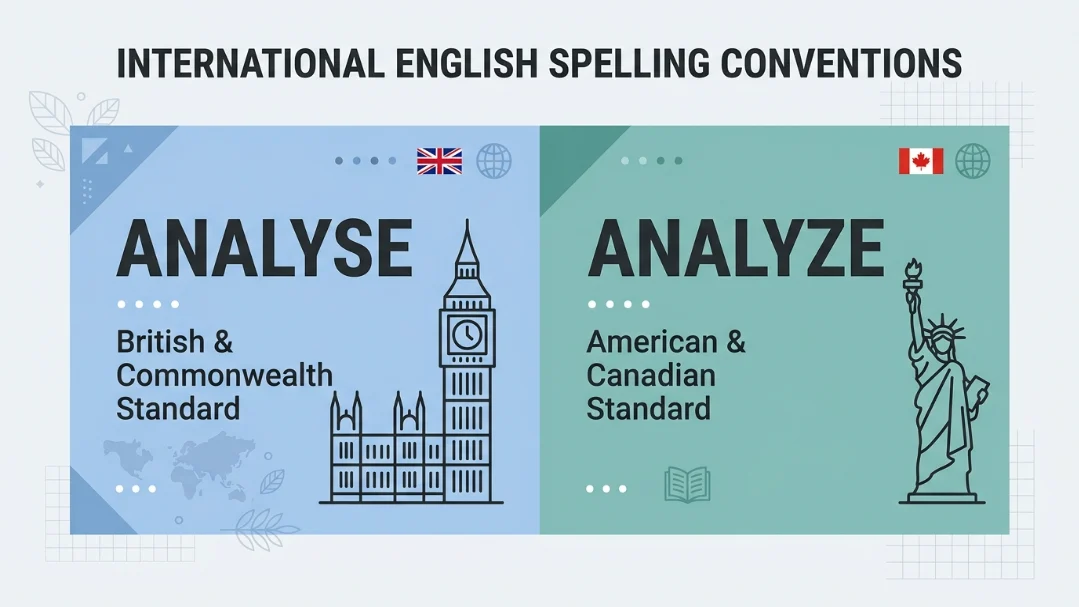
The primary difference between analyse or analyze depends entirely on your geographical target audience and regional spelling conventions. “Analyze” with a “z” serves as the standard spelling in American and Canadian English, whereas “analyse” with an “s” functions as the accepted form in British, Australian, New Zealand, and South African English. Despite this single letter variation, both spellings share an identical meaning, pronunciation, and grammatical purpose across the globe.
Global digital communication requires a sharp eye for linguistic details, especially when navigating regional variations like analyse or analyze. Choosing between these two spelling variants often frustrates content creators, business professionals, and academic researchers alike. Consequently, writers frequently worry that using the incorrect version will alienate readers or hurt their credibility with international audiences.
The core issue stems from historical shifts in how the English language evolved on different sides of the Atlantic Ocean. While Noah Webster championed the phonetic “z” in North America during the nineteenth century, British lexicographers chose to preserve the traditional “s” ending. Therefore, knowing your audience’s location forms the most critical factor when deciding which variant to deploy in your work.
This comprehensive guide removes all confusion by breaking down regional rules, real-world data, and actionable editing workflows. By mastering these differences, you can protect your brand authority and maximize your search engine optimization potential across global markets. Let us dive deep into the specific rules that govern this ubiquitous verb.
If you need a reliable mental shortcut to remember the rule, think of geographic alignments. Use the “z” spelling when writing for readers in the United States and Canada, but default to the “s” spelling when publishing content for the rest of the English-speaking world.
The following summary table outlines the essential differences between the two terms to give you an immediate visual overview:
| Primary Region | United Kingdom, Australia, New Zealand, South Africa | United States, Canada |
| Dictionary Standard | Oxford, Cambridge, Macquarie | Merriam-Webster, American Heritage |
| Derived Noun Form | Analysis (Universal across all regions) | Analysis (Universal across all regions) |
| Derived Adjective Form | Analytical / Analytic | Analytical / Analytic |
| Past Tense Variant | Analysed | Analyzed |
| Present Participle Form | Analysing | Analyzing |
Definition and Explanation
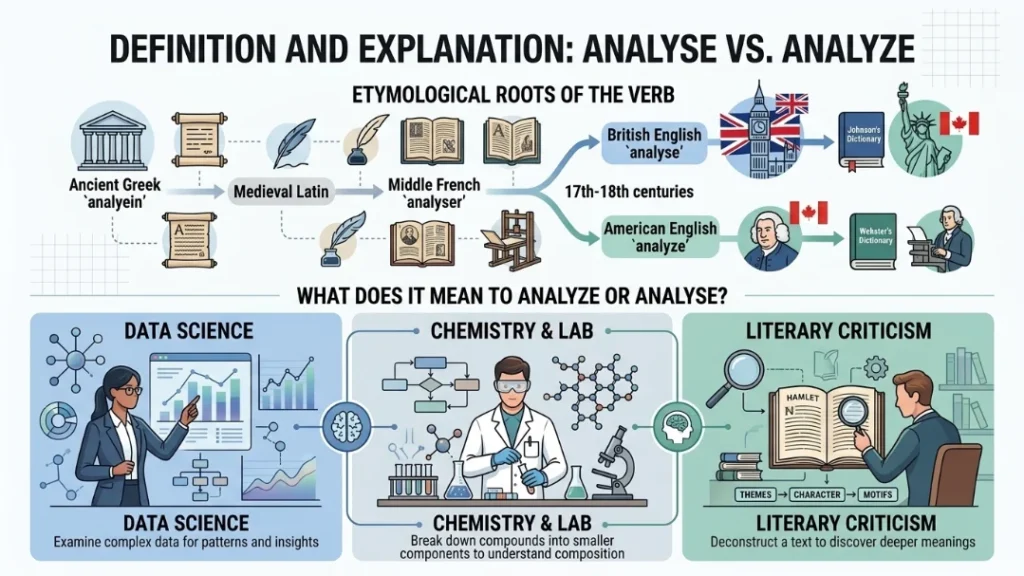
To understand why we choose analyse or analyze, we must explore the architectural history of the word itself. Understanding its etymological path helps writers appreciate how a single consonant split the English language into two distinct orthographic camps.
Etymological Roots of the Verb
The verb traces its origin back to the Greek word analyein, which literally translates to unloose, undo, or break down into constituent parts. This Greek root traveled through Medieval Latin and eventually entered Middle French as analyser. Because the French language utilized an “s” in the suffix, early British writers naturally adopted that specific visual layout when incorporating the word into their native vocabulary.
During the late eighteenth and early nineteenth centuries, American linguists began reassessing traditional spelling frameworks to simplify the language. They argued that the suffix pronounced as “ize” should visually reflect its phonetic reality. As a direct result, the American printing presses codified the “z” version, establishing a permanent stylistic boundary that remains active today.
What Does It Mean to Analyze or Analyse
Regardless of whether you choose to write analyse or analyze, the underlying cognitive action remains completely identical. The verb describes the meticulous process of breaking down a complex topic, dataset, or physical substance into smaller elements to gain a better understanding of its structure or behavior.
When a data scientist processes a spreadsheet, they evaluate trends. When a chemist inspects a blood sample, they identify compounds. Similarly, when a literary critic reviews a classic novel, they unpack the underlying themes. Accordingly, the word implies deep, methodical intellectual scrutiny rather than a casual, surface-level glance.
Advantages and Disadvantages of Precise Regional Usage
Adhering to strict localized spelling rules yields major benefits for corporate branding, audience engagement, and academic publishing. On the other hand, mixing your conventions randomly creates clear disadvantages that can undermine your overall messaging strategy.
Advantages of Correct Regional Targeting
Matching your spelling choice to your reader’s location creates an immediate, subtle sense of trust and familiarity. When a British reader encounters “analyse” on an e-commerce platform, they feel the content speaks directly to them. This seamless reading experience prevents cognitive interruptions, thereby allowing your target audience to focus entirely on your value proposition.
Furthermore, search engine algorithms are highly sophisticated systems that recognize regional user intent. By using localized variations, you optimize your digital assets for specific geographic search queries. Consequently, this strategic approach helps your articles rank more effectively in localized search results, driving higher quality organic traffic to your website.
Disadvantages of Inconsistent Spelling Patterns
Mixing spelling conventions within a single document signals a clear lack of professional quality control and editorial polish. If you write “analyze” in your introductory section but pivot to “analysed” in a later paragraph, readers will notice the inconsistency. As a consequence, this editorial sloppiness can cause users to question your attention to detail in other critical areas, such as product development or financial accounting.
In academic environments, regional inconsistency can lead to lower grades or journal rejection letters. Reviewers expect international submissions to adhere strictly to a single, coherent style guide, such as APA for American journals or Harvard style for British publications. Therefore, failing to lock down your spelling choices introduces unnecessary risks to your publication timeline.
Real-World Examples
To illustrate how these words behave in professional settings, we should examine their usage across various industries. Seeing the words in context clarifies their visual rhythm and reinforces correct deployment.
Examples of Analyse in British and Commonwealth Contexts
- The London-based financial advisory firm will analyse the quarterly market trends before recommending new asset allocations.
- Medical researchers in Sydney plan to analyse the genomic data of the patient cohort to identify rare genetic markers.
- To improve urban transport efficiency, the city council must carefully analyse traffic flow patterns at major intersections during rush hour.
- The literary professor asked the undergraduate students to analyse the underlying political metaphors in post-war British poetry.
Examples of Analyze in American and Canadian Contexts
- Software engineers in Silicon Valley will analyze the core system logs to detect potential cybersecurity vulnerabilities.
- Our marketing department needs to analyze user engagement metrics on social media to refine our upcoming product launch strategy.
- The federal agency will analyze soil samples from the agricultural zone to measure the long-term impact of synthetic fertilizers.
- Before signing the merger agreement, the corporate legal team must carefully analyze the target firm’s outstanding liabilities.
Regional and Global Usage Patterns
While the division between North America and the Commonwealth seems straightforward, global business environments often feature unique linguistic dynamics. Examining these patterns helps international writers navigate complex, cross-border corporate ecosystems.
The North American Standard
In the United States, writing “analyse” is universally viewed as an outright spelling error rather than an acceptable international variant. Corporate style guides, journalistic publications, and major universities accept only the “z” variant. Therefore, any digital content intended for an American audience must undergo strict filtering to remove the “s” spelling.
Canada presents a slightly more nuanced linguistic landscape due to its historical ties to the British Crown and its geographic proximity to the United States. While Canadian dictionaries acknowledge “analyse,” actual business and media organizations overwhelmingly prefer “analyze.” Consequently, Canadian writers generally align with their southern neighbors when producing professional copy.
The Commonwealth and International Framework
The United Kingdom remains the primary guardian of the “s” spelling convention, with major news outlets like the BBC enforcing it across all digital platforms. Australia and New Zealand follow the British standard closely, relying on the Macquarie Dictionary to cement “analyse” as their official national norm.
Interestingly, international organizations like the United Nations and the International Organization for Standardization (ISO) prefer Oxford spelling. This specific style guide pairs British grammatical rules with the phonetic “ize” suffix for words like “organize.” However, Oxford style still explicitly mandates the “s” spelling for analyse or analyze, making “analyse” the correct choice for international diplomacy texts.
Common Mistakes and Corrections
Even experienced professional editors can become confused when switching between global writing styles. Recognizing these common pitfalls allows you to build stronger quality assurance checkpoints into your content creation workflow.
The Analytical Trap
A highly frequent error occurs when writers assume that the spelling of the noun form determines the spelling of the verb form. Because the noun “analysis” always utilizes an “s” worldwide, American writers sometimes mistakenly carry that “s” over into the verb.
- Incorrect (US): We must analyse this data pipeline to find the operational bottleneck.
- Correct (US): We must analyze this data pipeline to find the operational bottleneck.
The Global Mix-Up
Another widespread mistake involves mixing American verb spellings with British past-tense inflections within the same body of text. This issue frequently happens when multiple authors collaborate on a single global project without establishing clear stylistic boundaries beforehand.
- Incorrect (UK): The laboratory team analyzed the first batch, but they have not yet analysed the second group.
- Correct (UK): The laboratory team analysed the first batch, but they have not yet analysed the second group.
Misapplying Phonetics in Commonwealth Copy
Writers who grew up consuming American media often accidentally inject the “z” variant into formal British or Australian communications. This subtle error often slips past basic spellcheck tools if the software is set to the wrong regional language profile.
- Incorrect (Australia): Financial planners must analyze the client’s current debt-to-income ratio.
- Correct (Australia): Financial planners must analyse the client’s current debt-to-income ratio.
Exercises with Answers
Practicing with targeted exercises helps train your brain to recognize regional spelling boundaries instantly. Complete the following ten sentences by selecting the correct option based on the specified regional target market.
Sentence Completion Tasks
- (Target Market: United Kingdom) The laboratory technician will __________ the liquid compound to determine its purity level.
- (Target Market: United States) Our software platform can __________ thousands of customer reviews in less than three seconds.
- (Target Market: Australia) Economists plan to __________ the latest employment figures to predict interest rate movements.
- (Target Market: Canada) The academic committee will __________ the survey responses before publishing the final report.
- (Target Market: United Kingdom) Having __________ the historical archives, the author discovered a completely new narrative thread.
- (Target Market: United States) The data team has __________ the website traffic logs to find out where users are dropping off.
- (Target Market: New Zealand) It is critical to __________ the soil quality before planting the new vineyard crops.
- (Target Market: United States) She loves to __________ classic literature to uncover hidden psychological archetypes.
- (Target Market: South Africa) The engineering firm must __________ the structural integrity of the bridge before reopening it.
- (Target Market: United States) We need an expert who can __________ our operational workflows to maximize corporate efficiency.
Answer Key and Detailed Explanations
- analyse | Explanation: The United Kingdom market requires the traditional British spelling that utilizes the “s” suffix.
- analyze | Explanation: The United States audience expects the standard American version containing the phonetic “z.”
- analyse | Explanation: Australian editorial standards rely on the Macquarie Dictionary, which strictly mandates the “s” form.
- analyze | Explanation: Canadian business and media channels overwhelmingly prefer the “z” format to align with North American norms.
- analysed | Explanation: Because the target market is the UK, the past participle must use the “s” spelling convention.
- analyzed | Explanation: The American audience requires the past participle form to feature the “z” configuration.
- analyse | Explanation: New Zealand orthography follows the British Commonwealth model, meaning the “s” variant is correct.
- analyze | Explanation: Writing for an American demographic requires standard US spelling rules across all literary analysis contexts.
- analyse | Explanation: South African English aligns directly with British standards, thereby making the “s” version necessary.
- analyze | Explanation: Standard American corporate communication demands the use of the “z” variant for present tense verbs.
Related Concepts and Comparisons
To fully master analyse or analyze, we should look at how it interacts with other words that undergo similar regional spelling transformations. This contextual mapping helps embed the underlying rule into your broader writing habits.
The British vs. American Suffix Rule
The choice between analyse or analyze is part of a larger structural pattern that divides British and American English. Most verbs that end in the phonetic sound of “ize” follow a predictable path. In the United States, these words always use “ize,” whereas in the United Kingdom, they can often use either “ise” or “ize.”
However, this flexibility does not apply to our focus keyword. While British writers can technically choose between “organise” and “organize,” they can never write “analyze” in a British context. The table below illustrates how different verbs handle these regional shifts:
| An-uh-lize | Analyse | Analyze | Strict (No blending allowed) |
| Or-guh-nize | Organise / Organize | Organize | Flexible in the UK only |
| Ree-uh-lize | Realise / Realize | Realize | Flexible in the UK only |
| Par-uh-lize | Paralyse | Paralyze | Strict (No blending allowed) |
Synonyms and Lexical Variety
When crafting deep content, using high-quality synonyms prevents your prose from sounding repetitive to the reader. Choosing the right synonym allows you to maintain precise semantic control while avoiding the constant repetition of analyse or analyze. Consider the following choices for your next project:
- Evaluate: Use this term when the primary goal involves judging the value, quality, or significance of a specific subject.
- Scrutinize: Deploy this word when you want to convey a sense of incredibly intense, critical, and hyper-detailed inspection.
- Examine: This serves as an excellent general-purpose option for looking at a topic closely to discover facts or reveal hidden patterns.
- Dissect: Choose this vivid verb when your process requires breaking down an idea or object into literal or metaphorical pieces.
FAQs
Here are actionable answers to the most common questions regarding these spelling variants:
Is analyze used in British English at all?
No, the “z” spelling is not used in formal British English. Major UK dictionaries and publishing houses classify it as an American variant, meaning you should strictly use “analyse” for British readers.
Why does the noun form analysis always use an s?
The noun form “analysis” always features an “s” because it comes directly from the original Greek noun analysis. Since the Greek root itself possessed an “s” in that position, all global variations of the English language preserved the spelling for the noun form.
Which spelling should I use for an international audience?
When writing for a truly global audience with no dominant country profile, you should choose one variant and maintain it consistently. Many international organizations prefer the British “s” version, but the most important factor is avoiding a mixture of both styles within the same document.
Does Microsoft Word automatically fix this spelling difference?
Microsoft Word will flag one of the versions as an error only if your regional language proofing tools are configured correctly. For instance, if your software language is set to English (United States), it will highlight “analyse” with a red underline.
How do Canadian universities handle these two spelling variants?
Canadian universities generally accept both forms, provided the student remains consistent throughout their entire assignment. However, because Canadian media leans heavily toward American spelling standards, many professors naturally prefer the “z” version.
Are there any pronunciation differences between analyse or analyze?
No, there is absolutely no difference in how these words are spoken aloud. Both variants use the exact same emphasis, phonetic structure, and vocal rhythm regardless of whether they are spelled with an “s” or a “z.”
Does using the wrong variant harm search engine rankings?
Using the wrong version will not trigger an automatic algorithmic penalty from search engines. However, it can hurt your localized user experience, which leads to lower dwell times and higher bounce rates that can indirectly drag down your visibility.
Which variant is preferred in scientific journals?
The correct choice depends entirely on the specific journal’s editorial office location and style manual. American publications like Science require the “z” variant, whereas British publications like Nature mandate the “s” variant.
Can I use both spellings in a single blog post?
No, you must never mix these spellings within a single piece of content. Doing so confuses your readers and signals a lack of professional editing, so you should always commit to one standard per article.
What is the past tense of analyse?
The past tense form of the British variant is “analysed,” while the past tense of the American variant is “analyzed.” Always ensure your past tense choice mirrors the regional suffix convention of your root verb.
Conclusion
Navigating the choice between analyse or analyze does not have to be a source of ongoing writing anxiety. By anchoring your decision in geographic targeting, you ensure your text always meets the expectations of your specific readers. Remember that the “z” belongs to North American channels, while the “s” serves the United Kingdom and the broader Commonwealth territories.
Maintaining absolute spelling consistency across your digital assets forms a vital component of professional brand management. When you protect the structural harmony of your copy, you build a stronger, more credible connection with your global audience. Furthermore, this attention to detail demonstrates a deep respect for your readers’ cultural norms and linguistic traditions.
To implement these rules effectively, we recommend updating your team’s internal style sheets and configuring your content management system’s proofing tools to match your core audience. Consistently applying these targeted standards will significantly polish your business reports, academic essays, and digital marketing campaigns. Commit to localized precision today, and watch your international communications achieve greater impact and authority across every market.