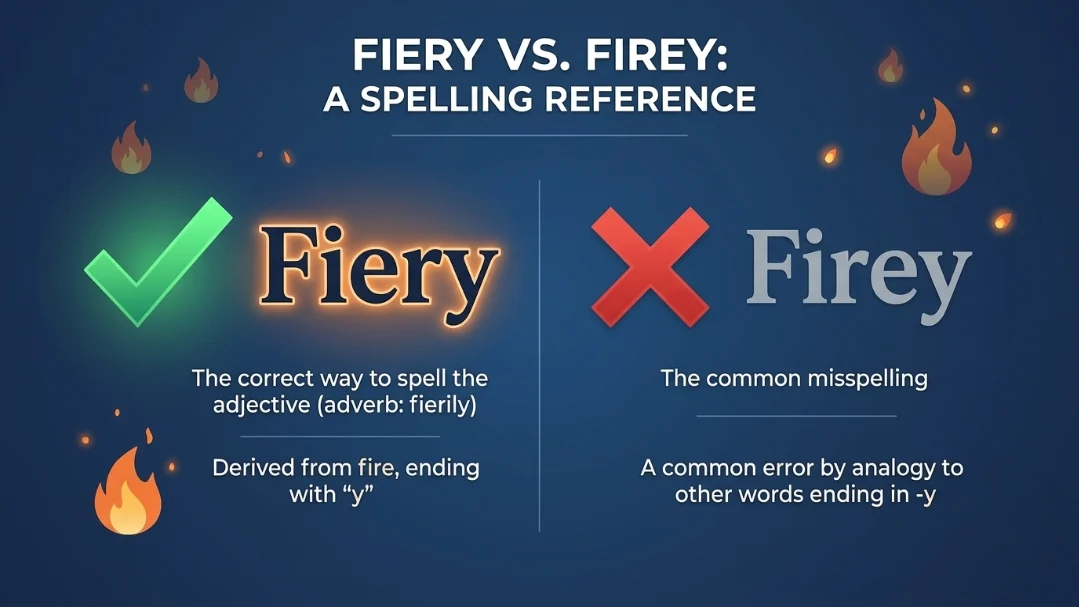
The correct spelling is fiery, while “firey” is an incorrect spelling and a common typographic error. Although the root word is “fire,” the letter “e” drops out and the letters “i” and “e” swap places when converting the noun into an adjective. Therefore, you should always use fiery in professional, academic, and creative writing.
Language often presents subtle traps that confuse even experienced writers. One of the most common dilemmas involves deciding between fiery or firey when describing something filled with flames or passion. Because the base noun is “fire,” your brain naturally wants to add a “y” to the end of the word to create an adjective. However, English spelling rules frequently defy simple logic.
This specific spelling confusion causes mistakes across essays, emails, and published articles worldwide. Understanding why one spelling triumphs over the other will immediately elevate your writing quality. Furthermore, mastering these minor language quirks helps you build stronger communication skills.
In this comprehensive guide, we will analyze the history, rules, and usage of this vibrant adjective. You will learn how to identify the correct form instantly, avoid common spelling traps, and apply the word correctly in various contexts. Let us dive into the mechanics of this word to ensure your writing remains flawless and professional.
If you need a quick answer, remember that fiery is the only accepted spelling in standard English. The alternative spelling, “firey,” is considered a misspelling by major dictionaries worldwide.
| Status | Correct and Standard | Incorrect Misspelling |
| Origin | Middle English (firy) | Common Typos |
| Acceptance | Universally Accepted | Rejected by Dictionaries |
| Usage | Formal and Informal | Avoid Completely |
Definition and Etymology
To understand why we spell this word uniquely, we must look into its history. The word fiery functions as an adjective that describes something consisting of fire, burning strongly, or glowing like a flame. Additionally, people use it metaphorically to describe intense emotions, hot flavors, or a spirited personality.
Historically, the word did not evolve through a simple modification of the modern noun “fire.” During the Middle English period, the word appeared in various forms, including firy and fyry. Over the centuries, the spelling stabilized into the form we recognize today. Because the word evolved before modern spelling standardization, the modern word retained its historical “i-e-r-y” sequence. Consequently, it does not follow the standard suffix rules of contemporary English.
Detailed Spelling Rules
Most English adjectives created from single-syllable nouns ending in a silent “e” simply drop the “e” before adding a suffix. For example, “bone” becomes “bony” and “ice” becomes “icy.” If we followed that exact pattern for “fire,” the resulting word would be “firy.”
However, the English language opted for a vowel swap instead. The letter “i” moves in front of the letter “e,” creating the distinct ier vowel cluster. This structure matches words like shrier or brier, which also carry deep historical roots. Because the human brain searches for predictable patterns, many writers insert the modern root “fire” directly into the adjective. Recognizing this historical exception prevents you from falling into the pattern trap.
Real-World Examples
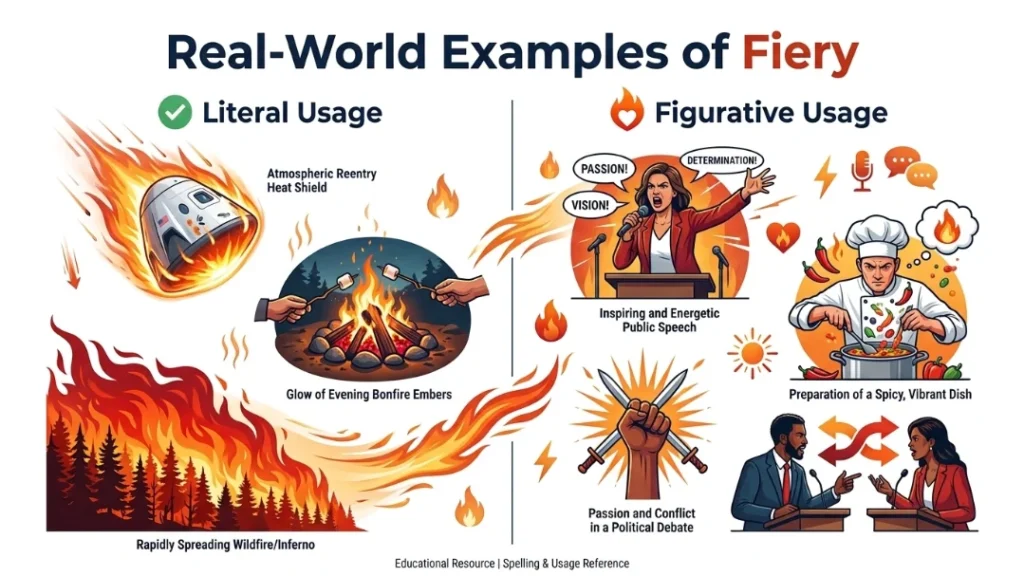
Analyzing the word within sentences helps solidify its proper usage. Because the word serves both literal and figurative purposes, observing it in different contexts provides valuable clarity.
Literal Usage
- The spacecraft endured a fiery reentry into the Earth’s atmosphere.
- Volunteers watched the fiery embers crackle during the evening bonfire.
- High winds quickly turned the small brush fire into a fiery inferno.
Figurative Usage
- Her fiery speech inspired the entire audience to take immediate action.
- The chef prepared a fiery salsa using fresh habanero peppers.
- Both politicians engaged in a fiery debate over the new economic policy.
Synonyms and Antonyms
Expanding your vocabulary around this concept allows you to vary your word choices. If you want to avoid repeating the focus keyword, select an appropriate alternative from the tables below.
Powerful Synonyms
- Blazing: Emphasizes intense physical light and heat.
- Passionate: Ideal for describing human emotions or speeches.
- Incandescent: Highlights a bright, glowing quality.
- Ferocious: Captures intense, aggressive energy.
Useful Antonyms
- Icy: Represents literal coldness or emotional detachment.
- Placid: Describes a calm, unbothered, and peaceful demeanor.
- Frigid: Useful for freezing temperatures or cold behavior.
- Apathetic: Captures a total lack of enthusiasm or passion.
Advantages of Using the Correct Spelling
Using the proper spelling of fiery provides several distinct advantages for writers, students, and professionals alike. Accuracy in language shapes how audiences perceive your expertise and attention to detail.
Enhanced Professional Credibility
When you submit a document free of spelling errors, you project authority and competence. Automated spellcheckers catch typos like “firey,” but spotting the error yourself ensures your drafts remain clean from the start.
Improved Search Engine Optimization
Search engines prioritize content that adheres to standard grammatical rules. By using fiery instead of the misspelled variant, you align your text with high-quality editorial standards, which can positively influence content ranking.
Clearer Communication
Standardized spelling ensures that readers focus entirely on your message rather than getting distracted by a typographical error. Smooth reading experiences build stronger connections between the author and the audience.
Disadvantages of Misspelling the Word
Conversely, allowing the spelling “firey” to slip into your final text introduces several negative consequences. These issues can impact your reputation and the effectiveness of your writing.
Loss of Reader Trust
Inaccurate spelling can make content appear amateurish or rushed. Academics, editors, and clients often judge the quality of research or services based on the mechanical accuracy of the presentation.
Distraction from Content
When a reader encounters an obvious spelling mistake, their internal reading flow breaks. This disruption causes them to analyze the error rather than processing the actual meaning of your paragraph.
Negative Impact on Grading
Students frequently lose valuable points on essays and standardized tests due to spelling blunders. Memorizing the correct spelling helps protect your academic performance.
Regional and Global Usage Patterns
Language patterns sometimes vary across geographical borders, but fiery remains a global standard. Unlike words like “color” or “flavour,” which change based on regional preferences, this adjective maintains a uniform spelling worldwide.
American English
In the United States, publications like The New York Times and The Wall Street Journal exclusively utilize fiery. American dictionaries do not recognize the alternative spelling as a valid variant.
British and Commonwealth English
Similarly, writers in the United Kingdom, Canada, Australia, and New Zealand adhere strictly to fiery. Major authorities, including the Oxford English Dictionary, categorize “firey” purely as an erroneous form. Therefore, no matter where your target audience lives, you must stick to the standard spelling.
Common Mistakes and How to Avoid Them
The primary reason people misspell this word involves visual familiarity with the root noun. Because you write the word “fire” thousands of times throughout your life, your hand automatically types those four letters sequentially.
To break this habit, use the mental imagery of an island to remind yourself of the letter I. Think to yourself: “An island is surrounded by water, which puts out a fiery blaze.” This simple connection reminds you that the letter I must lead the vowel sequence. Another helpful trick is to associate the word with cried. Both words share the i-e-d or i-e-r vowel order, which reinforces the correct placement.
Detailed Comparison Table
To clarify how fiery compares to similar adjectives derived from nouns, explore the organizational table below. This comparison highlights why this word stands out as a unique spelling exception.
| Wire | Drop ‘e’, add ‘y’ | Wiry | Wirey |
| Ice | Drop ‘e’, add ‘y’ | Icy | Icey |
| Smoke | Drop ‘e’, add ‘y’ | Smoky | Smokey |
| Fire | Vowel swap + add ‘ry’ | Fiery | Firey |
| Spire | Drop ‘e’, add ‘y’ | Spiry | Spirey |
Exercises with Answers
Practicing with real sentences strengthens your muscle memory and improves recall. Complete the following exercises by choosing the correct spelling option for each scenario.
Exercise 1
Choose the correct word: The dragon unleashed a (fiery / firey) blast of wind across the valley.
Exercise 2
Choose the correct word: Everyone admired the defense attorney’s (fiery / firey) closing argument.
Exercise 3
Choose the correct word: The restaurant is famous for its spicy, (fiery / firey) chicken wings.
Exercise 4
Choose the correct word: Autumn leaves coated the forest floor in a (fiery / firey) shade of orange.
Exercise 5
Choose the correct word: After hearing the unfair decision, he expressed his thoughts in a (fiery / firey) letter.
Answer Key
- Fiery (Literal description of intense heat and flames)
- Fiery (Figurative description of a passionate speech)
- Fiery (Figurative description of extreme culinary spice)
- Fiery (Figurative description of a bright, vibrant color)
- Fiery (Figurative description of an angry or passionate response)
Related Concepts and Variations
Understanding related linguistic concepts helps contextualize why certain words evolve uniquely. Exploring these variants ensures comprehensive mastery of the topic.
The Adverb Form
When you want to describe an action performed in a passionate or burning manner, use the adverb fierily. This word replaces the trailing “y” with an “i” before adding the standard “ly” suffix. For example: The sun shone fierily across the desert sands.
The Noun Form
The state of being passionate or filled with heat is known as fieriness. This noun structure follows standard English patterns where the “y” converts to an “i” prior to adding “ness.” For instance: The actor brought an undeniable fieriness to the dramatic role.
Advanced Linguistic Context
Linguists categorize words like fiery as historical relics that resisted modern phonetic standardization. During the transition from Old English to Middle English, the pronunciation of vowels underwent a massive shift known as the Great Vowel Shift.
As the spoken sounds changed, people tried to represent those new sounds phonetically on paper. The spelling of fiery captured a specific diphthong pronunciation that eventually stabilized in literature. Because printing presses adopted these established spellings, the irregular vowel order became locked into the English lexicon permanently.
FAQs
Is firey ever considered correct in British English?
No, “firey” is not considered correct in British English. Writers across the United Kingdom and the Commonwealth must use the standard spelling, which is fiery.
Why does the spelling of fiery change so much from fire?
The spelling changes due to historical developments in Middle English. The word evolved from older linguistic forms like firy, retaining its unique vowel sequence through centuries of usage.
How can I remember the correct spelling easily?
Remember that the letter I comes before the letter E in this word. You can use the mnemonic phrase: “I ignite every fiery ember” to keep the letters in their proper positions.
Is fiery an adjective or an adverb?
The word functions exclusively as an adjective in English sentences. If you need to modify a verb, you must use the adverbial form, which is spelled fierily.
Can I use fiery to describe spicy food?
Yes, you can use the word to describe food that contains intense heat from peppers or spices. This figurative usage is widely accepted in casual and professional culinary writing.
Does spellcheck always flag the word firey?
Most modern word processors and digital browsers will immediately flag “firey” with a red underline. However, you should not rely entirely on automated software to catch every mistake.
What is a fiery personality?
A fiery personality describes an individual who exhibits intense passion, strong emotions, or a quick temper. It signifies a spirited and highly dynamic character.
How do you pronounce the word fiery?
The word features three distinct syllables. It is pronounced as FAY-uh-ree or FY-ree, depending on regional accents and speech speed.
Are there any exceptions where firey is acceptable?
The only time you will see “firey” used acceptably is as a proper noun, such as a specific brand name or a fictional character name in creative works.
Conclusion
Mastering the difference between fiery or firey is a simple yet impactful way to improve your writing clarity. Although the spelling seems counterintuitive because it alters the root word “fire,” historical patterns have made fiery the absolute global standard. Keeping this rule in mind protects your authority as a communicator and prevents distracting grammatical errors.
To avoid mistakes, remember that the letter I must always precede the letter E. Applying this knowledge consistently across your essays, professional emails, and creative projects ensures your text remains polished. When you pay attention to these minor spelling details, you demonstrate precision and care in your work.