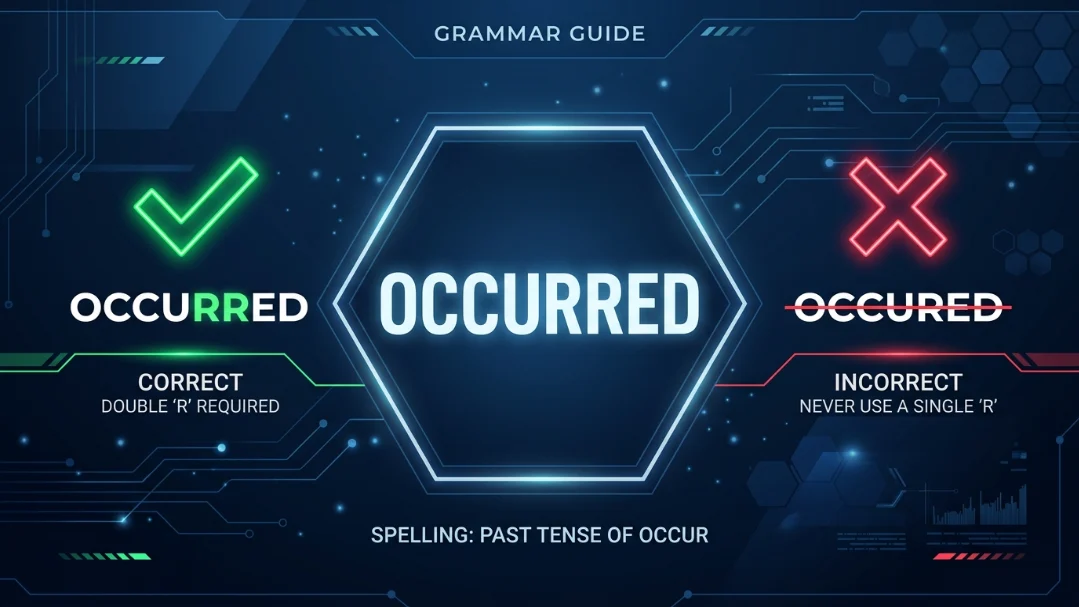
The correct spelling is occurred with a double “r.” You should always use this spelling when writing in the past tense, as the single “r” version (occured) is grammatically incorrect.
Have you ever looked at a word and felt unsure if you spelled it correctly? Many people struggle with the words occurred or occured. You are certainly not alone in this frustration. English spelling rules can feel tricky, especially when they involve doubling consonants. People often search for the right way to write these terms in emails, essays, and professional reports.
Understanding this spelling difference helps you communicate more clearly. It prevents small errors that might distract your readers. This article simplifies the rules so you never have to guess again. We will explore why the double “r” is necessary and how to remember it easily. By the end of this guide, you will feel confident using this word in any writing task. Let’s clear up this confusion once and for all.
The most important rule to remember is that occurred is the only correct spelling. Writers often mistake the single “r” version for the right one because it looks simpler. However, English grammar requires doubling the consonant when specific conditions are met. Always use two “r”s for the past tense of “occur.” This standard applies to all forms of the word, including “occurring” and “occurrence.” Keeping this simple rule in mind will save you time and improve your writing quality immediately.
Definition and Explanation
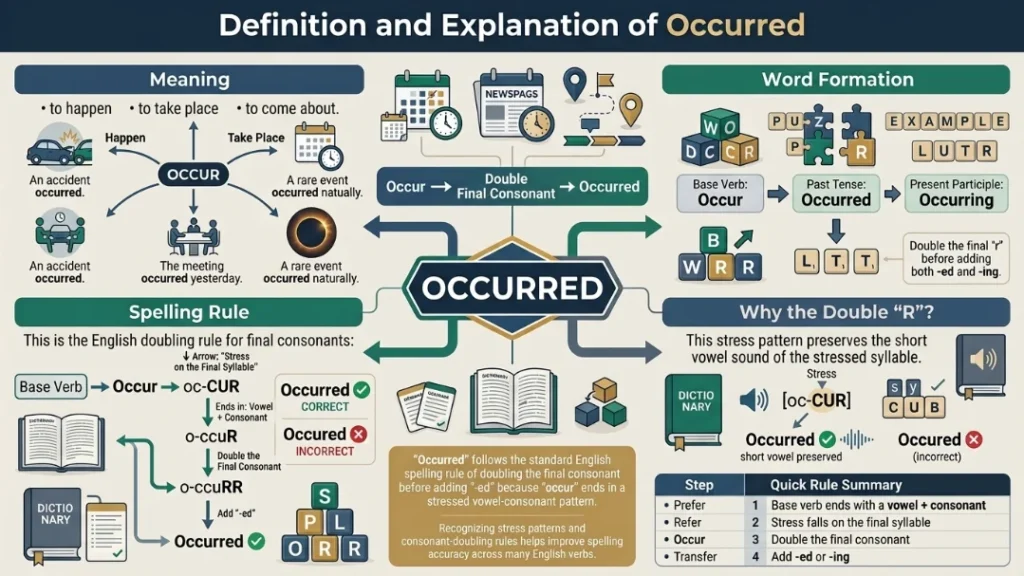
The word “occur” means to happen or take place. When you move this verb into the past tense, you must follow the rules for adding suffixes. In English, when a word ends in a single vowel followed by a single consonant, you usually double that consonant before adding “-ed” or “-ing.”
Because the stress in “occur” falls on the second syllable, you must double the “r.” This rule ensures the vowel sound remains short. If you do not double the “r,” the word might be mispronounced as having a long vowel sound. Therefore, occurred follows standard orthographic rules. Understanding these foundational patterns makes your spelling much more consistent across all types of verbs.
Advantages and Disadvantages of Proper Spelling
Using the correct spelling provides several clear advantages for your communication. It demonstrates attention to detail in professional settings. Employers and clients value accuracy because it suggests that you take your work seriously. Conversely, using an incorrect spelling like “occured” can undermine your credibility.
| Aspect | Impact of Correct Spelling | Impact of Incorrect Spelling |
| Professionalism | High; shows care and skill. | Low; looks careless. |
| Readability | High; readers focus on meaning. | Low; spelling errors distract. |
| Trust | Builds confidence in your writing. | Diminishes authority. |
| Clarity | Ensures message is clear. | Creates confusion for the reader. |
Real-World Examples
Seeing the word in context helps reinforce the correct spelling. You will find that occurred appears frequently in reports, legal documents, and news stories.
- A sudden power outage occurred during the storm.
- The accident occurred at the intersection of Main and Oak.
- No issues occurred during the software update process.
- He realized the error had occurred much earlier than expected.
Each of these examples demonstrates the past tense usage. Notice how the flow of the sentence remains smooth because the spelling is correct. If you replace the double “r” with a single “r,” the sentences feel incorrect to a native speaker’s eye.
Regional and Global Usage
English spelling standards remain consistent across major regions regarding this word. Whether you are using American English, British English, Australian English, or Canadian English, the spelling remains occurred.
This uniformity makes your job easier. You do not need to worry about regional variations like the ones found in “color” or “colour.” Every major dictionary confirms that the double “r” is the universal standard. If you are preparing an international document, you can safely use the double “r” form. Consistency across borders is one of the few benefits of global English standards.
Common Mistakes and Corrections
The most frequent mistake involves dropping one of the “r”s. Many writers treat “occur” like other verbs that do not require doubling. They might think of words like “offered,” which also ends in an “r” but only uses one.
However, “offered” only has one “r” because the stress falls on the first syllable. Since “occur” stresses the second syllable, doubling is mandatory. To fix this, always check the stress of the verb. If the stress is at the end, double the consonant. This simple check corrects almost all errors related to this pattern.
Exercises with Answers
Practice helps cement these rules in your long-term memory. Read the following sentences and decide if they are correct or incorrect.
- The error occured yesterday morning. (Correct/Incorrect)
- Significant changes occurred throughout the fiscal year. (Correct/Incorrect)
- She wondered why the incident occured. (Correct/Incorrect)
- We ensured that the event occurred on time. (Correct/Incorrect)
Answers:
- Incorrect (Should be occurred).
- Correct.
- Incorrect (Should be occurred).
- Correct.
Related Concepts and Comparisons
It helps to compare this word with others that follow the same doubling rule. This helps you recognize the pattern more quickly in future writing.
- Refer: Becomes referred because the stress is on the second syllable.
- Prefer: Becomes preferred for the same reason.
- Offer: Becomes offered because the stress is on the first syllable.
- Benefit: Becomes benefited because the stress is on the first syllable.
Comparing these examples shows why understanding syllable stress is the master key to spelling. Once you master this logic, you will spend far less time looking up spelling rules.
FAQs
Is occured a valid word?
No, “occured” is a misspelling. You should always use the double “r” form, which is “occurred.”
Why is there a double r in occurred?
The double “r” occurs because “occur” is a two-syllable word stressed on the last syllable. This requires doubling the final consonant.
Does the double r rule apply to occurring?
Yes, the rule applies to all forms, including “occurring” and “occurrence.” Always double the “r.”
How can I remember the correct spelling?
Remember that “occurred” has two syllables, and you need two “r”s to balance the weight of the stress.
Is occurred spelled the same in British and American English?
Yes, the spelling is identical in all major forms of English across the globe.
Does this rule apply to other words like refer?
Yes, “refer” follows the same rule and becomes “referred” in the past tense.
What happens if I use a single r in a professional document?
Using a single “r” usually makes the document appear unprofessional and may distract from your actual message.
Are there exceptions to this doubling rule?
There are very few exceptions, but always check the stress of the word first. If the stress is on the first syllable, do not double.
Does the double r affect pronunciation?
Yes, it helps indicate that the vowel sound is short rather than long.
Where can I find more spelling rules?
You can consult reliable resources like the Merriam-Webster dictionary or the Oxford English Dictionary for complex spelling queries.
Conclusion
Mastering the difference between occurred or occured is a simple yet powerful step toward better writing. By remembering the syllable stress rule, you can confidently apply the double “r” pattern to many other English verbs. Accuracy in spelling is more than just following rules; it is about showing respect for your readers and your own work.
Always take a brief moment to review your writing for these common patterns. If you find yourself typing a single “r” in “occurred,” remember the rule and make the fix. Over time, this becomes a habit that requires no extra thought. Keep practicing with similar words like “refer” or “prefer” to solidify your skills. Clear, correct writing is an essential tool for your professional and personal success. You now have the knowledge to avoid this mistake forever.

Charlotte Wilson is a language writer passionate about word meanings, synonyms, and clear communication. She creates accurate and engaging content to help readers expand their vocabulary and language skills.








8 thoughts on “Occurred or Occured| Correct Spelling and Usage Guide”